Cups, Ounces and Liters
How Many Ounces in a Cup? 8 Fluid Ounces, With Charts
One US cup is 8 fluid ounces. Charts both ways, and the cases where a cup means something else.
 By the Glubbo Editorial Team · Updated Oct 23, 2026 · 10 min read
Short answer
A US cup holds 8 fluid ounces, about 237 ml.
- NIST puts one US cup at 236.6 ml and one fluid ounce at 29.57 ml.
- Nutrition labels round the cup to 240 ml, per FDA labeling rules.
- 16 oz is 2 cups; a 16.9 oz bottle is about 2.1 cups.
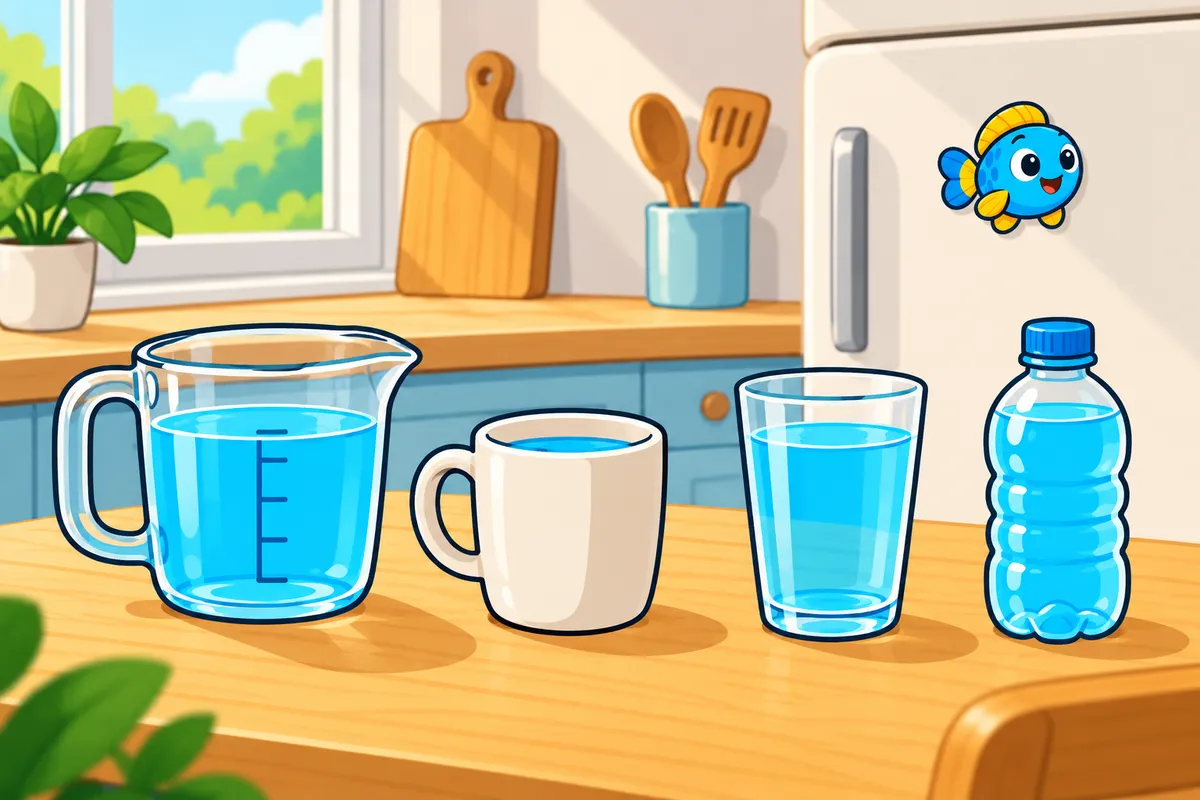
One US cup holds 8 fluid ounces, which is 236.6 ml. A recipe says one cup, your bottle says 16.9 fl oz, and a health page says 2 liters: three numbers for the same water in three units.
Once you know what one cup holds, every other amount on a label or a bottle follows from it.
How Many Ounces Are in a Cup?
Eight fluid ounces, whether the cup holds water, milk, coffee or juice. The US measurement agency gives the exact size as 236.588 ml for a cup and 29.5735 ml for a fluid ounce, and 8 × 29.5735 comes to the cup.
- 8 fl oz
- in one US cup
- 236.6 ml
- one US cup, by NIST
- 29.57 ml
- one US fluid ounce, by NIST
- 240 ml
- one cup on a nutrition label
A shorter table of approximate conversions rounds the cup to 0.24 L. That rounding is fine in a kitchen. For one glass, the gap between 236.6 ml and 240 ml is less than a teaspoon.
A US measuring cup is 236.6 ml, a food-label cup is 240 ml, a metric cup is 250 ml and an old imperial cup is about 284 ml. Identify the recipe's convention before scaling several cups.
Cups to Ounces Chart
Multiply cups by 8 to get fluid ounces. The charts run from an eighth of a cup to a full gallon, with milliliters worked out from the exact cup of 236.588 ml and rounded to one decimal.
Fractions of a Cup
Recipes and baby bottles use the small amounts. A third of a cup is 2.67 fl oz, which no ounce mark on a bottle shows, so measure thirds with a cup, not a bottle.
| Cups | US fluid ounces | Milliliters |
|---|---|---|
| 1/8 cup | 1 fl oz | 29.6 ml |
| 1/4 cup | 2 fl oz | 59.1 ml |
| 1/3 cup | 2.67 fl oz | 78.9 ml |
| 1/2 cup | 4 fl oz | 118.3 ml |
| 2/3 cup | 5.33 fl oz | 157.7 ml |
| 3/4 cup | 6 fl oz | 177.4 ml |
| 1 cup | 8 fl oz | 236.6 ml |
Many Cups at Once
Larger amounts are where drink counts live. Two cups make a pint and four make a quart, so the chart also shows where those units fall.
| Cups | US fluid ounces | Milliliters | Also called |
|---|---|---|---|
| 1 1/2 cups | 12 fl oz | 354.9 ml | |
| 2 cups | 16 fl oz | 473.2 ml | 1 pint |
| 3 cups | 24 fl oz | 709.8 ml | |
| 4 cups | 32 fl oz | 946.4 ml | 1 quart |
| 6 cups | 48 fl oz | 1,419.5 ml | |
| 8 cups | 64 fl oz | 1,892.7 ml | half a gallon |
| 12 cups | 96 fl oz | 2,839.1 ml | |
| 16 cups | 128 fl oz | 3,785.4 ml | 1 gallon |
The pint, quart and gallon in this chart are the US liquid units. Dry pints and quarts are larger, a difference that matters for berries and grain, never for water.
How Many Cups Is 16 oz?
Sixteen fluid ounces is exactly 2 cups, or one US pint. To go from ounces to cups, divide by 8: 12 oz is 1.5 cups and 32 oz is 4 cups. Odd bottle sizes land between the steps, so keep the decimal: a 21 oz bottle is 2.63 cups, not 2 and not 3.
Is a Cup Always 8 Ounces?
In the US, yes for recipes and measuring cups: 8 fluid ounces. Nutrition labels round it, and cups from other countries can differ. Where the number came from decides which cup you have.
Coffee makers are a practical exception to the everyday meaning: a machine “cup” may be 5 oz while a drinking mug holds 8 to 16 oz. Use the brewer's stated water capacity when planning a carafe.
US food labels follow a federal rule. For nutrition labeling, 21 CFR 101.9 says "a cup means 240 mL" and 1 fl oz means 30 mL. A carton that lists a 1 cup serving means 240 ml, about 1.4 % more than the exact cup.
Which Cup Does Another Country Use?
Outside the US, the word changes. NIST's culinary measurement tips say that customary measures "mean different things in different countries", and that older metric cups and spoons are slightly larger than US ones.
Canada is the nearest example: its kitchens pour a 250 ml cup, and its legal gallon is the imperial one.
| Cup | Milliliters | US fluid ounces | Where you meet it |
|---|---|---|---|
| US customary cup | 236.6 | 8 | US recipes and measuring cups |
| US legal cup | 240 | about 8.1 | US nutrition labels |
| Metric cup | 250 | about 8.5 | Australia, Canada and New Zealand |
| Japanese cup | 200 | about 6.8 | Japanese recipes |
| Rice cooker cup | about 180 | about 6.1 | The scoop that comes with a rice cooker |
| Old Canadian cup | 227.3 | about 7.7 | Pre-metric Canadian recipes |
The metric, Japanese, rice and old Canadian rows come from Wikipedia's cup table; the first two rows are the NIST and FDA values above. A recipe with its own milliliter figure settles the question, and a drinking glass or mug at home is not a set unit at all: measure it once.
Why Do Labels Round Pints, Quarts and Gallons Differently?
Because home-cooking charts and label rules round each step of the ladder on its own. The metric kitchen chart pairs 16 fl oz with 480 mL, 32 fl oz with 950 mL, 64 fl oz with 1950 mL and a gallon with 3.84 L, while the exact US sizes are 473.2 mL, 946.4 mL, 1,892.7 mL and 3.785 L.
| Amount | Exact US size | Kitchen chart | Chart runs high by |
|---|---|---|---|
| 16 fl oz (pint) | 473.2 mL | 480 mL | 1.4 % |
| 32 fl oz (quart) | 946.4 mL | 950 mL | 0.4 % |
| 64 fl oz (half gallon) | 1,892.7 mL | 1,950 mL | 3.0 % |
| 128 fl oz (gallon) | 3,785.4 mL | 3,840 mL | 1.4 % |
For a drink goal the gap is a few spoonfuls. It only matters when you pour a recipe or a dose to the milliliter, and then the exact column is the one to use.
How Many Ounces in a Cup of Water?
A cup of water holds 8 fluid ounces, the same as a cup of any other drink. A fluid ounce measures the space a liquid fills. The plain ounce on a kitchen scale measures weight, and you need the ingredient's density to convert between the two.
Fluid Ounce (fl oz)
- Measures volume, the space filled
- 29.57 ml
- 8 to a US cup
Ounce (oz)
- Measures weight, on a scale
- 28.35 g
- Not a cup measure
Water is the one drink where the two nearly agree: a cup of water weighs about 8.3 oz, because 236.6 ml of water is about 236.6 g and an ounce is 28.35 g. Flour, sugar, rice, oats and butter each have a different gram weight per cup, as King Arthur's ingredient chart also shows.
| 1 cup of | Weight in ounces | Weight in grams |
|---|---|---|
| Water | about 8.3 oz | about 236 g |
| Granulated sugar | 7 oz | 198 g |
| All-purpose flour | 4 1/4 oz | 120 g |
A US stick of butter is 1/2 cup, 8 tablespoons, 4 oz and about 113 g. That package conversion belongs to butter and does not apply to flour or sugar.
Recipe charts, King Arthur's included, round a cup of water to 8 oz (227 g). For your water count, stay with fluid ounces: a bottle label, a cup mark and a tracking app all use them.
How Many Cups Are in a 16.9 oz Water Bottle?
About 2.1 cups. A 16.9 fl oz bottle holds 500 ml, and 500 divided by 236.6 gives 2.11 US cups. A 32 oz reusable bottle holds exactly 4 cups, and a 40 oz tumbler 5.
Bottles sold in the US print fluid ounces. For the height, weight and ounces of each common bottle, compare the standard sizes maker by maker.
Bottles from Europe and Asia print liters instead:
- A 330 ml can is 1.4 cups.
- A 750 ml bottle is 3.2 cups.
- A 1 liter bottle is 4.23 US cups.
For more sizes, the liter chart covers 0.25 to 5 liters in ounces and cups, including the 1.5 L and 2 L sizes.
For packaged drinks, a standard US soda can is 12 fl oz while mini cans, juice boxes, cartons and 2-liter bottles use different common capacities. Read the net quantity because the container shape does not prove its size.
Counting Your Daily Water in Cups
Cups make a daily goal easy to picture. The US National Academies found that women aged 19 to 30 drink about "2.2 L (74 fluid ounces; ≈ 9 cups)" of fluids a day and men about 3.0 L, or roughly 13 cups. Those counts include coffee, tea and milk.
Convert any goal the same way:
- A 64 oz goal is 8 cups.
- 2 liters is 8.45 cups (2,000 ÷ 236.6).
- 100 oz is 12.5 cups.
- In a 20 oz bottle, a 64 oz day is 3.2 fills.
Your own number depends on your body, your day and the weather. If you want that figure first, the official ounce amounts for women and men are worked out here, and you can come back to turn them into cups.
One trap catches many people. A "glass" is not a unit: a tall tumbler can hold a cup and a half, and a small juice glass less than one. Count in cups only after you know what your own glass holds.
Cups, Spoons, Pints and Quarts in One Ladder
US kitchen units step up in fixed ratios, and the pint, quart and gallon steps have their own chart. Kitchen charts round the same steps to 15 ml for a tablespoon, 30 ml for a fluid ounce and 240 ml for a cup, per the metric kitchen chart.
From a Teaspoon to a Gallon
- 3 teaspoons = 1 tablespoon (14.8 ml)
- 2 tablespoons = 1 fluid ounce (29.6 ml)
- 8 fluid ounces = 1 cup (236.6 ml)
- 2 cups = 1 pint, 2 pints = 1 quart
- 4 quarts = 1 gallon (3,785 ml)
The spoon end of the ladder has its own questions, such as how many teaspoons fill a quarter cup. For those, 16 tablespoons fill one cup, and the spoon chart breaks every fraction down.
For partial measures, 1/4 cup is 4 tablespoons, 1/2 cup is 8 and 3/4 cup is 12. Thirds need teaspoons because 16 tablespoons do not divide evenly by three.
A 16 oz Mason jar is a pint and a 32 oz jar is a quart, but canning recipes still decide which jar sizes and headspace are safe. For tanks and ponds, inside length, width and water depth determine cubic volume before conversion to gallons. A jar starts with its named capacity; a tank starts with its dimensions.
Measure a Cup of Water the Right Way
Use a clear cup with a spout and lines on the side, set it on the counter and read the line at eye level. The flat-rimmed cups that come in a nested set are for flour and sugar, and using one for water is a common source of measuring errors.
A spouted liquid cup gives the truer reading, and the same page covers how to read the curve of the water.
When no cup is available, weighing plain water, dividing a labeled bottle or counting standard measuring spoons can reproduce the amount. An unmarked mug needs calibration before it can replace a measure.
Mark One Cup on Your Glass Tonight
- Pour one measured cup into your usual glass and mark the level.
- Find your bottle's size on its base or label and divide the fluid ounces by 8.
- Write your daily goal in cups on a note by the tap, and count in cups all day.
- For any amount the charts skip, such as 1.75 cups or 300 ml, type it into the Water Unit Converter and read cups, ounces and milliliters together.
General information for healthy adults, not medical advice. If a doctor has set your fluid amount, follow that.
All Guides in Cups, Ounces and Liters
Every guide, A to ZConversions 10 guides
Liquid units mix two systems and two kinds of ounce. These guides convert each one with NIST figures, so you can turn a recipe, a bottle label or a daily goal into the unit you use.
Conversions page How Many Tablespoons in a Cup? A Spoon Chart for Every Fraction
 How Many Ounces and Cups in a Liter? A Chart From 0.25 to 5 Liters
 How Many Pints and Quarts in a Gallon? The US Ladder in One Chart
 US Gallon vs Imperial Gallon: Which Is Bigger, and by How Much?
 How Much Does a Gallon of Water Weigh? 8.33 lb, Plus a Full Chart
 How Many Milliliters Are in a Cup? 237, 240, 250 or 284 mL
 How Many Cups in a Gallon in Canada? Metric and Imperial Answers
 Fluid Ounces vs Ounces: Why 8 fl oz Does Not Always Weigh 8 oz
 How Many Ounces Are in a Can of Soda and Other Drinks?
 How Many Gallons Are in a Cubic Foot? Cubic Volume Chart
Measuring at Home 9 guides
A cup can change meaning across recipes, and two foods in the same cup can weigh very different amounts. These guides help you choose the right tool, read the package and convert the ingredient you actually have.
Measuring at Home page Dry vs Liquid Measuring Cups: Which One to Use for Water and Flour
 How to Measure Water Without a Measuring Cup: 4 Reliable Methods
 How Many Grams Are in a Cup of Flour? Ingredient Chart
 How Big Is a Glass of Water? Official Sizes and How to Measure Yours
 How Many Tablespoons Are in a Stick of Butter?
 How Many Ounces Are in a Standard Coffee Cup?
 How Many Ounces Are in a Mason Jar? Full Size Chart
 How Many Ounces in a Bottle of Wine, a Liquor Bottle and a Shot?
 How Many Tablespoons Are in a Quarter Cup? Fraction Chart
Sources
- NIST. Approximate Conversions from U.S. Customary Measures to Metric, 2026.
- NIST. NIST Guide to the SI, Appendix B.9: Factors for Units Listed by Kind of Quantity or Field of Science, 2026.
- NIST. Metric Kitchen: Cooking Measurement Equivalencies, 2026.
- NIST. Culinary Measurement Tips, 2026.
- US Food and Drug Administration (Code of Federal Regulations). 21 CFR 101.9, Nutrition Labeling of Food, 2024.
- National Academies of Sciences. Dietary Reference Intakes for Water, Potassium, Sodium, Chloride, and Sulfate: Summary, 2005.
- Wikipedia. Cup (unit), 2026.
- King Arthur Baking. Ingredient Weight Chart, 2026.
Sources checked by the Glubbo Editorial Team on Oct 23, 2026. General information, not medical advice. How we write and check our guides.

