Cups, Ounces and Liters · Measuring at Home
How to Measure Water Without a Measuring Cup: 4 Reliable Methods
Use a scale first: one gram of plain water is about one milliliter. Labeled bottles and standard spoons also work.
 By the Glubbo Editorial Team · Updated Oct 23, 2026 · 8 min read
On This Page
- How Can I Measure One Cup of Water Without a Measuring Cup?
- Can I Weigh Water Instead of Measuring It?
- How Much Water Should You Weigh?
- How Many Tablespoons Make One Cup?
- Can You Use a Labeled Water Bottle?
- Can I Use a Drinking Glass as a Measuring Cup?
- How Can I Measure 250 mL Without a Cup?
- What Should You Avoid?
- Which Substitute Method Is Most Accurate?
- How Do You Measure Several Cups Without Repeating Errors?
- Pick the Tool With the Known Number
- Sources
Short answer
Weigh the water: 237 g is one US cup.
- For kitchen work, 1 g of plain water is about 1 mL.
- One US cup is 236.6 mL, so weigh about 237 g.
- Without a scale, use 16 standard US tablespoons or part of a labeled bottle.
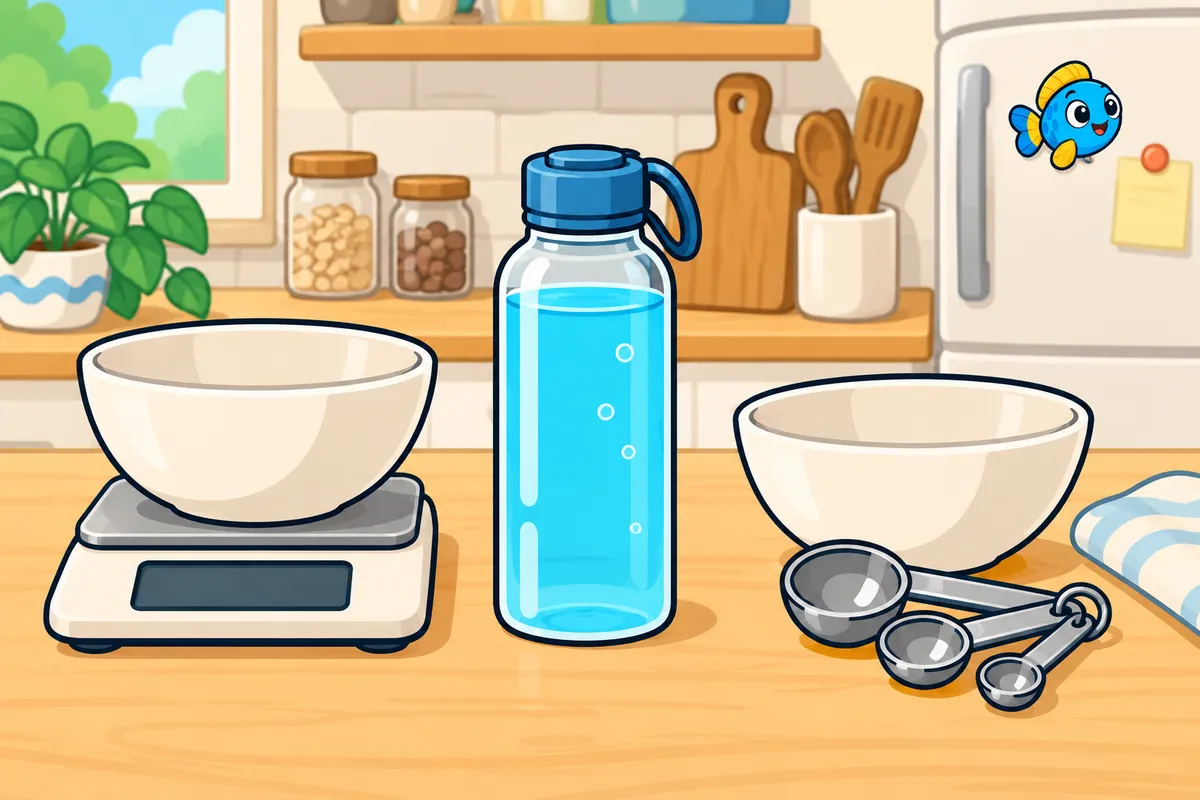
The best way to measure water without a measuring cup is to weigh it. Put a bowl on a scale, press tare, and add 237 g for one US cup or 250 g for 250 mL.
Plain water weighs almost one gram per milliliter at room temperature. A labeled bottle or standard measuring spoons are the next best options.
How Can I Measure One Cup of Water Without a Measuring Cup?
Weigh 236 to 237 g of water for one US customary cup. NIST lists the cup at 236.6 mL, and the USGS gives water a density close to 1 g per mL.
Measure a Cup of Water on a Scale
- Set an empty bowl or mug on the kitchen scale
- Press tare or zero so the container disappears from the reading
- Pour slowly until the display reads 237 g
- Stop there for one US cup; use 240 g only when a recipe defines a cup as 240 mL
The small temperature change in water density is irrelevant for everyday cooking. The USGS notes that the exact density is just under 1 g/mL and varies with temperature, but the rounded relationship is accurate enough to measure a recipe cup.
Do not include the bowl's weight. If your scale has no tare button, weigh the empty bowl first and add the target water weight to that number.
Can I Weigh Water Instead of Measuring It?
Yes. A kitchen scale is the most accurate common substitute, followed by a factory-labeled bottle, standard measuring spoons and a container you have calibrated before. A random mug or handful is the least reliable.
The score is a decision aid, not a laboratory rating. A bent spoon, low battery or bottle not filled to its printed capacity can still introduce error.
How Much Water Should You Weigh?
Use grams as milliliters for plain water. The US cup amounts below use the exact 236.588 mL cup and round the scale target to the nearest gram.
| Water needed | Milliliters | Scale target |
|---|---|---|
| 1/8 US cup | 29.6 mL | 30 g |
| 1/4 US cup | 59.1 mL | 59 g |
| 1/3 US cup | 78.9 mL | 79 g |
| 1/2 US cup | 118.3 mL | 118 g |
| 2/3 US cup | 157.7 mL | 158 g |
| 3/4 US cup | 177.4 mL | 177 g |
| 1 US cup | 236.6 mL | 237 g |
| 1 metric cup | 250 mL | 250 g |
| 2 US cups | 473.2 mL | 473 g |
If the water contains sugar, salt, milk powder or another dissolved ingredient, its density changes. Weigh plain water first, then add the other ingredient according to the recipe.

How Many Tablespoons Make One Cup?
Use 16 standard US tablespoons for one cup. NIST's kitchen table rounds a tablespoon to 15 mL and a cup to 240 mL, so the count is exact within that practical kitchen system.
| Cup fraction | Tablespoons | Teaspoons | Approximate mL |
|---|---|---|---|
| 1/8 cup | 2 tbsp | 6 tsp | 30 mL |
| 1/4 cup | 4 tbsp | 12 tsp | 60 mL |
| 1/3 cup | 5 tbsp + 1 tsp | 16 tsp | 80 mL |
| 1/2 cup | 8 tbsp | 24 tsp | 120 mL |
| 2/3 cup | 10 tbsp + 2 tsp | 32 tsp | 160 mL |
| 3/4 cup | 12 tbsp | 36 tsp | 180 mL |
| 1 cup | 16 tbsp | 48 tsp | 240 mL |
Fill each spoon level, pour it completely and keep count in groups of four. A measuring tablespoon has a defined volume; a dining spoon does not. NIST lists the exact US tablespoon at about 14.79 mL.
For a third or two-thirds cup, the teaspoon completes the fraction because one tablespoon equals three teaspoons. The cup-fractions chart gives doubling and halving shortcuts for those amounts.
Can You Use a Labeled Water Bottle?
Yes. A sealed 500 mL bottle gives:
- two metric cups
- 2.11 US cups
- four 125 mL portions
Use the printed net quantity and divide the bottle before opening or mark a transparent bottle at equal heights only when its sides are straight.
Useful Portions From Labeled Bottles
500 mL bottle
Two metric cups
- Half = 250 mL
- 47% = one US cup
Suits you if Best when the bottle has straight, visible sides
1 liter bottle
Four metric cups
- Quarter = 250 mL
- About 4.23 US cups total
Suits you if Good for 250 or 500 mL portions
16.9 fl oz bottle
Usually 500 mL
- Confirm the mL on the label
- Half = about 8.45 fl oz
Suits you if Use the metric amount to divide it cleanly
Bottle height is not always proportional to volume. A bottle with a narrow waist, shoulders or a thick base cannot be divided accurately by eye. Pouring half by weight is safer: a full 500 mL of water should contribute about 500 g above the empty bottle's weight.
Can I Use a Drinking Glass as a Measuring Cup?
Only after you measure that glass once. Glasses and mugs have no standard capacity, and the point where you normally stop filling may be far below the brim.
Calibrate it with a scale:
- Put the empty glass on the scale and press tare.
- Add 237 g of water for one US cup.
- Mark the waterline with removable tape.
- Add another known amount if you want a second mark.
The tape turns your own glass into a repeatable tool. The glass-size guide explains how to record its normal drinking capacity without treating it as a standard cup.

How Can I Measure 250 mL Without a Cup?
Weigh 250 g of water, use half of a 500 mL bottle, use one quarter of a 1-liter bottle, or count 16 tablespoons plus 2 teaspoons using exact US spoon sizes.
The spoon route needs explanation:
- 16 exact US tablespoons equal 236.6 mL, and 2 exact teaspoons add 9.9 mL, totaling 246.5 mL.
- Add about 3.5 mL more to reach 250, so spoons are clumsy for this target.
- With NIST's rounded 15 mL and 5 mL kitchen equivalents, 16 tablespoons plus 2 teaspoons equals 250 mL exactly.
That difference shows why the scale is best. It reaches the metric target directly without mixing exact and rounded spoon definitions.
If the Scale Shows Ounces Only
Convert the target grams to weight ounces by dividing by 28.3495. One US cup of water is about 8.35 oz by weight, while 250 mL of water is about 8.82 oz. Confirm that the scale is in ordinary weight ounces, not a liquid mode that silently assumes its own density.
What Should You Avoid?
Avoid guessing from a fist, disposable cup, soup spoon or phone dimensions. Those methods have no stable volume contract.
- A dinner tablespoon can be smaller or larger than a measuring tablespoon.
- A “standard glass” can hold anywhere from a small juice serving to a tall tumbler.
- Ice displaces space and changes how much liquid the glass contains.
- A photo of a cup cannot reveal its depth or wall thickness.
- Filling to the brim creates spills and may exceed the vessel's stated serving line.
For a liquid recipe, use a level surface and read a transparent container at eye level whenever possible. Those are also NIST's recommended liquid-measurement practices.
Which Substitute Method Is Most Accurate?
Weighing water is usually the most accurate substitute because it measures the target directly and avoids judging a line by eye. A factory-labeled bottle comes next when its shape lets you divide the contents reliably; measuring spoons work but add a counting and transfer error each time.
| Method | Best use | Main source of error |
|---|---|---|
| Kitchen scale | Any amount of plain water | Forgetting to tare the container |
| Labeled bottle | 250, 500 or 1,000 mL portions | Curved sides make visual fractions uneven |
| Measuring spoons | Small cup fractions | Losing count or leaving water in the spoon |
| Calibrated glass | Repeating one familiar amount | Filling above or below the saved mark |
| Unmarked mug or dining spoon | None when accuracy matters | Capacity is unknown |
Choose the method with one known number and the fewest repeated actions. Sixteen spoon transfers can each leave a few drops behind, while one scale reading reaches the total in a single pour.
Accuracy should match the recipe. Soup can tolerate a small rounding difference, but bread dough, gelatin and concentrated drink mixes may change when the liquid ratio moves; use the scale for those jobs.
How Do You Measure Several Cups Without Repeating Errors?
Calculate the total first and weigh or pour it once. Three US cups of water are 3 × 236.588 = 709.8 mL, so a scale target of about 710 g is clearer than filling an improvised glass three separate times.
For 2 1/2 cups, use about 591 g of water; if the recipe instead means metric cups, the same count is 625 mL, so identify the cup system before multiplying.
- When the water goes straight into a pot, place the empty pot on the scale and tare it. This removes a transfer vessel and prevents water left in another bowl from reducing the recipe amount.
- For a long recipe, write the cumulative target beside each addition. If a pot already contains 500 g of water and the next step adds 250 mL, the new water total should be 750 g above the empty-pot tare; the note makes a missed or doubled addition easier to catch.
Pick the Tool With the Known Number
Use the scale first because grams map directly to milliliters for plain water. When there is no scale, choose a bottle with a printed volume or actual measuring spoons. Calibrate a glass once before relying on it.
If you do have cup-shaped tools but are unsure which one is meant for liquids, the dry versus liquid measuring cup guide shows how their filling methods differ.
General information for healthy adults, not medical advice. If a doctor has set your fluid amount, follow that.
More in Cups, Ounces and Liters
Sources
- US Geological Survey. Water Density, 2026.
- NIST. Metric Kitchen: Cooking Measurement Equivalencies, 2026.
- NIST. Approximate Conversions from U.S. Customary Measures to Metric, 2026.
- NIST. Metric Kitchen: Culinary Measurement Tips, 2026.
Sources checked by the Glubbo Editorial Team on Oct 23, 2026. General information, not medical advice. How we write and check our guides.

