Cups, Ounces and Liters · Conversions
How Many Ounces and Cups in a Liter? A Chart From 0.25 to 5 Liters
A liter is 33.8 US fluid ounces, or a little over 4 cups. The chart covers every bottle from 250 ml to 5 liters.
 By the Glubbo Editorial Team · Updated Oct 23, 2026 · 6 min read
On This Page
Short answer
One liter is 33.8 fl oz, or about 4.2 US cups.
- NIST sets a US fluid ounce at 29.57 ml, so 1,000 ml is 33.8 fl oz.
- A 2 liter bottle holds 67.6 fl oz, or 8.45 cups.
- A liter is about 54 ml more than a US quart.
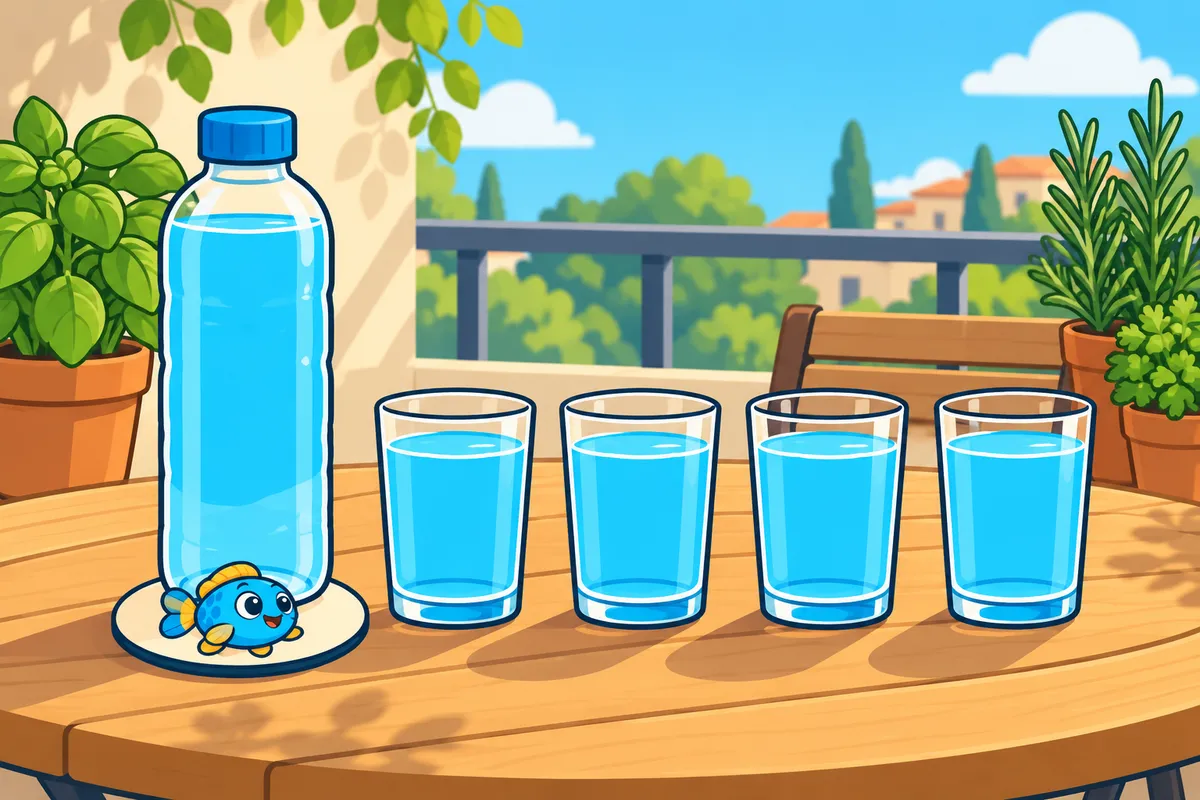
One liter holds 33.8 US fluid ounces, or 4.23 US cups. Most of the world sells water by the liter, while US recipes, cups and many reusable bottles count in fluid ounces.
That leaves you doing math over a 1.5 L bottle from a European supermarket or a 2 L bottle of soda. The charts in this guide do it once, for every common size.
How Many Ounces Are in a Liter?
33.8 US fluid ounces. The US fluid ounce is 29.5735 ml, and 1,000 ml divided by 29.5735 gives 33.81. Round it to 34 when you only need a rough count.
One Liter
- 1,000 ml
- 33.8 US fl oz
- 4.23 US cups
One US Quart
- 946.4 ml
- 32 US fl oz
- 4 US cups
The two look alike on a shelf, and a liter bottle is easy to mistake for a quart. The liter holds about 1.8 fluid ounces more, roughly three and a half tablespoons.
How Many Cups Are in a Liter?
About 4.23 US cups, or 4 cups plus about 3.5 tablespoons. The exact US cup is 236.588 ml, and 1,000 divided by that is 4.227.
Pour a liter bottle into a measuring cup and it fills the cup four times with a little left over. That leftover is why "a liter is 4 cups" drifts on big amounts: count 4 per liter over a 3 liter day and you miss 0.68 cup, more than half a cup. For the spoons in that leftover, the tablespoon chart breaks a cup into 16 parts.
A Liter in Other Kinds of Cup
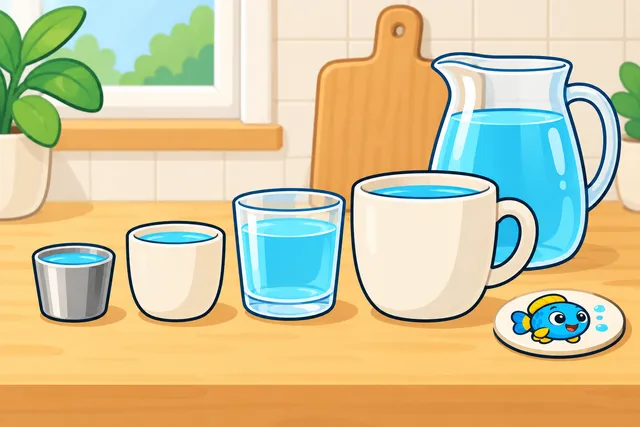
The answer changes with the cup your recipe or app uses, and so does the ounce:
| Measure | Size | In one liter |
|---|---|---|
| US customary cup | 236.6 ml | 4.23 cups |
| US nutrition-label cup | 240 ml | 4.17 cups |
| Metric cup (Canada, Australia) | 250 ml | 4.00 cups |
| US fluid ounce | 29.57 ml | 33.8 fl oz |
| Imperial fluid ounce | 28.41 ml | 35.2 fl oz |
| Imperial pint | 568.3 ml | 1.76 pints |
Where the sizes come from:
- The 240 ml cup is the one FDA labeling rules use.
- The 250 ml cup is the 1 cup in Health Canada's kitchen chart.
- The imperial ounce is 1/160 of the Canadian and UK gallon.
Pick the row that matches the number you started from.
Liters to Ounces and Cups Chart
Every row uses the exact factors of 29.5735 ml for a US fluid ounce, 236.588 ml for a US cup and 946.353 ml for a US liquid quart. Ounces are rounded to one decimal, cups and quarts to two.
Half a Liter and Smaller
These are the drink-sized bottles: the 330 ml can-sized bottle, the 500 ml standard bottle and the 750 ml sports bottle.
| Liters | Milliliters | US fl oz | US cups |
|---|---|---|---|
| 0.25 L | 250 ml | 8.5 fl oz | 1.06 cups |
| 0.33 L | 330 ml | 11.2 fl oz | 1.39 cups |
| 0.5 L | 500 ml | 16.9 fl oz | 2.11 cups |
| 0.75 L | 750 ml | 25.4 fl oz | 3.17 cups |
Big Bottles and Jugs
Here the quarts start to matter. Each liter adds 33.8 fluid ounces, 4.23 cups and 1.06 quarts.
| Liters | US fl oz | US cups | US quarts |
|---|---|---|---|
| 1 L | 33.8 fl oz | 4.23 cups | 1.06 qt |
| 1.5 L | 50.7 fl oz | 6.34 cups | 1.59 qt |
| 2 L | 67.6 fl oz | 8.45 cups | 2.11 qt |
| 2.5 L | 84.5 fl oz | 10.57 cups | 2.64 qt |
| 3 L | 101.4 fl oz | 12.68 cups | 3.17 qt |
| 3.5 L | 118.3 fl oz | 14.79 cups | 3.70 qt |
| 4 L | 135.3 fl oz | 16.91 cups | 4.23 qt |
| 5 L | 169.1 fl oz | 21.13 cups | 5.28 qt |
A US gallon is 3.79 L in the rounded table, so the 4 L jug in the chart holds a little more than a gallon.
How Many Cups Are in 2 Liters?
About 8.45 US cups, a little under eight and a half. A 2 liter bottle is the same amount as four 500 ml bottles, and it holds 67.6 fluid ounces and 2.11 quarts.
How Many Ounces Are in 2 Liters?
67.6 US fluid ounces. Double the 33.8 for one liter, or divide 2,000 ml by 29.5735.
That is 3.6 fluid ounces more than 64 oz, the amount people often treat as "2 liters." Eight 8 oz glasses make 64 oz, which is 1.89 L, so the eight-glass habit falls about 110 ml short of 2 liters.
A 2-liter soda bottle holds 67.6 fl oz, while common cans, juice boxes and milk cartons use their own package sizes; read the printed net quantity rather than estimating from the container shape.
How Many Liters Is 64 Ounces?
64 US fluid ounces is 1.89 liters. Multiply ounces by 29.5735 for milliliters, or divide by 33.8 for liters. The bottle and tumbler sizes people ask about land here:
| US fluid ounces | Milliliters | Liters |
|---|---|---|
| 16.9 oz | 500 ml | 0.50 L |
| 24 oz | 710 ml | 0.71 L |
| 32 oz | 946 ml | 0.95 L |
| 40 oz | 1,183 ml | 1.18 L |
| 64 oz | 1,893 ml | 1.89 L |
| 100 oz | 2,957 ml | 2.96 L |
| 128 oz (1 US gallon) | 3,785 ml | 3.79 L |
A 64 oz goal is therefore 110 ml short of 2 liters, and a 128 oz "gallon a day" goal is 3.79 L, not 4 L.
Is a Liter Bigger Than a Quart?
Yes, slightly. A US liquid quart is 946.4 ml, so a liter holds about 54 ml more, close to 6 %. The metric kitchen chart rounds the quart to 950 ml for home cooking.
There is a second quart, though. The US dry quart is 1.101 L, which is larger than a liter. It measures berries and grain, and it explains why dry and liquid cups are built differently; for water, always read "quart" as the 946 ml liquid one.
Converting Liters in Your Head
Multiply liters by 34 for fluid ounces and by 4.2 for cups. Both shortcuts land within 1 % of the exact answer.
From a Liter Label to Cups and Ounces
- Read the liters on the label, say 1.5 L
- Times 34 for fluid ounces: about 51 (exact 50.7)
- Times 4.2 for cups: about 6.3 (exact 6.34)
- Going back? Divide ounces by 34
The share of error stays the same as the amount grows, so only the size of the miss grows. For a 5 liter jug, 34 per liter gives 170 oz against an exact 169.1, a gap of 0.9 oz. For any amount that is not on this page, enter it in the unit converter and read every unit at once.
What 750 ml, 1.5 L and 2 L Come To in a Day
The chart turns into a plan once it meets a real bottle. Each example below uses the same factors as the tables. The 750 ml size is also the standard wine bottle, and its count in glasses and shots uses the same factor.
Write the Cups on Your Liter Bottle
Find the liters on your bottle's label, read its row in the chart, and write its size in cups on a strip of tape on the bottle. A 1 liter bottle gets "4.2 cups"; a 750 ml one gets "3.2".
Count the bottle once, write its cups on it, and the rest of the math disappears. From then on you count your day in bottles and multiply by the number on the tape, with one unit all day so ounces and liters never get mixed.
General information for healthy adults, not medical advice. If a doctor has set your fluid amount, follow that.
More in Cups, Ounces and Liters
Sources
- NIST. NIST Guide to the SI, Appendix B.9: Factors for Units Listed by Kind of Quantity or Field of Science, 2026.
- NIST. Approximate Conversions from U.S. Customary Measures to Metric, 2026.
- NIST. Metric Kitchen: Cooking Measurement Equivalencies, 2026.
- Government of Canada, Justice Laws. Weights and Measures Act, Schedule II: Canadian Units of Measurement, 2026.
- Health Canada. Measure ingredients like a pro, 2026.
- US Food and Drug Administration (Code of Federal Regulations). 21 CFR 101.9, Nutrition Labeling of Food, 2024.
Sources checked by the Glubbo Editorial Team on Oct 23, 2026. General information, not medical advice. How we write and check our guides.

