Cups, Ounces and Liters · Measuring at Home
Dry vs Liquid Measuring Cups: Which One to Use for Water and Flour
Use the spouted cup with lines for water and the flat-rimmed cups for flour, with the kitchen rules from NIST.
 By the Glubbo Editorial Team · Updated Oct 23, 2026 · 10 min read
On This Page
- What Is the Difference Between Dry and Liquid Measuring Cups?
- Do Dry and Liquid Measuring Cups Hold the Same Amount?
- What Sizes Do Measuring Cups Come In?
- Can You Use a Dry Measuring Cup for Liquid?
- Which Cup for Yogurt, Cottage Cheese and Peanut Butter?
- How Do You Read a Liquid Measuring Cup?
- Which Line Do You Read on a Jug With Cups, Ounces and Milliliters?
- How Do You Fill a Dry Measuring Cup?
- What Does a Cup of Water Weigh?
- What Is the Difference Between a Dry Quart and a Liquid Quart?
- Are Measuring Cups the Same in Every Country?
- Test Your Measuring Cups With a 500 ml Bottle
- Sources
Short answer
Water goes in a liquid cup, flour in a dry cup.
- A 1 cup dry measure and the 1 cup line hold the same 236.6 ml.
- Read a liquid cup on a level counter, at eye level.
- A US dry quart is 1.10 L; a liquid quart is 0.95 L.
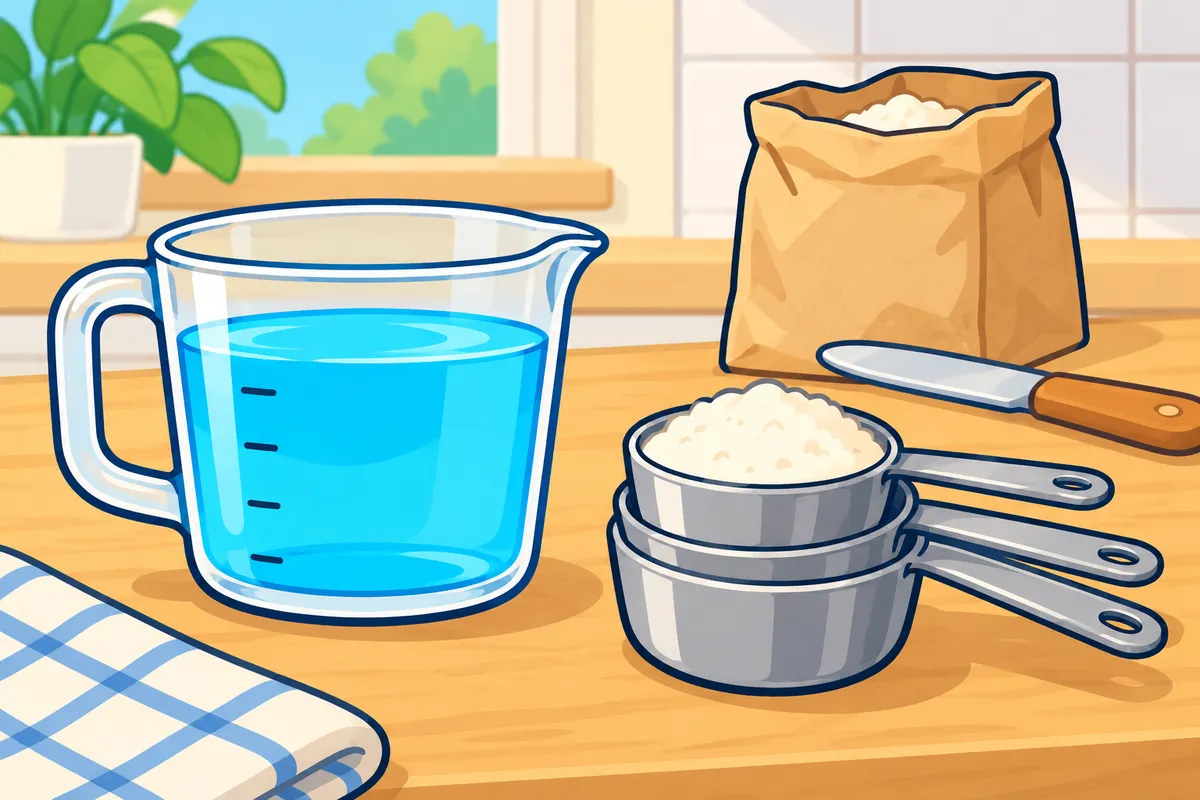
Water goes in the clear cup with a spout and lines; flour and sugar go in the flat-rimmed cups you fill and level. Both kinds hold the same US cup, 236.6 ml. What changes is how you fill them and how you read the amount.
You read a jug from the side, and you fill a dry cup to the top and sweep the excess off.
What Is the Difference Between Dry and Liquid Measuring Cups?
You read a liquid cup from the side and fill a dry cup to the rim. NIST's culinary measurement tips describe the fluid cup as "designed to measure the volume of liquid commodities like water", and the dry cup as one for "dry commodities like sugar." Health Canada says to fill a dry cup to the brim with no mound on top and to level it with a spatula or knife.
Three Ways to Measure in a Kitchen
Liquid measuring cup
For water and drinks
- Clear sides with lines
- Spout for pouring
- Read at eye level on the counter
Suits you if Suits you if you measure water, milk, broth or oil
Dry measuring cups
For flour and sugar
- Nested set, one size per cup
- Flat rim to level against
- Fill to the top, strike off the rest
Suits you if Suits you if you bake by US cup recipes
Kitchen scale
Most accurate
- Measures mass, not volume
- A best practice for accuracy
- Needs a recipe written in grams
Suits you if Suits you if your recipe lists grams
The scale is in the list because it is the most accurate tool: "measuring ingredients by mass (weight) using an appropriate kitchen scale is a best practice to improve recipe accuracy." For water you drink, though, a liquid cup or a marked bottle is all you need.
Do Dry and Liquid Measuring Cups Hold the Same Amount?
Yes, for the cup itself. The US cup is 236.588 ml, with no separate dry version, so a 1 cup dry measure filled level holds the same as a liquid cup filled to its 1 cup line.
What differs is how close you get to that amount:
- Water in a dry cup bulges above the rim or spills on the way to the bowl.
- Flour in a liquid cup settles unevenly, so the line tells you little.
To tell them apart at a glance, look for a spout or printed lines, which mark a liquid cup, against the plain flat rim of a nested dry cup.
What Sizes Do Measuring Cups Come In?
- A dry set usually holds four cups: 1/4, 1/3, 1/2 and 1 cup, and some sets add 1/8, 2/3 and 3/4.
- Liquid cups come as one jug sized by its top line, most often 1, 2, 4 or 8 cups, with milliliter marks beside the cup marks.
Each size below is worked out from the exact cup of 236.588 ml:
| Measure | Holds | Type | Good for |
|---|---|---|---|
| 1/4 cup | 59.1 ml | Dry | Sugar, oats, chopped nuts |
| 1/3 cup | 78.9 ml | Dry | The thirds that spoons cannot hit |
| 1/2 cup | 118.3 ml | Dry | Rice, flour in half-cup steps |
| 1 cup | 236.6 ml | Dry | Flour and sugar for most recipes |
| 1 cup jug | 236.6 ml to the top line | Liquid | Small amounts of milk or water |
| 2 cup jug (1 pint) | 473.2 ml to the top line | Liquid | Most everyday water amounts |
| 4 cup jug (1 quart) | 946.4 ml to the top line | Liquid | Soup stock, a day's bottle refill |
| 8 cup jug | 1,892.7 ml to the top line | Liquid | Batch cooking, big pitchers |
Pick the smallest jug that holds your amount. Health Canada's kitchen guide gives that rule for liquid cups, so 1 cup of water reads better in a 2 cup jug than in an 8 cup one.
Can You Use a Dry Measuring Cup for Liquid?
You can, but your amount will be less exact. To hold a full cup of water, you have to fill a dry cup right to the rim, and some always slops out as you carry it. NIST warns that using a dry cup instead of a fluid cup "is a common way of introducing measurement errors into the cooking process."
If a dry cup is all you have, fill it over the bowl you are pouring into. Pour slowly to the rim and tip it straight in.
The reverse swap is worse:
- Flour in a liquid cup packs down or mounds up.
- You cannot level it against a spout.
- A cup of flour can come out more or less than the recipe means.

Which Cup for Yogurt, Cottage Cheese and Peanut Butter?
Use a dry cup for anything thick enough to hold its shape, and a liquid cup only for what pours flat by itself. Health Canada lists yogurt, cottage cheese and nut butter as thick foods that cling to the sides of a liquid cup and are hard to read, so they go in dry cups and spoons.
| Food | Settles flat by itself? | Cup to use |
|---|---|---|
| Water, milk, juice, oil | Yes | Liquid cup, read at eye level |
| Broth, thin batter | Yes | Liquid cup |
| Yogurt, cottage cheese | No | Dry cup, leveled with a knife |
| Peanut butter and other nut butters | No | Dry cup or spoons, pressed in and leveled |
| Flour, sugar, oats | No | Dry cup, spooned in and leveled |
Thick foods trap air. Press peanut butter into the dry cup with a spatula until no gaps show, then level it, or a 1 cup measure can hold noticeably less than a cup.
How Do You Read a Liquid Measuring Cup?
Set the cup on a flat counter, pour, then bend down until your eyes are level with the line. Read the meniscus, the curved surface of the water, at eye level, as NIST says.
Reading a Liquid Cup in Four Moves
- Stand the cup on a level counter, not in your hand
- Pour to just below the line you want
- Crouch until the line is level with your eyes
- Top up until the water surface sits on the line
The tip to set the fluid cup on a level surface and read the meniscus at eye level comes straight from NIST. The crouch is the step most people skip, and it is the one that fixes the reading.
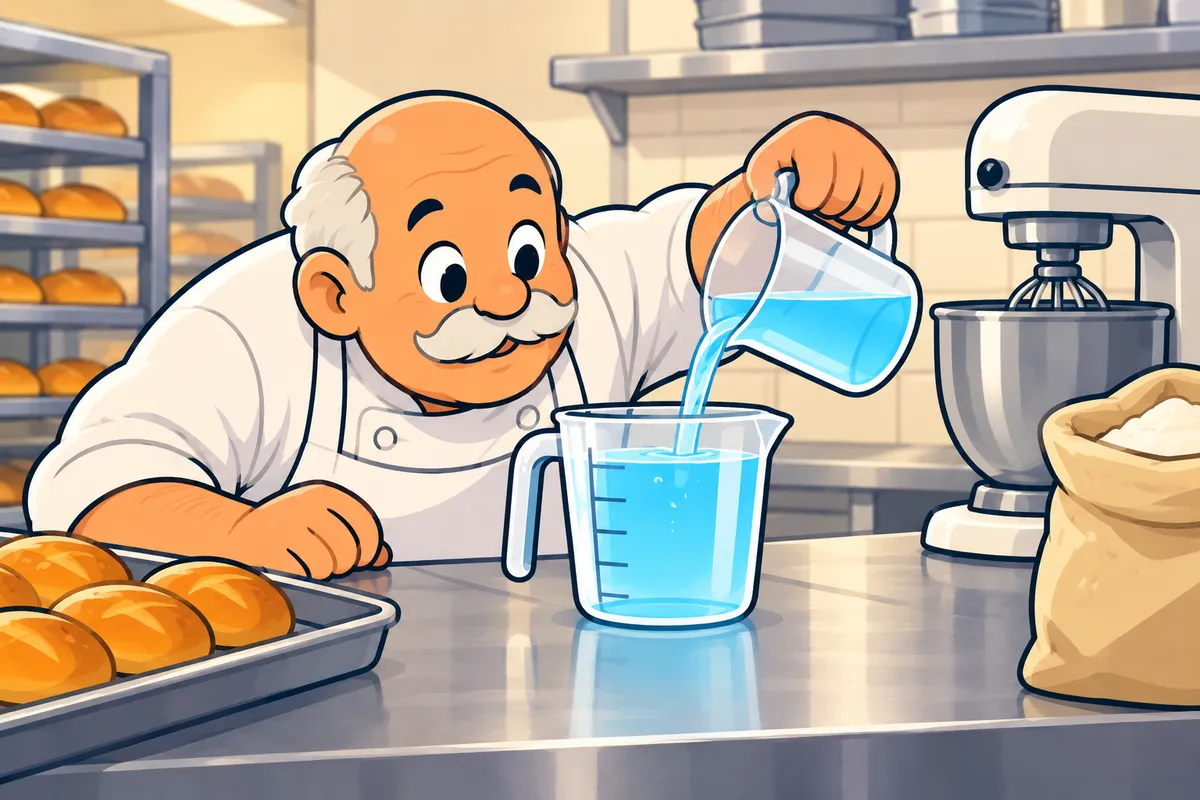
For drinking water, the same reading tells you what your own glass or bottle holds. Pour one measured cup into it once and you can count that glass in cups from then on, at 8 fl oz, about 237 ml, to the cup.
Which Line Do You Read on a Jug With Cups, Ounces and Milliliters?
Pick one scale and stay on it for the whole recipe. A jug prints cups, fluid ounces and milliliters side by side, and the three do not line up exactly: the US cup is 236.6 ml, and kitchen charts round it.
| Cup measure | Exact US cup | NIST kitchen chart | Health Canada chart |
|---|---|---|---|
| 1/4 cup | 59.1 ml | 60 mL | 60 mL |
| 1/3 cup | 78.9 ml | 80 mL | 80 mL |
| 1/2 cup | 118.3 ml | 120 mL | 125 mL |
| 3/4 cup | 177.4 ml | 180 mL | 180 mL |
| 1 cup | 236.6 ml | 240 mL | 250 mL |
At 1 cup the gap between 236.6 and 250 ml is 13.4 ml, a bit under a tablespoon. At 8 cups it grows to 107 ml, about 3.6 oz of water. For a drink goal that is small; for bread dough it changes the texture.
The Canadian gallon and cup page goes further into the 250 ml cup.
How Do You Fill a Dry Measuring Cup?
Spoon the ingredient in, then sweep the top flat. Health Canada gives these steps for flour, dried lentils and quinoa:
- Spoon the ingredient into the cup until it overflows, rather than pushing the cup into the bag.
- Sweep the top flat with a knife or spatula.
- Tip it into the bowl without tapping or pressing.
Dipping packs the ingredient down, so the cup holds more than the recipe means. Pressing a thick food such as peanut butter in until no gaps show is the one time packing is right.
What Does a Cup of Water Weigh?
About 236 g, because a milliliter of water weighs close to a gram. A scale gives the most accurate reading of all, and NIST calls weighing a best practice for recipes. Put the jug on the scale, press tare, and pour until it reads the weight in the table.
| Water at room temperature | Weight |
|---|---|
| 1/2 cup, 118.3 ml | 118 g |
| 1 cup, 236.6 ml | 236 g |
| 2 cups, 473.2 ml | 472 g |
| 4 cups, 946.4 ml | 945 g |
| 8 cups, 1,892.7 ml | 1.89 kg |
Weighing sidesteps the 236.6, 240 and 250 ml question, because grams do not change with the cup. The weight of water at different temperatures and amounts has the numbers for larger volumes.
What Is the Difference Between a Dry Quart and a Liquid Quart?
The dry quart is bigger. NIST lists the US dry quart at 1.101 L and the US liquid quart at 0.946 L, so a dry quart holds about 16 % more. The pints split the same way: 550.6 ml dry against 473.2 ml liquid.
US Liquid Quart and Pint
- Quart: 946.4 ml
- Pint: 473.2 ml
- For water, milk, juice
US Dry Quart and Pint
- Quart: 1,101.2 ml
- Pint: 550.6 ml
- For berries and produce
You meet dry quarts at a farm stand, on a box of strawberries or a basket of tomatoes. A recipe that says "a quart of water" always means the liquid quart. The shorter approximate conversions list carries only the liquid pint and quart, at 0.47 L and 0.95 L.
The cup and the spoons have no dry versions, which is why the quart is the only place the split shows up in a home kitchen.
Metric Kitchens Skip the Split
Liters and milliliters work the same for both kinds of food. The metric kitchen page notes that in the metric system, liquid and dry ingredients are both measured in liters or milliliters. A 250 ml line means 250 ml of water or of rice.
Why Do Some Recipes Say "Packed" Cup?
Brown sugar is the main one. A packed cup means you press the sugar into the dry measure until it holds its shape when tipped out, so a packed cup of brown sugar weighs about 220 g, against about 125 g for a loosely spooned cup of granulated sugar. The tip to spoon and level applies only to ingredients that do not need packing.
Other ingredients you may see packed: shredded cheese, fresh herbs and cooked rice. If the recipe does not say packed, spoon and level.
Are Measuring Cups the Same in Every Country?
No. The US cup is 236.6 ml, the metric cup used in Australia, New Zealand and some Canadian recipes is 250 ml, and Japan's cup is 200 ml. The metric kitchen page notes that in the metric system all ingredients, liquid and dry, use liters and milliliters.
| Country | Cup size | Where you see it |
|---|---|---|
| United States | 236.6 ml | US cookbooks and food labels |
| Australia, New Zealand | 250 ml | Metric recipes |
| Japan | 200 ml | Japanese cookbooks and rice cookers |
| UK (informal) | 250 ml or 284 ml (half an imperial pint) | Older recipes may use either |
If a recipe does not name its cup, check the country it comes from. The gap between 200, 237 and 250 ml is small in a glass of water but adds up in a cake.
Test Your Measuring Cups With a 500 ml Bottle
Check your cups against an amount you already know. A sealed 500 ml (16.9 oz) bottle poured into a liquid jug should reach just above the 2 cup line, by about 27 ml, close to 2 tablespoons. If it lands well below or above that, the jug's lines are off.
The numbers come from the exact sizes: 2 cups are 473.2 ml, so a 500 ml bottle leaves 26.8 ml, and a tablespoon is 14.79 ml. Dry cups test the same way with a measuring tablespoon and water:
- 1/4 cup: 4 level tablespoons should fill it to the rim.
- 1/3 cup: 5 tablespoons plus 1 teaspoon.
- 1/2 cup: 8 tablespoons.
- 1 cup: 16 tablespoons.
A cup that fails the test goes in the drawer for scooping, never for measuring. For small liquid amounts below a quarter cup, tablespoons are more exact than a jug.
If the correct cup is missing entirely, a tared scale, labeled bottle or standard measuring spoons can measure the water without guessing. An ordinary drinking glass becomes reliable only after you calibrate its fill line.
General information for healthy adults, not medical advice. If a doctor has set your fluid amount, follow that.
More in Cups, Ounces and Liters

Sources
- NIST. Culinary Measurement Tips, 2026.
- NIST. NIST Guide to the SI, Appendix B.9: Factors for Units Listed by Kind of Quantity or Field of Science, 2026.
- NIST. Metric Kitchen: Cooking Measurement Equivalencies, 2026.
- NIST. Approximate Conversions from U.S. Customary Measures to Metric, 2026.
- Health Canada. Measure ingredients like a pro, 2026.
Sources checked by the Glubbo Editorial Team on Oct 23, 2026. General information, not medical advice. How we write and check our guides.

