Cups, Ounces and Liters · Conversions
How Much Does a Gallon of Water Weigh? 8.33 lb, Plus a Full Chart
A gallon of room-temperature water weighs 8.33 pounds. The chart runs from a cup to five gallons, in pounds and kg.
 By the Glubbo Editorial Team · Updated Oct 23, 2026 · 8 min read
On This Page
- How Much Does a Gallon of Water Weigh?
- Water Weight Chart, From a Cup to Five Gallons
- How Much Does a Liter of Water Weigh?
- How Much Does a Cup of Water Weigh?
- How Much Does a Case of Bottled Water Weigh?
- Does Hot Water Weigh Less Than Cold Water?
- How Much Does a Fish Tank or a Rain Barrel of Water Weigh?
- Mistakes When You Estimate Water Weight
- When the Weight Changes What You Carry
- Working Out the Weight of Any Amount
- Weigh Your Load Before the Next Trip
- Sources
Short answer
A US gallon of water weighs about 8.33 lb.
- That is 3.78 kg at 20 °C (68 °F), from NIST's water density of 0.99821 g/ml.
- A liter weighs 998 g (2.2 lb); a US cup weighs 236 g (8.3 oz).
- Cold water near 4 °C is densest: 8.35 lb per gallon.

A US gallon of water weighs about 8.33 pounds, or 3.78 kg, at room temperature, and a liter weighs 2.2 pounds. A gallon jug at the store pulls on your arm more than you expect, and a full day of water in a backpack pulls harder.
Water's weight follows from two numbers: how much space it fills and how dense it is. Both are published, so every figure here comes from the same arithmetic.
How Much Does a Gallon of Water Weigh?
The weight comes out in three steps:
- The fluid data for water give a density of 0.99821 g per ml at 20 °C (68 °F).
- A US gallon is 3,785.41 ml, so it holds 3,778.6 g of water.
- A pound is 453.59 g. Divide 3,778.6 by 453.59 and you get 8.33 lb, before you add the jug.
Why Some Charts Say 8.34 Pounds
The usual 8.34 lb is the weight of cooler water. At 10 °C (50 °F) the density of 0.99970 g per ml makes a gallon 8.343 lb; at 20 °C it is 8.330 lb. The gap is about a fifth of an ounce, far less than any jug weighs.
Water Weight Chart, From a Cup to Five Gallons
Every row takes the volume from the standard factors and multiplies it by 0.99821 g per ml, the density at 20 °C. Pounds use 453.59 g and ounces 28.35 g.
US Sizes
| Amount | Milliliters | Grams | Ounces | Pounds |
|---|---|---|---|---|
| 1 fl oz | 29.6 ml | 29.5 g | 1.04 oz | 0.07 lb |
| 1 cup | 236.6 ml | 236.2 g | 8.33 oz | 0.52 lb |
| 1 pint | 473.2 ml | 472.3 g | 16.66 oz | 1.04 lb |
| 1 quart (32 oz bottle) | 946.4 ml | 944.7 g | 33.32 oz | 2.08 lb |
| 40 oz tumbler | 1,182.9 ml | 1,180.8 g | 41.65 oz | 2.60 lb |
| 1/2 gallon | 1,892.7 ml | 1,889.3 g | 66.64 oz | 4.17 lb |
| 1 gallon | 3,785.4 ml | 3,778.6 g | 133.29 oz | 8.33 lb |
| 5 gallons | 18,927.1 ml | 18,893.2 g | 666.44 oz | 41.65 lb |
Metric Sizes
| Amount | Grams | Kilograms | Pounds |
|---|---|---|---|
| 250 ml glass | 249.6 g | 0.25 kg | 0.55 lb |
| 500 ml bottle | 499.1 g | 0.50 kg | 1.10 lb |
| 750 ml bottle | 748.7 g | 0.75 kg | 1.65 lb |
| 1 liter | 998.2 g | 1.00 kg | 2.20 lb |
| 1.5 liters | 1,497.3 g | 1.50 kg | 3.30 lb |
| 2 liters | 1,996.4 g | 2.00 kg | 4.40 lb |
| 3 liters | 2,994.6 g | 2.99 kg | 6.60 lb |
The weight of a bottle itself is not in the chart. A steel bottle adds its own weight on top, and the bottle size chart lists empty weights next to each size.
How Much Does a Liter of Water Weigh?
About 1 kilogram, or 2.2 pounds. At 20 °C the density gives 998.2 g per liter, and at 4 °C it gives 999.97 g. For any everyday purpose, one liter of water weighs one kilogram and one milliliter weighs one gram.
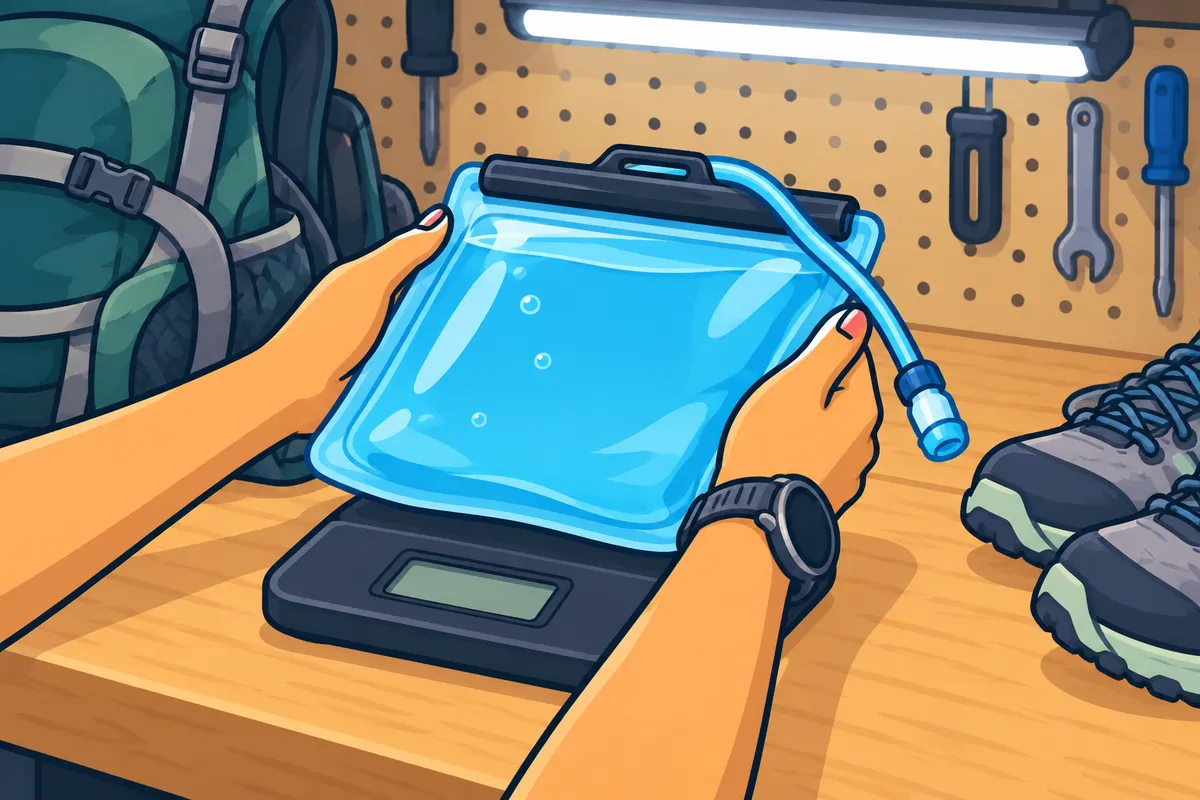
That one-to-one match makes a kitchen scale a measuring cup. Pour water onto a zeroed scale and the grams read off the milliliters within 0.2 %.
Why Does a Liter of Water Weigh a Kilogram?
Because the kilogram started out as water. The kilogram was "originally defined as the mass of one cubic decimeter of water at the temperature of maximum density," per NIST's page on SI mass units. A cubic decimeter is a liter, so the match is by design.
The kilogram now rests on a fixed value of the Planck constant, not on water. Water stayed almost exactly where the old definition put it, which is why the 1 kg liter still works on a scale.
How Much Does a Cup of Water Weigh?
About 236 grams, or 8.33 ounces. A US cup is 236.59 ml, and at room temperature that much water weighs 236.2 g. The 240 ml cup on US nutrition labels weighs 239.6 g.
- 236 g
- a US cup of water at room temperature
- 8.33 oz
- the same cup, by weight
- 239.6 g
- the 240 ml cup on US nutrition labels
A cup of water weighs a little more than 8 ounces on a scale even though it holds 8 fluid ounces. The two ounces measure different things, volume and weight, and each fluid ounce of water weighs 1.04 ounces. Some recipe charts round a cup of water to 8 oz (227 g); the physical weight is the 236 g above.
How Many Grams Are in a Cup of Water?
236 grams for a US cup at room temperature, or 240 g if you round as US food labels do. A metric cup of 250 ml holds 249.6 g. If a recipe gives water in grams, weigh it and skip the cup.
How Much Does a Case of Bottled Water Weigh?
A 24-pack of half-liter bottles holds 12 kg of water, or 26.4 lb, before the plastic and the cardboard. Multiply the bottle's grams from the metric chart by the count in the pack.
| Pack | Water alone | In pounds |
|---|---|---|
| 24 bottles of 500 ml (16.9 oz) | 11.98 kg | 26.4 lb |
| 12 bottles of 1 L | 11.98 kg | 26.4 lb |
| 6 bottles of 1.5 L | 8.98 kg | 19.8 lb |
| 6 bottles of 2 L | 11.98 kg | 26.4 lb |
| 5 gallon cooler bottle | 18.9 kg | 41.65 lb |
Packaging adds a pound or two to a case. A stored emergency supply is worth weighing the same way before you decide where the cases live.
Does Hot Water Weigh Less Than Cold Water?
Yes, slightly. Warm water expands, so a gallon holds less of it by weight. The density falls from 0.99997 g per ml at 4 °C to 0.95837 g per ml at boiling, and a gallon drops from 8.35 lb to 8.00 lb.
Water is densest at about 4 °C. That is why the heaviest gallon is a cold one from the fridge, not a hot one.
For drinking water, temperature changes a gallon's weight by less than 1 % between the fridge and the tap. It only matters near boiling.
How Much Does a Fish Tank or a Rain Barrel of Water Weigh?
Multiply the gallons by 8.33. A 10 gallon tank holds 83 lb of water, a 55 gallon barrel holds 458 lb, and a cubic foot holds 62.3 lb.
| Container | Gallons | Water weight |
|---|---|---|
| 10 gallon aquarium | 10 | 83.3 lb |
| 20 gallon aquarium | 20 | 166.6 lb |
| 55 gallon barrel | 55 | 458.2 lb |
| 1 cubic foot | 7.48 | 62.3 lb |
A cubic foot is 1,728 cubic inches, and the US gallon is 231 cubic inches, so a cubic foot holds 7.48 gallons. The glass, the stand and the gravel come on top, so check the floor's rating before you fill a big tank.
For a container without a stated gallon capacity, inside dimensions determine the cubic volume, and rocks, pumps and freeboard reduce the usable water. Calculate gallons first, then multiply by 8.33 lb per gallon for the water load.
Mistakes When You Estimate Water Weight
The water is rarely where the estimate goes wrong. The container, the gallon and the ounce are.
| Mistake | What happens | Do this instead |
|---|---|---|
| Leaving out the container | A steel or glass bottle adds its own weight | Weigh it full once, or add the maker's empty weight |
| Using a UK gallon figure | An imperial gallon of water weighs 10.0 lb, not 8.33 | Check which gallon your source means |
| Treating fluid ounces as weight ounces | 32 fl oz of water weighs 33.3 oz | Use the chart's ounce column for weight |
| Packing "a liter per hour" without a scale | Four hours of water is 8.8 lb on your back | Weigh the full pack before you leave |
The imperial gallon is about 20 % bigger than the US one, so the UK gallon weighs ten pounds of water by its very definition.
When the Weight Changes What You Carry
Each example uses the chart's 20 °C figures. Colder water adds about 0.2 %.
Working Out the Weight of Any Amount
Turn the amount into milliliters, then read the milliliters as grams. That is accurate to within about 0.2 % at room temperature.
From a Label to Pounds of Water
- Read the size: 24 fl oz
- Times 29.57 for ml: 710 ml
- Read ml as grams: about 709 g
- Divide by 453.6 for pounds: 1.56 lb
For a size that is not on the chart, the Water Unit Converter turns it into milliliters in one step; the last two steps above take it from there. To find the size of a glass with no label, weigh it full on a kitchen scale and read the grams as milliliters.
Weigh Your Load Before the Next Trip
Add up the liters you plan to carry and multiply by 2.2 for pounds, or multiply gallons by 8.33. Then fill everything and lift the pack at home, the night before. If it feels too heavy on the stairs, it will feel heavier at mile eight, so plan a refill stop instead of carrying the whole day from the start.
General information for healthy adults, not medical advice. If a doctor has set your fluid amount, follow that.
More in Cups, Ounces and Liters



Sources
- NIST Chemistry WebBook. Thermophysical Properties of Fluid Systems: Water, isobaric data at 0.101325 MPa, 0 to 100 °C, 2026.
- NIST Chemistry WebBook. Thermophysical Properties of Fluid Systems: Water, isobaric data at 0.101325 MPa, 2 to 8 °C, 2026.
- NIST. NIST Guide to the SI, Appendix B.9: Factors for Units Listed by Kind of Quantity or Field of Science, 2026.
- NIST. SI Units: Mass, 2026.
- National Academies of Sciences. Dietary Reference Intakes for Water, Potassium, Sodium, Chloride, and Sulfate: Summary, 2005.
Sources checked by the Glubbo Editorial Team on Oct 23, 2026. General information, not medical advice. How we write and check our guides.

