Cups, Ounces and Liters · Conversions
How Many Gallons Are in a Cubic Foot? Cubic Volume Chart
One cubic foot holds 7.4805 US gallons or 28.3168 liters. One cubic meter holds exactly 1,000 liters.
 By the Glubbo Editorial Team · Updated Oct 23, 2026 · 8 min read
On This Page
- How Many Gallons Are in a Cubic Foot?
- How Many Liters Are in a Cubic Foot?
- How Many Gallons Are in a Cubic Yard?
- How Many Liters Are in a Cubic Meter?
- How Do You Calculate Gallons From Tank Dimensions?
- How Do You Calculate a Cylinder?
- What If the Dimensions Are in Inches?
- Why Is Actual Capacity Lower Than the Calculation?
- How Do Irregular Shapes Change the Volume Estimate?
- How Can You Check a Cubic-Volume Calculation?
- How Does a Small Measurement Error Grow?
- Keep Volume and Weight Separate
- Sources
Short answer
One cubic foot holds 7.4805 US gallons.
- It also equals 28.3168 liters or about 29.922 US liquid quarts.
- One cubic yard is 27 cubic feet and holds about 201.97 US gallons.
- One cubic meter holds exactly 1,000 liters or about 264.17 US gallons.
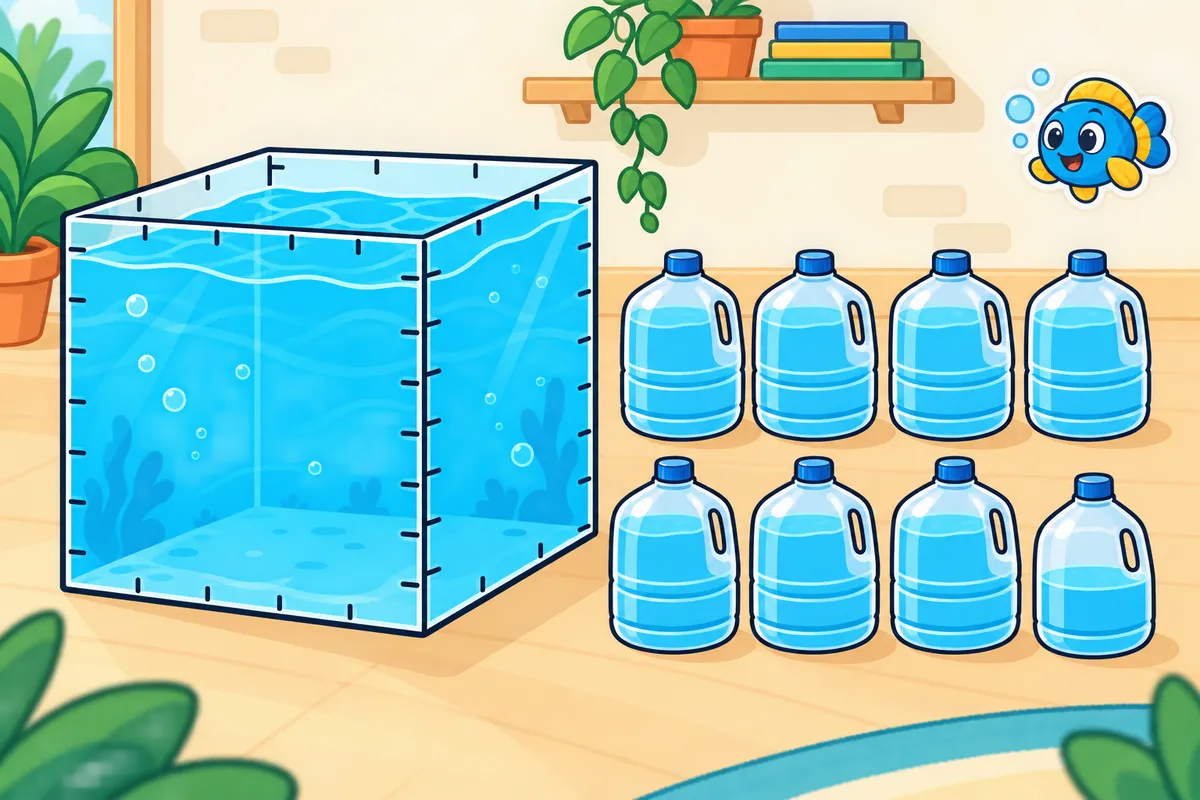
One cubic foot holds 7.4805 US gallons, 28.3168 liters or about 29.922 US liquid quarts. One cubic yard holds about 201.97 gallons, and one cubic meter holds about 264.17 gallons.
Measure the inside dimensions of a tank, calculate its cubic volume, then apply the matching conversion factor.
How Many Gallons Are in a Cubic Foot?
One cubic foot equals 7.48052 US liquid gallons. NIST's current general table rounds it to 7.481 gallons and 28.316 liters; its higher-precision conversion table gives 28.3168 L per cubic foot.
| Cubic feet | US gallons | Liters | US liquid quarts |
|---|---|---|---|
| 0.5 ft³ | 3.740 gal | 14.158 L | 14.961 qt |
| 1 ft³ | 7.481 gal | 28.317 L | 29.922 qt |
| 2 ft³ | 14.961 gal | 56.634 L | 59.844 qt |
| 5 ft³ | 37.403 gal | 141.584 L | 149.610 qt |
| 10 ft³ | 74.805 gal | 283.168 L | 299.221 qt |
| 20 ft³ | 149.610 gal | 566.336 L | 598.442 qt |
US liquid quarts equal four per gallon. Keep “liquid” in the unit because a US dry quart is larger and does not belong in a water-tank calculation.
How Many Liters Are in a Cubic Foot?
One cubic foot equals 28.3168 liters. Multiply cubic feet by 28.3168 to get liters, or divide liters by 28.3168 to return to cubic feet.
- Cubic feet to liters:
ft³ × 28.3168 - Cubic feet to US gallons:
ft³ × 7.48052 - Liters to cubic feet:
L ÷ 28.3168
A 3.5 ft³ container has a theoretical volume of 99.109 L. Rounded to whole liters, that is 99 L.
How Many Gallons Are in a Cubic Yard?
One cubic yard holds about 201.974 US gallons. A cubic yard equals exactly 27 cubic feet, so:
27 ft³ × 7.48052 gal/ft³ = 201.974 gal
| Cubic yards | Cubic feet | US gallons | Liters |
|---|---|---|---|
| 0.25 yd³ | 6.75 ft³ | 50.49 gal | 191.14 L |
| 0.5 yd³ | 13.5 ft³ | 100.99 gal | 382.28 L |
| 1 yd³ | 27 ft³ | 201.97 gal | 764.55 L |
| 2 yd³ | 54 ft³ | 403.95 gal | 1,529.11 L |
| 5 yd³ | 135 ft³ | 1,009.87 gal | 3,822.77 L |
NIST lists one cubic yard as 0.765 cubic meter and exactly 27 cubic feet. The 0.765 value is rounded; the higher-precision metric volume is 0.764555 m³.
One Cubic Foot
- 7.4805 US gallons
- 28.3168 liters
- A cube 1 ft on every side
One Cubic Yard
- 27 cubic feet
- 201.97 US gallons
- A cube 3 ft on every side
How Many Liters Are in a Cubic Meter?
One cubic meter holds exactly 1,000 liters. It also equals about 264.172 US gallons, 35.3147 cubic feet or 1.30795 cubic yards.
A meter cube is much larger than it may sound: each edge is 100 cm, so the volume is 100 × 100 × 100 = 1,000,000 cubic centimeters. One milliliter equals one cubic centimeter, giving 1,000,000 mL or 1,000 L.
NIST's metric conversion page rounds the relationship to 1.31 cubic yards per cubic meter. Use 1,000 L when the input is already metric; it avoids an unnecessary trip through gallons. Convert to US gallons only when the final equipment or order uses gallons.
How Do You Calculate Gallons From Tank Dimensions?
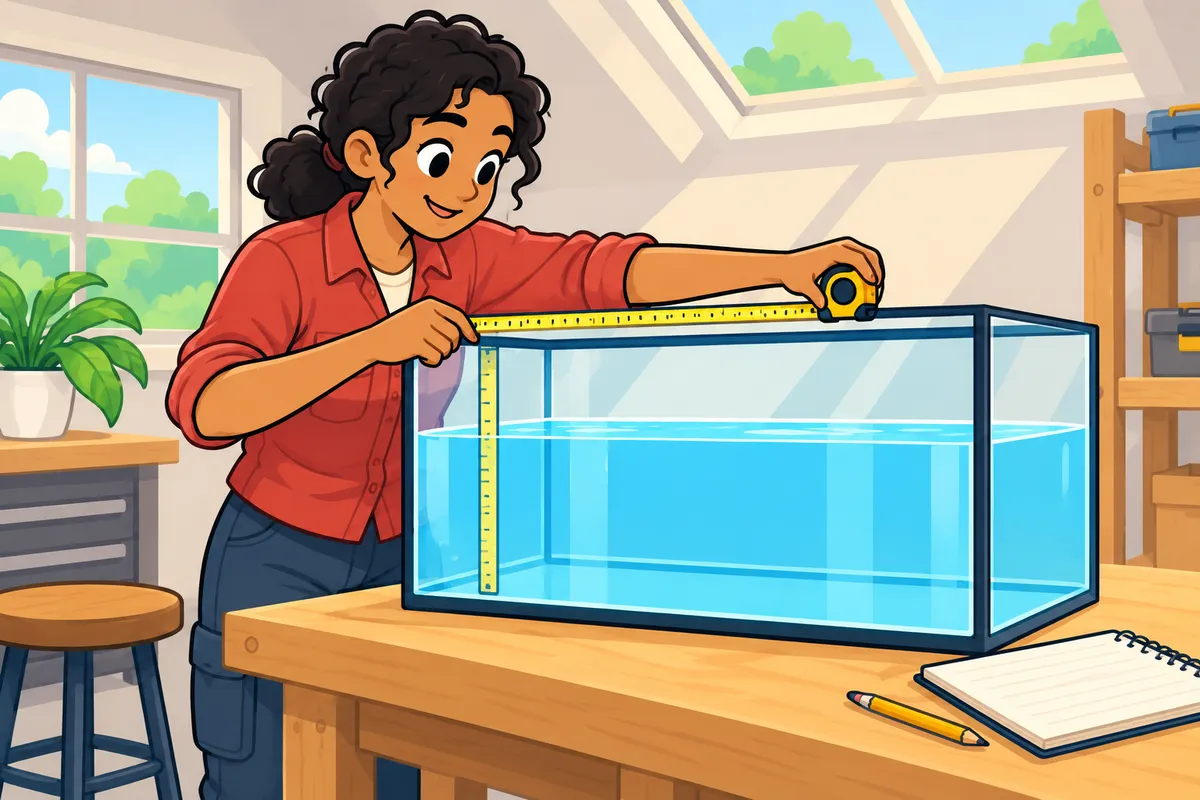
For a rectangular tank, multiply inside length × inside width × liquid depth. Keep all three measurements in the same unit, then convert the cubic result.
Rectangular Tank to Gallons
- Measure inside length, width and actual liquid depth
- Multiply the three dimensions to get cubic feet or cubic inches
- Multiply ft³ by 7.48052, or divide in³ by 231
- Round for the accuracy of your original measurements
Rectangular Aquarium Example
An aquarium's inside dimensions are 4 ft long, 1.5 ft wide and the water is 1.25 ft deep.
4 × 1.5 × 1.25 = 7.5 ft³
7.5 × 7.48052 = 56.10 US gallons
The theoretical water volume is 56.1 gallons. Gravel, rocks, equipment and an air gap displace water, so the amount actually added will be lower.
How Do You Calculate a Cylinder?
For a vertical cylindrical tank, calculate π × radius² × liquid height. The radius is half the inside diameter.
If a round tank is 2 ft in inside diameter and the water is 3 ft deep, the radius is 1 ft:
π × 1² × 3 = 9.4248 ft³
9.4248 × 7.48052 = 70.50 gallons
Horizontal Cylinders Need a Different Formula
Measure a horizontal cylinder with a partial fill using a segment formula or a tank chart from the manufacturer. Multiplying the full circular area by the liquid depth works only when the cylinder stands upright.
Before using the cylinder result, check three inputs:
- diameter means the full inside width, while the formula needs half of it as radius;
- height means the liquid depth for a vertical cylinder, not necessarily the tank's full height;
- every dimension must use the same unit before multiplication.
What If the Dimensions Are in Inches?
Multiply length × width × depth in inches to get cubic inches, then divide by 231 because one US gallon contains exactly 231 cubic inches.
For a box 24 × 18 × 12 inches:
24 × 18 × 12 = 5,184 in³
5,184 ÷ 231 = 22.44 gallons
The Cubic-Foot Route Gives the Same Answer
You can also divide cubic inches by 1,728 to get cubic feet, then multiply by 7.48052. Both routes produce the same result apart from rounding.
Use one route from start to finish:
- direct route: cubic inches ÷ 231 = US gallons;
- feet route: cubic inches ÷ 1,728 × 7.48052 = US gallons.
Choose the Formula From Your Measurements
Feet
Result in cubic feet
- L × W × D in feet
- Multiply by 7.48052 for gallons
Suits you if Rooms, large tanks and ponds with straight sides
Inches
Result in cubic inches
- L × W × D in inches
- Divide by 231 for gallons
Suits you if Aquariums and small rectangular containers
Meters
Result in cubic meters
- L × W × D in meters
- Multiply by 1,000 for liters
Suits you if Metric tanks and reservoirs
Why Is Actual Capacity Lower Than the Calculation?
The formula gives geometric capacity for the measured empty space. Real containers lose liquid volume to:
- wall thickness and rounded corners;
- sloped sides;
- equipment, substrate and other objects;
- freeboard below the rim.
Measure inside surfaces rather than exterior dimensions, and use actual water depth rather than full height. For a manufactured tank, its rated capacity may use nominal exterior dimensions, so record how many gallons you actually add when dosing or planning weight.
How Many Decimal Places Should You Keep?
Match the result to the measurements. Dimensions read to the nearest inch do not support a capacity stated to a thousandth of a gallon.
Keep full calculator precision while multiplying, then round the final household result to one decimal gallon or a whole liter. For chemical dosing, use the tank maker's usable volume or a metered fill because a neat geometric calculation cannot account for every rounded corner and internal fitting.
How Do Irregular Shapes Change the Volume Estimate?
The simple length-times-width-times-depth formula works only for a rectangular interior with straight sides. Curved ends, steps, sloped walls and built-in compartments need a shape-specific calculation or a measured fill.
Break a composite container into simple parts when the boundaries are clear. Calculate each rectangular or cylindrical part in the same unit, add the cubic volumes, then make one final conversion to gallons or liters.
| Interior shape | Best starting method |
|---|---|
| Rectangular box | Inside length × width × water depth |
| Upright round tank | π × inside radius² × water depth |
| Several simple sections | Calculate each section, then add |
| Curved or irregular vessel | Metered fill or maker's usable capacity |
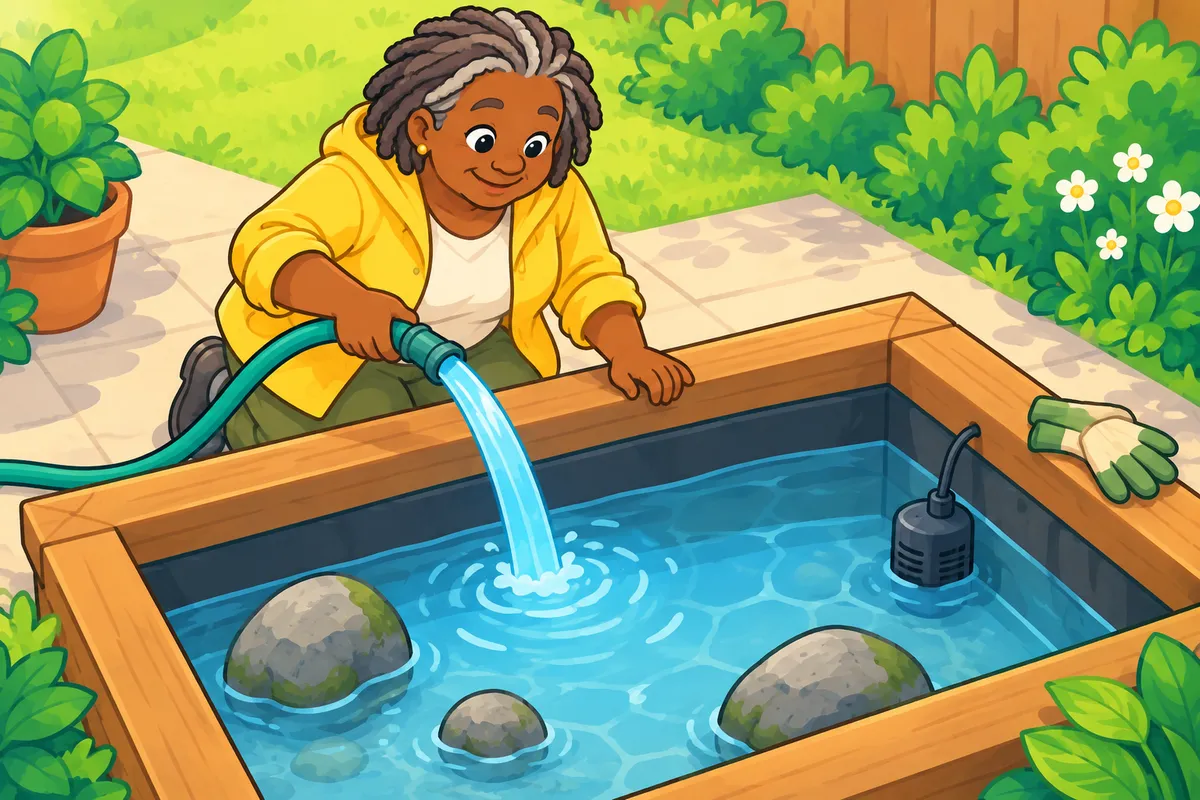
Do not subtract a rock or pump by guessing its outside dimensions if precision matters. For a small waterproof object, the rise in water inside a suitable graduated container gives displaced volume; for a large installed object, a metered fill or the manufacturer's usable-capacity data is safer.
An oval or horizontal cylinder also needs the correct geometry for the filled depth. Multiplying its maximum width by maximum height treats the curved corners as liquid and overstates capacity.
How Can You Check a Cubic-Volume Calculation?
Check units, scale and a second calculation path. Every dimension must use the same length unit before multiplication; 4 feet × 3 feet × 18 inches is invalid until 18 inches becomes 1.5 feet.
Next, test whether the size is plausible. A box measuring 1 foot on every side must equal 1 cubic foot and about 7.48 gallons, so a result of 0.748 or 74.8 gallons signals a misplaced decimal or conversion factor.
For an inch-based rectangular tank, compare two routes:
- divide cubic inches by 231 to get US gallons;
- divide cubic inches by 1,728, then multiply cubic feet by 7.48052.
The results should agree apart from rounding. If they do not, revisit the dimension units before using the number for a pump, treatment dose or structural load.
Finally, compare the geometric result with the maker's rated or usable capacity. A lower published figure can reflect rounded corners, wall thickness and the intended unfilled space rather than a mistake in your arithmetic.
How Does a Small Measurement Error Grow?
Volume multiplies three dimensions, so errors can accumulate. If length, width and depth are each measured a little high, the final capacity is high in all three directions at once.
Measure inside the container at representative points and use actual water depth. For sloped or uneven walls, a single maximum width can be especially misleading; several sections or a measured fill produce a better planning value.
Keep Volume and Weight Separate
Cubic dimensions tell you volume. They do not tell you how heavy the contents are until you apply density. Water near room temperature weighs about 8.33 lb per US gallon, so a theoretical 100-gallon fill adds roughly 833 lb before the tank itself.
Use the weight-of-water guide after finding gallons or liters. The Water Unit Converter handles the final gallon, liter and cup conversion once you have calculated the cubic volume.
General information for healthy adults, not medical advice. If a doctor has set your fluid amount, follow that.
More in Cups, Ounces and Liters



Sources
Sources checked by the Glubbo Editorial Team on Oct 23, 2026. General information, not medical advice. How we write and check our guides.

