Cups, Ounces and Liters · Conversions
US Gallon vs Imperial Gallon: Which Is Bigger, and by How Much?
The UK gallon and pint are both about a fifth bigger than the US ones. Every step, in milliliters.
 By the Glubbo Editorial Team · Updated Oct 19, 2026 · 7 min read
On This Page
- Is a UK Gallon Bigger Than a US Gallon?
- Which Gallon Does Your Number Use?
- How Many Liters Are in an Imperial Gallon?
- Why Are US and UK Gallons Different?
- Is a UK Pint Bigger Than a US Pint?
- Is a UK Mpg the Same as a US Mpg?
- How Many Gallons Is 1, 2 or 4 Liters of Water?
- Where Mixing Up the Two Pints Goes Wrong
- Converting Between the Two Gallons
- Write the Converted Pint on the Recipe Card
- Sources
Short answer
The imperial gallon is about 20 % bigger.
- NIST lists the imperial gallon at 4.546 L and the US gallon at 3.785 L.
- A UK pint is 568 ml; a US pint is 473 ml.
- Multiply imperial amounts by 1.2 to get US ones.
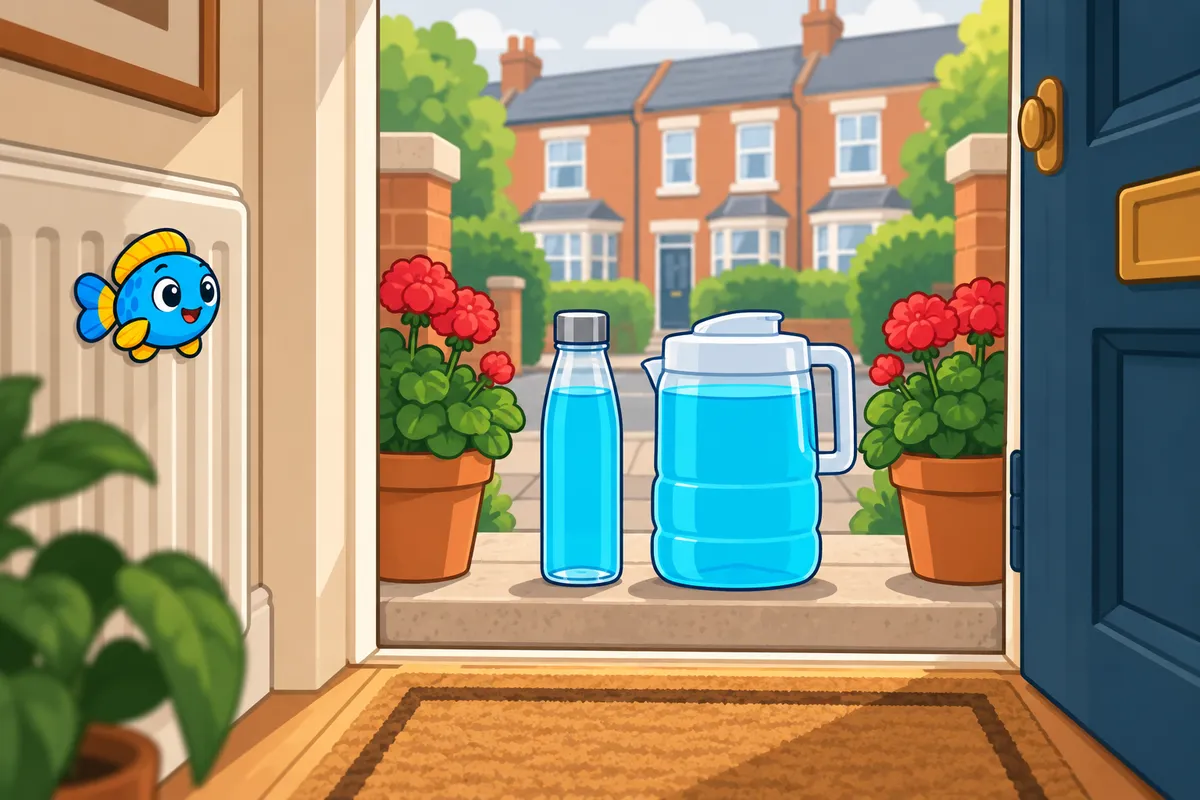
The UK (imperial) gallon is about 20 % bigger than the US gallon: 4.546 liters against 3.785. The pint is bigger by the same fifth, 568 ml in the UK and 473 ml in the US.
A British recipe that asks for a pint of water and an American video that tells you to drink a gallon a day are using different units with the same names, and the gap is big enough to change a recipe or a daily count.
Is a UK Gallon Bigger Than a US Gallon?
Yes, by about 20 %. The conversion table puts the imperial gallon, the one used in the UK and Canada, at 4.546 09 liters and the US gallon at 3.785 41 liters. The UK gallon holds about 761 ml more, a little over three US cups.
Both gallons split the same way, 4 quarts to the gallon and 2 pints to the quart. So every step below the gallon keeps the same 20 % gap.
| Unit | US liquid | Imperial (UK, Canada) | Imperial holds more by |
|---|---|---|---|
| Gallon | 3,785.4 ml | 4,546.1 ml | 760.7 ml |
| Quart | 946.4 ml | 1,136.5 ml | 190.2 ml |
| Pint | 473.2 ml | 568.3 ml | 95.1 ml |
| Gill (a quarter pint) | 118.3 ml | 142.1 ml | 23.8 ml |
The quart and pint rows divide each gallon by 4 and by 8. Divide any imperial figure by its US partner and you get 1.201 every time.
A 4 liter jug sits between the two: it is 1.06 US gallons and 0.88 imperial gallons.
Which Gallon Does Your Number Use?
The country the number came from decides it. A gallon or pint from a US label, recipe or app is the US unit; one from a British book, a British parent's recipe or an older Canadian cookbook is imperial. When a source prints liters or milliliters, no choice is needed.
Read the Gallon by Where It Came From
- A US jug, label, recipe or appUS gallon, 3.785 L
- A British recipe or older UK bookImperial gallon, 4.546 L
- An older Canadian cookbookImperial gallon, 4.546 L
- A label or recipe in liters or mlNo conversion needed
- You cannot tellFind an ml figure, or ask the source
Does Canada Use the Imperial Gallon?
Yes. Canada's Weights and Measures Act defines its gallon as the imperial one, at the same 4.546 09 liters. So a Canadian recipe that asks for a gallon or a pint means the larger, imperial size, while Canadian kitchens count in 250 ml cups.
Fuel is still sold by the imperial gallon in a handful of places, among them Antigua and Barbuda, Grenada and Saint Lucia, per Wikipedia's gallon entry.
How Many Liters Are in an Imperial Gallon?
4.546 liters, or 4,546 ml. In US units that is:
- 1.20 US gallons
- 4.8 US quarts
- 19.2 US cups
- 153.7 US fluid ounces
Going the other way, a US gallon is 0.833 of an imperial gallon. If a British friend asks how big your US gallon jug is, "five sixths of yours" is close enough.
Why Are US and UK Gallons Different?
Each one started from a different yardstick. The US gallon is legally 231 cubic inches, inherited from the old English wine gallon that Queen Anne's 1706 statute fixed; the US adopted it in 1836, according to the gallon entry on Wikipedia.
Britain went a different way. Before 1976 the imperial gallon was defined as the volume of 10 pounds of water at 62 °F, and it was later fixed at exactly 4.546 09 liters. The ounce differs too:
- An imperial pint holds 20 imperial fluid ounces where a US pint holds 16 US ounces.
- An imperial gill is 5 ounces against 4 in the US.
US gallon
- 231 cubic inches
- Old English wine gallon, fixed in 1706
- Adopted by the US in 1836
Imperial gallon
- 10 pounds of water at 62 °F
- Fixed at exactly 4.546 09 liters
- Used in the UK and Canada
The 10 Pound Gallon Still Checks Out
You can test the old definition with today's numbers. Water at 20 °C has a density of 0.99821 g per ml, so 4,546 ml weighs 4,538 g, or 10.00 lb. The US gallon of water at the same temperature weighs 8.33 lb.
Britain sized its gallon to hold ten pounds of water; the US sized its gallon to fill 231 cubic inches.
Is a UK Pint Bigger Than a US Pint?
Yes: a UK pint is 568 ml against 473 ml for a US pint, so the UK pint holds about 95 ml more, close to 20 %. In US cups the UK pint is 2.4 cups, where a US pint is exactly 2.
- 568 ml
- one UK (imperial) pint
- 473 ml
- one US pint
- 284 ml
- a UK half pint, 10 imperial fl oz
A pint glass of water poured in a UK pub is therefore a bigger drink than one poured in a US bar, if each fills its own country's pint to the line.
How Many Ounces Are in a UK Pint?
20 imperial fluid ounces. In US fluid ounces the same 568 ml is 19.2 oz, because the two countries' ounces differ too, by about 4 % in the other direction. For other amounts in UK or US ounces, the Water Unit Converter takes both kinds.
A Pint of Water Weighs a Pound, Almost
At 20 °C a US pint of water weighs 16.7 oz (472 g), just over one pound (16 oz). A UK pint weighs 20.0 oz (567 g), a pound and a quarter. The weight chart covers every size of water from a cup to a five-gallon jug.
Is a UK Mpg the Same as a US Mpg?
No. A mile per imperial gallon covers the same distance on 20 % more fuel, so the same car gets a bigger number in UK miles per gallon. Multiply a UK mpg figure by 0.833 for the US one: 40 UK mpg is 33.3 US mpg, and 30 US mpg is 36 UK mpg.
The conversion factor is the gallon ratio, 1.20095 imperial to US, so the gallon chart above also converts fuel economy.
| US mpg | UK (imperial) mpg |
|---|---|
| 20 mpg | 24.0 mpg |
| 30 mpg | 36.0 mpg |
| 40 mpg | 48.0 mpg |
| 50 mpg | 60.0 mpg |
How Many Gallons Is 1, 2 or 4 Liters of Water?
Divide the liters by 3.785 for US gallons or by 4.546 for imperial ones. A 4 liter jug is just over a US gallon and just under an imperial one.
| Liters | US gallons | Imperial gallons |
|---|---|---|
| 1 L | 0.26 | 0.22 |
| 2 L | 0.53 | 0.44 |
| 3 L | 0.79 | 0.66 |
| 4 L | 1.06 | 0.88 |
| 5 L | 1.32 | 1.10 |
A daily target in liters turns into the same fraction of a gallon whichever country you ask, but the fraction changes with the gallon: 3 liters is about four fifths of a US gallon and two thirds of an imperial one.
Where Mixing Up the Two Pints Goes Wrong
Each example converts with the exact sizes: 4,546.09 ml for the imperial gallon, 3,785.41 ml for the US gallon and 236.59 ml for a US cup.
Converting Between the Two Gallons
Multiply imperial gallons, quarts or pints by 1.2 to get US ones, and US amounts by 0.83 to get imperial ones. The 1.2 shortcut lands within 0.1 % of the exact ratio of 1.201, and 0.83 within 0.5 % of its inverse.
- 2 imperial pints is 2.4 US pints, or 4.8 US cups.
- 5 US gallons is 4.2 imperial gallons.
The US ladder itself, from the gallon down to the cup, has its own chart with every step in milliliters.
Write the Converted Pint on the Recipe Card
Settle which pint or gallon the number means by where it was written, then write the converted amount in milliliters on the card, so you only do it once.
General information for healthy adults, not medical advice. If a doctor has set your fluid amount, follow that.
More in Cups, Ounces and Liters
Sources
- NIST. NIST Guide to the SI, Appendix B.9: Factors for Units Listed by Kind of Quantity or Field of Science, 2026.
- Government of Canada, Justice Laws. Weights and Measures Act, Schedule II: Canadian Units of Measurement, 2026.
- Wikipedia. Gallon, 2026.
- NIST Chemistry WebBook. Thermophysical Properties of Fluid Systems: Water, isobaric data at 0.101325 MPa, 2026.
Sources checked by the Glubbo Editorial Team on Oct 19, 2026. General information, not medical advice. How we write and check our guides.

