Cups, Ounces and Liters · Conversions
How Many Milliliters Are in a Cup? 237, 240, 250 or 284 mL
A cup can mean 236.6, 240, 250 or 284 mL. The recipe or label tells you which number to use.
 By the Glubbo Editorial Team · Updated Oct 23, 2026 · 7 min read
On This Page
- How Many Milliliters Are in a US Cup?
- Why Is a Cup Sometimes 236 mL and Sometimes 240 mL?
- Is a Metric Cup 250 mL?
- How Many Milliliters Are in a UK Cup?
- How Do I Tell Which Cup a Recipe Means?
- Does 237 mL Versus 240 mL Matter?
- How Do You Convert Cups to Milliliters?
- How Should You Scale a Recipe Across Cup Systems?
- How Can You Check Whether Your Cup Is Accurate?
- Which Number Should You Use Today?
- Sources
Short answer
A US cup is 236.6 mL; food labels use 240 mL.
- US measuring cup: 236.588 mL, usually rounded to 237 mL.
- US Nutrition Facts cup: 240 mL; metric recipe cup: 250 mL.
- An old imperial cup is 284.1 mL, but modern UK recipes usually use mL or grams.

One US customary cup is 236.588 milliliters, normally rounded to 237 mL. A US food label uses 240 mL, a metric recipe cup uses 250 mL, and an old imperial cup is about 284 mL.
Those four answers describe four different conventions. The right number depends on where the cup appears.
How Many Milliliters Are in a US Cup?
A US measuring cup holds 236.588 mL. NIST's general table of units lists one measuring cup as exactly 8 US fluid ounces and about 237 mL.
For ordinary cooking, 237 mL is the closest whole-milliliter conversion. NIST's practical Metric Kitchen chart rounds the same cup to 240 mL because a difference of 3 mL is well under one US teaspoon.
| US cups | Exact milliliters | Kitchen rounding |
|---|---|---|
| 1/8 cup | 29.6 mL | 30 mL |
| 1/4 cup | 59.1 mL | 60 mL |
| 1/3 cup | 78.9 mL | 80 mL |
| 1/2 cup | 118.3 mL | 120 mL |
| 2/3 cup | 157.7 mL | 160 mL |
| 3/4 cup | 177.4 mL | 180 mL |
| 1 cup | 236.6 mL | 240 mL |
| 2 cups | 473.2 mL | 480 mL |
| 4 cups | 946.4 mL | 950 mL |
Use the exact column for a conversion calculation. Use the kitchen column when a recipe already rounds its spoons and cups to convenient metric amounts.
US Measuring Cup
- 236.588 mL exact
- 8 US fl oz
- Use for US cup recipes
US Label Cup
- 240 mL by FDA rule
- A labeling convention
- Use when reading Nutrition Facts
Why Is a Cup Sometimes 236 mL and Sometimes 240 mL?
The FDA defines a cup as 240 mL for nutrition labeling. The rule in 21 CFR 101.9 also defines a teaspoon as 5 mL, a tablespoon as 15 mL and a fluid ounce as 30 mL for the label.
That does not change the physical US cup. It gives packaged-food labels a clean metric partner for household measures. The difference is only 3.412 mL per cup:
240 mL - 236.588 mL = 3.412 mL
Even over four cups, the gap is 13.6 mL, slightly under one FDA tablespoon. A soup or glass of water will not reveal it. A tightly balanced baking formula may, so follow the recipe's own grams or milliliters when they are supplied.

Is a Metric Cup 250 mL?
Yes. A metric cup is 250 mL, so four metric cups make exactly one liter. Australia and New Zealand commonly use this cup in recipes, and modern Canadian recipe charts often do too.
The metric cup is 13.4 mL larger than a US customary cup, a difference of about 5.7%. That is small for one drink but grows across a batch.
If a cake calls for 4 cups, the US measure gives 946 mL while four metric cups give 1,000 mL. That 54 mL gap is more than 3 tablespoons. Do not silently switch cup systems in a baking recipe.
How Many Milliliters Are in a UK Cup?
An imperial cup is 284.1 mL, because it is half an imperial pint. It appears in old British and Commonwealth references, but it is rarely the working unit in a current UK recipe; modern recipes normally state milliliters and grams.
Do not assume every recipe hosted on a .co.uk site uses an imperial cup. If the page gives grams, milliliters or a conversion key, those printed units settle the question. If it simply says “cup,” check the author's location and whether the other measures look American.
NIST's historic metric study noted the need to distinguish a 250 mL metric cup from a 237 mL customary cup. That same rule helps with older British material: identify the convention before calculating.
How Do I Tell Which Cup a Recipe Means?
Use the recipe's country, neighboring units and own conversion notes. The word “cup” alone is not enough.
Identify the Cup Before You Pour
- Check where the recipe was written: US recipes usually mean 236.6 mL
- Look for a measurement note: 250 mL identifies a metric cup
- Prefer listed grams or milliliters when the recipe supplies them
- Convert the whole recipe with one convention, never cup by cup with mixed rules
Clues that point to a US recipe include Fahrenheit oven temperatures, sticks of butter and fluid ounces. Celsius temperatures with weights in grams usually point to a metric recipe, even if a cup appears in one line.
When the Recipe Gives Cups and Grams
Treat the printed grams as the stronger instruction because they identify the tested ingredient mass directly. Do not convert the cup again through a generic chart and replace the recipe author's figure. For liquids, the printed milliliters serve the same role.
For an unlabeled family recipe, measure one familiar ingredient against the original cook's cup if possible. Otherwise choose one convention, write it on the recipe and keep it consistent on every attempt.
Does 237 mL Versus 240 mL Matter?
Usually it does not matter for water, broth, rice cooking or a single cup of milk. The 3.4 mL difference is less than a teaspoon. It matters more when the error repeats or when flour and liquid must balance precisely.
| Recipe amount | US customary total | FDA/kitchen total | Difference |
|---|---|---|---|
| 1 cup | 236.6 mL | 240 mL | 3.4 mL |
| 2 cups | 473.2 mL | 480 mL | 6.8 mL |
| 4 cups | 946.4 mL | 960 mL | 13.6 mL |
| 8 cups | 1,892.7 mL | 1,920 mL | 27.3 mL |
At eight cups, the difference is almost one US fluid ounce. That can show up in dough or candy. It is still far smaller than replacing eight US cups with eight 250 mL metric cups, which adds 107 mL.
How Do You Convert Cups to Milliliters?
Multiply US cups by 236.588. To go back, divide milliliters by 236.588.
- US cups to mL:
cups × 236.588 - mL to US cups:
mL ÷ 236.588 - Metric cups to mL:
cups × 250 - Imperial cups to mL:
cups × 284.131
For example, 1.75 US cups × 236.588 = 414.0 mL. A 500 mL bottle contains 500 ÷ 236.588 = 2.11 US cups, or exactly 2 metric cups.
The Water Unit Converter handles live cup and milliliter amounts. For spoon-sized fractions, use the tablespoons and teaspoons chart instead of trying to read 30 mL at the bottom of a large jug.
How Should You Scale a Recipe Across Cup Systems?
Convert the original recipe to one metric amount first, then multiply that amount. This keeps every batch tied to the same cup definition and prevents a small difference from being repeated at each measuring step.
Suppose a US recipe needs 1 1/2 cups of milk. The exact volume is 1.5 × 236.588 = 354.9 mL; a double batch needs 709.8 mL, and a half batch needs 177.4 mL. Starting again with a 250 mL metric cup would produce 375 mL for the original batch, already 20.1 mL more than intended.
| Batch size | US recipe calculation | Milk to measure |
|---|---|---|
| Half batch | 0.75 × 236.588 mL | 177.4 mL |
| Original | 1.5 × 236.588 mL | 354.9 mL |
| Double | 3 × 236.588 mL | 709.8 mL |
| Triple | 4.5 × 236.588 mL | 1,064.6 mL |
For dry ingredients, use the recipe's stated grams instead of treating milliliters as grams. A 250 mL cup of flour and 250 mL of sugar occupy the same volume but do not have the same mass; the ingredient-weight chart keeps those conversions separate.
Convert all instances of the same unit together. If a recipe lists milk, water and oil in cups, write all three metric amounts before cooking so no later line silently returns to a different cup convention.
How Can You Check Whether Your Cup Is Accurate?
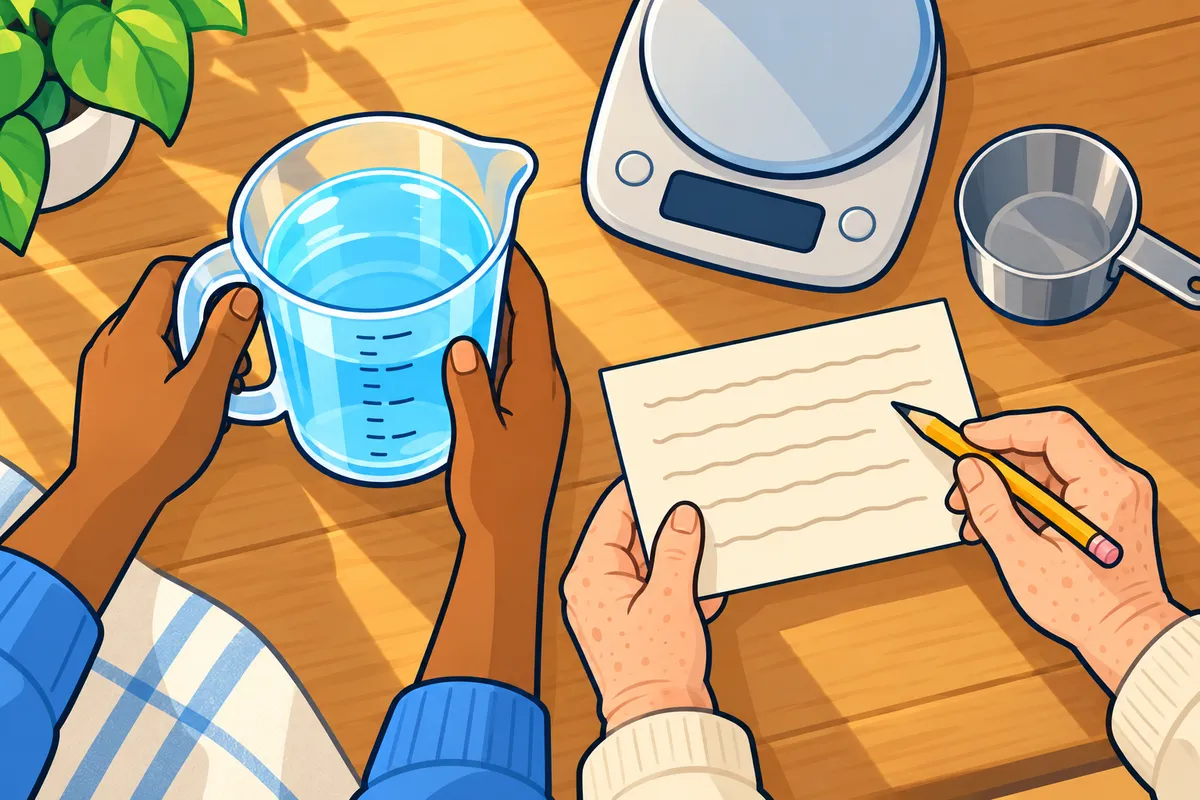
Test a cup with plain water and a kitchen scale:
- Put the empty cup on the scale, press tare, fill to the printed line on a level counter and compare the water weight with the intended milliliters; for ordinary kitchen work, one gram of water is approximately one milliliter.
- Repeat the test twice because the fill line is read by eye.
- If a US cup repeatedly holds close to 237 g of water, its mark matches the customary cup; a result near 250 g points to a metric cup.
A large, repeatable difference may mean the vessel is decorative, the scale needs checking or the line is being viewed from above instead of at eye level.
This calibration is useful for an inherited cup whose label has worn away. Mark the verified line or store a note with the tool, then keep using the same reference rather than correcting every recipe differently.
Which Number Should You Use Today?
Use 236.6 mL for a physical US cup. Use 240 mL for a US Nutrition Facts label, 250 mL for a named metric cup, and 284.1 mL only when an older source clearly means the imperial cup.
When accuracy matters, skip the cup argument and use the recipe's metric quantity. Measure liquids in milliliters and dry ingredients in grams with the correct tool; dry and liquid measuring cups need different filling techniques, even when their stated capacity is the same.
General information for healthy adults, not medical advice. If a doctor has set your fluid amount, follow that.

More in Cups, Ounces and Liters



Sources
- NIST. Appendix E: General Tables of Units of Measurement, 2026.
- NIST. Metric Kitchen: Cooking Measurement Equivalencies, 2026.
- US Food and Drug Administration. 21 CFR 101.9, Nutrition Labeling of Food, 2026.
- NIST. U.S. Metric Study Interim Report: The Consumer, 1971.
Sources checked by the Glubbo Editorial Team on Oct 23, 2026. General information, not medical advice. How we write and check our guides.

