Cups, Ounces and Liters · Measuring at Home
How Many Grams Are in a Cup of Flour? Ingredient Chart
Grams per cup depend on the ingredient and preparation. Use a named ingredient weight, never one universal conversion.
 By the Glubbo Editorial Team · Updated Nov 3, 2026 · 8 min read
On This Page
- How Many Grams Are in a Cup of Flour?
- Why Do Cup Weights Differ by Ingredient?
- How Many Grams Are in a Cup of Sugar?
- How Many Grams Are in a Cup of Rice?
- How Many Grams Are in a Cup of Butter?
- How Do You Convert Cups to Grams Accurately?
- How Many Cups Are in a Pound of Flour?
- Should You Trust a Universal Cups-to-Grams Converter?
- How Do You Measure a Cup When No Gram Weight Is Given?
- How Do Storage and Moisture Change a Cup Weight?
- How Do You Convert a Whole Recipe to Grams?
- Use Weight When the Recipe Depends on Ratios
- Sources
Short answer
One cup of enriched white flour is about 125 g.
- Rolled oats are about 81 g per cup; whole-wheat flour about 120 g.
- Granulated sugar is about 200 g per cup and US butter about 227 g per cup.
- Preparation matters: cooked rice and dry rice need separate entries.
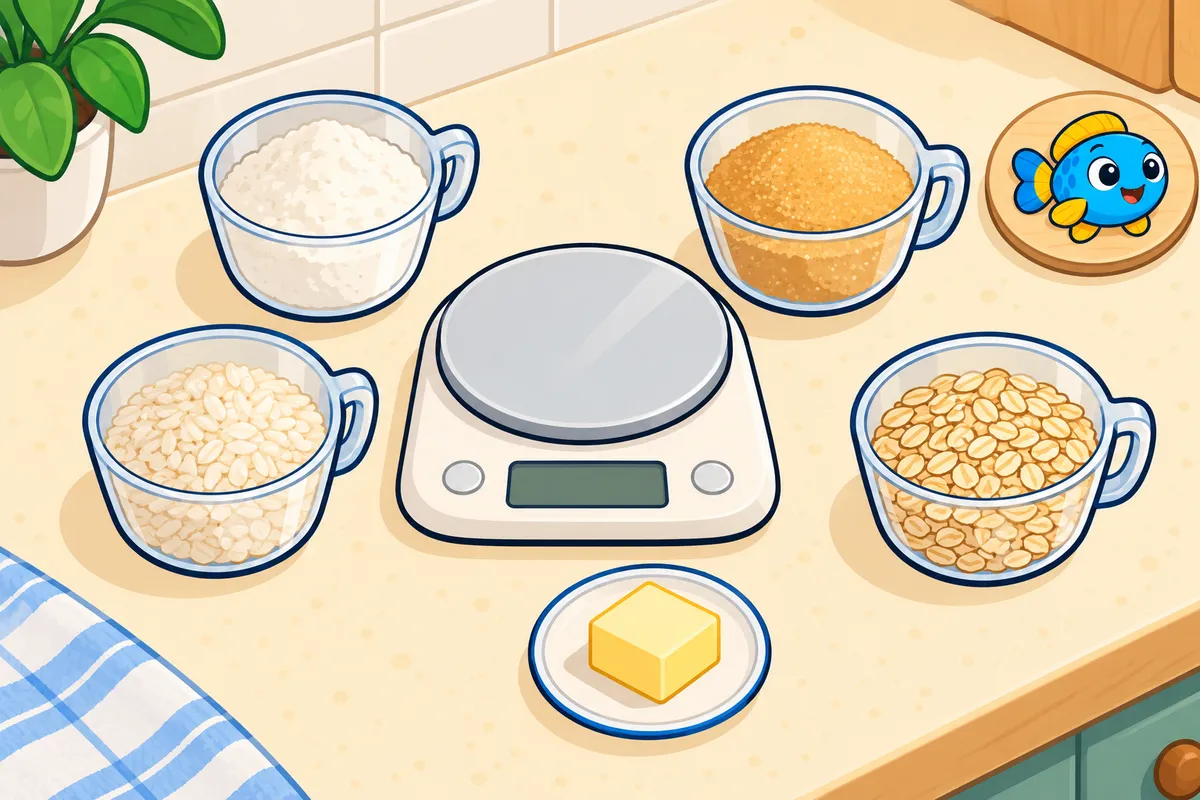
One cup does not have one gram weight. A cup of enriched white flour is about 125 g, granulated sugar about 200 g, uncooked long-grain rice about 185 g, rolled oats about 81 g, and butter about 227 g.
The ingredient, its preparation and how you fill the cup all change the result.
How Many Grams Are in a Cup of Flour?
The USDA Food Buying Guide uses 125 g per cup of enriched white flour and 120 g per cup of whole-wheat flour in its grain conversion table.
Those numbers assume a level cup, not flour packed into the vessel. Scooping the cup directly through a bag compresses flour and can add a meaningful amount. Spoon flour into the cup, let it mound, and sweep the top level without tapping.
| Ingredient and state | Approximate grams per US cup | How to measure |
|---|---|---|
| Enriched white flour | 125 g | Spoon in and level |
| Whole-wheat flour | 120 g | Spoon in and level |
| Rolled oats | 81 g | Fill loosely and level |
| Granulated sugar | 200 g | Scoop or pour, then level |
| Packed brown sugar | 220 g | Press firmly, then level |
| Uncooked long-grain white rice | 185 g | Fill dry and level |
| Cooked long-grain white rice | 158 g | Spoon without hard packing |
| Butter | 227 g | Two US sticks, or weigh |
| Plain yogurt | about 245 g | Spoon in, remove large air pockets |
The flour, whole-wheat flour and oat figures come from USDA's Food Buying Guide. The other values are practical household references drawn from USDA FoodData Central portion records and, for butter, the manufacturer's conversion table. Brand, moisture and handling can move a value, so a recipe's own gram figure wins.
Why Do Cup Weights Differ by Ingredient?
A cup measures volume; grams measure mass. Dense ingredients place more mass into the same space, while light or airy ingredients place less.
Air spaces matter too. A cup of oats contains many gaps, while butter fills nearly the entire cup. Grinding, chopping, sifting and cooking change how pieces fit together and how much water the ingredient holds.
How Many Grams Are in a Cup of Sugar?
One level US cup of granulated sugar is about 200 g. Packed brown sugar is heavier, commonly about 220 g, because pressing removes air gaps and holds more sugar in the same volume.
Powdered sugar is lighter and especially sensitive to sifting. Do not use the granulated-sugar number for confectioners' sugar, and do not convert “one cup sugar” until you know which sugar the recipe names.
Granulated Sugar
- About 200 g per cup
- Pour or scoop, then level
- Do not press it down
Packed Brown Sugar
- About 220 g per cup
- Press out large air gaps
- Should hold the cup shape
If a recipe supplies 400 g of granulated sugar, divide by 200 g per cup to get about 2 cups. That conversion applies only to that sugar and reference weight.
How Many Grams Are in a Cup of Rice?
A cup of uncooked long-grain white rice is about 185 g, while a cup of cooked rice is about 158 g. Cooked rice weighs less per cup because absorbed water swells the grains and increases the space between them.
The total pot becomes heavier after cooking, but each cup of the expanded rice contains fewer original dry grains. That is why “1 cup rice” must state dry or cooked.
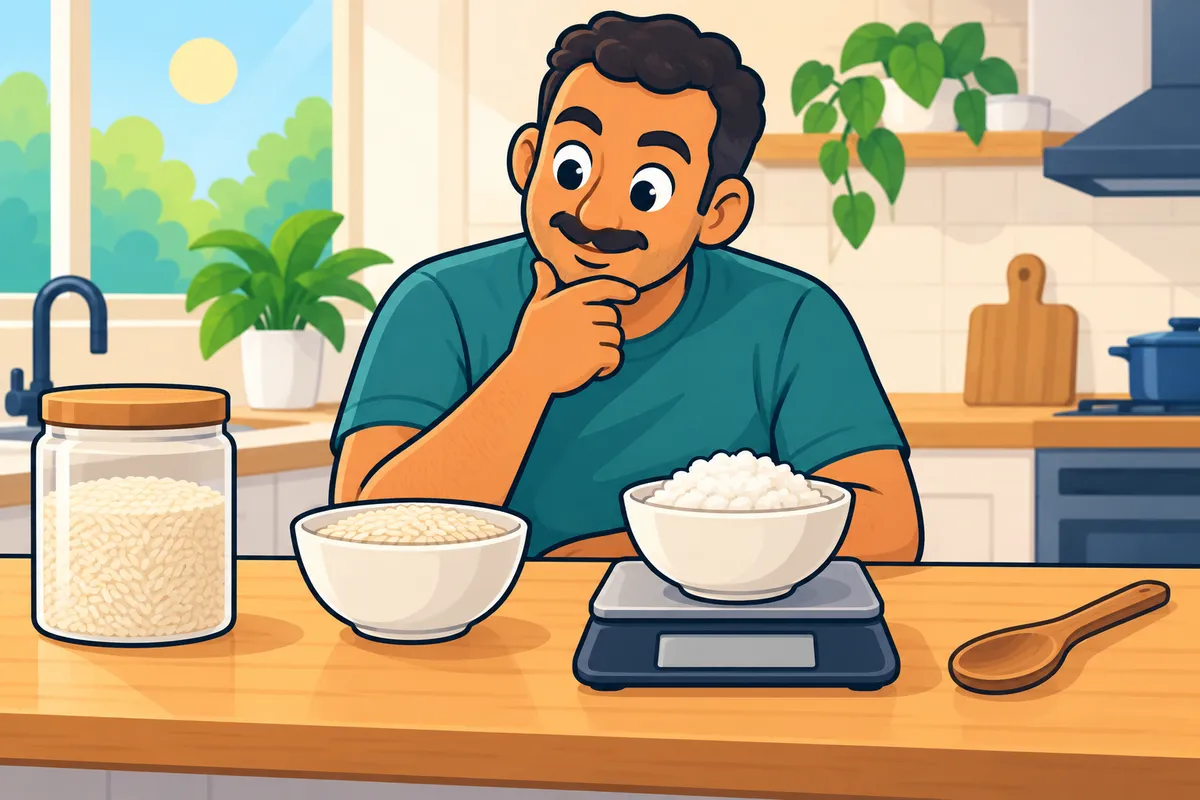
Short-grain, brown and wild rice have different shapes and packing. Use the package or recipe's tested yield when accuracy matters, especially for large batches. Record the dry weight before cooking if you need to repeat the same yield.
How Many Grams Are in a Cup of Butter?
One US cup of butter weighs 227 g, equal to two US sticks or 16 tablespoons. Land O'Lakes lists 1 cup as 227 g and 8 oz by weight.
Butter is one of the easiest ingredients to convert because a US stick is packaged in a fixed 1/2-cup amount. Use the wrapper marks for tablespoons or weigh the unwrapped butter. The separate butter-stick chart covers halves, thirds and quarters of a stick.
How Do You Convert Cups to Grams Accurately?
Multiply cups by the grams-per-cup value for the named ingredient and state. Divide grams by that value to convert back.
- Cups to grams:
cups × ingredient grams per cup - Grams to cups:
grams ÷ ingredient grams per cup - Pounds to grams:
pounds × 453.6
Keep full precision while multiplying, then round to the nearest gram for an ordinary kitchen scale. Do not round the grams-per-cup figure before a large batch unless the source already provides a whole number.
Scale the Weight, Not the Rounded Cup Result
For a double or half batch, adjust the gram amount directly. If one batch uses 312.5 g flour, a double batch uses 625 g. Converting 312.5 g back to a rounded cup figure and then doubling it introduces a second rounding error.
How Many Cups Are in a Pound of Flour?
At the USDA value of 125 g per cup, one 453.6 g pound of enriched white flour is about 3.63 cups:
453.6 g ÷ 125 g per cup = 3.63 cups
For whole-wheat flour at 120 g per cup, a pound is about 3.78 cups. A bag labeled 5 lb therefore contains roughly 18.1 cups of white flour or 18.9 cups of whole-wheat flour by these references.
These are planning estimates. Bag settling, flour type and filling technique can shift the cup count, which is why buying or scaling by weight is more repeatable.
Should You Trust a Universal Cups-to-Grams Converter?
Only if it asks for the ingredient and preparation. A converter that turns any cup into one gram number is treating volume as though every food had the density of one chosen substance.
Information a Reliable Conversion Needs
Exact ingredient
Flour is not sugar
- Name the grain, sugar or fat
- Do not use water density for food
Suits you if Required for every cups-to-grams conversion
Preparation state
Dry is not cooked
- State sifted, packed, chopped or cooked
- Moisture changes both mass and volume
Suits you if Required for rice, produce and powders
Recipe authority
Use its tested weight
- Prefer grams supplied by the recipe
- Weigh rather than reverse-engineer cups
Suits you if Best for baking and scaled production
USDA FoodData Central explains that its foods can include portion sizes such as one cup with gram weights, and that portions are specific to the food and data type. That is the right model: a table of named foods, not one factor for all foods.
How Do You Measure a Cup When No Gram Weight Is Given?
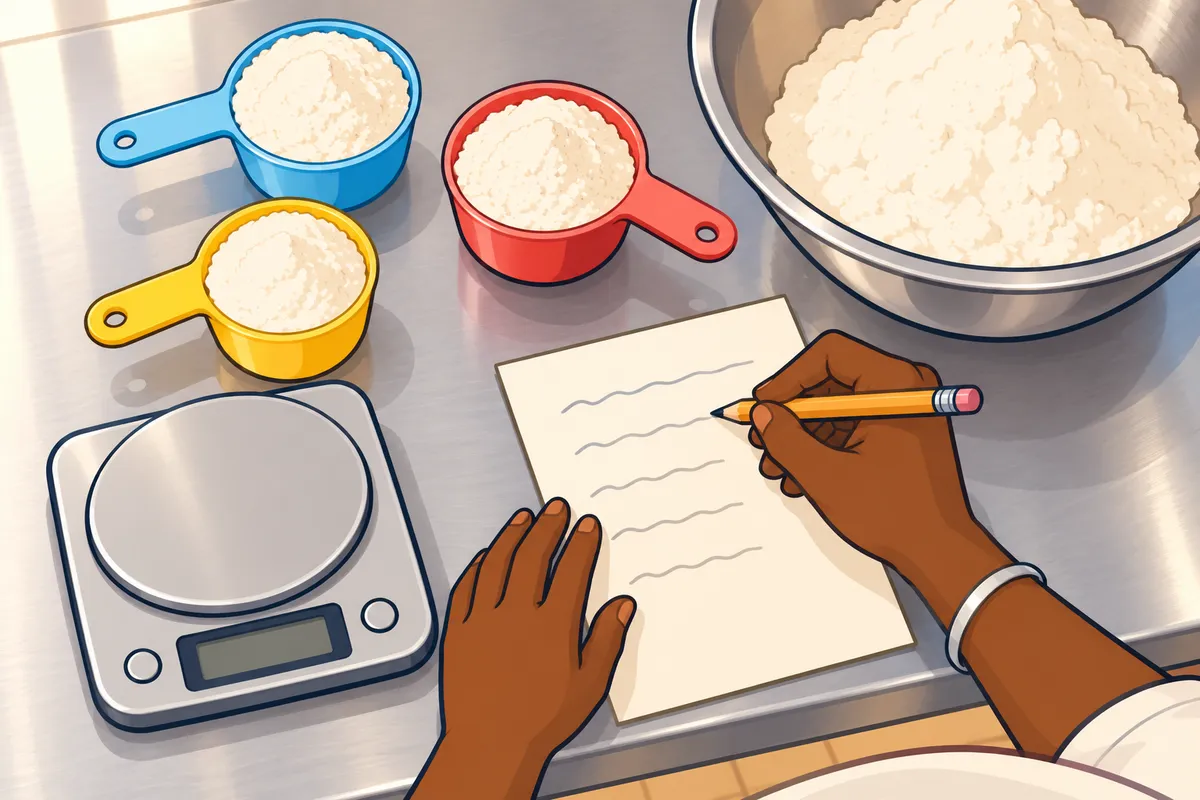
Use the cup method the ingredient calls for, then weigh your own result three times. Average the readings and write the value on the recipe.
NIST calls measuring ingredients "by mass (weight) using an appropriate kitchen scale" "a best practice to improve recipe accuracy", and says to "strike off excess dry ingredients when using a dry metric measuring cup". Spooning the flour in first is our advice, not NIST's. A three-measure average reduces the effect of one unusually loose or packed cup.
Build a Gram Reference for Your Ingredient
- Place an empty bowl on the scale and press tare
- Fill one cup exactly as the recipe describes
- Record the grams, empty the bowl and repeat twice
- Add the three weights and divide by three
That average belongs to your ingredient, tool and technique. It is more useful for repeating your family recipe than borrowing a generic number from a different product.
How Do Storage and Moisture Change a Cup Weight?
Settling changes how much dry food fits into a cup, while moisture changes the mass of the food itself:
- Flour transported in a bag can compact over time.
- Brown sugar can lose moisture and harden.
- Cooked grains continue to absorb or release water during storage.
When you fill the cup:
- Loosen flour before spooning it into a cup and use the preparation named by the recipe.
- Do not shake a cup to make more fit unless the instruction explicitly says to pack the ingredient.
- Level the top without pressing it down.
For a product you use often, compare a freshly opened package with the same cup method after storage. If the readings move enough to affect the recipe, keep using the recipe's gram target and let the scale compensate for settling instead of changing the cup line.
Moisture-sensitive foods also need the correct state in the table. “Cooked rice” after draining, “rice with cooking liquid” and “dry rice” describe three different materials, so one grams-per-cup value cannot serve all three.
How Do You Convert a Whole Recipe to Grams?
Convert each ingredient separately with its own reference weight, then scale the gram list. Do not total the recipe's cups and multiply by one average density.
Suppose a batter uses 2 cups of white flour, 1/2 cup granulated sugar and 1/2 cup butter. At 125 g, 200 g and 227 g per cup respectively, those amounts become 250 g flour, 100 g sugar and about 113.5 g butter. The combined ingredient mass is about 463.5 g, but each line reaches that total through a different factor.
| Ingredient | Cup amount | Reference | Gram amount |
|---|---|---|---|
| White flour | 2 cups | 125 g/cup | 250 g |
| Granulated sugar | 1/2 cup | 200 g/cup | 100 g |
| Butter | 1/2 cup | 227 g/cup | 113.5 g |
Keep that converted list with the recipe and test it before replacing the original. A published recipe's own gram values remain stronger evidence because the author may use a different flour method or product than the general reference table.
Use Weight When the Recipe Depends on Ratios
Use grams for bread, pastry, candy and any batch you plan to scale. Cups remain convenient for forgiving foods, but the conversion must always name the ingredient.
If you need to choose the right vessel before weighing, dry and liquid cups use different filling methods. For pure water, the separate water-weight guide can use the near 1 g-per-mL relationship that does not apply to these dry foods.
General information for healthy adults, not medical advice. If a doctor has set your fluid amount, follow that.

More in Cups, Ounces and Liters


Sources
- USDA Food and Nutrition Service. Food Buying Guide Grains Conversions, 2025.
- USDA FoodData Central. Foundation Foods Documentation, 2024.
- Land O'Lakes. Butter Conversion Calculator, 2026.
- NIST. Metric Kitchen: Culinary Measurement Tips, 2026.
Sources checked by the Glubbo Editorial Team on Nov 3, 2026. General information, not medical advice. How we write and check our guides.

