Cups, Ounces and Liters · Measuring at Home
How Big Is a Glass of Water? Official Sizes and How to Measure Yours
There is no standard glass. Here are the sizes official guidance counts, and a quick way to measure the one you use.
 By the Glubbo Editorial Team · Updated Oct 19, 2026 · 7 min read
On This Page
- How Big Is a Glass of Water?
- How Much Does a Typical Glass Hold?
- Is a Glass of Water the Same as a Cup?
- How Do You Measure How Much Your Glass Holds?
- How Much Water Is in a Mug?
- How Many Glasses of Water Make 2 Liters?
- How Many Glasses Are in a Water Bottle, a Liter or a Gallon?
- Tumblers, Juice Glasses and Ice in the Count
- Write Your Glass Size Where You Will See It
- Sources
Short answer
A glass has no fixed size; most hold 150 to 360 ml.
- The NHS counts a small glass as 150 ml; the 8x8 habit assumes 8 oz (237 ml).
- The FDA's reference amount for one drink of water is 12 fl oz (360 ml).
- Weigh your glass full on a kitchen scale: 1 g of water is about 1 ml.
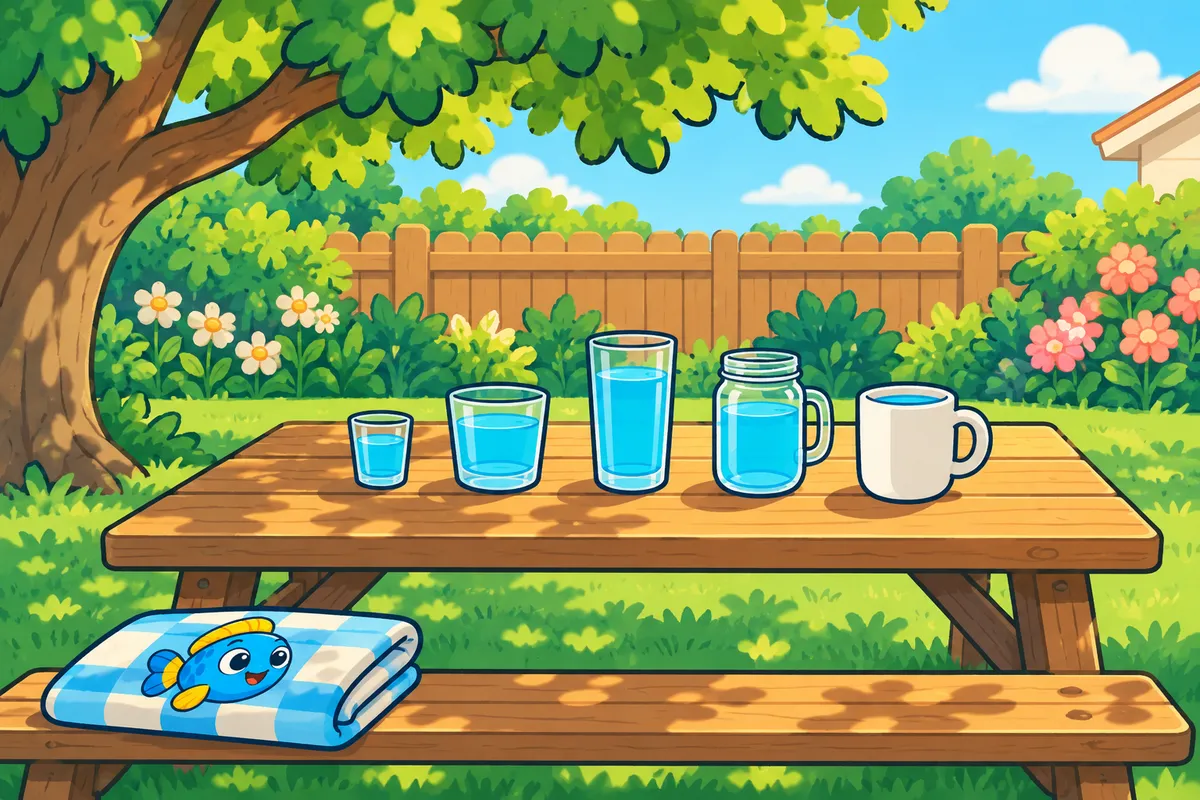
A glass of water has no fixed size: most glasses hold between 150 and 360 ml (5 to 12 fl oz), and the glass in your cupboard may sit anywhere in that range. "Eight glasses a day" and "a glass with every meal" mean very different amounts depending on which one you pick up.
The useful question is how big your own glass is. It takes a minute to find out, and then every glass you count means something.
How Big Is a Glass of Water?
Official guidance uses three sizes:
- The NHS counts juice by "one small glass (150ml)".
- The old eight-glasses habit pictures an 8 fl oz glass.
- US label rules set a larger reference amount for a drink of water.
That spread is wide. Eight small glasses come to 1.2 liters, and eight 360 ml (12 oz) glasses come to 2.88 liters, more than twice as much.
How Much Does a Typical Glass Hold?
None of the official sizes is a rule about glassware; each is a counting unit for a drink. Seen side by side, they show how far a "glass" can stretch.
The FDA figures come from the table of reference amounts "customarily consumed per eating occasion" in 21 CFR 101.12. It lists 12 fl oz (360 mL) for water and carbonated drinks, and 8 fl oz (240 mL) for juice and for milk. Alcohol is counted in its own unit, and a standard glass of wine is smaller than any of these.
The pint glass is there for contrast. Filled to the line, it holds a US pint of 473 ml, twice the 8 oz glass.
What the Eight-Glasses Habit Assumes
Eight 8 oz glasses make 64 fl oz, or 1.89 liters. Count eight glasses of 360 ml instead and you reach 2.88 liters. Whether eight glasses is enough depends a lot on which of those glasses you mean.
Is a Glass of Water the Same as a Cup?
No. A cup is a unit with a size, 8 fl oz in the US (236.6 ml); a glass is any glass you own. The NHS blurs the two on purpose, telling adults to drink "6 to 8 cups or glasses of fluid a day" without saying how big either is.
On a US label, FDA rules write a cup of milk as 240 mL, the rounded cup. So when a guide says "cups", you can count 237 ml each; when it says "glasses", measure your own first.
How Do You Measure How Much Your Glass Holds?
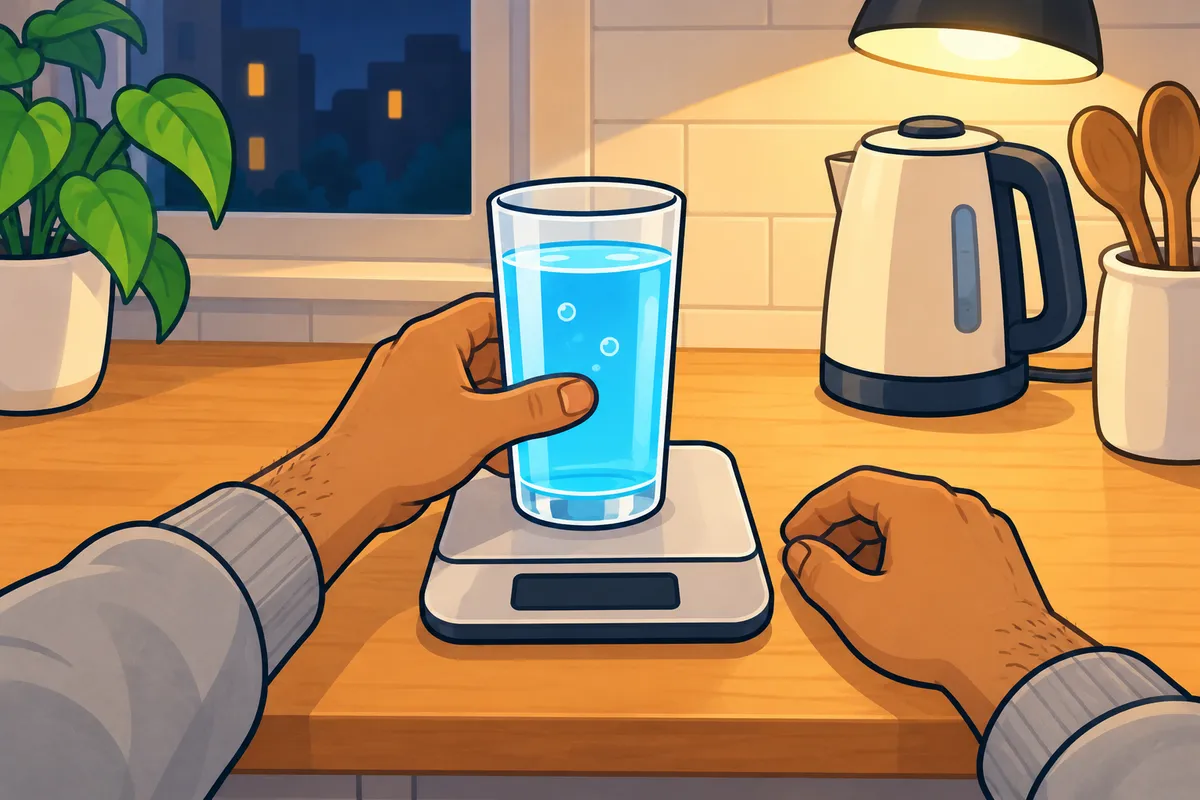
Weigh it. Set the empty glass on a kitchen scale, press zero, fill it to the level you usually drink, and read the grams. Each gram of water is about one milliliter, so 300 g on the scale means a 300 ml glass.
Measure Your Glass on a Kitchen Scale
- Put the empty glass on the scale and press zero
- Fill it to where you usually stop, not the brim
- Read the grams: that number is your milliliters
- Divide by 29.57 for US fluid ounces
The method works because water at room temperature has a density of 0.99821 g per ml at 20 °C. Reading grams as milliliters is off by under 0.2 %, less than a teaspoon in a large glass.
Without a Scale
Use something whose size you already know:
- Pour a sealed 500 ml (16.9 oz) bottle into the glass and count how many fills it gives.
- Fill the glass from a liquid measuring cup one cup at a time.
A bottle that fills your glass twice exactly means a 250 ml glass. Two and a half fills means 200 ml.
With Measuring Spoons
Fill your glass one US tablespoon at a time, 14.79 ml each, and count:
- An 8 oz glass takes 16 tablespoons.
- A 12 oz glass takes about 24.
- A 150 ml juice glass takes about 10.
It is slow but needs only a spoon, and the tablespoon chart shows how the counts line up with cup fractions.
Fill Line, Not Brim
Measure the glass the way you drink from it. You may stop a finger's width below the rim, or at half, so a "16 oz" glass filled to your usual line may hold well under 16 oz.
If you drink with ice, measure with the ice in. The scale then reads only the water you will actually drink.
How Much Water Is in a Mug?
A mug has no standard size either, so measure it like a glass. The FDA's reference amount for a flavored, sweetened coffee or tea drink is the same 12 fl oz (360 mL) it uses for water.
Mugs are rarely filled to the brim, and milk takes up room in the cup.
Measure the mug at the level you actually fill it, the same way as a glass.
How Many Glasses of Water Make 2 Liters?
It depends on the glass: 8.5 glasses of 8 oz, 13.3 small 150 ml glasses, or 5.6 glasses of 12 oz. Divide 2,000 ml by the milliliters your glass holds, then compare two daily amounts from the US National Academies.
The Academies' adequate intake for ages 19 to 30 includes about 2.2 L of fluids a day for women and 3.0 L for men, coffee, tea and milk included.
| Glass | 2 liters | 2.2 L (women 19–30) | 3.0 L (men 19–30) |
|---|---|---|---|
| 150 ml small glass | 13.3 | 14.7 | 20.0 |
| 237 ml (8 fl oz) | 8.5 | 9.3 | 12.7 |
| 250 ml | 8.0 | 8.8 | 12.0 |
| 360 ml (12 fl oz) | 5.6 | 6.1 | 8.3 |
| 473 ml (US pint) | 4.2 | 4.6 | 6.3 |
Those are benchmarks for healthy young adults, not a target set for you. The amounts by sex and age, in ounces and liters, are the place to find a number for your own day.
How Many Glasses Are in a Water Bottle, a Liter or a Gallon?
A 500 ml bottle (16.9 oz) is 2.1 glasses of 8 oz, 3.3 small glasses or 1.4 tall ones. The same sum works for any container once you know your glass in milliliters.
| Container | 150 ml glass | 237 ml (8 oz) glass | 360 ml (12 oz) glass |
|---|---|---|---|
| 500 ml bottle | 3.3 | 2.1 | 1.4 |
| 1 liter bottle | 6.7 | 4.2 | 2.8 |
| 1.5 liter bottle | 10.0 | 6.3 | 4.2 |
| 1 US gallon jug | 25.2 | 16.0 | 10.5 |
A bottle that is not a round number of glasses is a reason to track in milliliters or ounces: "half a bottle" is easier to log than "1.05 glasses".
Tumblers, Juice Glasses and Ice in the Count
The glass itself is rarely the problem. Counting it as if it were some other glass is.
| Mistake | What happens | Do this instead |
|---|---|---|
| Counting a 12 oz tumbler as an 8 oz glass | You drink 50 % more than you log | Log the tumbler as 1.5 glasses, or in ml |
| Counting a small 150 ml glass as 8 oz | You log 58 % more than you drink | Measure it once and log its real size |
| Logging an ice-filled glass as full | The water is only part of the glass | Measure with the ice in |
| Mixing a mug, a tumbler and a bottle in one count | "Six glasses" means nothing | Count in ml or oz all day |

Once you know your glass in ml, dividing by 237 gives you US cups, and a whole jug of water weighs out the same way on a larger scale.
Write Your Glass Size Where You Will See It
Put the glass you use most on the scale once, and write its milliliters on a strip of tape under the glass or on the cupboard door. From then on count your day in milliliters, glass by glass, and let the Water Unit Converter turn it into ounces or cups.
General information for healthy adults, not medical advice. If a doctor has set your fluid amount, follow that.
More in Cups, Ounces and Liters
Sources
- NHS. Water, drinks and hydration, 2023.
- US Food and Drug Administration (Code of Federal Regulations). 21 CFR 101.12, Reference Amounts Customarily Consumed per Eating Occasion, 2024.
- NIST. NIST Guide to the SI, Appendix B.9: Factors for Units Listed by Kind of Quantity or Field of Science, 2026.
- NIST Chemistry WebBook. Thermophysical Properties of Fluid Systems: Water, isobaric data at 0.101325 MPa, 15 to 40 °C, 2026.
- National Academies of Sciences. Dietary Reference Intakes for Water, Potassium, Sodium, Chloride, and Sulfate: Summary, 2005.
Sources checked by the Glubbo Editorial Team on Oct 19, 2026. General information, not medical advice. How we write and check our guides.

