How Much Water Does a Rabbit Drink a Day? Amounts by Weight
About 120 ml per kg a day, a chart for your rabbit's weight, and what changes the amount.
 By the Glubbo Editorial Team · Updated Oct 19, 2026 · 8 min read
On This Page
Short answer
About 120 ml of water per kg of body weight a day.
- A 2 kg (4.4 lb) rabbit drinks about 240 ml (8 oz) a day.
- That is about twice what a dog or cat of the same weight needs, says Merck.
- Rabbits drink significantly more from an open bowl than from a sipper bottle.
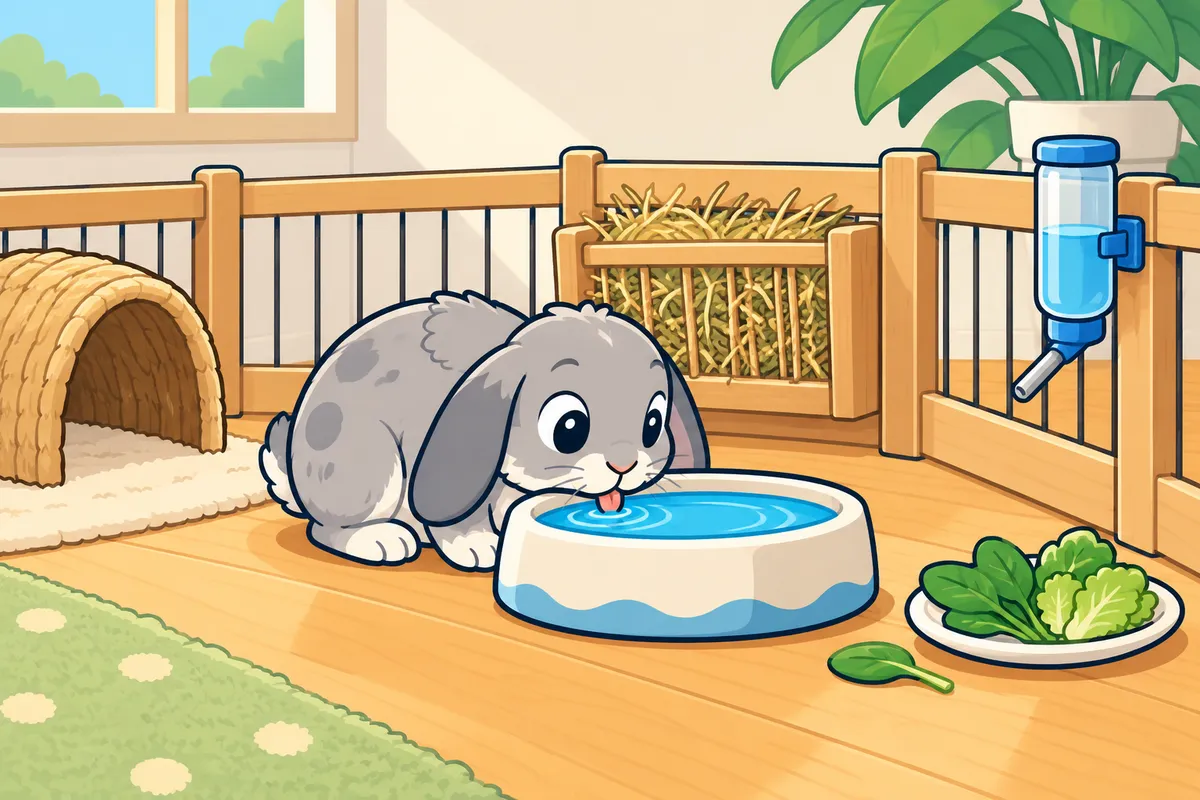
A healthy rabbit drinks about 120 ml of water per kg of body weight a day, so a 2 kg (4.4 lb) rabbit drinks about 240 ml. Owners are often surprised by how fast the bowl goes down: a rabbit that weighs less than a house cat can drink as much in a day, and that is normal.
General information for healthy adult rabbits, not veterinary advice. If your vet has given your rabbit a water plan, follow that.
How Much Water Should a Rabbit Drink a Day?
About 120 ml per kg of body weight a day. The Merck Veterinary Manual's rabbit nutrition chapter gives that rate from metabolic studies, so a 2 kg (4.4 lb) rabbit drinks about 240 ml, or 8 oz, in a day.
- 120 ml
- of water per kg of rabbit a day
- 2 ×
- the rate for a dog or cat of the same size
- 240 ml
- a day for a 2 kg (4.4 lb) rabbit
Water a Day by Your Rabbit's Weight
Weigh your rabbit on a kitchen scale, then find the nearest row. The figures are 120 ml per kg, rounded, with US fluid ounces beside them.
| Rabbit's weight | Water a day | About |
|---|---|---|
| 1 kg (2.2 lb), a dwarf breed | 120 ml | 4 oz, half a cup |
| 1.5 kg (3.3 lb) | 180 ml | 6 oz |
| 2 kg (4.4 lb) | 240 ml | 8 oz, one cup |
| 3 kg (6.6 lb) | 360 ml | 12 oz |
| 4 kg (8.8 lb) | 480 ml | 16 oz, two cups |
| 5 kg (11 lb) | 600 ml | 20 oz |
| 6 kg (13.2 lb), a giant breed | 720 ml | 24 oz, three cups |
Treat the row as a middle, not a target. Merck's table of laboratory animal data gives 300 to 700 ml a day for rabbits that reach 3 to 4 kg, measured on dry food in mild temperatures, so healthy rabbits spread wide around the 120 ml line.
Checking the Bowl Against Your Rabbit's Row
Why Do Rabbits Drink So Much Water?
Because a rabbit is small and its gut works hard. Merck says the rabbit's rate is "about twice the amount usually calculated for an equally sized dog or cat", and explains it by the rabbit's digestive tract and by metabolic scaling: smaller animals use more water for each kilogram of body.
A rabbit lives on fiber. Merck says a rabbit "should always have an unlimited supply of hay", because nibbling keeps the gut moving. Dry hay brings almost no water with it, so the bowl has to make up the difference.
A rabbit on mostly hay will drink more from its bowl than one that also eats plenty of fresh greens. Merck's laboratory table notes that intake varies with the moisture in the feed, and leafy greens are mostly water.
Bowl or Bottle for Your Rabbit?
A bowl, if you can. Merck states that a rabbit "will drink significantly more water from an open bowl than a sipper bottle." A bottle is still a fair backup where a bowl will not work, such as in a travel carrier.
The bowl has one downside. Merck's veterinary chapter on rabbit diseases says the skin fold under a doe's chin can get wet and sore when she drinks, and lists open water crocks among the causes.
It suggests open receptacles with small openings or raised off the ground, and says drinking valves generally prevent wet dewlaps. If your rabbit has a heavy dewlap, watch her chin after each drink and ask your vet before you swap a bowl for a bottle.
Heavy Bowl
- Rabbits drink significantly more from it
- Choose one heavy enough not to tip
- Wash it every day
Sipper Bottle
- Rabbits drink less from it
- Rabbits chew the valve: pick stainless steel
- Check it still flows every day
Merck's housing chapter warns that rabbits "often chew on the watering valve and may eventually destroy it unless it is made of stainless steel." Its owner pages add that heavy bowls work well indoors if you clean them daily.
Guinea pigs are the reverse case: they drink more from a bottle than from a bowl, so a home with both pets needs two different setups. A ferret sits in between: Merck says either works, but ferrets play with bowls and spill them, so a bottle is the usual pick.
Is My Rabbit Drinking Enough Water?
Measure one ordinary day and compare it with your rabbit's row in the table. A day within the wide healthy range, and a rabbit that eats, hops and leaves droppings as usual, is a rabbit drinking enough. A sudden drop in drinking along with a drop in eating is the pattern that needs a vet.
Measure one day at the bowl
- Pour a measured amount into the bowl in the morning
- Measure what is left 24 hours later
- Divide what went by your rabbit's weight in kg
- Write it down and repeat on another normal day
A spill or a tipped bowl ruins the count, so use your heaviest bowl for the measuring day. If two rabbits share a bowl, you will get the pair's total, which is still useful as a normal for the pair.
Not Eating Usually Means Not Drinking
Merck notes that a rabbit brought to the vet for not eating "is most often also dehydrated." A rabbit that stops eating can slide into a dangerous gut slowdown, so treat lost appetite as urgent, not as a fussy day.
The link runs both ways. Merck's chapter on noninfectious rabbit diseases says that "when food intake is decreased, water intake is also commonly decreased", so a half-full bowl at night and an untouched hay rack are one warning, not two. Cats show the same pairing: Cornell lists a poor appetite among the signs of a dehydrated cat.
Signs of illness in rabbits
10 items- Body temperature under 100.4°F (38°C) or over 105°F (40.6°C)
- Secretions from the nose or eyes
- Fur loss or red, swollen skin
- Dark red urine
- Loss of energy
- Loss of appetite and weight
- Drooling
- Diarrhea or no droppings for more than 12 hours
- Not hopping or moving normally
- Trouble breathing
What Does a Rabbit's Urine Say About Its Water?
Cloudy urine is normal in a rabbit, and it is one more reason the bowl matters. Rabbits pass calcium out through the kidneys at a far higher rate than other animals, Merck explains, as much as 60 % against 2 % to 5 % in other vertebrates, and that calcium makes the urine cloudy.
When too much calcium meets too little water, it can settle out as sludge or stones in the bladder. Merck lists inadequate water intake among the causes, along with a calcium-rich diet in an inactive rabbit.
| What you see | What Merck says | What to do |
|---|---|---|
| Cloudy, chalky urine | Normal: the calcium leaving through the kidneys | Nothing, except keep the bowl full |
| Thick, gritty sludge | Calcium settling out; low water intake is one cause | See your vet and ask about diet and water |
| Clear urine in a rabbit that seems unwell | Healthy rabbit urine is usually cloudy; clear urine is a key sign in ketosis | See your vet |
| Dark red urine | On Merck's list of signs of illness | Contact your vet right away |
Diet feeds into this. Merck's nutrition chapter limits pellets for an adult pet rabbit to ¼ cup per 5 lb of body weight a day, and its veterinary chapter on rabbit diseases notes that alfalfa, a main part of regular rabbit pellets, is high in calcium, while hay stays unlimited.
Mistakes That Leave a Rabbit Short
- Measuring on a day the bowl got tipped or shared, then treating the number as your rabbit's normal.
- Judging only the bowl: Merck says a rabbit that eats less drinks less too, so an untouched hay rack matters as much as the water level.
- A hutch or pen in full sun, with no shade over the water.
- A bowl of pellets topped up all day, which pushes calcium up and hay down.
- Reading a quiet rabbit that has stopped eating as a fussy day.
Water on Hot Days
Heat is a bigger danger to rabbits than to most pets: Merck says long exposure to temperatures above 80°F (27°C) can make them sick. For water, that means more bowls, in more shade, checked more often.
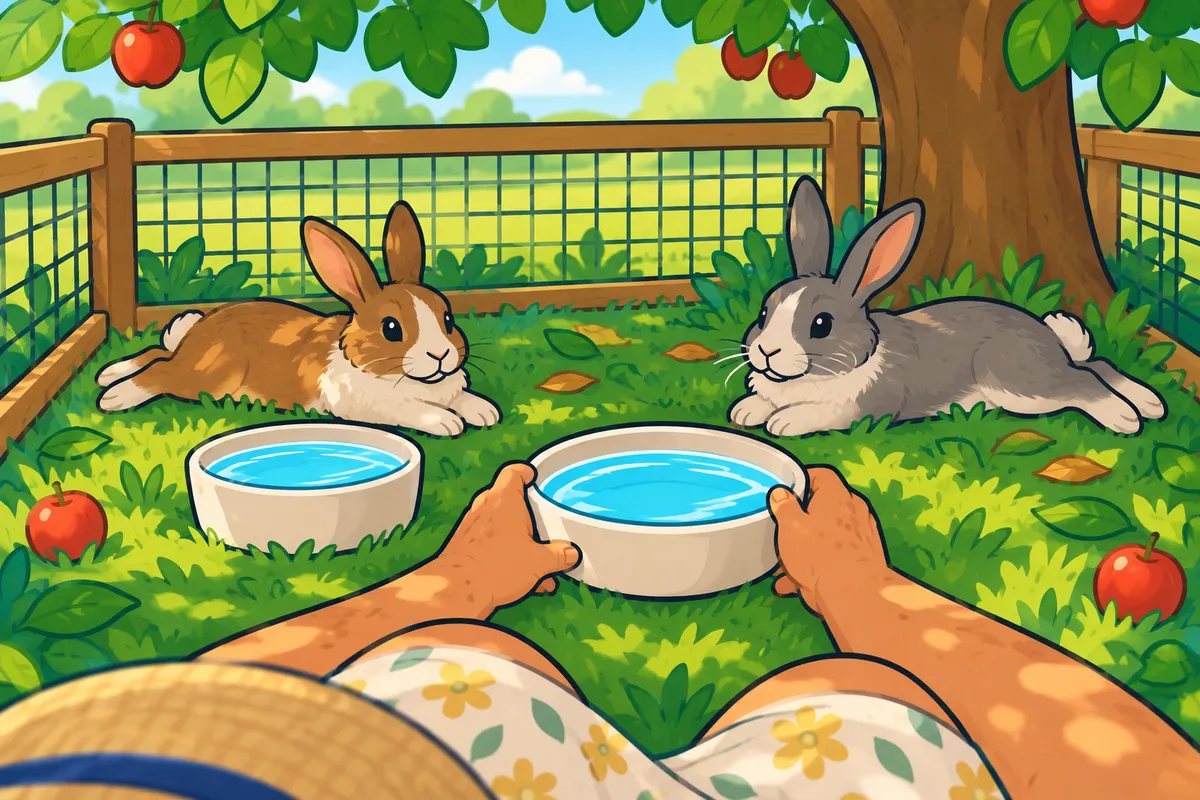
Rabbits do best at about 50 to 70°F (10 to 21°C), Merck says. On days well above that, check the bowls at noon as well as morning and evening, and get frozen bottles, chilled tiles and a cool room ready before the afternoon peak.
Set Up Your Rabbit's Water Today
Three water setups for three kinds of home
Indoor pen
One heavy bowl
- A heavy ceramic bowl that cannot tip
- Washed and refilled every day
Suits you if your rabbit lives in the house with a pen or a free-roam room.
Outdoor hutch in summer
Two bowls in shade
- Both bowls in the deepest shade
- Check them at noon on hot days
Suits you if your rabbit lives outside and the days go above 80°F (27°C).
Carrier or trip
Bottle as backup
- A stainless steel sipper tube
- Offer a bowl again at every stop
Suits you if a bowl would spill, such as in a car or at the vet.
Weigh your rabbit tonight, read its row in the table, and fill the bowl with more than that. Tomorrow morning, measure what is left and write the number down.
General information for healthy adults, not medical advice. If a doctor has set your fluid amount, follow that.

More in Pets


Sources
- Merck Veterinary Manual. Nutrition of Rabbits, 2024.
- Merck Veterinary Manual. Select Physiological Data for Laboratory Animals, 2026.
- Merck Veterinary Manual. Housing of Rabbits, 2024.
- Merck Veterinary Manual. Providing a Home for a Rabbit, 2026.
- Merck Veterinary Manual. Noninfectious Diseases of Rabbits, 2024.
- Merck Veterinary Manual. Signs of Illness in Rabbits, 2026.
Sources checked by the Glubbo Editorial Team on Oct 19, 2026. General information, not medical advice. How we write and check our guides.

