Signs of Dehydration in Dogs and How to Check Your Dog at Home
The nine signs the AKC's chief vet lists, the skin and gum checks, and the point where it becomes an emergency.
 By the Glubbo Editorial Team · Updated Oct 19, 2026 · 9 min read
On This Page
Short answer
Dry, sticky gums, slow skin, sunken eyes, low energy.
- Lift the skin between the shoulder blades: in a well dog it springs back at once.
- Press a gum: the white spot should turn pink again almost straight away.
- The AKC treats dehydration with vomiting or heat signs as an emergency.
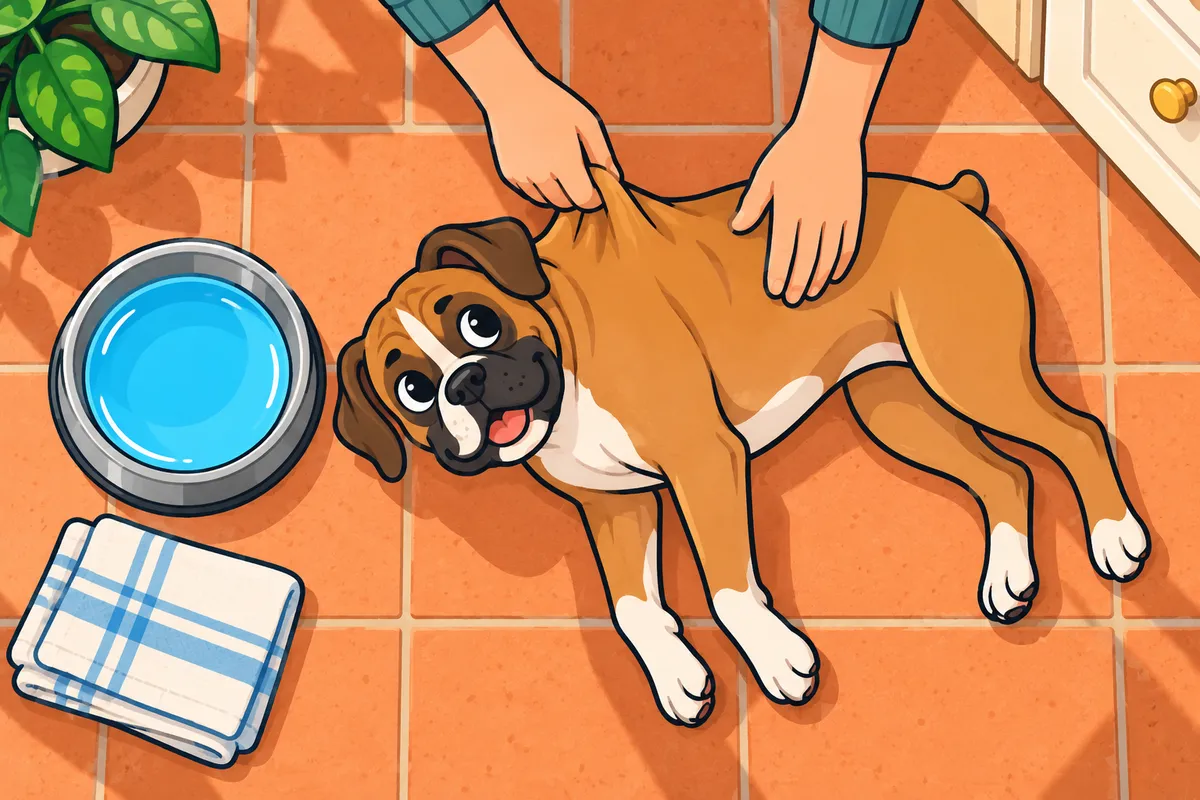
A dehydrated dog has dry, sticky gums, skin that is slow to spring back, sunken eyes and low energy. Two checks, the skin lift and the gum touch, take under a minute, and while neither replaces a vet, both tell you how fast you need one.
The first signs are quiet ones. The dog skips half its breakfast, lies on the cool floor instead of meeting you at the door, and its gums feel tacky when you lift its lip. Breeds differ, so your own dog on a good day is the yardstick.
General information for adult dogs, not veterinary advice. A dog that seems unwell needs a vet, not a home test.
How Can You Tell if a Dog Is Dehydrated?
Check the skin and the gums, then look at the whole dog. The American Kennel Club says skin that is slow to settle and dry, sticky gums are the two signs you can test with your hands; low energy, panting and sunken eyes back them up.
Two checks in under a minute
- Lift a fold of skin between the shoulder blades and let go
- Watch it: it should spring straight back
- Touch the gums: they should feel wet and slippery
- Press a gum until it whitens, then watch it turn pink
Do both checks on a calm, ordinary day first. The AKC asks you to learn your own dog's baseline, because breeds differ and a reading means little without one.
The Signs the AKC's Chief Vet Lists
Dr. Jerry Klein, the AKC's chief veterinarian, gives nine signs. No single one proves dehydration, and a panting dog after a run may be only hot, but two or three together deserve your attention.
The nine signs on the AKC list
9 items- Loss of skin elasticity
- Loss of appetite
- Vomiting (with or without diarrhea)
- Reduced energy levels and lethargy
- Panting
- Sunken, dry-looking eyes
- Dry nose
- Dry, sticky gums
- Thick saliva
Is a Dry Nose a Sign of Dehydration?
It can be one, but not on its own. The AKC lists a dry nose as one of nine signs, so treat it as a reason to do the skin and gum checks, not as proof. A dry nose with wet gums and skin that springs back points away from dehydration; a dry nose with sticky gums and low energy points toward it.
How Do You Do a Skin Tent Test on a Dog?
Gently lift the loose skin near the shoulder blades, let go, and watch how it settles. The AKC says that in a well-hydrated dog the skin springs back instantly; in a dehydrated dog it takes longer, and in a severe case it can stay up like a little tent.
Use the same spot every time. The skin over the neck and shoulders is loose on most dogs, so the change is easiest to see there.
Dogs Whose Skin Misleads
Some dogs fail the test while well hydrated, and some pass it while dry. The vets who wrote the Merck Veterinary Manual's fluid chapter name the traps, and the AKC adds one more.
| Dog | Why the skin test misleads | What to check instead |
|---|---|---|
| Wrinkly breeds (Bulldogs, Neapolitan Mastiffs) | AKC: their skin may be less elastic even when well | The gums, and your dog's own baseline |
| Old or very thin dogs | Merck: lost fat and skin collagen give poor skin and sunken eyes despite normal hydration | The gums, appetite and the water bowl |
| Puppies | Merck: very young animals may have extra skin elasticity | Call your vet early; puppies are a higher-risk group |
| A nauseated dog | Merck: drooling can make the gums look wetter than they are | The skin and how the dog acts |
What a Study of Working Dogs Found
A 2019 study in the American Journal of Veterinary Research tested both home checks on fit working dogs before and after exercise. Skin tent time rose after 15 minutes of exercise, and capillary refill time did not change in a useful way.
- 9
- exercise-conditioned working dogs
- 15 min
- of exercise in each session
- 0.83 %
- average body weight lost
The dogs lost 0.83 % of their weight on average, a small loss that was not statistically significant by itself, yet skin tent time rose significantly. The authors judged capillary refill no use for spotting small shifts. Nine dogs is a small sample, so treat the result as a strong hint rather than a rule.
What Do Dehydrated Dog Gums Look Like?
Healthy gums are pink, wet and slippery under your finger. A dehydrated dog's gums feel dry or sticky, and the AKC adds that its saliva turns thick instead of thin and watery.
The press test is called capillary refill. Push a fingertip on the gum above a canine tooth until it turns white, lift it, and watch how long the pink takes to come back. A slower return than your dog's usual is the sign.
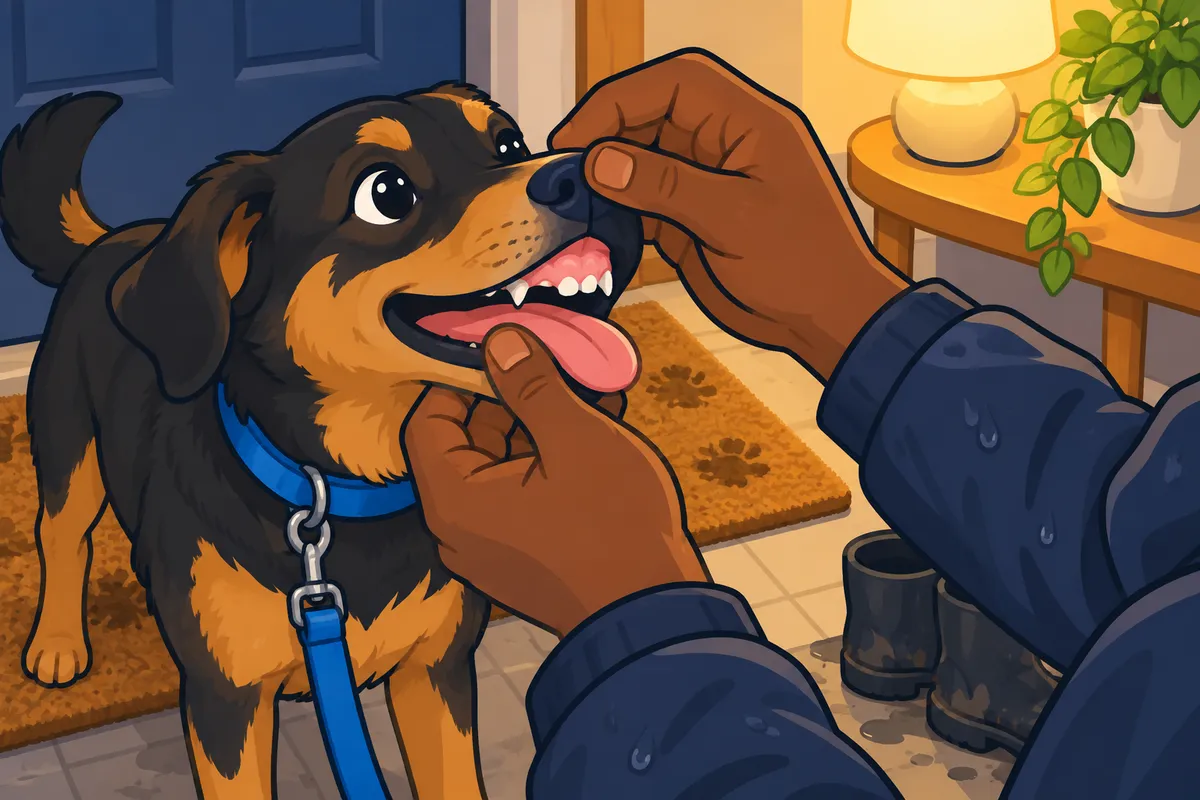
Trust the feel of the gums more than the refill count. The working-dog study above found refill time a poor guide to small losses, and the AKC lists dry, sticky gums as a sign on their own.
How Vets Grade Dehydration
Vets estimate dehydration as a percentage of body weight lost as water, from what they see and feel. Merck's fluid chapter sets out four steps and admits that the estimate "is always, to some extent, subjective".
| Estimate | What the vet finds (Merck) |
|---|---|
| 4 to 5 % | Semidry gums, normal skin, eyes still moist |
| 6 to 7 % | Dry gums, mild loss of skin elasticity, eyes still moist |
| 8 to 10 % | Dry gums, clear loss of skin elasticity, sunken eyes, acute weight loss, weak rapid pulse |
| 12 % or more | Very dry gums, no skin elasticity left, deeply sunken dull eyes, weak thready pulse, possible altered consciousness |
Merck's scale starts at 4 to 5 %, where the skin is still normal and only the gums feel semidry, so a dog can be short of water before the skin test shows it. That is why you watch the bowl and the dog's energy, not only the skin.
How Much Water Is Missing at Each Stage
Merck works out the missing water as body weight in kg times the percentage. Its own example is a 12 kg dog at 8 %, which has lost 0.96 liters (12 × 0.08), close to a full liter bottle. The table applies the same arithmetic to four sizes of dog, beside a healthy day's drinking at Cornell's 40 to 60 ml per kg.
| Dog | Healthy day | Missing at 5 % | Missing at 8 % | Missing at 12 % |
|---|---|---|---|---|
| 4 kg (8.8 lb) | 5 to 8 oz (160 to 240 ml) | 7 oz (200 ml) | 11 oz (320 ml) | 16 oz (480 ml) |
| 12 kg (26 lb) | 16 to 24 oz (480 to 720 ml) | 20 oz (600 ml) | 32 oz (960 ml) | 49 oz (1,440 ml) |
| 25 kg (55 lb) | 34 to 51 oz (1.0 to 1.5 L) | 42 oz (1.25 L) | 68 oz (2.0 L) | 101 oz (3.0 L) |
| 40 kg (88 lb) | 54 to 81 oz (1.6 to 2.4 L) | 68 oz (2.0 L) | 108 oz (3.2 L) | 162 oz (4.8 L) |
Read across a row: at 8 % a 25 kg dog is missing more than a whole day of drinking. The healthy-day range comes from Cornell's Riney Canine Health Center. The arithmetic is for understanding only; your vet decides how much fluid a dehydrated dog gets and how.
How Much Should a Healthy Dog Drink?
About 40 to 60 ml per kg of body weight a day, says Cornell, and more than 100 ml per kg counts as excessive drinking that needs a vet. The AKC gives a rougher rule: at least one ounce of water a day for each pound of body weight, adjusted by your vet for age, weight and health. A dog that drinks far below its own usual amount is a reason to run the two checks.
What Causes Dehydration in Dogs?
Mostly too little water going in. The AKC calls lack of water intake the primary cause, whether the bowl ran dry or the dog would not drink. Other causes add to the list:
- Vomiting and diarrhea
- Heatstroke and fever
- Illnesses such as kidney disease, diabetes or some cancers
Dogs that pant hard during exercise lose water faster, more so on hot days. A dog that eats less also drinks less of its water from food, so a lost appetite and a dry dog often go together.
Dogs More at Risk
The AKC names four groups that dry out faster or show it later:
- Puppies
- Senior dogs
- Nursing mothers
- Toy breeds
For a dog in one of these groups, act on one or two signs sooner than you would for a fit adult.
Beach Days
A thirsty dog laps seawater. Cornell's vets ask you to do three things:
- Give your dog plenty of fresh water before the beach, so it is less likely to drink the sea out of thirst.
- Keep fresh water on hand through the day.
- Take frequent half-hour breaks from the water.
Too much salt water shows as muscle tremors, disorientation and seizures, which Cornell calls potentially life-threatening.
When Is a Dehydrated Dog an Emergency?
Any time the signs are there, the AKC's advice is to go to the vet straight away. It calls dehydration with persistent vomiting, or with suspected heatstroke, a medical emergency. Do not wait to see whether a dry, flat, panting dog picks up after a drink.
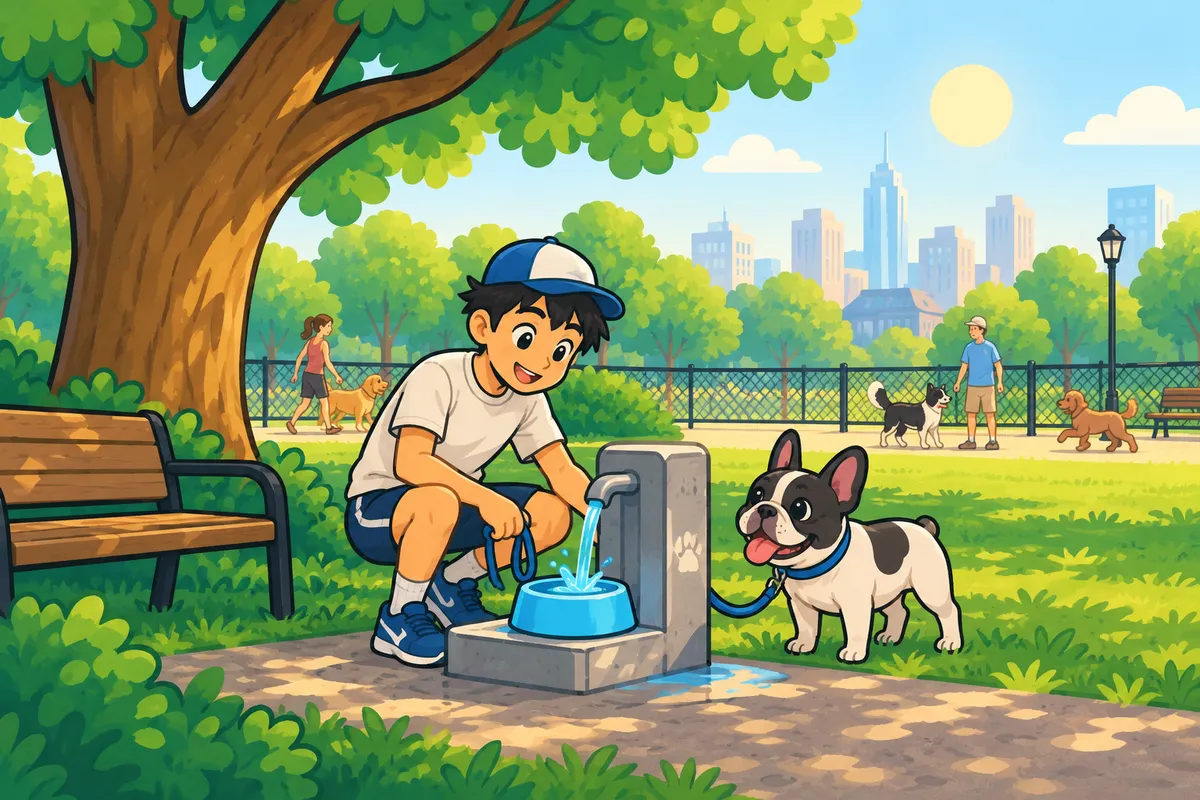
On the way, offer fresh, cool water, as the AKC suggests, and let the dog drink at its own pace. The AKC adds that an electrolyte drink such as Pedialyte can help a dog that is not vomiting, but ask your vet about the amount first instead of guessing.
What the Vet Does
The vet replaces the lost water with fluid under the skin or into a vein, the AKC says, and then looks for the reason. That can mean blood work, X-rays or other tests, because a dog that keeps drying out for no clear cause often has an illness behind it.
Measure Your Dog's Normal Before the Next Hot Walk
Pick a quiet evening and do both checks while your dog is well. Time how long the shoulder skin takes to settle, note how the gums feel and how fast a pressed spot turns pink, and write it on the card where you keep the vet's number.
Then fill the bowl to a marked line in the morning and measure what is left at bedtime. The pet water calculator turns one measured day into ml per kg and shows it beside your dog's healthy range. A dog you have checked on a good day is a dog you can read quickly on a bad one.
General information for healthy adults, not medical advice. If a doctor has set your fluid amount, follow that.

More in Pets



Sources
- American Kennel Club. Dehydration in Dogs: What to Know, 2026.
- Merck Veterinary Manual. The Fluid Resuscitation Plan in Animals, 2025.
- American Journal of Veterinary Research (Goucher, Hartzell, Seales, Anmuth, Zanghi and Otto), record in FAO AGRIS. Evaluation of skin turgor and capillary refill time as predictors of dehydration in exercising dogs, 2019.
- Cornell Richard P. Riney Canine Health Center. Canine Polyuria and Polydipsia (PU/PD), 2024.
- Cornell University College of Veterinary Medicine. Summer safety tips, 2026.
Sources checked by the Glubbo Editorial Team on Oct 19, 2026. General information, not medical advice. How we write and check our guides.

