Signs of Dehydration in Cats and the Two Checks You Can Do at Home
What Cornell's cat vets list as the signs, how to check the skin and gums, and when it cannot wait.
 By the Glubbo Editorial Team · Updated Oct 19, 2026 · 9 min read
On This Page
- How Can You Tell if a Cat Is Dehydrated?
- How Do You Do a Skin Tent Test on a Cat?
- How Do You Check a Cat's Gums?
- What Causes Dehydration in Cats?
- When Should You Call the Vet About a Dehydrated Cat?
- Can You Treat a Dehydrated Cat at Home?
- How Much Water Does a Cat's Food Bring?
- What to Do Next, by What You See
- Sources
Short answer
Lethargy, poor appetite, dry gums and sunken eyes.
- Lift the skin over the shoulders: in a well cat it snaps back almost at once.
- Touch the gums: dry or tacky gums are a warning sign.
- Cornell says to contact a vet promptly if you think your cat is dehydrated.
Cats hide illness well, and a dehydrated cat often just looks a little quiet. The signs are small: a cat that skips breakfast, gums that feel sticky under your finger, skin that is slow to settle after you lift it.
General information for adult cats, not veterinary advice. A cat that seems unwell needs a vet, not a home test.
How Can You Tell if a Cat Is Dehydrated?
Look for lethargy, weakness, a poor appetite and dry gums. The Cornell Feline Health Center lists these four, and adds that in more severe cases the eyes can look sunken. Two quick checks at home, the skin and the gums, back up what you see.
Signs Cornell lists in a dehydrated cat
5 items- Lethargy
- Weakness
- Poor appetite
- Dry mucous membranes
- Eyes "sunken into their sockets" (more severe cases)
Mucous membranes are the moist linings you can see, and the gums are the easiest to reach. No single sign proves dehydration. Two or more of them together, in a cat that is not its usual self, is the moment to call your vet.
Litter Box and Water Bowl Changes
The litter box often shows it first. Hill's lists these signs:
- Fewer urine clumps, or fewer trips to the box.
- Hiding.
- A change in how much the cat drinks.
PetMD adds panting and a cat that shows no interest in water at all.
Scoop at the same time each day for a few days and count the clumps, so you know what a normal day looks like for your cat. A drop in that count is easier to spot against your own numbers than against a general rule.
Thirst Can Go Either Way
A dehydrated cat does not always drink more. Some cats with kidney disease or diabetes drink a lot and still lose water, while a cat with a sore mouth may drink less than it needs, so the bowl alone can mislead you.
How Do You Do a Skin Tent Test on a Cat?
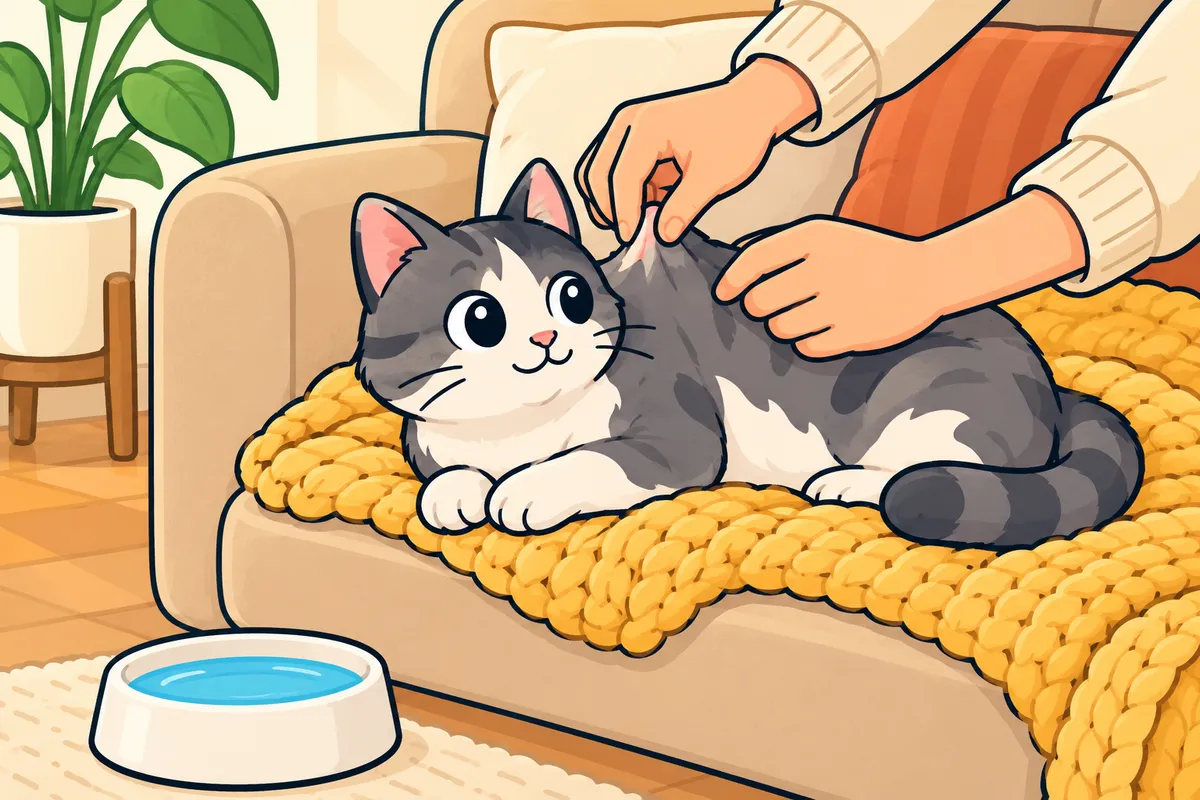
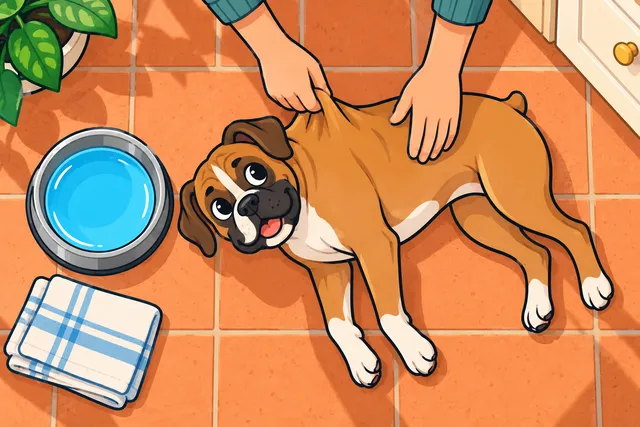
Gently lift a fold of loose skin over the shoulders and let it go. In a well-hydrated cat it snaps back "almost immediately", says Cornell. In a dehydrated cat it takes much longer to settle and may stay "tented", standing up like a little ridge.
The skin tent check in four moves
- Let your cat settle on a lap, a towel or the sofa
- Pinch up the loose skin over the shoulder blades
- Let go and watch how fast it flattens
- Try it on a healthy day to learn your cat's normal
Never pull hard, and stop if your cat tenses or tries to leave. Cornell gives no stopwatch time; Hill's treats a delay of more than two to three seconds as a possible sign. Count "one-one-thousand, two-one-thousand" and you have the same yardstick.
Why Older Cats Fool the Skin Test
Cornell warns that geriatric cats "may show decreased skin turgor even when they are normally hydrated." Skin loses its stretch with age, so a 16-year-old cat can fail the skin tent check on a perfectly good day. Hill's says the same of cats that have recently lost weight, and PetMD says the test works only in young, healthy animals with elastic skin.
For an older cat, lean on the other signs: appetite, energy and the gums. A slow skin tent on its own in a senior cat tells you little; a slow skin tent plus a cat that has stopped eating tells you a lot.
How Do You Check a Cat's Gums?
Lift the side of your cat's upper lip with one finger and touch the gum above the teeth. Healthy gums feel moist and slick. PetMD's test is the opposite case: gums that are dry to the touch and a little tacky mean a cat is most likely dehydrated.
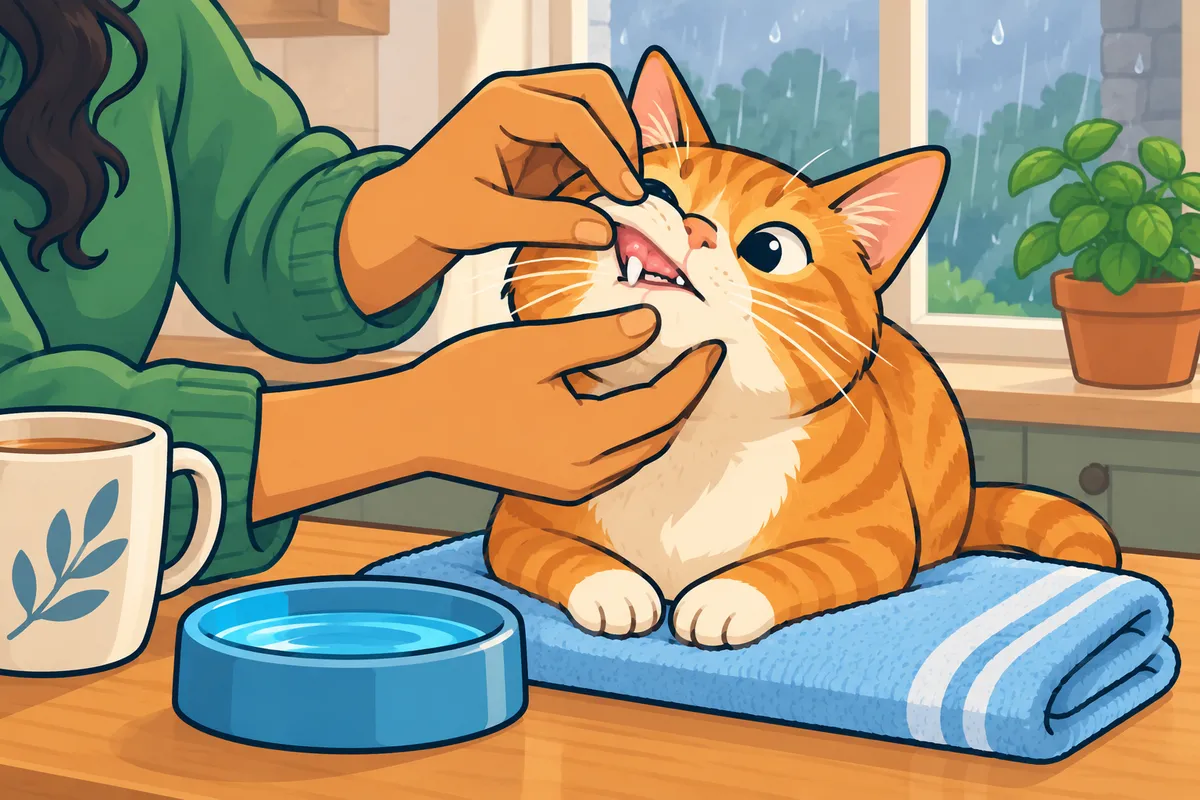
Practice both checks on a calm day. A cat that already knows the lift of a lip and the pinch of skin lets you check it quickly on the day it matters.
What Causes Dehydration in Cats?
A cat dries out when it loses water faster than it takes it in, or when it stops drinking and eating. Cornell sorts the causes into those two groups.
Losing more water comes mostly from illness: chronic kidney disease, diabetes, vomiting, diarrhea, an overactive thyroid, and some medicines such as the diuretics used for heart disease. Taking in less comes from weakness, a low appetite, painful teeth, no access to water and conflict with other pets in the house.
That last cause is easy to miss. A cat that is bullied away from the only bowl in a busy kitchen can go short every day without anyone noticing. PetMD also lists fever, injury, hot weather and dry air among the causes, and Hill's names inflammatory bowel disease and stale water.
What to Do About Each Cause
Each cause points to something you can watch for at home. The table pairs them up.
| Situation | Why water runs short | What you can do |
|---|---|---|
| Vomiting or diarrhea | The cat loses water faster than it drinks | Call your vet, especially if the cat is also quiet or off its food |
| Kidney disease, diabetes or an overactive thyroid | The illness makes the body lose more water | Keep up checkups and bloodwork; offer wet food and several bowls |
| Diuretics for heart disease | The medicine makes the cat pass more urine | Ask your vet which signs to watch for at home |
| Sore teeth or mouth | Drinking hurts, so the cat drinks less | Book a dental check |
| Another pet guards the bowl | The cat avoids the only water in the house | Put bowls in two or more rooms |
| An outdoor cat | No water where it spends the day | Leave fresh water outside as well as in |
| Hot weather or dry indoor air | The cat loses more water by breathing | Keep the room cool and the bowl fresh; call the vet if the cat pants |
| A senior cat | Kidney disease is common and the skin test is less reliable | Judge by gums and appetite, not by skin |
Why Kidney Disease Matters Most
Kidney disease is common in older cats, and dehydration makes it worse. Cornell's chronic kidney disease page gives these numbers.
- up to 40 %
- of cats over 10 have chronic kidney disease
- 80 %
- of cats over 15
Cornell warns that "dehydration can speed up damage to the kidneys and cause clinical signs to worsen." Regular checkups and bloodwork for senior cats catch the disease before it shows, because early kidney disease often causes no visible signs.
When Should You Call the Vet About a Dehydrated Cat?
Call as soon as you think your cat is dehydrated. Cornell advises you to "contact a veterinarian promptly", and PetMD says to call and go in straight away when the signs appear.
What Happens at the Vet
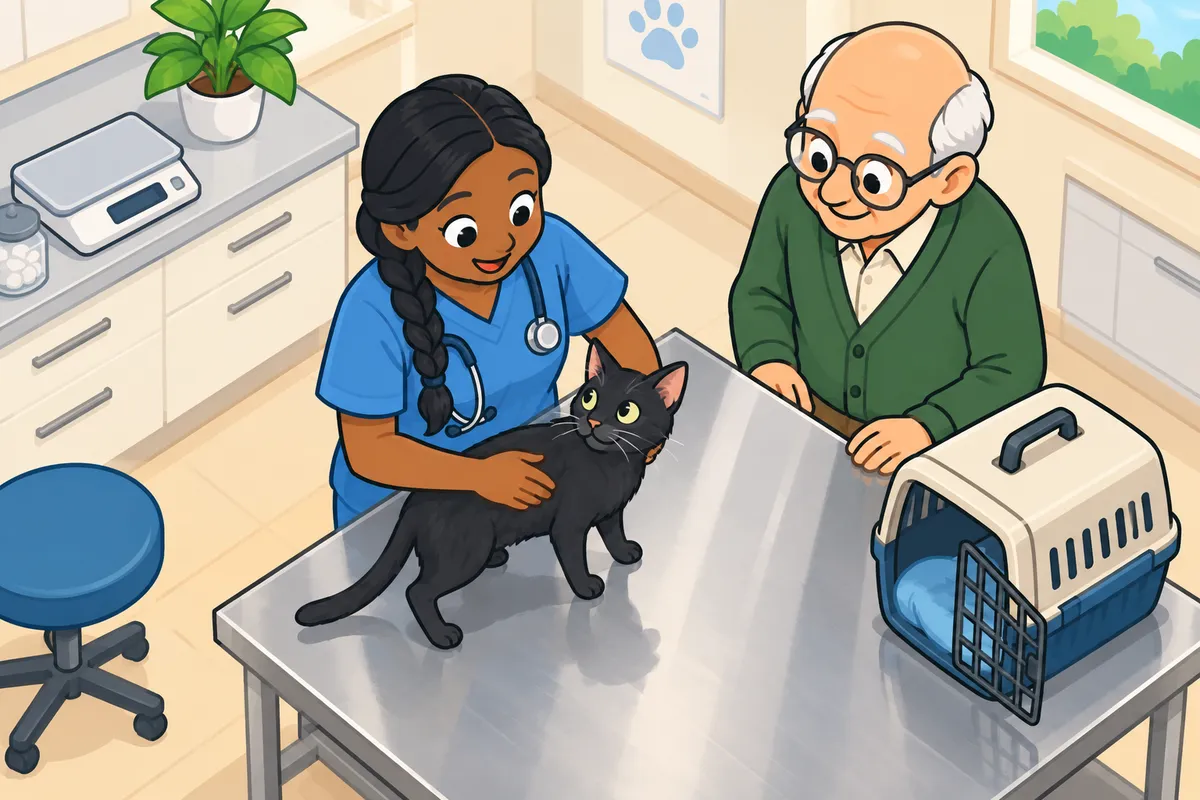
The vet has to find the reason as well as replace the water. PetMD describes the visit: a full exam, then blood and urine tests that show how dehydrated the cat is and why.
The vet gives a mild case fluids under the skin, often as an outpatient visit. A sicker cat stays for an IV catheter.
A very dehydrated cat can need several days to get back to normal.
Can You Treat a Dehydrated Cat at Home?
No. As Hill's puts it, you can't treat dehydration at home, because the cause needs a vet. What you do at home is prevention: water the cat will actually drink, and food that brings water with it.
For a healthy cat, Cornell suggests:
- Fresh water in places the cat can reach easily, with no other pet in the way.
- Wet food, or water added to meals.
A little tuna water or low-sodium chicken broth in the water tempts some cats, and some like a fountain, though preferences vary. Hill's adds that flavored water should be changed daily so it does not spoil.
Mistakes That Hide Dehydration
- Waiting a day to see whether a quiet cat bounces back, when Cornell says to call promptly.
- Keeping one bowl in a house where another pet chases the cat away from it.
- Switching a cat from wet to dry food and not watching how much more it drinks.
- Leaving flavored water out for days; stale water puts a cat off drinking.
How Much Water Does a Cat's Food Bring?
A canned diet can bring half or more of a cat's daily water, and a dry diet almost none. PetMD puts a healthy cat's need at about 4 ounces of water per 5 pounds of body weight a day, food included, so a 4.5 kg (10 lb) cat needs about 240 ml (8 oz) in all. The Merck Veterinary Manual gives the water in each kind of food.
| Food | Water, per Merck | Water in 100 g | Water in one serving |
|---|---|---|---|
| Canned | 60 % to over 87 % | 60 to 87 ml | 94 to 136 ml in a 5.5 oz (156 g) can |
| Semi-moist | 25 % to 35 % | 25 to 35 ml | 13 to 18 ml in 50 g |
| Dry | 3 % to 11 % | 3 to 11 ml | 2 to 6 ml in 50 g |
Merck adds that cats "often do not drink a lot of water", and that several water sources encourage drinking. Cornell's figure for wet food, up to 80 % water, sits inside Merck's range. Rabbits sit at the other end: Merck puts a rabbit at about twice the water of a cat its size, 120 ml per kg a day.
How Much Water the Food Bowl Supplies
To see your own cat's daily amount with its food taken off, enter its weight and diet in the cat water calculator.
What to Do Next, by What You See
Your next step
- My cat passes both checks and eats normallyKeep fresh water in two or more spots
- My cat eats only dry food and drinks littleAsk your vet about adding wet food
- My cat is over 10Book yearly bloodwork for the kidneys
- My cat is quiet, off its food or has dry gumsCall your vet today
Write your cat's age, weight, usual appetite and the vet's number on one card, and tape it inside a cupboard door. On the day a cat is off its food, that card and your litter-clump count are what the vet asks for first.
General information for healthy adults, not medical advice. If a doctor has set your fluid amount, follow that.

More in Pets
Sources
- Cornell Feline Health Center. Hydration, 2021.
- Cornell Feline Health Center. Chronic Kidney Disease, 2025.
- PetMD. Cat Dehydration Symptoms and How To Help, 2024.
- Hill's Pet Nutrition. Signs of Dehydration in Cats and What to Do, 2025.
- Merck Veterinary Manual. Nutritional Requirements of Small Animals, 2024.
Sources checked by the Glubbo Editorial Team on Oct 19, 2026. General information, not medical advice. How we write and check our guides.

