Dog and Cat Water Intake Calculator: How Much Should Your Pet Drink?
Your dog's or cat's daily water from its weight, and the amount that calls for a vet.
400–650 ml of water a day
13.5–22 oz · 1.75–2.75 cups
- From the bowl
- Call your vet above1,000 ml a day34 oz, the 100 ml per kg line
- Your measured day
For healthy adult dogs and cats. If your vet set an amount, follow that.
Type in your dog's or cat's weight and the calculator shows how much water a healthy adult pet takes in a day, in milliliters, ounces and cups. It also shows the daily amount that should send you to the vet. For a cat, it takes off the water that wet food already brings.
Every number on this page comes from veterinary sources: Cornell University's College of Veterinary Medicine, the American Kennel Club (AKC), VCA Animal Hospitals, International Cat Care and the Merck Veterinary Manual.
General information for healthy adult dogs and cats, not veterinary advice. If your vet has set a water amount for your pet, follow that.
How Much Water Should a Dog Drink a Day?
A healthy adult dog drinks about 40 to 60 ml of water per kilogram of body weight a day, according to Cornell's Riney Canine Health Center. The AKC gives a simpler rule: at least 1 ounce per pound, about 65 ml per kg. A 10 kg (22 lb) dog lands between 400 and 650 ml.
The calculator shows that whole span, from Cornell's low end to the AKC's ounce per pound, because the two sources put the top in different places. Hot weather and exercise move your dog toward the top of it.
| Dog's weight | A typical day | Call vet above 100 ml/kg |
|---|---|---|
| 5 kg (11 lb) | 200 to 330 ml (7 to 11 oz) | 500 ml (17 oz) |
| 10 kg (22 lb) | 400 to 650 ml (13.5 to 22 oz) | 1,000 ml (34 oz) |
| 20 kg (44 lb) | 800 to 1,300 ml (27 to 44 oz) | 2,000 ml (68 oz) |
| 30 kg (66 lb) | 1,200 to 1,960 ml (40.5 to 66 oz) | 3,000 ml (101 oz) |
| 40 kg (88 lb) | 1,600 to 2,610 ml (54 to 88 oz) | 4,000 ml (135 oz) |
A third source agrees. The Merck Veterinary Manual puts the need of most mammals in mild weather at about 44 to 66 ml per kg, inside the same span. The typical-day column spans 40 ml per kg to 1 oz per lb.
Two Dogs, Two Bowls
Dogs that eat canned food drink less from the bowl, because the food holds much of their water. Merck says this of dogs and cats alike, so a low bowl count on a wet diet is normal.
How Much Water Should a Cat Drink a Day?
A healthy adult cat needs about 4 ounces of water for every 5 pounds of lean body weight a day, says the Cornell Feline Health Center. That is about 52 ml per kg, so a 10 lb (4.5 kg) cat needs about 1 cup (240 ml). Part of that water can come from food.
VCA Animal Hospitals gives the same 4 ounces per 5 pounds. Cornell counts lean weight, so for an overweight cat, enter the weight your vet gives as its ideal.
| Cat's weight | Water a day (food + bowl) | Call vet above 100 ml/kg |
|---|---|---|
| 3 kg (6.6 lb) | 160 ml (5.5 oz) | 300 ml (10 oz) |
| 4 kg (8.8 lb) | 210 ml (7 oz) | 400 ml (14 oz) |
| 5 kg (11 lb) | 260 ml (9 oz) | 500 ml (17 oz) |
| 6 kg (13.2 lb) | 310 ml (10.5 oz) | 600 ml (20 oz) |
Many cats drink very little, and Merck notes this too. It adds that several water sources around the house encourage drinking, so a second bowl in another room helps.
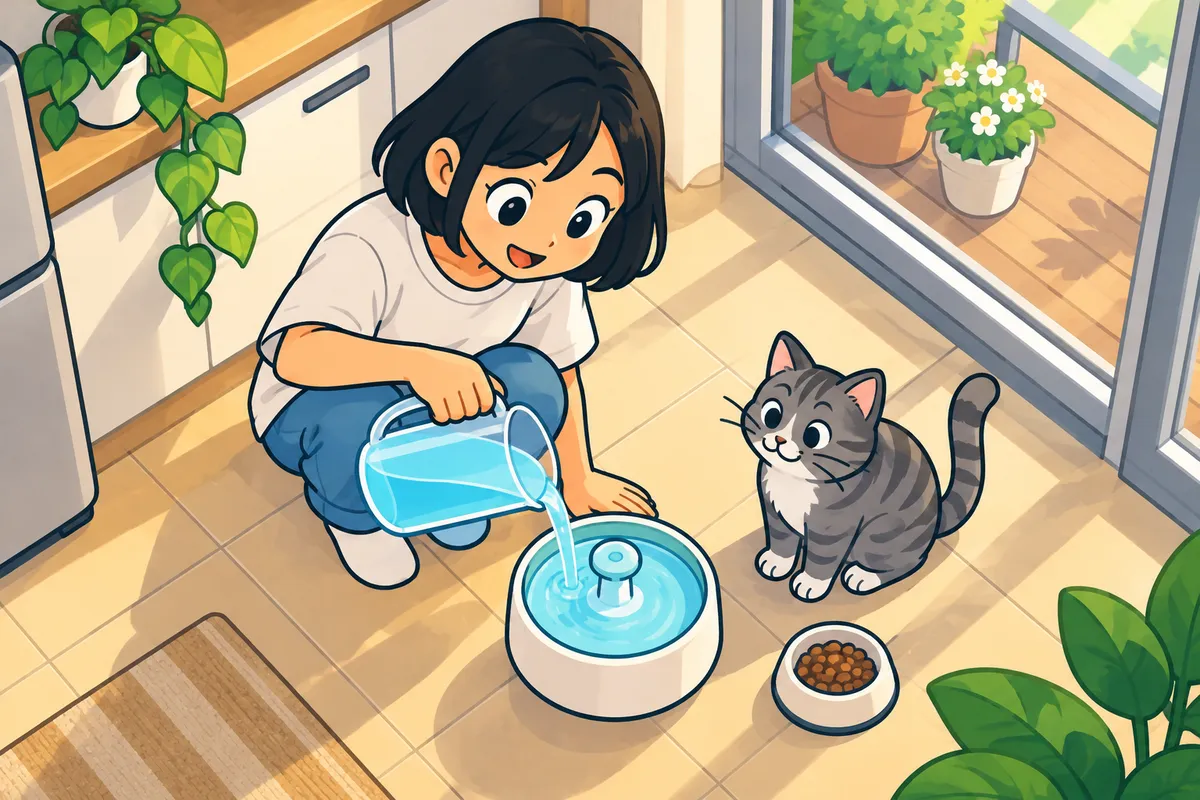
Do Cats on Wet Food Need to Drink Water?
Yes, keep fresh water out for every cat, but a cat on wet food drinks much less from the bowl. Wet food can be up to 80 % water, says Cornell, so the food covers a large share of the day's need. A cat on dry food takes most of its water by drinking.
The Merck Veterinary Manual puts canned pet food at 60 % to over 87 % water, and dry food at 3 % to 11 %. Pick wet or mixed in the calculator and enter the wet food your cat eats in a day; it takes that water off the bowl amount.
We count 75 % moisture unless you type the number from your can's label. That sits inside Merck's range and leans toward more water in the bowl, and the few percent in dry food stay out of the sum.
How Much Water Is Too Much for a Dog?
More than 100 ml per kg of body weight a day is too much for a dog, according to Cornell's Riney Canine Health Center; vets call it polydipsia. For a 20 kg (44 lb) dog, that is over 2,000 ml (68 oz). International Cat Care uses the same 100 ml per kg line for cats.
The AKC warns about a smaller rise too. A dog drinking clearly more than its own usual amount can have a problem even below that line.
The AKC counts over 30 medical causes of drinking and peeing more. The most common are diabetes, Cushing's disease and chronic kidney disease, and it notes that finding them early improves a dog's outlook.
Measure One Full Day
The calculator's check turns one measured day into ml per kg and puts it beside the typical range and the vet line. International Cat Care describes the method for cats, and it works the same way for a dog:
- In the morning, fill the bowl to the brim with water you have measured in a jug.
- Keep other pets away from that bowl for 24 hours, or give each pet its own.
- Next morning, measure what is left and subtract it from what you poured.
- Enter both amounts in the calculator's check.
- Repeat on another ordinary day, because one hot afternoon or a long walk can skew a single reading.
When to See a Vet
See your vet the same day if your pet shows signs of dehydration, and book a visit when it drinks above its vet line or clearly more than usual. The AKC treats dehydration in a dog as an emergency, and Cornell asks you to contact a vet promptly if you think your cat is dehydrated.
Signs of Dehydration in Dogs
The AKC's chief veterinarian, Dr. Jerry Klein, lists these signs:
- Skin that springs back slowly
- Loss of appetite
- Vomiting, with or without diarrhea
- Low energy and lethargy
- Panting
- Sunken, dry-looking eyes
- A dry nose
- Dry, sticky gums
- Thick saliva
Two checks take seconds. Lift a little skin between the shoulder blades and let go: in a well-hydrated dog it snaps back at once. Then press a finger on the gums and lift it; they should turn pink again almost straight away.
Try both on a day your dog is well, so you know what normal looks like for that dog.
Signs of Dehydration in Cats
Cornell lists lethargy, weakness, a poor appetite and dry gums, with sunken eyes in more severe cases. VCA adds skin that has lost its stretch.
Drinking More Than Usual
International Cat Care asks you to see a vet for any cat drinking more than usual, even without numbers, and to mention it when you see your cat at the bowl more often. Drinking above the 100 ml per kg line makes that visit more urgent.
Never take water away to stop the drinking. The AKC says to restrict a dog's water only on your vet's advice, and Merck says healthy animals given plenty of water regulate their own intake.
How the Calculator Works
It works from your pet's weight in kilograms, and pounds convert at 0.4536 kg each. Every result uses the same weight, so you can switch units without the numbers drifting.
- Dog, a typical day: 40 ml × kg for the low end, and 1 oz × lb (65.2 ml × kg) for the top.
- Cat, a day's water: 0.8 oz × lb (52.2 ml × kg), food and bowl together.
- Cat on wet or mixed food: the wet food's weight × its moisture (75 % unless you enter your label's figure) comes off the bowl amount, never below zero.
- Vet line, dogs and cats: 100 ml × kg.
- Rounding: milliliters to the nearest 10, ounces to the nearest half, and cups (8 oz, 236.6 ml) to the nearest quarter.
Measure One Normal Day at the Bowl
Run the calculator, then measure one ordinary day with the bowl method above and write the result down with the date. That one day gives you your pet's own normal, and a change from it tells your vet more than any chart.
Common Questions
Does this calculator work for puppies and kittens?
No. It uses figures for healthy adult dogs and cats. Ask your vet how much water a puppy or kitten should get.
Should I take my dog's water away at night?
Not on your own. The AKC says never to restrict a dog's water unless your vet tells you to, and the Merck Veterinary Manual says healthy animals given plenty of water regulate their own intake.
Can I enter my pet's weight in pounds?
Yes. Switch to lb and the calculator converts the weight, takes wet food in ounces and shows every result in fluid ounces and cups.
How can I get my cat to drink more?
Put fresh water in more than one place. The Merck Veterinary Manual says several water sources encourage drinking, which matters most for cats, because many drink little. Wet food adds water too.
General information for healthy adults, not medical advice. If a doctor has set your fluid amount, follow that.

Guides Behind the Numbers



Sources
- Cornell Richard P. Riney Canine Health Center. Canine Polyuria and Polydipsia (PU/PD), 2024.
- American Kennel Club. Why Is My Dog Drinking So Much Water? Polydipsia or Excessive Thirst in Dogs, 2026.
- American Kennel Club. Dehydration in Dogs: What to Know, 2026.
- Cornell Feline Health Center. Hydration, 2021.
- VCA Animal Hospitals. How to Improve Water Intake for Your Dehydrated Young Cat, 2026.
- International Cat Care. Increased Thirst and Drinking, 2025.
- Merck Veterinary Manual. Nutritional Requirements of Small Animals, 2024.
Formula and sources checked by the Glubbo Editorial Team on Oct 16, 2026.

Glubbo
Log a drink in 1 tap. Every glass fills a fish tank
Free · No account needed
912 people installed Glubbo in the last 30 days912 installed in 30 days
Free · No account needed

