How Long Can a Dog Go Without Water? The Line Vets Draw
What the Merck Veterinary Manual says about days without water, and why the safe gap is far shorter.
 By the Glubbo Editorial Team · Updated Oct 19, 2026 · 8 min read
On This Page
- How Long Can a Dog Go Without Water?
- What Happens to a Dog That Goes Without Water?
- Why Vets Never Take Water Away All at Once
- How Long Can a Puppy Go Without Water?
- How Long Can a Senior Dog Go Without Water?
- How Long Can a Small Dog Go Without Water?
- What Shortens the Time Without Water?
- See a Vet When Your Dog Has Gone Without Water
- Leave Your Dog Water That Lasts Your Longest Day
- Sources
Short answer
A few days to survive, far less to stay unharmed.
- The Merck Veterinary Manual says a lack of water can kill in a matter of days.
- One day's water for a healthy dog, 40 to 60 ml per kg, is about 5 % of its weight.
- Even in a vet's water test, water is cut gradually and the test stops at a 5 % loss.
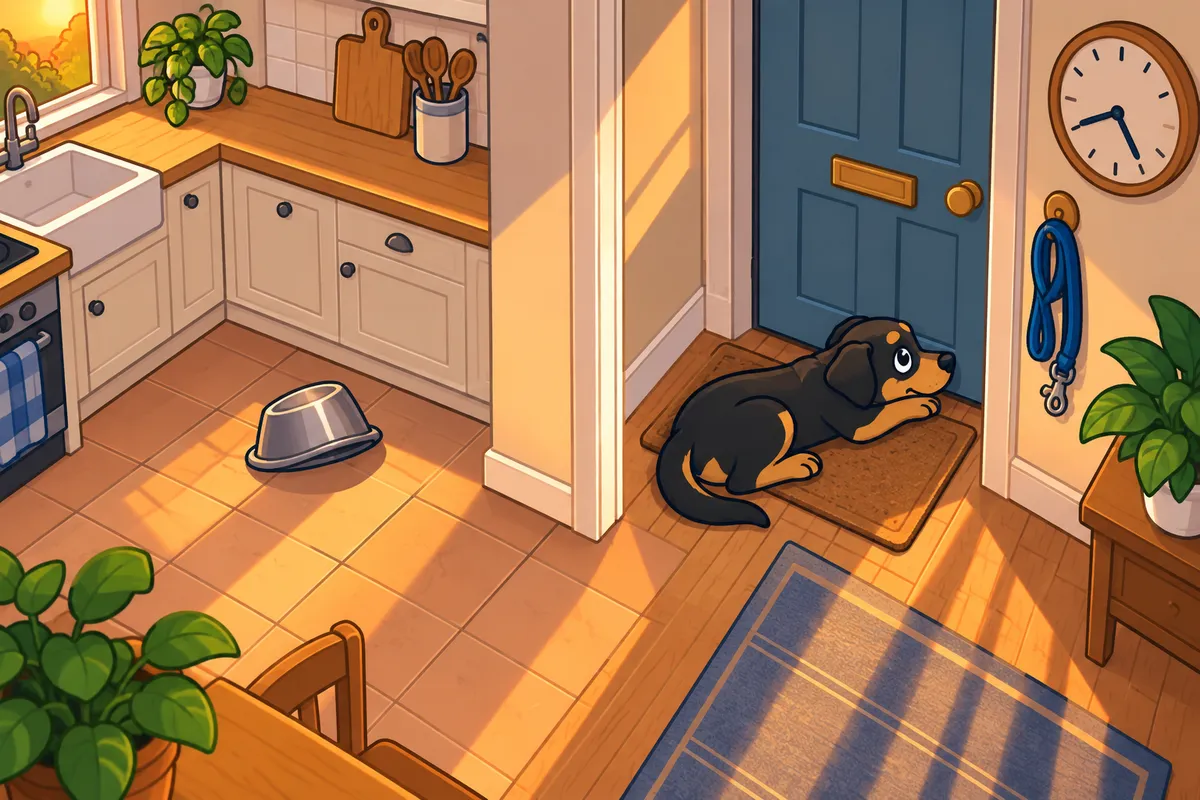
A few days at most, and the safe gap is far shorter than that. Vets treat roughly one missed day of water as the point to call, not the point to wait for.
The question usually comes after an ordinary accident: a bowl kicked over at 8 in the morning that nobody noticed until 7 at night.
General information for adult dogs, not veterinary advice. A dog that has gone without water and seems unwell needs a vet, not a home test.
How Long Can a Dog Go Without Water?
A few days at most. The Merck Veterinary Manual's nutrition chapter calls water the most important nutrient and states that a lack of water can lead to death in a matter of days.
No vet source sets a number of hours that is safe, because heat, size, food and health all move it. Pet sites quote clinics for three days at most, and in the same breath say a dog should never go without water for more than a few hours.
- Days
- until a lack of water can kill
- 40 to 60 ml
- per kg a day for a healthy dog
- 5 %
- weight loss where vets stop a water test
Survival is the wrong target. Long before the end of those days a dog shows the signs the Merck Veterinary Manual's emergency chapter lists for dehydration: skin that doesn't snap back when pinched, dry gums and sunken eyes.
One Day of Water Is About the 5 % Line
Two vet figures give a rough yardstick, and a pet-site rule sits beside them:
- Cornell's Riney Canine Health Center puts a healthy dog at about 40 to 60 ml per kg a day.
- Five percent of body weight is 50 ml per kg, right in the middle of that range.
- The common pet-site rule of 1 oz of water per pound a day, which the same Green Matters page quotes from WebMD, is about 65 ml per kg, at the top of it.
So one missed day of drinking is about as much water as the 5 % loss vets refuse to go past, even with daily exams. That is a sum, not a measurement: how fast a real dog loses water depends on heat, panting, food and illness, and no source puts a clock on it.
Treat one missed day as the limit, not the starting point.
What Happens to a Dog That Goes Without Water?
It dries out in steps that a vet can see and feel. The Merck Veterinary Manual's fluid chapter grades dehydration as a share of body weight lost as water, and Merck works out the missing water as weight in kg times that share.
The table puts Merck's four steps beside what they mean for one ordinary 20 kg (44 lb) dog, using Merck's own formula.
| Merck's estimate | What the vet finds (Merck) | Water missing in a 20 kg dog |
|---|---|---|
| 4 to 5 % | Semidry gums, normal skin, eyes still moist | 0.8 to 1 L |
| 6 to 7 % | Dry gums, mild loss of skin elasticity | 1.2 to 1.4 L |
| 8 to 10 % | Clear loss of skin elasticity, sunken eyes, weak rapid pulse | 1.6 to 2 L |
| 12 % or more | Very dry gums, no skin elasticity, dull sunken eyes, possible altered consciousness | 2.4 L or more |
Look at the first row. At 4 to 5 % the skin still behaves normally, so a dog can be short of a whole liter before the skin test shows anything.
That is why pressing the gums and pinching the skin works as a rough check at home, never as proof that a dog is fine.
What the Numbers Mean by Size
The 5 % line falls at about the same day of drinking for every dog, but the milliliters behind it shrink fast with size. These rows use Cornell's daily range and Merck's formula.
| Dog | Healthy day, 40 to 60 ml/kg | 5 % of its weight as water |
|---|---|---|
| Pip, a 4 kg (8.8 lb) Chihuahua | 160 to 240 ml | 200 ml |
| A 20 kg (44 lb) mixed breed | 800 to 1,200 ml | 1 L |
| Bella, a 30 kg (66 lb) Labrador | 1.2 to 1.8 L | 1.5 L |
Pip's whole margin is 200 ml, less than a cup. The same 11 hours cost him about 75 to 110 ml, so a small spill or a dry afternoon takes a far bigger share of his reserve. The calculator does the same sum for your dog's weight.
Why Vets Never Take Water Away All at Once
Even when a vet needs to restrict water on purpose, the vet does it slowly and stops early. That tells you how little room a dog has.
To test for diabetes insipidus, the Merck Veterinary Manual has owners first measure normal drinking for 3 to 5 days. Then the daily allowance drops by only 5 % to 10 % a day, with weight and hydration checked daily.
The test ends at the first of three points:
- urine specific gravity above 1.025
- a daily allowance below 60 ml per kg
- "5% dehydration (or loss of 5% of body weight)"
Merck states that "an abrupt withdrawal of water is not recommended" and that gradual deprivation is preferred. So the experts, with daily exams and lab work, will not let a dog lose more than 5 %.
Cornell's vets go further for dogs at home: even a dog that drinks a lot should keep its water, because "restricting access can lead to dehydration or dangerous electrolyte abnormalities." Call the vet about the thirst instead of cutting the bowl.
How Long Can a Puppy Go Without Water?
Less time than an adult, and no vet source gives a number. A puppy is small, so its whole day is a few hundred milliliters at most, and a puppy that has had no water for part of a day needs fresh water now and a call to your vet if it seems flat or will not drink.
Puppies are also hard to read. Merck's fluid chapter warns that very young animals may have extra skin elasticity, which makes the skin test look better than the puppy is.
How Long Can a Senior Dog Go Without Water?
Again less than a fit adult, especially an old dog with an illness that raises its urine. Cornell's polyuria page lists kidney disease, diabetes, adrenal gland disease and liver disease among the causes of a dog that urinates and drinks more.
A dog like that keeps losing urine when the bowl runs dry, so it falls behind faster than a healthy dog would. Old dogs also fool the eye: Merck notes that geriatric animals can have sunken eyes and poor skin elasticity with normal hydration, so judge an old dog by its gums, its appetite and the bowl.
How Long Can a Small Dog Go Without Water?
The same rough day of water to the 5 % line, with a much thinner reserve. Pip's row in the size table shows why: his whole margin is 200 ml.
Small dogs also feel a hot patio quickly. Cornell lists heat among the reasons a dog drinks more, and on a hot afternoon a small dog's 200 ml goes faster than a big dog's liter.
What Shortens the Time Without Water?
Heat, effort, a dry diet and illness. Merck names diet, environment, activity and health as what sets a dog's water need, and each one below makes water leave faster or arrive slower.
What brings a dog to the line sooner
5 items- Heat, which Cornell lists among the causes of extra drinking
- Hard exercise: Merck counts activity level
- Kidney disease, diabetes, adrenal or liver disease (Cornell)
- A dry-food diet at 3 % to 11 % water (Merck)
- Any illness: Merck counts health status
Food pulls the other way. Merck gives canned food 60 % to over 87 % water and dry food 3 % to 11 %, so a dog on wet food keeps getting some water from its meals and a dog on kibble gets almost none.
See a Vet When Your Dog Has Gone Without Water
Go straight away if your dog shows signs of dehydration or shock. Merck's emergency chapter lists both, and puts shock and heat stroke among the problems that need treatment at once.
Call your vet too if your dog has had no water for about a day, or if a puppy, an old dog or a dog with kidney disease or diabetes has gone dry for part of one. Offer fresh, cool water on the way, let it drink at its own pace, and leave fluids and salts to the vet.
If the bowl was full all along and your dog simply would not touch it, the reasons are different: mouth pain, a diet change or illness can all stop a dog drinking.
Leave Your Dog Water That Lasts Your Longest Day
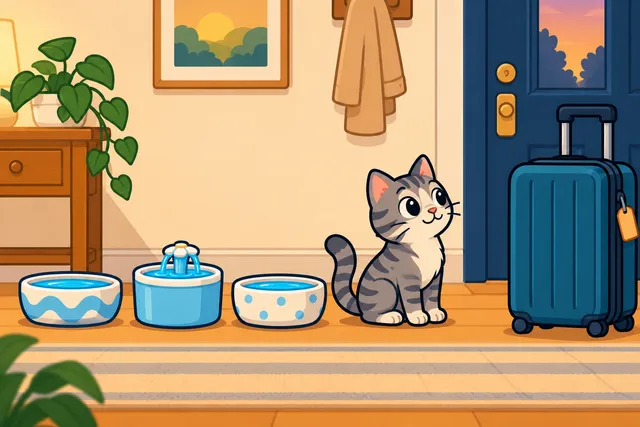
Plan for the longest gap of your week, not the average one. Merck notes that several water sources encourage drinking, and two bowls also mean one spill no longer leaves your dog dry.
Water for the time you are away
- Out for a morningOne full, heavy bowl that cannot tip
- Away a full working dayTwo heavy bowls in two rooms, and a midday check
- Away on a hot dayTwo bowls in the shade, and someone who looks in
- Away overnight or longerA sitter or boarding, never a full bowl alone
Fill each bowl to at least the top of your dog's daily range, more on hot days. In a house with a cat or a rabbit as well, the whole-house water table puts each one's daily amount side by side.
General information for healthy adults, not medical advice. If a doctor has set your fluid amount, follow that.
More in Pets
Sources
- Merck Veterinary Manual. Nutritional Requirements of Small Animals, 2024.
- Cornell Richard P. Riney Canine Health Center. Canine Polyuria and Polydipsia (PU/PD), 2024.
- Merck Veterinary Manual. Diabetes Insipidus in Animals, 2024.
- Merck Veterinary Manual. The Fluid Resuscitation Plan in Animals, 2025.
- Merck Veterinary Manual. Evaluation and Initial Treatment of Dog and Cat Emergencies, 2025.
Sources checked by the Glubbo Editorial Team on Oct 19, 2026. General information, not medical advice. How we write and check our guides.

