Water Intoxication in Dogs: Signs After Swimming and Fetch
How a game in the water dilutes a dog's blood sodium, the signs to spot on the bank, and the breaks that prevent it.
 By the Glubbo Editorial Team · Updated Oct 19, 2026 · 8 min read
On This Page
- What Are the Signs of Water Intoxication in Dogs?
- What Is Water Intoxication in Dogs?
- How Fast Does Water Intoxication Happen in Dogs?
- How Do Dogs Get Water Intoxication?
- Which Dogs Are Most at Risk of Water Intoxication?
- Can a Dog Get Water Intoxication From Drinking From Its Bowl?
- Is It Water Intoxication or Salt Water Poisoning?
- What Should You Do if You Suspect Water Intoxication?
- Can Dogs Recover From Water Intoxication?
- A Lake Day Built Around Breaks
- Sources
Short answer
A water emergency: low blood sodium after swimming.
- Watch for nausea, vomiting, lethargy and a swollen belly after water play.
- Cornell's vets advise frequent half-hour breaks from the water.
- Cut long retrieves: Cornell names chasing balls or sticks in water as the risk.

Water intoxication is a dog swallowing so much water, fast, that its blood sodium drops and its brain swells. It follows long swims, fetch in a lake or pool, and play-biting at a hose or sprinkler, and it can turn a healthy dog into an emergency within one outing.
A spaniel that has spent two hours diving for a ball stumbles on the way back to the car, and its owner thinks it is tired.
General information for adult dogs, not veterinary advice. If you suspect water intoxication, go to a vet or emergency clinic now.
What Are the Signs of Water Intoxication in Dogs?
A sick, wobbly, bloated dog after water play. Two vet sources list the signs:
- The ASPCA Animal Poison Control Center lists the first signs, in milder cases, as nausea, vomiting, lethargy and abdominal distention; in more severe cases ataxia, weakness, coma, seizures, hypothermia and bradycardia may follow.
- The American Kennel Club adds restlessness, heavy drooling, pale gums, enlarged pupils and glassy eyes.
Most of the early signs look like a dog that is simply worn out, which is why they get missed. Read them against the last hour: a dog that was swimming or retrieving and now shows any of these needs a vet.
| What you see | The sign it matches |
|---|---|
| Licking lips, drooling, retching | Nausea, vomiting |
| Lies down and will not get up to play | Lethargy, weakness |
| A tight, swollen belly | Abdominal distention |
| Staggering, stumbling, falling | Ataxia (loss of coordination) |
| Cold to the touch, slow heartbeat | Hypothermia, bradycardia |
| Fits, collapse, no response | Seizures, coma |
A dog that is only tired walks straight and perks up when you call it. If it staggers, vomits or looks confused, do not wait for a rest in the shade to fix it.
What Is Water Intoxication in Dogs?
Too much water taken in too fast, so the blood becomes dilute. Cornell's vets put it in one line: when dogs swallow too much, "their electrolytes in the bloodstream become diluted," and brain swelling can bring seizures and possibly death.
Hyponatremia in Dogs, the Number Behind It
The vet's word for it is hyponatremia, a low level of sodium in the blood. The ASPCA notes that hyponatremia shows up on the dog's blood tests, and the Texas A&M review explains that water intoxication can cause a rapid drop in sodium, which makes the brain swell.
The review prints two numbers:
- A laboratory reference range of 144 to 155 mmol/L for a dog's blood sodium.
- A worked example, a miniature pinscher at 107 mmol/L, which lost sodium through illness rather than drinking too much, so it shows the scale of a low result and not how water intoxication looks.
How fast the sodium falls matters as much as the number.
How Fast Does Water Intoxication Happen in Dogs?
It can become serious within the same outing. Vets give no fixed time, but Texas A&M's vets describe a rapid fall in sodium, and say vomiting and disorientation may quickly progress to seizures and death. The AKC says only that the problem can come on suddenly.
Do not wait for a second sign once the first one shows after water play. Keep watching your dog on the drive home too, because a dog that looked fine on the bank can start staggering in the car.
How Do Dogs Get Water Intoxication?
By swallowing water while they play, hour after hour. Cornell describes the dog that is "in and out of the pool or a lake all day, especially chasing balls or sticks," and the few case reports the Texas A&M review found mostly describe dogs gulping water while playing in ponds or lakes.
| Activity | Why water goes in | What to change |
|---|---|---|
| Retrieving a ball or stick from water | Every grab at the water scoops some up | Fewer throws, and a half-hour break out of the water (Cornell) |
| Swimming all day | Hours in and out of the water add up | Frequent half-hour breaks through the day (Cornell) |
| Diving for objects | The dog swallows water while its head is under | Keep toys on the surface (AKC) |
| Pool or beach days | The ASPCA says most cases follow a beach or pool day in warm months | Plan the breaks before you go |
Can a Dog Get Water Intoxication From a Hose or Sprinkler?
Yes. The AKC lists even play-biting at the stream from a garden hose or sprinkler among the ways a dog can overload its system, next to swimming, diving and retrieving.
Hose play has an easy fix: keep the stream away from the dog's mouth, or cool it in a shallow pool instead.

Which Dogs Are Most at Risk of Water Intoxication?
The dogs that play in water the longest, and the smallest ones. The risk sits with three kinds of dog:
- Dogs that play in water for hours: Cornell names the dog in and out of a pool or lake all day chasing balls or sticks, and the ASPCA places most cases in the warmer months after a beach or pool day.
- Toy and small dogs: the AKC adds that they are at greater risk than larger ones, because their bodies have more work to clear the same extra water.
- High-energy, high-drive dogs: the AKC says they may push on through the discomfort after taking in too much water.
The same article notes that breeds developed for water work may swallow less water as they swim.
A ball-mad retriever will fetch from the water until it drops and will not take a break on its own, so the break is your job.
Can a Dog Get Water Intoxication From Drinking From Its Bowl?
Very unlikely for a healthy dog. The cases the Texas A&M review describes come from dogs gulping water at play in ponds or lakes, and the ASPCA ties it to beach and pool days, not to the water bowl at home.
Cornell's vets add the other side. Their page on dogs that drink a lot says to assume the dog needs the water, because "restricting access can lead to dehydration or dangerous electrolyte abnormalities." A dog that drinks far more than usual from its bowl needs a vet visit to find out why, not a smaller bowl.
Is It Water Intoxication or Salt Water Poisoning?
Fresh water and seawater cause opposite problems with similar signs. Cornell explains that too much fresh water swells brain cells, while too much salt water "pulls water out of brain cells, causing them to shrink."
Too Much Fresh Water
- Lakes, rivers, pools
- Blood sodium falls
- Brain cells swell
- Nausea, vomiting, lethargy, swollen belly
Too Much Salt Water
- Sea and surf
- Blood salt rises
- Brain cells shrink
- Muscle tremors, disorientation, seizures
Both need a vet straight away. For a beach day, Cornell's first step is to make sure your dog has had plenty of fresh water before you go, so it is less likely to drink the sea. Seawater is only one risk: green pond scum and chlorinated pool water can harm a dog too.
What Should You Do if You Suspect Water Intoxication?
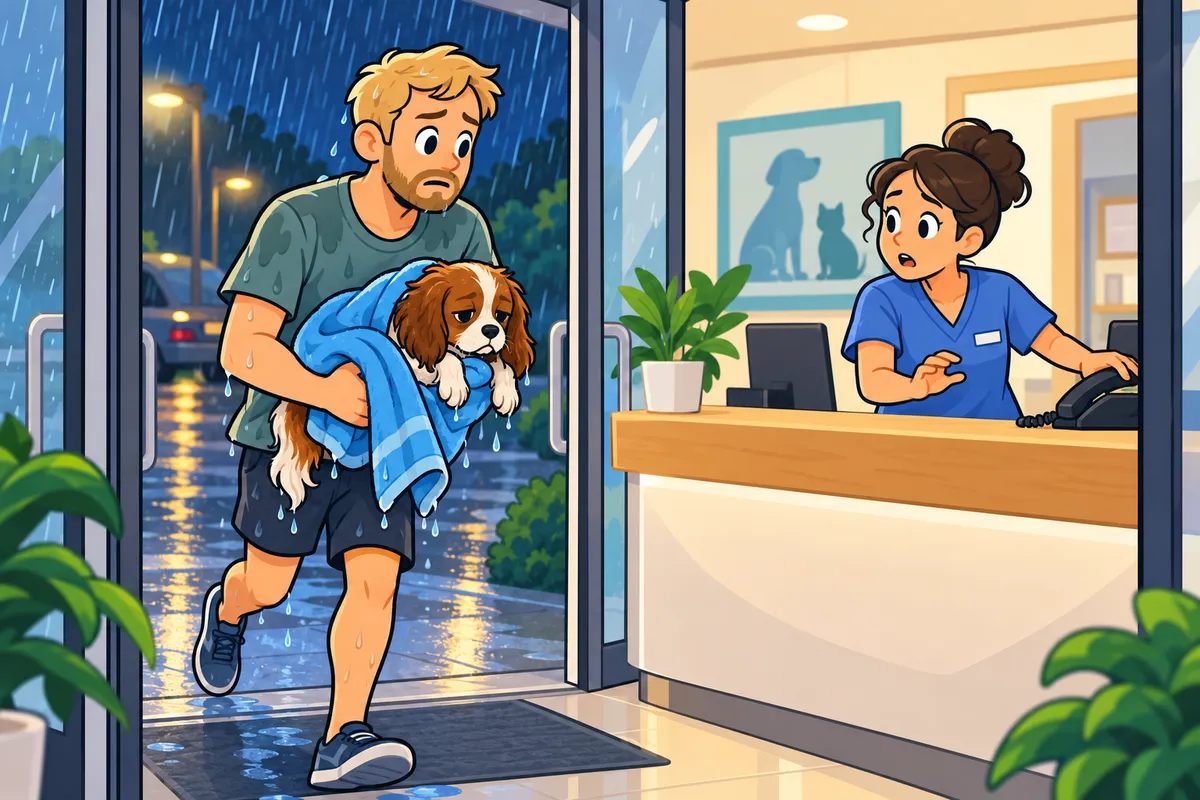
Get out of the water and go. Cornell warns that the brain swelling, left unchecked, leads to seizures and possibly death, so the next stop is a vet or an emergency clinic, not the car park. Call ahead so the clinic expects you.
How Vets Treat It
The vet confirms the low sodium with a blood test, then raises it slowly. The ASPCA describes close observation and repeated blood tests for milder cases, fluids with more sodium for dogs with signs, and other drugs in critical cases. The AKC names drugs that reduce brain pressure and diuretics that remove the extra fluid.
The Texas A&M review gives the pace for treating severe low sodium: sodium should rise by no more than 10 to 12 mmol/L in the first 24 hours, with blood rechecked 2 to 4 hours after treatment starts. A faster correction is the danger, which is why a home fix with salt is not an option.
Can Dogs Recover From Water Intoxication?
Many can when treated early. The AKC says mild cases, where a dog only staggers, can recover their internal balance, while in severe cases the brain damage may be irreversible and the dog may die. Cornell likewise warns that brain swelling left unchecked can end in seizures and death.
That gap between mild and severe is the reason to act on the first sign. A wobble after swimming is a reason to leave the water and call a vet, not to wait.
A Lake Day Built Around Breaks
Plan the breaks before you arrive. Cornell's vets advise frequent half-hour breaks from the water through the day, so the dog stops swallowing water long before it adds up.
A morning at the lake, with a half-hour break at each mark
- 9 AM
- 9:40 AM
- 10:30 AM
- 11:20 AM
- 12:10 PM
Rules for the bank
4 items- Throw a flat disc, not a tennis ball, so the dog can close its mouth around it
- Keep the dog in sight, and watch for splashing, a low head or a mouth held open
- Give frequent rests, with a bathroom break between swims
- No diving for objects and no play-biting at a hose or sprinkler
Pack a towel and your own bowl of fresh water, and count the throws. A dog that would retrieve all afternoon is the one that needs you to call the break.
General information for healthy adults, not medical advice. If a doctor has set your fluid amount, follow that.

More in Pets

Sources
- Cornell University College of Veterinary Medicine. Summer safety tips, 2026.
- ASPCApro (ASPCA Animal Poison Control Center). Treating Acute Water Intoxication in Pets, 2025.
- American Kennel Club. Water Intoxication in Dogs: Can Dogs Drink Too Much Water?, 2026.
- Today's Veterinary Practice (Heinz and Cook, Texas A&M College of Veterinary Medicine), peer reviewed. Evaluation and Management of the Hyponatremic Patient, 2022.
- Cornell Richard P. Riney Canine Health Center. Canine Polyuria and Polydipsia (PU/PD), 2024.
Sources checked by the Glubbo Editorial Team on Oct 19, 2026. General information, not medical advice. How we write and check our guides.

