How Much Water Do Ferrets Drink? Bowl, Bottle and Hot Days
The daily amount researchers record for ferrets, bowl or bottle, and the heat and illness signs that need a vet.
 By the Glubbo Editorial Team · Updated Oct 19, 2026 · 8 min read
On This Page
Short answer
About 75 to 100 ml a day for an adult ferret.
- A 2024 review in Laboratory Animal Research gives 75 to 100 ml of water a day.
- Bowl or bottle both work; ferrets tip and play with bowls, so use heavy steel.
- No sweat glands: ferrets overheat and dehydrate easily, so keep them cool.
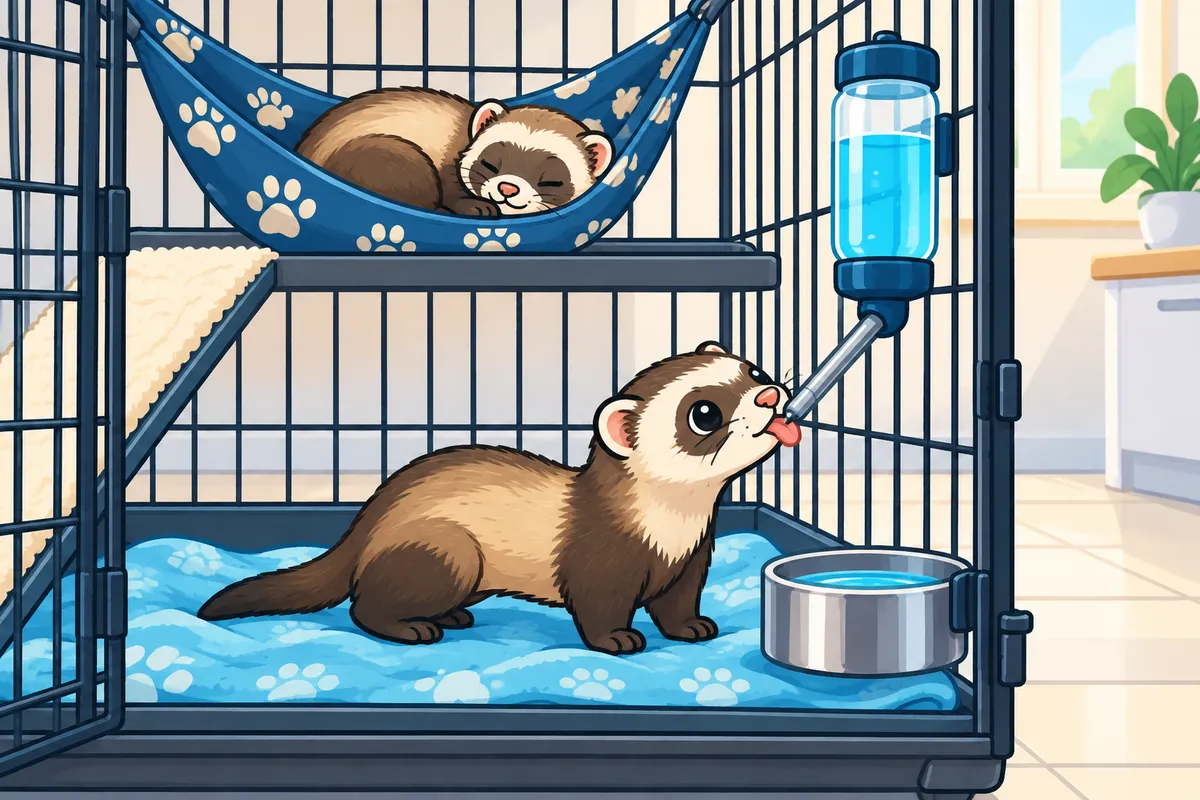
An adult ferret drinks about 75 to 100 ml (2.5 to 3.4 oz) of water a day, and it has no sweat glands, so a hot room dries it out fast. A ferret also sleeps up to 18 hours a day and tips its bowl for fun.
That mix of a small body, no sweat glands and a habit of spilling water is why ferret owners need a plan for water as well as a bowl.
General information for healthy adult ferrets, not veterinary advice. If your vet has set a plan for your ferret's water or food, follow that.
How Much Water Do Ferrets Drink a Day?
About 75 to 100 ml (2.5 to 3.4 oz). A 2024 review of ferret care in Laboratory Animal Research lists daily water intake of 75 to 100 ml for ferrets, and says that supplying safe, fresh water on demand is essential.
The same review gives adult males (hobs) 1 to 2 kg and females (jills) 0.5 to 1.5 kg, so a big hob can weigh three or four times a small jill. Expect the hob near the top of the range and the jill near the bottom, then measure your own.
| Fact | Value | Source |
|---|---|---|
| Daily water | 75 to 100 ml | Laboratory Animal Research, 2024 |
| Adult male (hob) | 1 to 2 kg (2.2 to 4.4 lb) | Laboratory Animal Research, 2024 |
| Adult female (jill) | 0.5 to 1.5 kg (1.1 to 3.3 lb) | Laboratory Animal Research, 2024 |
| Food a day | 5 % to 7 % of body weight, in about ten small meals | Laboratory Animal Research, 2024 |
| Sleep | up to 18 hours a day | Merck Veterinary Manual |
Ferrets eat about ten small meals a day, the review says, and drink around them. A ferret that sleeps up to 18 hours, as the Merck Veterinary Manual's ferret home page notes, does its drinking in the short waking spells.
Do Ferrets Drink Water Through the Day?
Yes, in many short visits, because its meals set the rhythm. The review gives food intake as 5 % to 7 % of body weight a day, eaten in about ten small meals, so a ferret visits its water many times a day in short bursts.
Water for Two Ferrets in One Cage
At 75 to 100 ml each, a hob and a jill sharing a cage drink 150 to 200 ml a day between them. A 250 ml bottle covers one day with little to spare, so a second water source matters.
The review recommends housing ferrets in pairs, not larger groups. Two ferrets means two water sources, checked at every feed.
Should a Ferret Drink From a Bowl or a Bottle?
Either works; many owners offer both. The Merck Veterinary Manual's ferret management chapter says you can offer water "in either a bowl or a bottle," and adds that bottles are often preferred because ferrets play with bowls and spill them.
Water containers for ferrets
Bottle with a sipper tube
Spill-proof
- Clips to the cage side (Merck)
- Stays clean of bedding and food
- Check the tip flows every day
Suits you if your ferret tips or splashes every bowl you give it.
Heavy stainless steel bowl
Natural drinking
- Sturdy, so it does not tip (Merck)
- Steel dishes are what the review names
- Gets played in: refill often
Suits you if you can clip or weigh the bowl down and check it twice a day.
Both together
Backup
- A stuck sipper no longer means no water
- Lets the ferret choose
- Two things to clean each day
Suits you if you keep two ferrets, or leave them for a working day.
Both sources ask for sturdy, clean containers:
- Merck's owner page warns that ferrets often tip over water and food bowls, so it asks for sturdy containers.
- The 2024 review names stainless steel dishes or bottles with sipper tubes, and asks you to clean water utensils regularly.
Do Ferrets Drink More Water in Hot Weather?
They need to, and heat is the main danger. Merck says ferrets are sensitive to heat and humidity because they have no sweat glands, and that they "easily overheat and become dehydrated."
Merck's owner page gives 18 to 23 °C (65 to 75 °F) as usually comfortable. The 2024 review says ferrets find temperatures above 30 °C (86 °F) hard to handle, and that humidity is best kept between 40 % and 65 %.

A ferret cannot sweat its way out of a hot room, so on a hot day the cool room matters as much as the full bowl.
The Temperatures That Matter
| Temperature | What it means for a ferret | Source |
|---|---|---|
| 15 to 21 °C (59 to 70 °F) | The range recommended for ferrets in laboratories | Laboratory Animal Research, 2024 |
| 18 to 23 °C (65 to 75 °F) | Usually comfortable at home | Merck owner page |
| Above 30 °C (86 °F) | Hard to handle with underdeveloped sweat glands | Laboratory Animal Research, 2024 |
| Body temperature above 40.5 °C (105 °F) | On Merck's list of ferret emergencies | Merck emergency page |
| Humidity of 40 % to 65 % | The range the review recommends | Laboratory Animal Research, 2024 |
A room that reaches 30 °C on a summer afternoon is already past the comfortable range, and the water bowl alone will not fix it. Move the cage to the coolest room, out of direct sun and away from drafts and windows, as Merck's owner page advises.
Merck adds that ferrets handle cold better than heat, and that their food intake may double in the cold. Keep water unfrozen and topped up in a cold shed or garage as well.
Can Ferrets Drink Milk?
No; give water instead. The ASPCA Animal Poison Control Center explains that pets do not have much lactase, the enzyme that digests milk sugar, so milk and dairy foods can cause diarrhea or other digestive upset.
Ferrets are carnivores. Merck says their diet should be meat based and high in protein, 35 % to 40 % in the professional chapter, so milk adds nothing a ferret needs and diarrhea costs it water it cannot spare.
When Is a Ferret Not Drinking an Emergency?
Sooner than for a dog or cat. The Merck Veterinary Manual's page on ferret emergencies warns that ferrets "can quickly become dehydrated and weak," and that they may hide illness until it is advanced.
The 24-hour and immediate groups come from Merck's ferret emergency page. In male ferrets, Merck's page on ferret hormone disorders notes that adrenal disease can cause an enlarged prostate and difficulty urinating, so a male that strains over the litter tray is not a water problem.
What if My Ferret Drinks Far More Than Usual?
Treat it as a sign, not a good habit: Merck lists excessive water consumption among the things to show a vet within 24 hours. That is why a measured normal matters, since "far more than usual" only means something against your ferret's own numbers.
Doubling your own ferret's usual figure for two or three days running is the kind of change to report; a ferret that sits near the top of the 75 to 100 ml range every day is just a thirsty ferret.
How to Check Your Ferret's Water
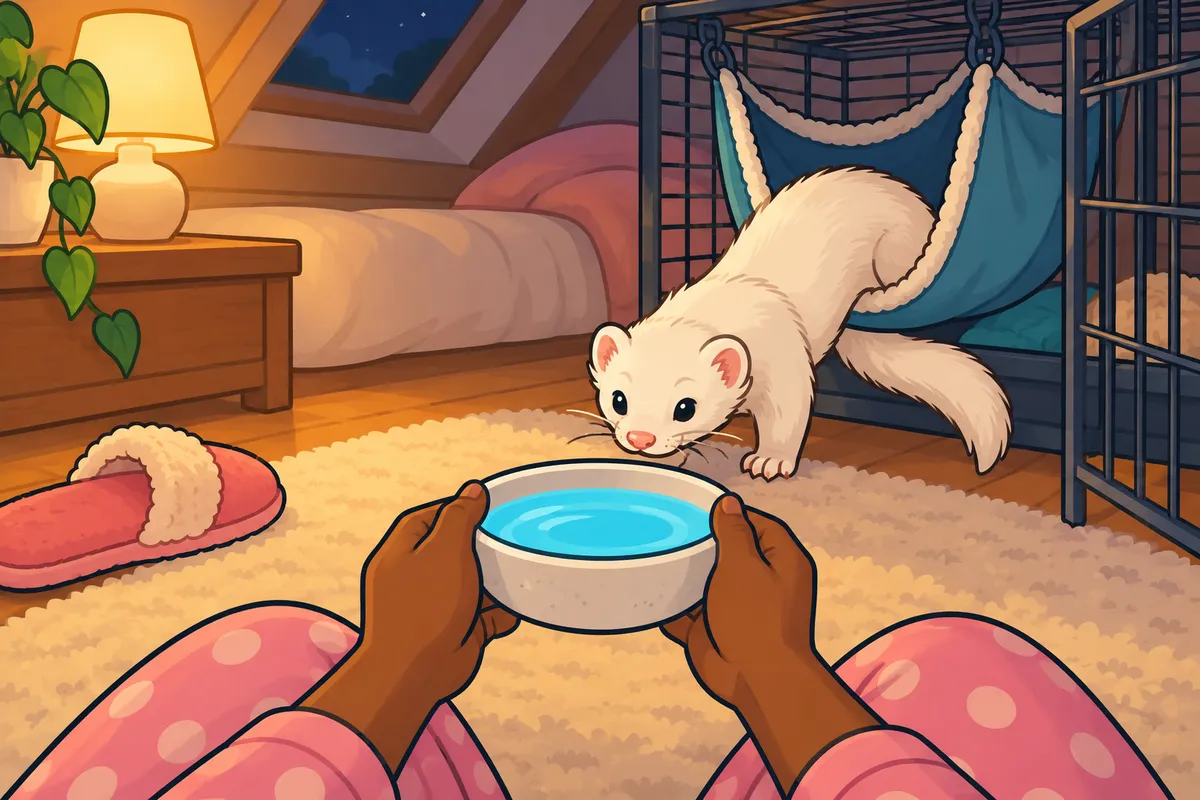
Measure, because a sleeping ferret will not show you when it drinks. Fill the bottle or bowl with a measured amount, and measure again 24 hours later.
Measure a ferret's day
- Weigh the bottle in the evening and again the next evening: each gram lost is a milliliter drunk, the trick that reads a hamster's night at the bottle
- Note the day's room temperature, since heat raises the number
- Repeat on three ordinary days and keep the middle value as your ferret's normal
Compare the result with the 75 to 100 ml range above. A ferret well below it on several days, or one that suddenly drinks far more, is worth a vet visit before it turns into the emergency Merck describes.
How Long Does a Bottle Last for One Ferret or Two?
Refill it every day anyway, but the sum shows how much margin you have if you are late. At 75 to 100 ml a ferret a day, a bottle holds:
| Bottle | One ferret | Two ferrets |
|---|---|---|
| 120 ml (4 oz) | 1.2 to 1.6 days | 0.6 to 0.8 days |
| 250 ml (8.5 oz) | 2.5 to 3.3 days | 1.3 to 1.7 days |
| 500 ml (17 oz) | 5 to 6.7 days | 2.5 to 3.3 days |
A small bottle shared by two ferrets is empty before the day ends, which is why a heavy steel bowl beside the bottle is the backup, and why the bottle's tip needs testing each morning. Leaks and spills mean the real figure is lower than this table.
Tonight, fill a bottle with a measured amount and clip a heavy bowl beside it. Tomorrow evening, weigh or measure what is left and write the figure on a sticky note by the cage.
General information for healthy adults, not medical advice. If a doctor has set your fluid amount, follow that.

More in Pets

Sources
- Laboratory Animal Research (Pramod, Atul, Pandey, Anbazhagan, Mhaske and Barathidasan). Care, management, and use of ferrets in biomedical research, 2024.
- Merck Veterinary Manual. Management of Ferrets, 2026.
- Merck Veterinary Manual (pet owner version). Providing a Home for a Ferret, 2024.
- Merck Veterinary Manual (pet owner version). Emergencies of Ferrets, 2026.
- Merck Veterinary Manual (pet owner version). Hormonal Disorders of Ferrets, 2024.
- ASPCA Animal Poison Control. People Foods to Avoid Feeding Your Pets, 2026.
Sources checked by the Glubbo Editorial Team on Oct 19, 2026. General information, not medical advice. How we write and check our guides.

