How Much Water Should a Hamster Drink per Day? About 30 ml
The amount vets measure for a Syrian hamster, how to check a bottle it drains at night, and what a change means.
 By the Glubbo Editorial Team · Updated Oct 19, 2026 · 8 min read
On This Page
- How Much Water Should a Hamster Drink per Day?
- How Much Water Does a Dwarf Hamster Need?
- Do Hamsters Need a Water Bottle?
- How Can You Tell How Much Your Hamster Drinks?
- Why Is My Hamster Drinking So Much Water?
- How Long Can a Hamster Go Without Water?
- Why Is My Hamster Not Drinking Water?
- When to Take Your Hamster to a Vet
- Hang the Bottle Low and Weigh It for Three Nights
- Sources
Short answer
About 30 ml a day for a golden (Syrian) hamster.
- Merck's lab data put a healthy adult golden hamster at 30 ml a day on a dry diet.
- Use a bottle with a stainless steel sipper tube near the floor; no glass tubes.
- Extra thirst with weight loss or a wetter cage can mean kidney disease: see a vet.
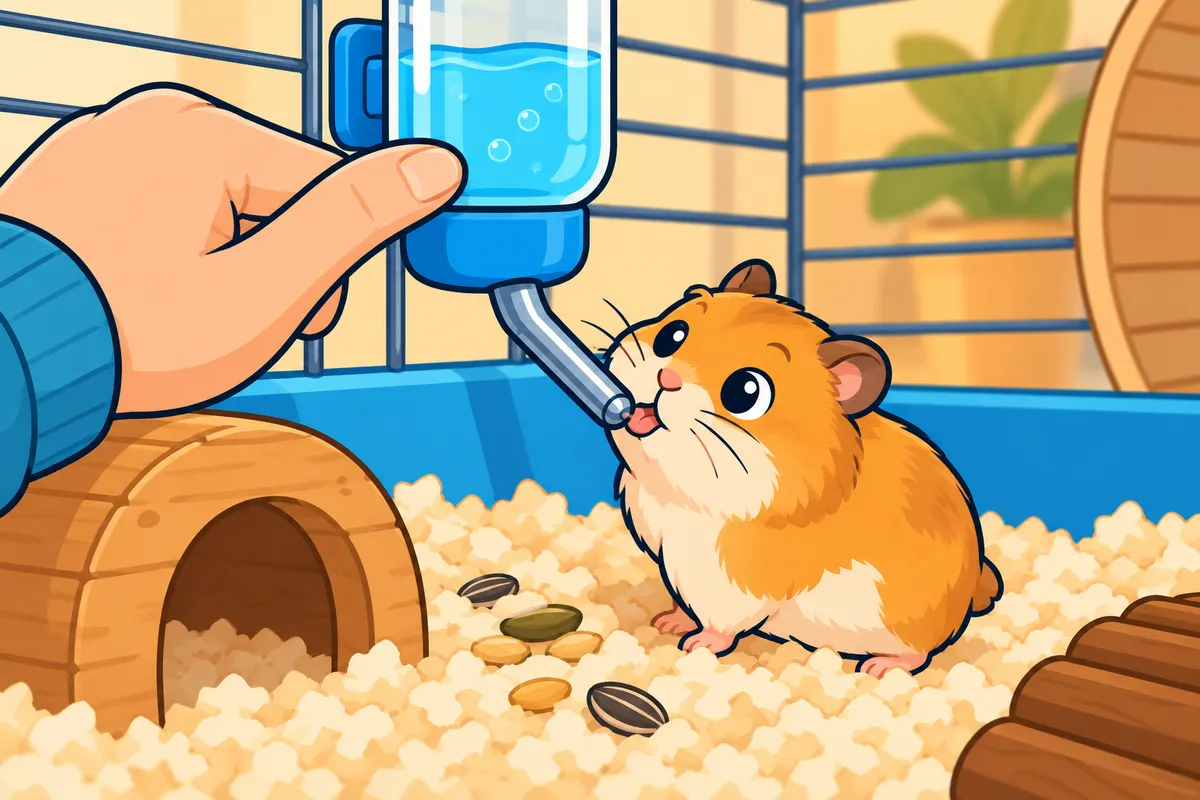
A golden (Syrian) hamster drinks about 30 ml (1 oz) of water a day by the Merck Veterinary Manual's lab figure, and your own hamster's normal is the real benchmark. A hamster drinks while you sleep, so the bottle a little lower each morning is the only daily health check most owners get. A hamster weighs about 100 g, so a few milliliters up or down is a real change.
General information for healthy adult hamsters, not veterinary advice. If your vet has given you a plan for your hamster's water, follow that.
How Much Water Should a Hamster Drink per Day?
About 30 ml (1 oz) for a golden, or Syrian, hamster. The Merck Veterinary Manual's table of laboratory animal data gives 30 ml a day as typical for healthy adult golden hamsters on a dry diet, drinking as much as they like in thermoneutral conditions: a temperature that is neither hot nor cold for the animal.
- 30 ml
- a day for an adult golden hamster
- 110 to 140 g
- adult Syrian weight; females larger
- 18 to 26 °C
- the cage range Merck gives (64 to 79 °F)
Owner guides give lower numbers:
- The community Hamster Care wiki says hamsters drink about 10 to 30 ml a day depending on size and activity.
- Pet sites often split the figure by species.
Merck's 30 ml is the top of that spread, from lab animals on a dry diet, so a pet hamster that drinks 12 ml is not in trouble: measure yours and use the result as its normal.
The same Merck chapter puts adult Syrian hamsters at 110 to 140 g, with females larger than males. Merck's table gives guinea pigs 10 ml per 100 g, so by body weight a lab hamster at 30 ml drinks about two to two and a half times what a guinea pig drinks for its size.
What Moves the Number
Merck's table says intake varies with:
- body mass
- the number of animals per cage
- the moisture in the food
- the temperature
Its 30 ml is the dry-diet figure, so a hamster that gets fresh vegetables drinks less from the bottle and is still well.
The Merck pet owner page on hamster care says small amounts of fruit and vegetables can be given as treats, up to about a tenth of the diet. A cucumber slice is mostly water, and it shows up as a fuller bottle the next morning.
| Your bottle holds | At 30 ml a day it lasts | Refill anyway |
|---|---|---|
| 60 ml (2 oz) | about 2 days | every day |
| 125 ml (4 oz) | about 4 days | every day |
| 250 ml (8 oz) | about 8 days | every day |
Refill daily even when the bottle is half full: Merck asks you to clean the water bottle or bowl often, usually every day. A large bottle is a backup for a sipper that sticks, never a reason to leave water for a week.
How Much Water Does a Dwarf Hamster Need?
Less than a Syrian in total, and no vet source gives a measured figure. Merck describes dwarf hamsters only as under 100 g, and its laboratory table has no dwarf row.
The nearest measured animal is the lab mouse, for which Merck gives 4 to 7 ml a day. A dwarf hamster sits between a mouse and a Syrian in size, so its day is likely somewhere between those two figures. Treat that as a rough guess.
Pet sites that split the figure by species give roughly 5 to 15 ml for dwarfs, but none of them is a vet source. What matters more is your own hamster's normal, measured over a few ordinary days.
Do Hamsters Need a Water Bottle?
They need fresh water at all times, and a bottle is the usual way to give it. Merck's owner page says to use a water bottle with a sipping tip, and its veterinary chapter recommends stainless steel sipper tubes close to the floor.
Water containers for a hamster
Bottle with a steel sipper
What Merck recommends
- Stainless steel tube, set near the floor
- Stays clear of bedding and food
- Check the tip is not blocked daily
Suits you if you keep any hamster, Syrian or dwarf.
Glass-tube bottle
Not for Syrians
- Syrians readily bite through glass
- Swap it for a steel tube
Suits you if never, for a Syrian hamster.
Small heavy bowl
Backup only
- Fills with bedding and food
- Clean it every day (Merck)
- Covers a sipper that sticks
Suits you if you want a second source beside the bottle.
Avoid glass tubes for Syrians. Merck says glass water tubes are "contraindicated for Syrian hamsters because they readily bite through glass."

How Can You Tell How Much Your Hamster Drinks?
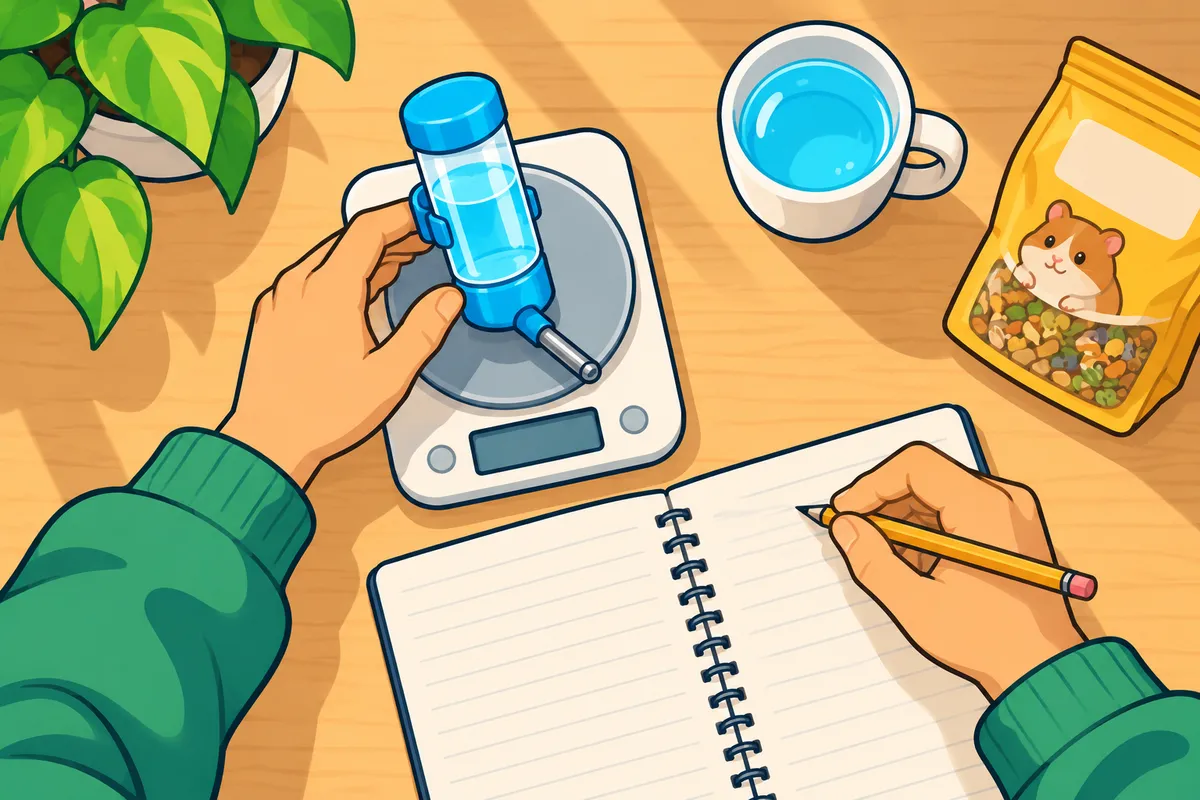
Weigh the bottle. Merck's owner page notes that hamsters are nocturnal and sleep through the day, so you will rarely watch them drink, but a kitchen scale reads the night's drinking for you: 1 g of water is 1 ml.
Measure a night of drinking
- Weigh the full bottle in the evening and write it down
- Hang it back on the cage for the night
- Weigh it again the next evening, at the same time
- The difference in grams is the ml your hamster drank
Do this on three ordinary days and take the middle value. A small loss from drips and evaporation is part of every reading, so compare your hamster with its own normal, not with the last decimal of Merck's 30 ml.
Why Is My Hamster Drinking So Much Water?
Heat, a dry diet or illness. A hot room raises any animal's water need, and the Merck pet owner page on hamster diseases lists extra thirst, increased urination or a wetter cage with weight loss as signs of kidney inflammation.
Merck's veterinary chapter adds that degenerative kidney disease happens more often in older Syrian hamsters, particularly females. A hamster of two years or more that starts draining its bottle faster and losing weight needs a vet visit.
Do Hamsters Drink More in Summer?
Often, yes. Merck's table lists temperature among the things that change intake, and its 30 ml was measured in thermoneutral conditions, so a room hotter than that, such as an attic bedroom in a heatwave, can push the number up. Merck's owner page keeps hamsters between 18 and 26 °C (64 and 79 °F).
Keep the cage out of direct sun and away from radiators, and expect the bottle to drop a little more on hot days. A rise that stays after the weather cools, or comes with weight loss, is the one to take to a vet.
| Room temperature | What Merck says | What to do with the water |
|---|---|---|
| Below 5 °C (41 °F) | Hamsters often hibernate; Syrians do not fatten first and will starve if they do not wake to eat | Move the cage somewhere warmer, and keep fresh water in the bottle |
| 18 to 26 °C (64 to 79 °F) | The cage range Merck gives | Daily bottle check and a refill |
| Above 26 °C (79 °F) | Outside that range, and temperature changes intake | Shade, away from radiators; look at the bottle twice a day |
How Long Can a Hamster Go Without Water?
Not long, and no vet source gives a safe number of hours. The Vet Desk, in a guide reviewed by Dr. Luqman Javed, DVM, says only that a hamster "cannot survive without water" and needs fresh water at all times. Pet sites repeat about three days as the outer limit, which is a ceiling and not a plan.
For a trip, the same guide says to leave as many working bottles as the cage holds as a backup, and to have someone replace the water daily. A hamster that has had no water for a day and seems limp or sunken needs a vet the same day.
Why Is My Hamster Not Drinking Water?
Check the bottle before the hamster. A blocked sipper keeps the level still while the hamster goes thirsty, and Merck asks you to make sure the sipper isn't blocked when you clean it each day.
- Blocked sipper: tap the ball at the tip; a drop should appear. If not, refill and clean the tube.
- Tube too high: Merck recommends the tube close to the floor so the hamster can reach it.
- A cold room: Merck notes hamsters often hibernate below 5 °C (41 °F), and that Syrians do not fatten first and will starve if they do not wake to eat.
- Illness: Merck lists diarrhea, known as wet tail, among common hamster problems, and some causes bring dehydration and weight loss.
Keep the room inside Merck's 18 to 26 °C (64 to 79 °F) range and a sleepy, cold hamster is far less likely.
When to Take Your Hamster to a Vet
Merck's owner pages give the signs, and some are emergencies. Small animals lose water fast, so act the same day.
These come from Merck's pet owner page on hamster disorders.
Hang the Bottle Low and Weigh It for Three Nights
Tick each line, then measure for three nights so you know its normal.
Your hamster's water, set up right
5 items- A bottle with a stainless steel sipper, set low; no glass tube for a Syrian
- Bottle cleaned and refilled every day, tip checked for a drop
- A small heavy bowl as a backup if the sipper often sticks
- The cage in a room between 18 and 26 °C
- Three evenings of bottle weights written on a card
Write the three nights' readings on a card by the cage. If the other pets in your home have their own bowls, the same measured-day habit works for every one of them.
General information for healthy adults, not medical advice. If a doctor has set your fluid amount, follow that.

More in Pets

Sources
- Merck Veterinary Manual. Select Physiological Data for Laboratory Animals, 2026.
- Merck Veterinary Manual. Hamsters, 2026.
- Merck Veterinary Manual (pet owner version). Providing a Home for a Hamster, 2026.
- Merck Veterinary Manual (pet owner version). Disorders and Diseases of Hamsters, 2026.
- The Vet Desk (reviewed by Luqman Javed, DVM). How Long Can a Hamster Go Without Food and Water?, 2025.
- Hamster Care wiki (community). Water, 2026.
Sources checked by the Glubbo Editorial Team on Oct 19, 2026. General information, not medical advice. How we write and check our guides.

