Water at Home · Filters and Treatment
Is Filtered Water Safe to Drink? When a Filter Helps or Hurts
When the glass from your pitcher or fridge is safe, what a filter cannot fix, and how an old cartridge causes trouble.
 By the Glubbo Editorial Team · Updated Oct 19, 2026 · 7 min read
On This Page
- Is Filtered Tap Water Safe to Drink?
- Does a Home Filter Remove PFAS?
- Can a Filter Make Unsafe Water Safe?
- Can an Old Water Filter Make Water Worse?
- Does Filtered Water Lose Fluoride?
- Should You Drink Filtered, Tap or Bottled Water?
- Do Brita and PUR Pitchers Make Water Safe?
- Who Should Be Careful With Home Filters?
- What to Check Before You Buy or Replace a Filter
- Sources
Short answer
Yes, from a safe tap and a cartridge changed on time.
- The CDC says most pitcher and fridge filters are not designed to remove germs.
- Change cartridges on the maker's schedule so germs do not grow in them.
- For lead, the filter needs an NSF/ANSI 53 lead claim.
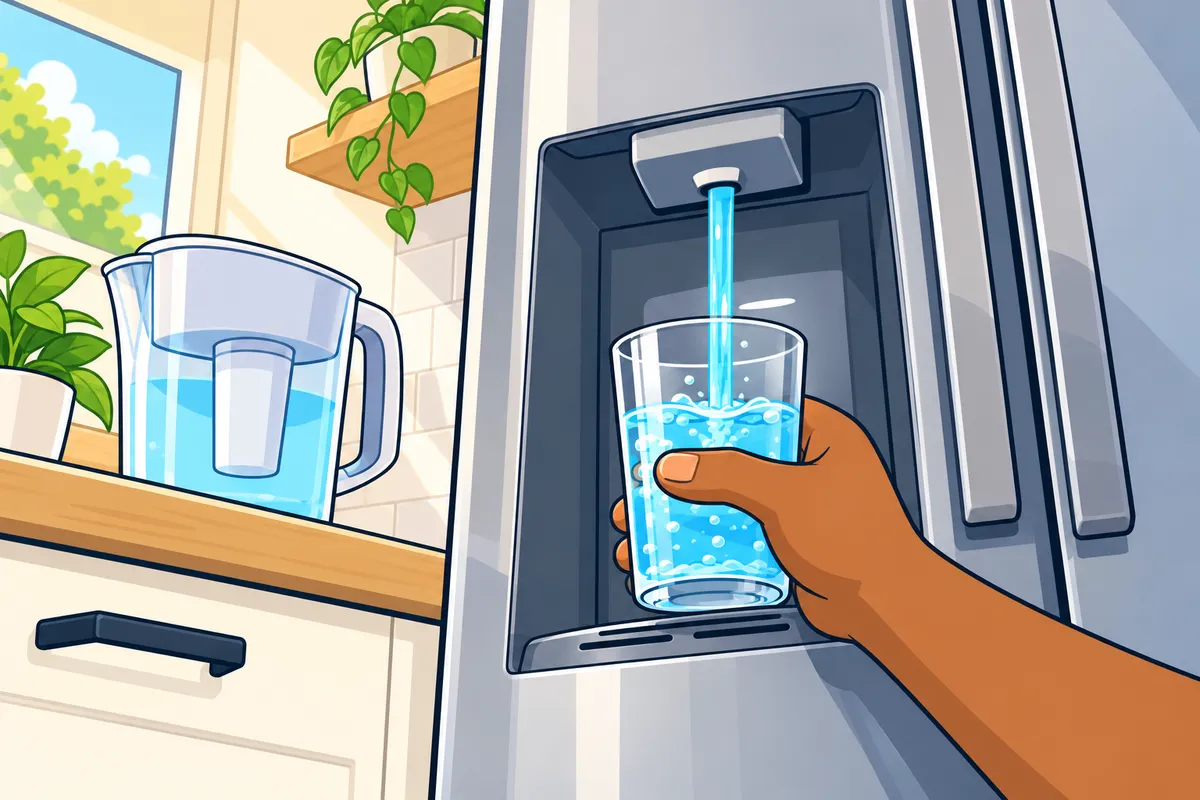
Filtered water is as safe as the tap water that went in, as long as you change the cartridge on time. A filter cannot turn unsafe water safe unless the maker built it for the specific problem, and most pitcher and fridge filters are not designed to remove germs.
A filter can also make water worse, in one specific way: an overdue cartridge lets germs grow. Whether the glass from your pitcher or fridge door is safe comes down to the water that went in and the cartridge it went through.
Your Filtered Water Is Safe to Drink When
4 items- The tap water going in meets drinking water standards
- You change the cartridge on the maker's schedule
- Its certification names what your report or test found
- No boil notice is in force, or you boil as well
Is Filtered Tap Water Safe to Drink?
Yes, as safe as the tap water itself, and sometimes safer. The CDC says that if your water is free of harmful germs and chemicals, you may not need a filter at all, so a filter on safe tap water mostly changes taste, smell or, with the right certification, lead.
Most pitcher and fridge filters use carbon. They typically improve taste or remove heavy metals like lead, and they are not designed to remove germs.

When the Filter Earns Its Place
A filter matters when your water report or a test names something listed on its certification. Lead is the common case: the EPA's consumer tool lists point-of-use and pitcher filters certified to bring lead down to 5 parts per billion or less.
Those filters held up in real homes. In a study across more than 345 locations in Flint, Michigan, over 97 % of filtered samples were below 0.5 µg/L of lead, and the highest was 2.9 µg/L, well under the bottled water standard. In the shop, the lead claim sits in small print on the box, next to the NSF/ANSI 53 mark.
For scale:
- EPA's lead action level for utilities is 15 ppb today.
- Its 2024 rule lowers it to 10 µg/L (the same as 10 ppb) once the rule takes effect in late 2027.
- The highest filtered Flint sample, 2.9 ppb, sat under a fifth of today's level and under a third of the new one.
Is Refrigerator Filtered Water Safe to Drink?
Yes, from a safe supply and a filter that is not overdue. A fridge filter is usually a carbon cartridge like a pitcher's, so it shares the same limit: it is not designed to remove germs, so it cannot turn unsafe water safe.
The overdue cartridge is the common slip with fridges, because it sits out of sight at the back of the fridge or behind the grille. Write the date you fitted it somewhere you will see it.
Does a Home Filter Remove PFAS?
Some do, if they are certified for it and kept up. EPA found that point-of-use filters using granular activated carbon, ion exchange resin or reverse osmosis can greatly reduce PFAS, and that they work only when you replace them on the maker's schedule. On the label, look for NSF/ANSI 53 or 58 with a PFAS reduction claim.
The rules around it are still moving. EPA's drinking water rule set two limits:
- 4.0 parts per trillion for PFOA and for PFOS.
- 10 ppt for PFHxS, PFNA and GenX.
On 18 May 2026 EPA proposed to keep the PFOA and PFOS limits and let water systems request two more years, to 2031, to meet them, and to rescind the limits for the other three and the mixture rule; as of 19 October 2026 those are proposals, not final.
| Home option | Typical price range (EPA) | Replace |
|---|---|---|
| Granular activated carbon filter | About $20 to $1,000 | Filter, on the maker's schedule |
| Ion exchange resin filter | About $20 to $1,000 | Filter, on the maker's schedule |
| Reverse osmosis | About $150 to $1,000 | Cartridges and the membrane |
One limit applies to all of them. EPA says certifications as of April 2024 do not yet show that a filter removes PFAS down to the levels of the new standard, and it is working with the standard-setting bodies to update them.
Can a Filter Make Unsafe Water Safe?
Only a filter built for the specific problem, and germs need the most. The CDC's guide gives the bar for each kind of germ:
- Parasites need NSF 53 or 58 or an absolute pore size of 1 micron or less.
- Bacteria need 0.3 micron or less.
- Viruses need nanofiltration or reverse osmosis.
| Problem in the water | What removes it | A carbon pitcher? |
|---|---|---|
| Bad taste or smell | NSF 42 or activated carbon filters | Yes |
| Lead | A filter certified for lead (NSF 53 claim) | Only if certified for lead |
| PFAS | NSF/ANSI 53 or 58 PFAS claim; carbon, ion exchange or RO | Only if certified for PFAS |
| Parasites and amebas | NSF 53 or 58 cyst claim; absolute 1 micron or less | Usually no |
| Bacteria | Absolute 0.3 micron or less; ultrafiltration, nanofiltration, RO | No |
| Viruses | Nanofiltration or reverse osmosis | No |
| Many chemicals (lead, copper, sodium) | Reverse osmosis | No |
The word "absolute" carries weight in those ratings. An absolute 1-micron filter has every pore that size or smaller, while a "mean" 1-micron filter only averages it and may let a 1-micron germ through.
The same pore-size rule decides what a filter does to plastic particles, where the smallest pieces slip under a 1-micron rating.
During a boil water notice, a pitcher filter is no substitute for the pot. A boil notice means boiled or bottled water for drinking, ice and formula, filter or not.
Can an Old Water Filter Make Water Worse?
It can, by growing germs. The CDC asks you to change filters regularly, on the maker's schedule, both to keep them working and to prevent germs from growing in them. A cartridge holds everything it trapped, and an overdue one also stops doing the job its label claims.
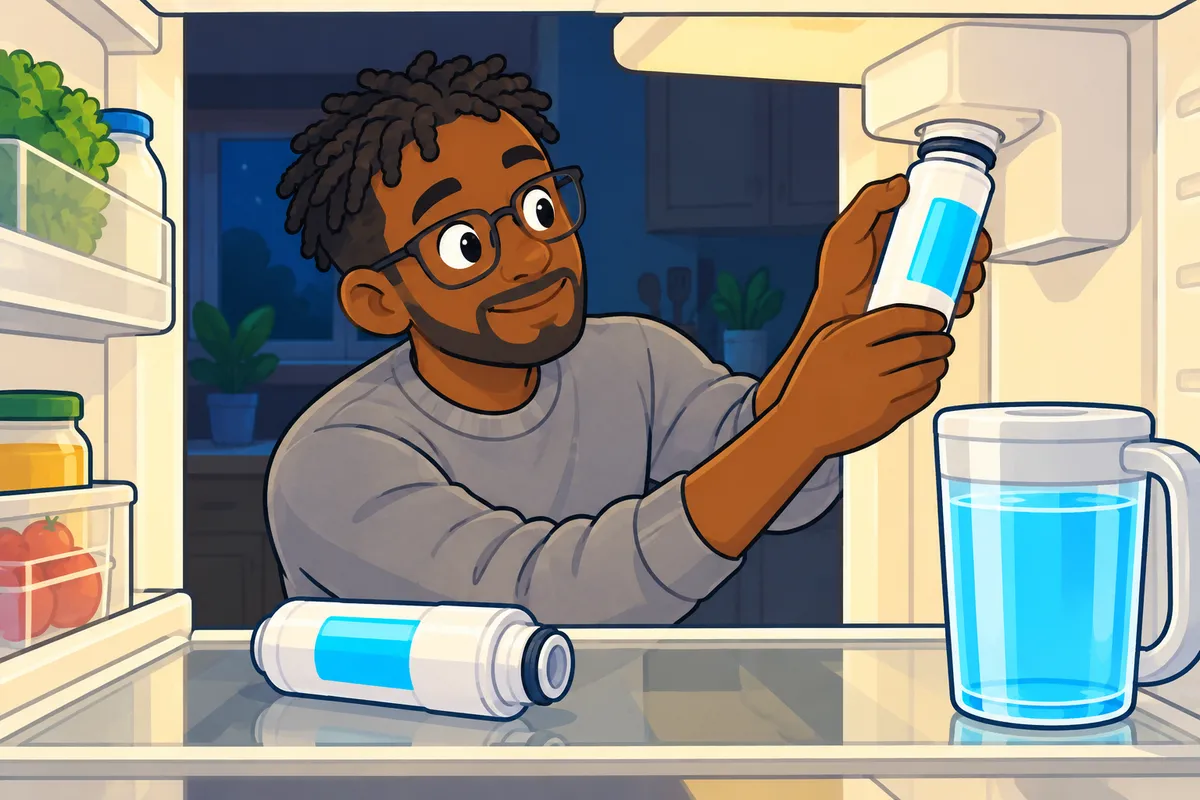
Whole-house filters carry a second risk. The CDC warns that a whole-home filter that removes chlorine or other disinfectants can let more germs grow in your plumbing, because the disinfectant was what kept them down on the way to your taps.
Change a Cartridge the Way the CDC Asks
- Check the maker's schedule and the date you fitted it
- Put on gloves before you take the old one out
- Fit the new cartridge as the maker's instructions say
- Wash your hands afterwards
The maker sets the first flush, from a few pitchers to a full day for reverse osmosis, so follow the leaflet in the box.
Does Filtered Water Lose Fluoride?
Some filters take it out. The CDC notes that filters can remove useful substances as well as harmful ones, naming chlorine and fluoride, and its overview of home systems says reverse osmosis may reduce fluoride.
That matters only if your city adds it for teeth. The CDC's recommended level is 0.7 mg of fluoride per liter; if a filter removes most of it and nearly all your water goes through that filter, tell your dentist.
Should You Drink Filtered, Tap or Bottled Water?
A different party checks each, and none of the checks cover your own cartridge. Public tap water falls under EPA standards that utilities must meet, while the FDA regulates bottled water and requires bottlers to sample and test both the source water and the finished product, its page on bottled water explains.
| Water | Who checks it | What can go wrong at home |
|---|---|---|
| Tap | Your utility, to EPA standards | Lead from your own pipes and fixtures |
| Filtered tap | Your utility before the filter; you after it | An overdue cartridge, or a filter not rated for the problem |
| Bottled | The bottler, under FDA rules | Cost over months of daily use |
The CDC notes that bottled water may not be the most cost-effective option for long-term use, though it is the right choice during a boil notice or a coliform result.
Do Brita and PUR Pitchers Make Water Safe?
They make safe water taste better, and some models also carry a lead claim. Safety depends on the model and cartridge in your hands, not the brand, so look for the standard on the box: NSF 42 for taste and odor, NSF 53 for lead or cysts, NSF 58 for reverse osmosis. Reading that label takes about a minute once you know the numbers.
Who Should Be Careful With Home Filters?
People with weakened immune systems. The CDC says they are more likely to get sick from germs in water, with Cryptosporidium a particular concern, and asks them to talk with a healthcare provider and a water disinfection specialist before buying a system.
It also asks them not to change filters themselves, since the old cartridge can expose them to the germs or chemicals it caught. Someone else in the household, wearing gloves, should do it.
What to Check Before You Buy or Replace a Filter
Start from the newest water report or test result, then buy the filter its certification matches.
- Read your utility's latest water report, or test a well, and write down what it names: lead, PFAS, nitrate, bacteria.
- Match the standard on the box to that problem: 42 for taste, 53 for lead or cysts, 58 for reverse osmosis.
- Skip the filter for bacteria; a coliform result or boil notice needs boiled or bottled water.
- Put the fit date on the cartridge and set a phone reminder for the swap.
General information for healthy adults, not medical advice. If a doctor has set your fluid amount, follow that.

More in Water at Home
Sources
- US Environmental Protection Agency. EPA's Lead and Copper Rule Improvements (fact sheet), 2024.
- US Environmental Protection Agency. Per- and Polyfluoroalkyl Substances (PFAS), 2026.
- US Environmental Protection Agency. Identifying Drinking Water Filters Certified to Reduce PFAS, 2025.
- US Food and Drug Administration. FDA Regulates the Safety of Bottled Water Beverages, 2026.
- US Centers for Disease Control and Prevention. About Choosing Home Water Filters, 2024.
- US Centers for Disease Control and Prevention. About Home Water Treatment Systems, 2024.
- US Environmental Protection Agency. Consumer Tool for Identifying Point-of-Use and Pitcher Filters Certified to Reduce Lead in Drinking Water, 2026.
- US Environmental Protection Agency, Flint archive (Bosscher and colleagues, 2019). Flint Water Sampling Objectives, 2019.
- US Centers for Disease Control and Prevention. About Water Fluoridation, 2024.
Sources checked by the Glubbo Editorial Team on Oct 19, 2026. General information, not medical advice. How we write and check our guides.

