Water at Home · Filters and Treatment
Reverse Osmosis Water System: What It Removes, Costs and Wastes
The parts under the sink, what the membrane stops, what it costs, how much water it drains and the upkeep it needs.
 By the Glubbo Editorial Team · Updated Oct 19, 2026 · 8 min read
On This Page
- How Does a Reverse Osmosis Water System Work?
- What Does a Reverse Osmosis System Remove?
- What Does Reverse Osmosis Not Remove?
- How Much Water Does a Reverse Osmosis System Waste?
- How Much Water Does a Home RO System Make a Day?
- How Much Does a Reverse Osmosis System Cost?
- How Often Do You Change Reverse Osmosis Filters?
- Should You Get an Under-Sink or Whole-House RO System?
- Is an RO System Right for Your House?
- Sources
Short answer
A membrane unit for one tap; it wastes water.
- Waste runs from about 1:1 (EPA) to 4:1 (Nebraska's 20 % recovery).
- A household membrane makes about 10 to 35 gallons a day into a 2 to 5 gallon tank.
- Expect $450 and up, plus $120 or more a filter cycle (Penn State).
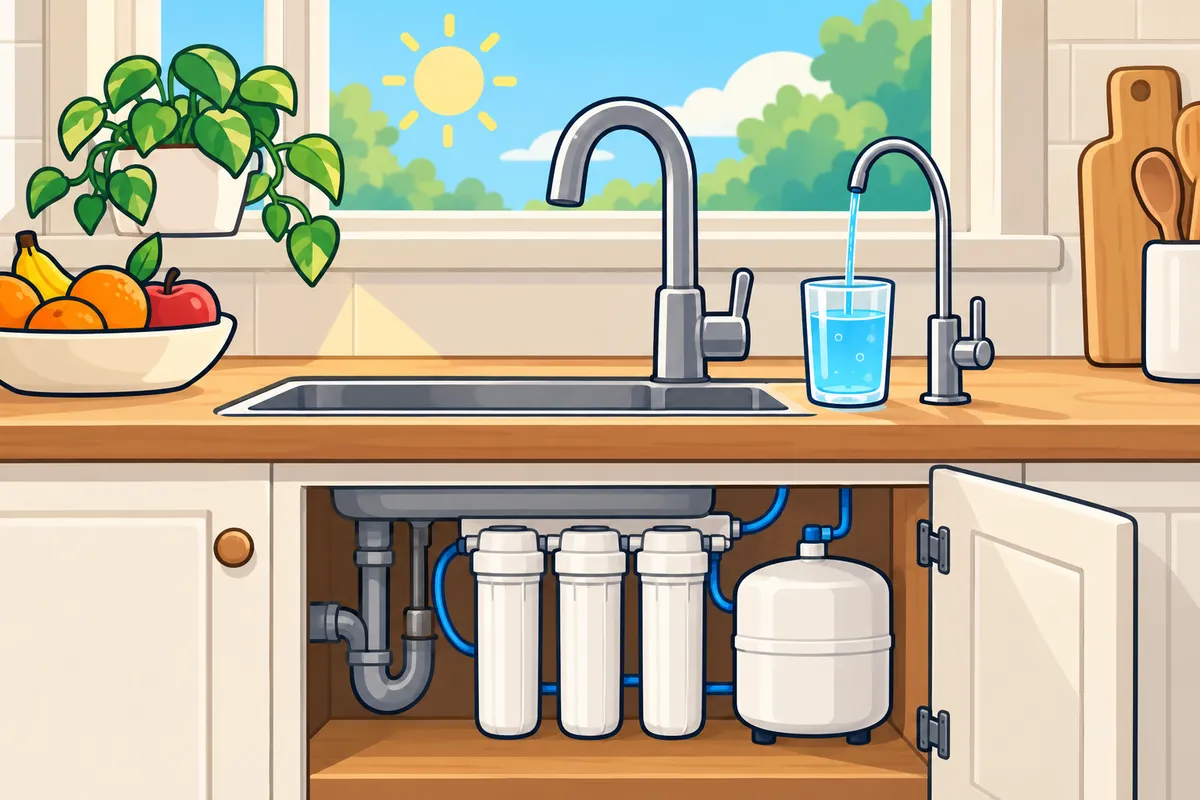
A home reverse osmosis system pushes tap water through a membrane into a small tank that feeds its own faucet. It removes germs and many dissolved chemicals, costs about $450 and up before you add filters, and sends part of the water it takes in down the drain.
The water from the small extra faucet beside your kitchen tap has been through more than any pitcher manages. Both facts, the thorough cleaning and the waste, come from the same part: a membrane with pores small enough to hold back most of what is dissolved in tap water.
- 10–35 gal
- of treated water a day from a household membrane
- 2–5 gal
- held in the usual storage tank
- 20–30 %
- recovery Nebraska gives for most household units
How Does a Reverse Osmosis Water System Work?
It pushes tap water through a membrane that lets water through and holds most dissolved substances back. The University of Nebraska's guide explains that pressure goes on the contaminated side of the semipermeable membrane; cleaner water passes to the treated side, and a stream of wastewater flushes the rejected contaminants away.
A typical home system has these parts in a row, Nebraska lists: a pretreatment filter, the RO membrane, a flow regulator, a post-treatment filter and a storage tank, plus its own faucet.
Where Your Tap Water Goes in an RO Unit
- Pre-filter catches particles that would clog the membrane
- The membrane lets water through and holds most dissolved substances back
- A flow regulator sends the rejected water to the drain
- Treated water waits in a 2 to 5 gallon tank
- A post-filter polishes it on the way to the faucet
Pressure is the one thing the house must supply. Nebraska says your feed line pressure must be enough to beat the membrane's osmotic pressure and the back pressure from the tank; where it is not, an auxiliary pump raises it.

Countertop Units
Nebraska puts most home RO systems in one of two places, under the sink or on the countertop. Both are point-of-use units that treat water for one tap, so the same rules follow a countertop model: rejected water has to go somewhere, the filters need changing on the maker's schedule, and its NSF/ANSI 58 listing tells you what it removes.
Output is where people get caught out. Every membrane makes 1 to 2 % less per degree below 77 °F, Nebraska says, so 45 °F well water gives about half the amount. Size a countertop unit, like any other, for your coldest month.
What Does a Reverse Osmosis System Remove?
Germs and many dissolved chemicals. The CDC says reverse osmosis removes parasites, bacteria and viruses, and some chemicals including lead, copper, chromium, chloride and sodium; it may also reduce arsenic and fluoride, so the label tells you which.
What a Certified RO Unit Can Take Out
4 items- Parasites, bacteria and viruses
- Lead, copper and chromium
- Sodium and chloride
- Nitrate, arsenic and radium, per Nebraska's table; fluoride may be reduced
That breadth sets it apart. In the CDC's guide to choosing home water filters, only nanofiltration and reverse osmosis appear against viruses, the one group no carbon pitcher touches, a gap that decides whether filtered water is safe in a given house.
For lead, a reverse osmosis unit is one of the tools that work, alongside pitchers and faucet filters with an NSF/ANSI 53 lead claim. For nitrate, Penn State puts a home unit at about 83 to 92 % removal, and why a very high well can still beat it comes down to arithmetic.
What Does Reverse Osmosis Not Remove?
Dissolved gases and some small organic chemicals. Nebraska names hydrogen sulfide, the gas behind a rotten-egg smell, plus some pesticides, solvents and volatile organic chemicals (VOCs) that pass through the membrane.
So a well that smells of sulfur needs a different treatment, and water with solvent contamination needs a carbon stage or a different system. Read the certification for the exact chemicals before you trust a unit with them.
Does Reverse Osmosis Remove PFAS?
It can, if the unit is certified for it. EPA found that point-of-use reverse osmosis, carbon and ion exchange systems can greatly reduce PFAS when kept up, and Penn State says an RO unit should carry NSF/ANSI 58 with PFOA and PFOS reduction claims. Both add a limit: the certification test uses a combined 20 nanograms per liter, and it does not show that a unit reaches EPA's drinking water limit of 4 parts per trillion for each.
How Much Water Does a Reverse Osmosis System Waste?
Sources disagree on the ratio, and the gap is the unit's design:
- Nebraska's 2014 guide puts most household systems at a 20 to 30 % recovery rate: at 20 %, 100 gallons of feed water gives 20 gallons to drink and sends 80 down the drain.
- Penn State says reverse osmosis can waste up to 90 % of incoming water.
- EPA's 2025 page on PFAS filters puts the process at roughly one gallon wasted for every gallon treated.
So "drains most of its intake" describes older, low-recovery designs, and newer units may do better. Ask the maker for the unit's rated recovery or efficiency before you buy, and compare that one number across models.
The wastewater is your own tap water carrying what the membrane rejected, more concentrated than before. That is why the unit needs a drain connection and why a high recovery rate saves water.
How Much Water Does a Home RO System Make a Day?
About 10 to 35 gallons a day from a household membrane, Nebraska says, stored in a tank of 2 to 5 gallons. That covers drinking and cooking at one tap, with room to spare for most households.
The tank sets your rhythm. Fill a large pot from a 2-gallon tank and you wait for it to refill; a bigger tank or a faster membrane fixes that if you cook a lot.
How Much Does a Reverse Osmosis System Cost?
From about $450 for the system, plus $120 or more each time you replace the filters, according to Penn State Extension's price table. That is well above a pitcher and in the same range as dispensers and faucet-connected systems, and over the years most of the cost is filters.
| Home option | Starting cost | Replace every | Replacement cost |
|---|---|---|---|
| Pour-through pitcher | $25 to $75 | 3 to 6 months | $15 to $45 |
| Countertop or under-sink dispenser | $400 to $1,350 | About 6 months | $60 to $180 |
| Reverse osmosis system | $450 and up | Carbon blocks 6 to 12 months; RO cartridges 12 to 24 months | $120 and up |
How Often Do You Change Reverse Osmosis Filters?
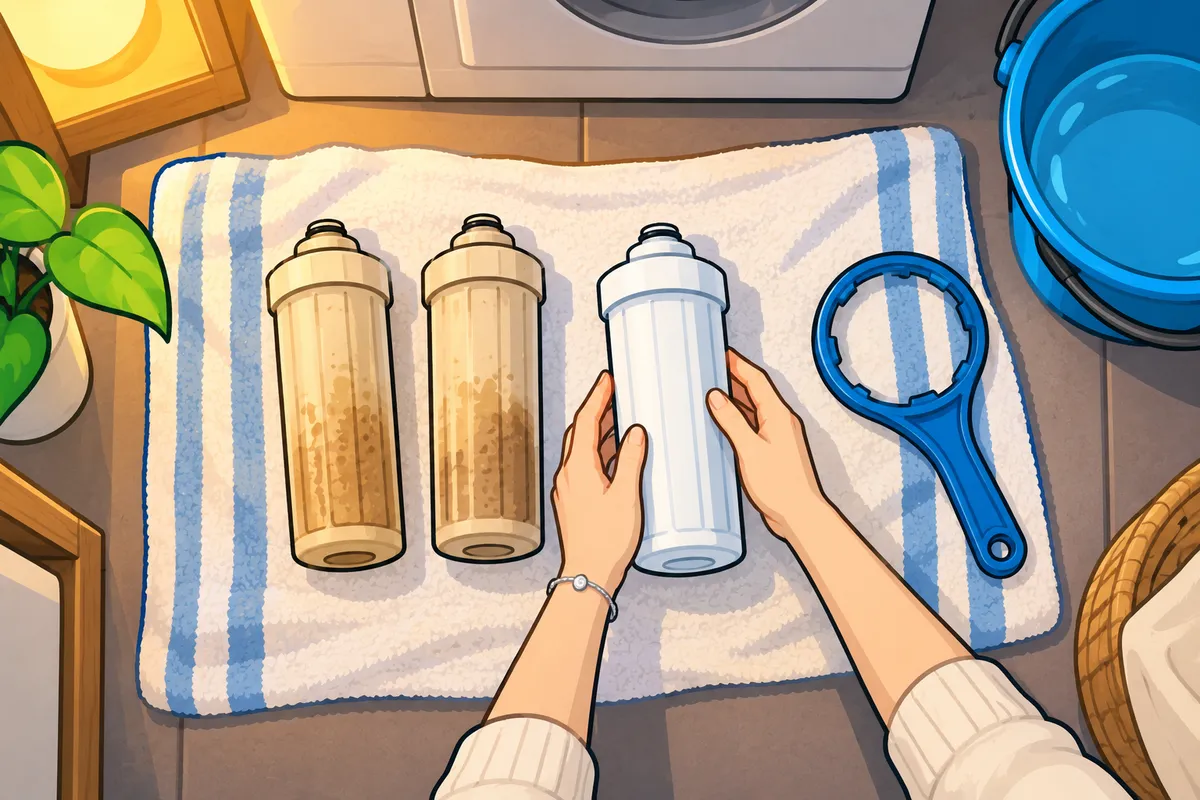
The pre-filters and post-filters on the maker's schedule, the membrane only when it fails. Nebraska says pre- and post-filters need regular replacement, with timing from the manufacturer or dealer, while you replace the membrane only once it clogs completely or tears.
It adds two habits that are easy to skip:
- Disinfect the system regularly with the products the maker supplies.
- Test the treated water from time to time to make sure the membrane still works.
| Part | Its job | When to replace it |
|---|---|---|
| Pre-filter | Catches particles before the membrane | Regularly, on the maker's schedule |
| RO membrane | Rejects dissolved substances to the drain | Only when completely clogged or torn |
| Post-filter | Treats water on its way to the faucet | Regularly, on the maker's schedule |
| Whole system | Stays free of germs | Disinfect regularly with the maker's products |
| Treated water | Shows whether the membrane still works | Test it from time to time |
Should You Get an Under-Sink or Whole-House RO System?
Under the sink, for most homes. Nebraska notes that point-of-entry units, which treat all the water coming into the house, cost more to buy, install and run than point-of-use units, and you rarely need membrane-treated water to flush a toilet.
Under-Sink (Point of Use)
- Treats drinking and cooking water
- 10 to 35 gallons a day covers it
- Lower purchase and running cost
Whole-House (Point of Entry)
- Treats every tap and appliance
- Costs more to buy, install and run
- Drains far more water each day
The CDC lists NSF Standard 58 as the certification for reverse osmosis systems. Nebraska adds that WQA-certified products carry the Water Quality Association Gold Seal.
Water That Tastes Different
Reverse osmosis water has fewer dissolved minerals than most tap water, so it tastes flatter to some people. Bottled water made the same way carries the legal name "reverse osmosis water", one of the kinds of purified water on a bottle label.
Is an RO System Right for Your House?
- Read your water report or well test and list what you want removed.
- Check that a unit's NSF/ANSI 58 certification names each of those.
- Ask for the installed price, the yearly filter cost and the rated recovery in writing.
- Ask whether your water pressure is enough, or whether you need a pump.
- Plan for the drain line, and mark the filter change dates on a calendar.
General information for healthy adults, not medical advice. If a doctor has set your fluid amount, follow that.

More in Water at Home

Sources
- University of Nebraska-Lincoln Extension (Dvorak and Skipton). Drinking Water Treatment: Reverse Osmosis (G1490), 2014.
- US Centers for Disease Control and Prevention. About Home Water Treatment Systems, 2024.
- US Centers for Disease Control and Prevention. About Choosing Home Water Filters, 2024.
- Penn State Extension (Robillard, Sharpe and Swistock). Nitrates in Drinking Water, 2025.
- Penn State Extension (Kibuye). Home Water Treatment for PFAS, 2024.
- US Environmental Protection Agency. Identifying Drinking Water Filters Certified to Reduce PFAS, 2025.
Sources checked by the Glubbo Editorial Team on Oct 19, 2026. General information, not medical advice. How we write and check our guides.

