Water at Home · What Can Be in Water
How to Remove Nitrates From Water, and the Fixes That Fail
The three treatments that take nitrate out of well water, how much each removes, and the first steps before you buy one.
 By the Glubbo Editorial Team · Updated Oct 19, 2026 · 8 min read
On This Page
- How Do You Remove Nitrates From Well Water?
- Does Reverse Osmosis Remove Nitrates?
- Does a Water Softener Remove Nitrates?
- Does a Carbon Filter Remove Nitrates?
- Can You Boil Nitrates Out of Water?
- How Much Nitrate Is Too Much in Drinking Water?
- Is Treated Well Water Safe for a Baby?
- Two Wells, Two Systems
- From a High Nitrate Result to Safe Water
- Sources
Short answer
Use reverse osmosis, anion exchange or distillation.
- The CDC names those three; boiling makes nitrate stronger.
- Penn State puts home reverse osmosis at about 83 to 92 % nitrate removal.
- Bottled water for babies under 6 months until the problem is fixed.

Use reverse osmosis, anion exchange or distillation: those are the three treatments the CDC names for nitrate, and a home system should be certified to remove it. Boiling does the opposite and makes nitrate stronger, and a carbon pitcher is not on the list at all.
Nitrate has no color, taste or smell, so the first sign of it is usually a number on a lab letter. By then the question is what to buy, and the shop shelf is full of filters that do nothing to it. Each of the three treatments has a cost the brochure leaves out, and none of them is the first thing to do.
How Do You Remove Nitrates From Well Water?
With ion exchange, distillation or reverse osmosis, the three methods the CDC lists for nitrate, choosing a system certified to remove it. But the Minnesota Department of Health puts treatment last. Its order is:
- A safe alternative water source.
- A licensed contractor to inspect the well.
- Finding and removing the nitrate sources on your property.
That order saves money. A cracked well cap or a septic field too close can be fixed once, while a treatment system needs cartridges, salt or electricity for as long as the problem stays.

Penn State Extension names where it comes from: fertilizer and manure spread on fields, plus septic systems and lawn fertilizer. Shallow wells and springs are especially prone to it, so a well downhill of a field or a drain field is the first suspect.
When you cannot move the source, treatment comes next. People reach for four things, and one of them does nothing to nitrate.
What Takes Nitrate Out, and What Does Not
Reverse osmosis
Most common at one tap
- About 83 to 92 % removed (Penn State)
- Wastes much of the water it takes in
- Usually serves the kitchen tap
Suits you if your nitrate is moderate and you want treated water to drink and cook with.
Anion exchange
Treats more water
- Swaps nitrate for chloride on a resin
- High sulfate gets in the way
- Brine waste is high in nitrate
Suits you if a lab test shows low sulfate and you want more than one tap treated.
Distillation
Small batches
- About a gallon every 4 to 5 hours
- Highest running cost: electricity
Suits you if you need a few liters a day and can wait for them.
Boiling or a carbon pitcher
Does not work
- Boiling concentrates nitrate
- Not one of the CDC's three methods
Suits you if never, for nitrate.
Does Reverse Osmosis Remove Nitrates?
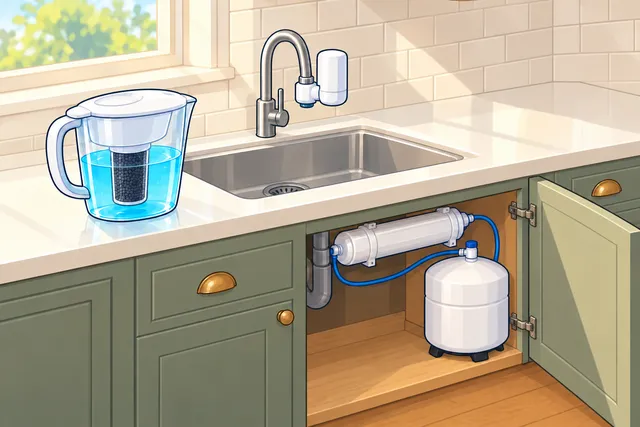
Yes, most of it. Penn State estimates a home unit removes around 83 to 92 percent of the nitrate it receives. Units usually run at one tap, such as the kitchen sink, and send part of the water down the drain to carry the rejected nitrate away.
The percentage matters more than the word "removes". The University of Nebraska's guide to reverse osmosis works an example: a membrane with 85 % rejection takes 34 mg/L out of water carrying 40, which leaves 6.
So a very high well can beat a good membrane. Nebraska's own example shows 80 mg/L still above the limit after treatment, and Penn State warns that above 110 mg/L of nitrate-nitrogen even 90 % removal can leave water over 10 mg/L, so you test the treated water instead of assuming it.
The waste is the other cost. Penn State says reverse osmosis can waste up to 90 percent of the water it takes in, and Nebraska puts most household systems at 20 to 30 % recovery, which means a unit fed 100 gallons yields 20 gallons and sends 80 down the drain. A home unit also takes space under the sink and filters changed on the maker's schedule, which add to that cost every year.
Does a Water Softener Remove Nitrates?
A standard softener is the wrong tool. Penn State's softening guide explains that a softener trades sodium for calcium and magnesium, the minerals that make water hard; nitrate needs a resin that trades for it, charged with chloride, which is why the job is called anion exchange.
The CDC's overview of home systems does say some softeners may also remove nitrates, so the label decides. Buy only a unit whose certification names nitrate, and see what a softener does to your water before assuming the one in your basement already helps.
Water Softener
- Swaps sodium for calcium and magnesium
- Built for scale and soap scum
- Removes nitrate only if certified for it
Anion Exchange Unit
- Swaps chloride for nitrate
- Built for nitrate and sulfate
- Needs a sulfate result before you buy
Why Sulfate Matters for Anion Exchange
Penn State notes that the resin prefers sulfate. In water high in sulfate, the resin fills up with it and stops taking nitrate early, so have the lab report sulfate before you choose this system. The salt brine that cleans the resin comes out high in nitrate, too, and needs careful disposal.
Can a Full Resin Put Nitrate Back?
Yes. Penn State warns that a saturated resin can release nitrate back into the treated water, so the water leaving the unit can carry more than the water entering it. That is the reason to retest treated water at a certified lab after the first weeks and on a schedule, not once.
Does a Carbon Filter Remove Nitrates?
No carbon filter appears among the methods the CDC names for nitrate, and pitcher and fridge filters are mostly carbon. The CDC lists only ion exchange, distillation and reverse osmosis, so a pitcher bought for nitrate gives a false sense of safety.
Carbon still sits inside most reverse osmosis units, Penn State notes, as one stage among several. There it protects the membrane and the taste, while the membrane does the nitrate work.
Can You Boil Nitrates Out of Water?
No. The Minnesota Department of Health says boiled water is not a safe option, because boiling makes nitrate more concentrated: the water leaves as steam and the nitrate stays. A kettle of 9 mg/L water that loses a fifth to steam ends above the 10 mg/L limit, and the same happens to lead in the pot.
Distillation is the one heat method that works, because it keeps the steam instead of the pot. Nebraska lists nitrate among what a distiller removes, and a pot, a lid and a cup can do it for a small batch in an emergency.
How Much Nitrate Is Too Much in Drinking Water?
The EPA limit is 10 mg/L of nitrate measured as nitrogen, and 1 mg/L for nitrite. Above it, the risk falls on babies under six months, and the EPA lists the symptoms as shortness of breath and blue-baby syndrome.
Labs report it two ways, so check the unit. Penn State gives the same limit as 45 mg/L of nitrate or 10 mg/L of nitrate-nitrogen, a factor of about 4.5.
| Lab reports | Same amount as nitrogen | Against the 10 mg/L limit |
|---|---|---|
| 22 mg/L as nitrate | About 5 mg/L | Under it |
| 45 mg/L as nitrate | 10 mg/L | At the limit |
| 90 mg/L as nitrate | About 20 mg/L | Twice over |
| 30 mg/L as nitrogen | 30 mg/L | Three times over |
A result of 30 "as nitrate" is therefore under the limit, while 30 "as nitrogen" is not, and the lab sheet should say which one it is.
| Lab result (as nitrogen) | What the sources say | What to do |
|---|---|---|
| Under 1 mg/L | MDH: natural levels are usually under 3 | Keep testing yearly |
| 1 to 10 mg/L | MDH: above 1 suggests more testing may be a good idea | Ask about pesticides; test the well yearly |
| Above 10 mg/L | EPA limit; MDH: use another water source | Bottled water for babies; inspect, then treat |
| Above 110 mg/L | Penn State: reverse osmosis may not bring it under 10 | Fix the source; treat only with retesting |
Is Treated Well Water Safe for a Baby?
The Minnesota Department of Health recommends that no babies under six months drink treated water. Bottled water may be safer for them in case the treatment stops working, MDH says, even after a system goes in. Penn State gives the same bottled-water advice for pregnant women, because nitrate can reach the fetus.
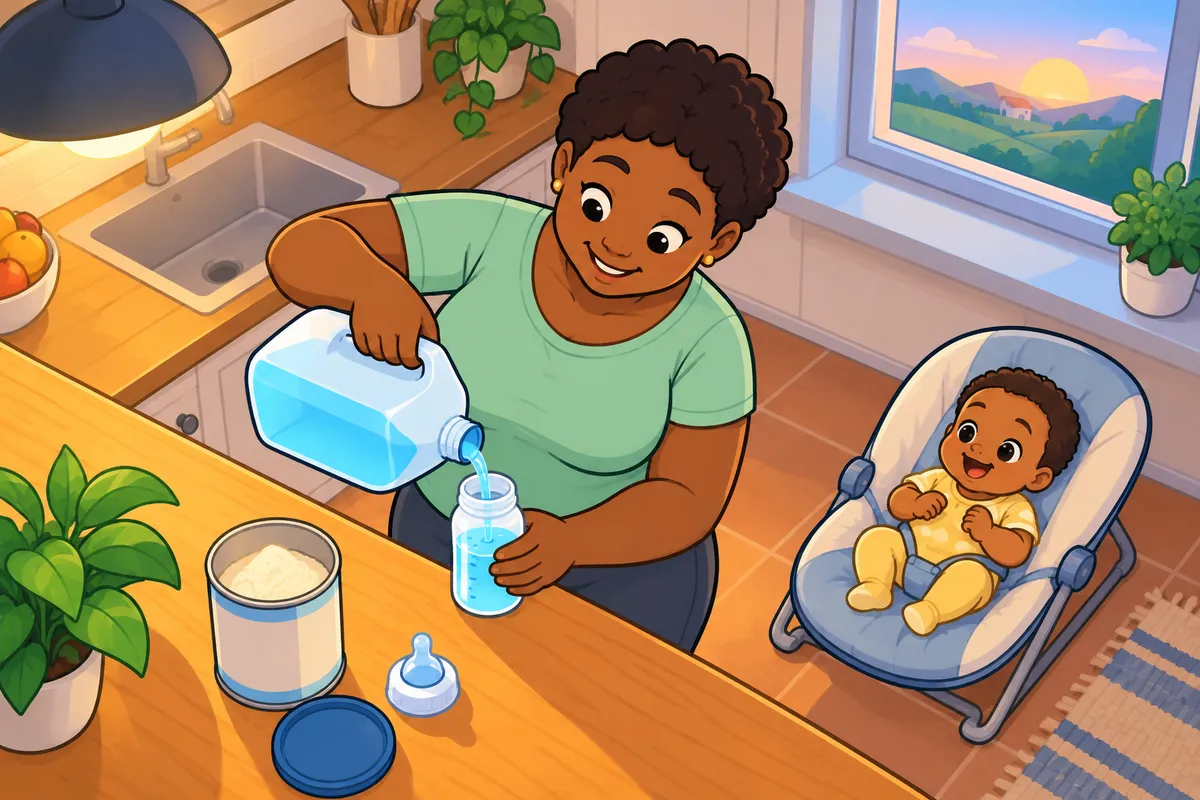
MDH also asks parents who have just had a baby to test the well before they bring the baby home. The CDC's well testing guidelines already include nitrate in every well's yearly test, and add a test when someone in the home becomes pregnant.
Two Wells, Two Systems
The same lab number leads to different systems in different houses.
From a High Nitrate Result to Safe Water
The order matters more than speed: safe water for the baby today, the cause next, the system last.
Your Order of Operations
- Switch to bottled water for baby formula today
- Have a licensed well contractor inspect the well
- Find and remove nitrate sources near the well
- Choose a system certified to remove nitrate, and get sulfate on the lab report if you want ion exchange
- Retest the treated water at a certified lab, and again on a schedule
General information for healthy adults, not medical advice. If a doctor has set your fluid amount, follow that.

More in Water at Home
Sources
- US Centers for Disease Control and Prevention. Chemicals That Can Contaminate Tap Water, 2025.
- Penn State Extension (Robillard, Sharpe and Swistock). Nitrates in Drinking Water, 2025.
- Minnesota Department of Health. Nitrate in Drinking Water, 2026.
- University of Nebraska-Lincoln Extension (Dvorak and Skipton). Drinking Water Treatment: Reverse Osmosis (G1490), 2014.
- University of Nebraska-Lincoln Extension (Dvorak and Skipton). Drinking Water Treatment: Distillation (G1493), 2013.
- US Environmental Protection Agency. National Primary Drinking Water Regulations, 2026.
- US Centers for Disease Control and Prevention. About Home Water Treatment Systems, 2024.
- US Centers for Disease Control and Prevention. Guidelines for Testing Well Water, 2024.
Sources checked by the Glubbo Editorial Team on Oct 19, 2026. General information, not medical advice. How we write and check our guides.

