Water at Home · What Can Be in Water
Does Boiling Water Remove Lead? What Boiling Leaves Behind
What a pot of boiling water kills, what it leaves in or concentrates, and the fix for each problem it cannot touch.
 By the Glubbo Editorial Team · Updated Oct 19, 2026 · 7 min read
On This Page
- Does Boiling Water Remove Lead?
- Does Boiling Tap Water Remove Chemicals?
- Does Boiling Water Remove Nitrates?
- Does Boiling Water Remove Chlorine?
- Does Boiling Tap Water Remove Minerals?
- What Does Boiling Water Actually Remove?
- Does a Longer Boil Make Water Safer?
- Does Boiling Water Remove PFAS?
- Start From the Notice or the Test
- Sources
Short answer
No. Boiling kills germs; lead stays in the pot.
- The EPA's answer is a plain no, and the CDC says boiling removes no chemicals.
- Water lost as steam leaves the same lead in less water, so the level rises.
- For lead, use cold water and a filter certified to NSF/ANSI 53 for lead.
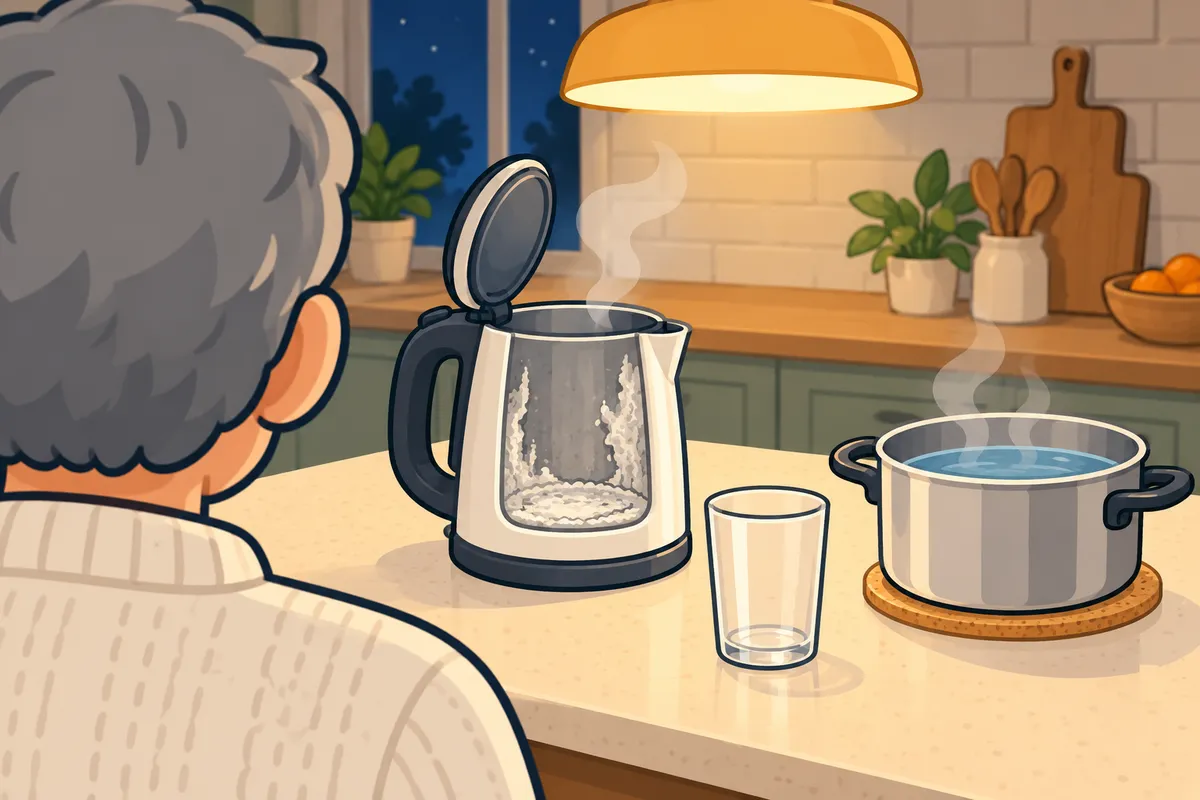
A pot of boiling water feels like the safest water in the house. For germs it is, and that is the whole of what boiling does.
Lead, nitrate and the other dissolved things people worry about go into the pot and come out of it again. Some of them come out stronger.
Does Boiling Water Remove Lead?
No. The EPA's answer is one line long: "No, boiling water does not remove lead." Lead is a metal dissolved in the water or sitting in it as tiny flakes from old pipes, and heat that kills a germ does nothing to a metal.
The CDC's lead page adds the habit that matters more than any pot. Drink and cook only with water that comes out of the tap cold, because warm or hot tap water can carry higher levels of lead than cold.
Can Boiling Make Lead in Water Worse?
Yes, a little. Lead does not leave with the steam, so every cup that boils away leaves the same lead in less water. The longer the pot boils, the higher the level climbs.
Take one example: your tap water holds 12 parts per billion of lead, under the EPA's current action level of 15 ppb in the national regulations. Boil it until a fifth has steamed off, and the 12 ppb now sits in 80 % of the water: 12 ÷ 0.8 = 15 ppb.
As of 19 October 2026, the EPA's national regulations table says water systems must comply with a lower lead action level of 10 ppb from November 1, 2027, so the margin in this example is thinner than it looks. If your worry is lead, boiling is the wrong tool, and a long boil makes it worse.
Does Boiling Tap Water Remove Chemicals?
No. The CDC's list of chemicals that can get into tap water says it plainly: boiling will not remove chemicals from water. That covers arsenic, nitrate, lead, PFAS and the rest of its list.
Ready.gov draws the same line for emergencies. Boiling and chlorine kill germs, it says, but they do not remove heavy metals, salts and most other chemicals. Of its three emergency methods, distillation is the one that removes those three, because it keeps the steam and leaves them in the pot.
| What is in the water | Does boiling remove it? | What works instead |
|---|---|---|
| Bacteria, viruses, parasites | Yes | A rolling boil, 1 minute |
| Lead | No (EPA) | Cold water only; a filter certified for lead |
| Nitrate | No, it concentrates (MDH) | Ion exchange, distillation or reverse osmosis |
| Arsenic | No | Reverse osmosis, ultrafiltration, distillation or ion exchange |
| PFAS | No | A filter certified to NSF/ANSI 53 or 58 for PFAS |
| Chlorine | Not a listed method | Let it stand a few days, or a pet-store product |
| Chloramine | No (EPA) | A filter certified for chloramine reduction (EPA) |
Sources: CDC chemicals, EPA, EPA on chloramine, MDH, CDC disinfection.
Does Boiling Water Remove Nitrates?
No, it makes them stronger. The Minnesota Department of Health says boiled water "is not a safe option because boiling water will make nitrate more concentrated", the same arithmetic as lead.
This one matters most for babies. Bottle-fed babies under six months are at the highest risk from nitrate, MDH says. So a well with high nitrate needs bottled water or another safe source for formula, never a boiled kettle.
Which home systems take nitrate out of well water depends on the level and the rest of the water.
Does Boiling Water Remove Chlorine?
It depends on which one your city adds:
- Plain chlorine leaves water on its own: the CDC says water left to sit out for a few days loses it.
- Chloramine does not leave, and the EPA says boiling does not remove it, nor does letting it sit at room temperature, nor a reverse osmosis filter.
Many utilities use chloramine because it lasts longer in the pipes, so check your water report for the word before you rely on time or heat. Standing, not boiling, is the listed method for chlorine. For fish and frogs, which take water straight into their blood, pet stores sell a product that removes both.
For people, there is usually nothing to remove: chlorine or chloramine up to 4 mg/L is safe to drink, and a taste you dislike has simpler fixes than boiling, such as a taste and odor filter.
Does Boiling Tap Water Remove Minerals?
No. Boiling sends water off as steam and leaves what is dissolved in it behind, and Ready.gov puts salts on the list boiling does not remove. As the pot loses water, the minerals that stay sit in less of it.
The white crust inside a kettle is the clue people misread. Penn State Extension explains that calcium and magnesium are what make water hard, and hard water leaves scale. Some of the minerals settle on the kettle wall as scale; the rest stay in the water you pour, and the kettle has not softened or purified it.
What Does Boiling Water Actually Remove?
Germs. A rolling boil for 1 minute kills bacteria, viruses and parasites, which is why utilities issue a boil water notice when germs may have entered the pipes. That one job is the reason boiling is still the right answer during a boil water advisory.
The notice itself tells you which problem you have.
Boil water notice
- Germs may be in the pipes
- A rolling boil for 1 minute kills them
- Your pot is the right tool
- Brush teeth and wash food with boiled water too
Do-not-drink notice
- A chemical has entered the supply
- Boiling leaves it in the pot and can concentrate it
- Use bottled water or another safe source
- Wait for the utility to lift the notice

When Boiling Is Still Worth Doing
Boil when germs are the worry and your water has no chemical problem:
- A boil notice.
- A well that tested positive for coliform bacteria.
- Water from a source you have not tested.
If both germs and a chemical are in question, bottled water covers both at once.
Does a Longer Boil Make Water Safer?
No. For germs, the time that counts is the one in the notice: the CDC asks for a full rolling boil for 1 minute, and 3 minutes above 6,500 feet, while the EPA draws the altitude line at 5,000 feet. Past that minute, every extra minute of boiling steams off more water and leaves the dissolved chemicals in what remains.
Does Boiling Water Remove PFAS?
No. Boiling will not remove chemicals, and the treatment listed for PFAS is a filter certified to NSF/ANSI 53 or NSF/ANSI 58 for PFAS reduction. Boiling is not on that list, so a PFAS result calls for a certified filter or another water source, not a longer boil.
Two kettle habits belong in the same pile:
- Boiling hot tap water for tea because it heats faster, when cold tap water is the advice for drinking and cooking.
- Expecting boiling to soften hard water because the kettle scales up.
Lead gets into water from your own pipes, so the fix lives at the tap, not on the stove.
Start From the Notice or the Test
Every problem on this page has one fix, so the work is learning which problem you have.
Your problem, your fix
- A boil notice or a coliform bacteria resultA rolling boil for 1 minute (3 above 6,500 ft)
- Lead in your water or old pipesCold water only, and a filter certified to NSF/ANSI 53 for lead
- Nitrate above the EPA limitIon exchange, distillation or reverse osmosis
- A do-not-drink notice (chemical)Bottled water until the utility lifts the notice
- PFAS in a test resultA filter certified to NSF/ANSI 53 or 58 for PFAS
- Chloramine taste you dislikeA filter certified for chloramine reduction
Whether your tap water needs anything at all starts with its yearly report and the violations column most people skip.
For lead, a certified filter is the fix that works, and the label tells you in a minute whether a filter does it.
General information for healthy adults, not medical advice. If a doctor has set your fluid amount, follow that.

More in Water at Home
Sources
- US Environmental Protection Agency. Does boiling water remove lead?, 2026.
- US Centers for Disease Control and Prevention. About Lead in Drinking Water, 2025.
- CDC. Drinking Water Advisories: An Overview, 2024.
- US Environmental Protection Agency. Emergency Disinfection of Drinking Water, 2026.
- US Centers for Disease Control and Prevention. Chemicals That Can Contaminate Tap Water, 2025.
- Minnesota Department of Health. Nitrate in Drinking Water, 2026.
- Ready.gov (FEMA). Water, 2021.
- US Centers for Disease Control and Prevention. About Water Disinfection With Chlorine and Chloramine, 2024.
- US Environmental Protection Agency. National Primary Drinking Water Regulations, 2026.
- US Environmental Protection Agency. How Can I Remove Monochloramine From My Drinking Water?, 2009.
- Penn State Extension (Robillard, Sharpe and Swistock). Water Softening, 2025.
Sources checked by the Glubbo Editorial Team on Oct 19, 2026. General information, not medical advice. How we write and check our guides.

