Water at Home · Wells, Storage and Emergencies
Is Rainwater Safe to Drink? How to Make Roof Water Safe
What gets into rain on its way to your glass, the CDC treatment steps with doses, and the chemicals they leave behind.
 By the Glubbo Editorial Team · Updated Nov 2, 2026 · 11 min read
On This Page
- Is Rainwater Safe to Drink Straight From the Sky?
- Why Is Rainwater Not Safe to Drink?
- Is Rainwater No Longer Safe to Drink Because of PFAS?
- How Do You Make Rainwater Safe to Drink?
- Is Rainwater Safe to Drink After Boiling?
- How Do You Filter Rainwater for Drinking?
- Is It Safe to Bathe in Rainwater?
- Should You Test Rainwater You Drink?
- Is It Legal to Collect Rainwater?
- Decide What Your Barrel Water Is For
- Common Questions
- Sources
Short answer
Not untreated: kill the germs, then test for chemicals.
- Boil 1 minute (3 above 6,500 ft). Bleach is weaker on parasites.
- Boiling and bleach do not remove lead, copper or PFAS from a roof or the air.
- Fit a first flush diverter and test the water regularly if you drink it.
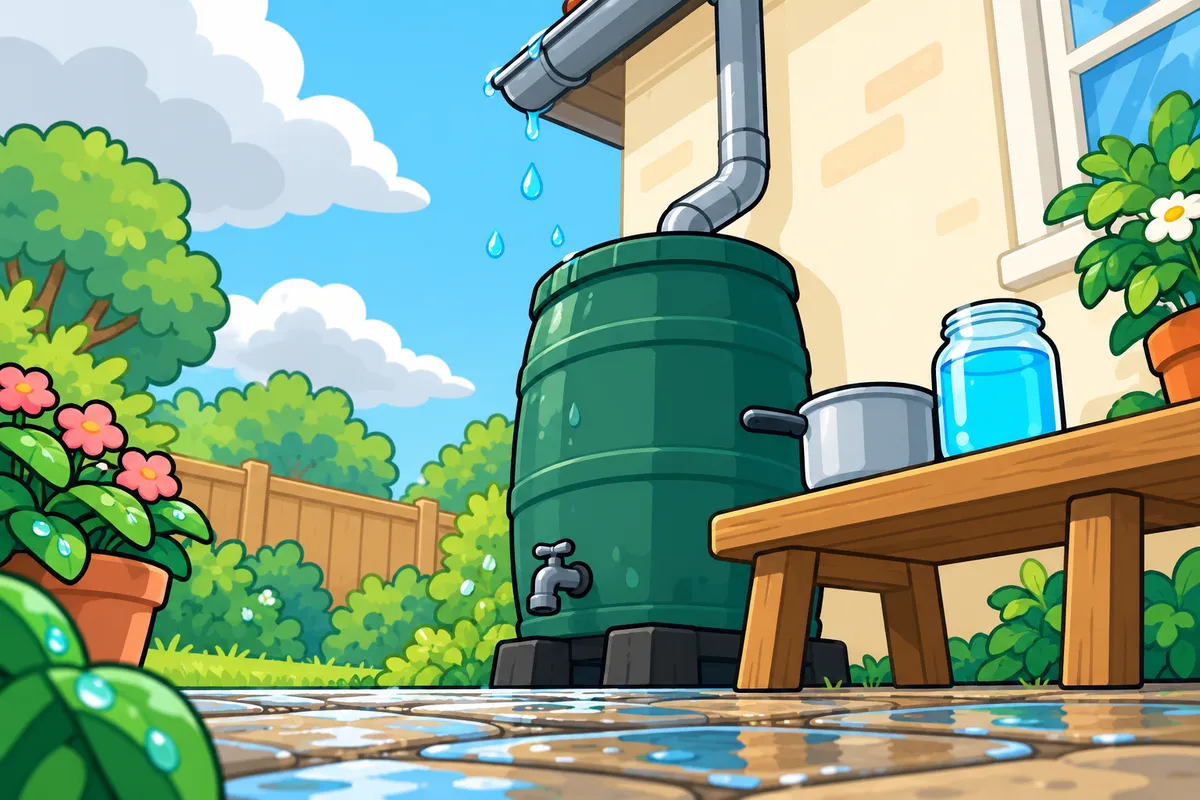
No, not straight from a barrel or a tank. The CDC says rainwater is not necessarily safe to drink until you remove the germs and chemicals in it, and that it can look clean and still make you sick. Boiling kills the germs, but bleach is weaker on parasites, and neither removes chemicals.
Most people asking this have a rain barrel, a tank on a cabin, or a storm that cut the tap. In each case the risk sits less in the rain itself and more in the roof, gutters and container it runs through.
What Kills the Germs
- A rolling boil for 1 minute
- 8 drops of 5 to 9 % bleach per gallon, then 30 minutes
- A 1-micron filter followed by a disinfectant
What Stays in the Water
- Lead, copper or asbestos from the roof
- PFAS from the air
- Fuel or other toxic chemicals
Is Rainwater Safe to Drink Straight From the Sky?
Not reliably. Rain falls through dust, smoke and whatever chemicals the air holds, and the air is one of the sources of contamination on the federal list.
Catching drops in a clean glass skips the roof and gutters, which are sources of dirt and germs. It does nothing about what the air put in the rain before it reached you, and the best-measured example of that is PFAS:
- a 2022 paper led by Ian Cousins at Stockholm University compared rain from many countries with drinking water guidelines;
- two of the four PFAS it checked, PFOA and PFOS, often came out far above the US EPA's lifetime health advisory levels;
- PFAS do not break down when you boil water.
Why Is Rainwater Not Safe to Drink?
Because rain runs over surfaces before you catch it, and then it sits. The CDC says chemicals such as asbestos, lead or copper can enter rainwater once it falls, from roofing, gutters, pipes and storage materials, and that bird droppings on the roof end up in the barrel or tank.
Where Rainwater Picks Up Germs and Chemicals
5 items- Smoke, dust and chemicals in the air the rain falls through
- Roofing materials, which can release lead, copper or asbestos
- Bird and animal droppings washed off the roof
- Gutters, pipes and the storage barrel or tank itself
- Mosquitoes breeding in an open barrel
How much of this reaches your water depends on where you live, how much it rains, the season, and how you collect and store it. One neighbor's clean test result says little about your own barrel.
What Studies Found in Roof Tanks
Researchers have found disease germs in tanks more than once. A 2011 review from Australia's CSIRO found bacterial and protozoan pathogens that spread from animals in household and shared rainwater systems, and several case-control studies that linked gastroenteritis to drinking untreated roof water.
The picture is mixed. A 2018 review of Australian rainwater lists E. coli, Salmonella, Campylobacter, Legionella, Giardia and Cryptosporidium among germs detected in collected rain. The same review says the trace metals in it were generally below health limits outside heavy-industry areas, and that population studies did not show a higher risk of stomach illness.
A tank can test clean for months and still deliver a bad week after a bird or a dead animal gets in. Regular testing and treatment cover that week; a one-off check does not.
Why You Should Never Pipe It Into Your Tap Water
Mixing them spoils the treated supply. Rainwater can contaminate water that was already treated, such as tap or bottled water, so make sure it has no way into pipes that carry drinking water.
Is Rainwater No Longer Safe to Drink Because of PFAS?
Measured against the US health advisories of 2022, rain at the places the paper drew on often failed for two of the four PFAS it checked. The Cousins paper concluded that:
- PFOA and PFOS levels in rainwater often greatly exceed the US EPA's lifetime drinking water health advisory levels.
- The sum of four PFAS in rain is often above Denmark's drinking water limit.
Read that result with its frame. The authors were testing whether PFAS have pushed the planet past a safe limit for chemical pollution, and they compared rain with recently proposed guideline levels, far lower than older ones. The paper did not study illness in people who drink rainwater.
What it does change is the treatment plan. PFAS are chemicals, so boiling does nothing to them, and a filter with a PFAS-specific claim for that exact model is the household fix to look for.
How Do You Make Rainwater Safe to Drink?
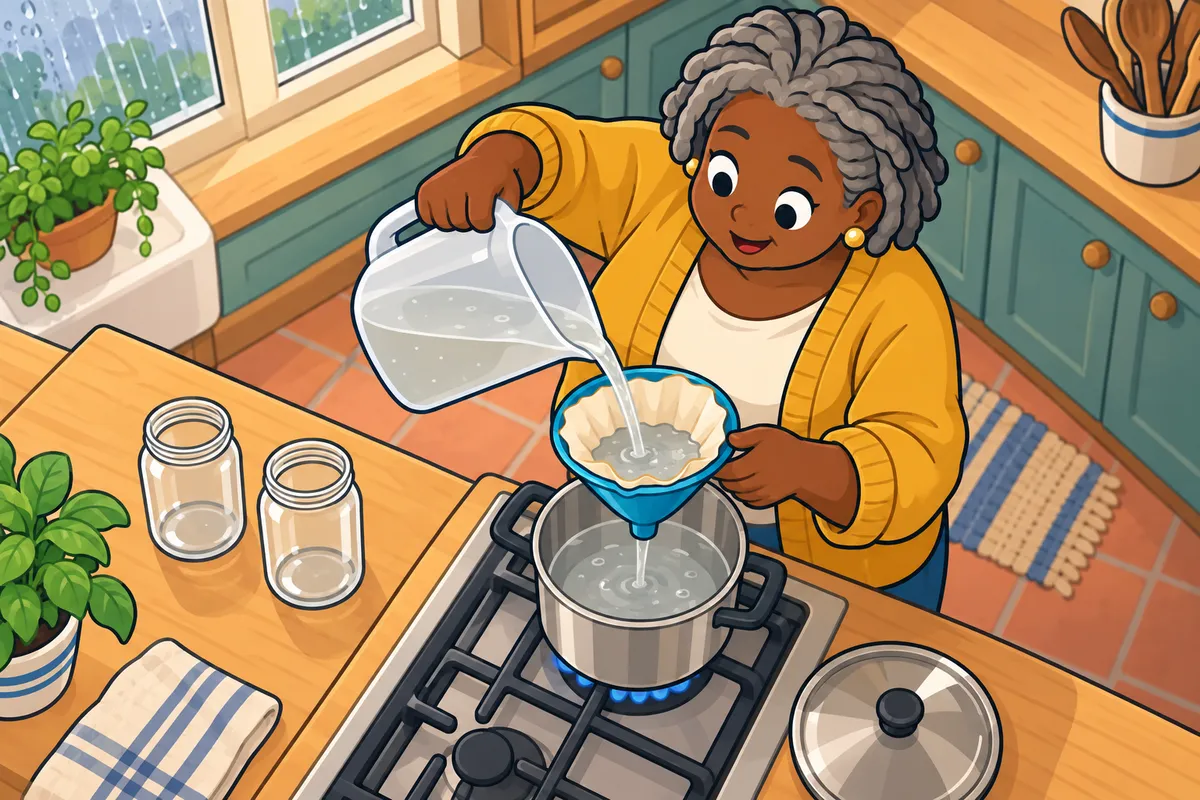
Clean it at the roof, clear it, kill the germs, then deal with any chemicals a test finds. The CDC's rainwater guidance gives the collection and testing steps, and its emergency water page gives the doses for boiling, bleach and filters. Put together, they make this order:
From Barrel to Glass
- Divert the first flush of each storm and screen the inlet
- Pour cloudy water through a cloth or coffee filter, or let it settle
- Boil 1 minute, or add bleach and wait 30 minutes
- Test for chemicals and add a filter that removes what shows up
- Store it in clean, covered containers
Step 1, Collect Cleaner Water
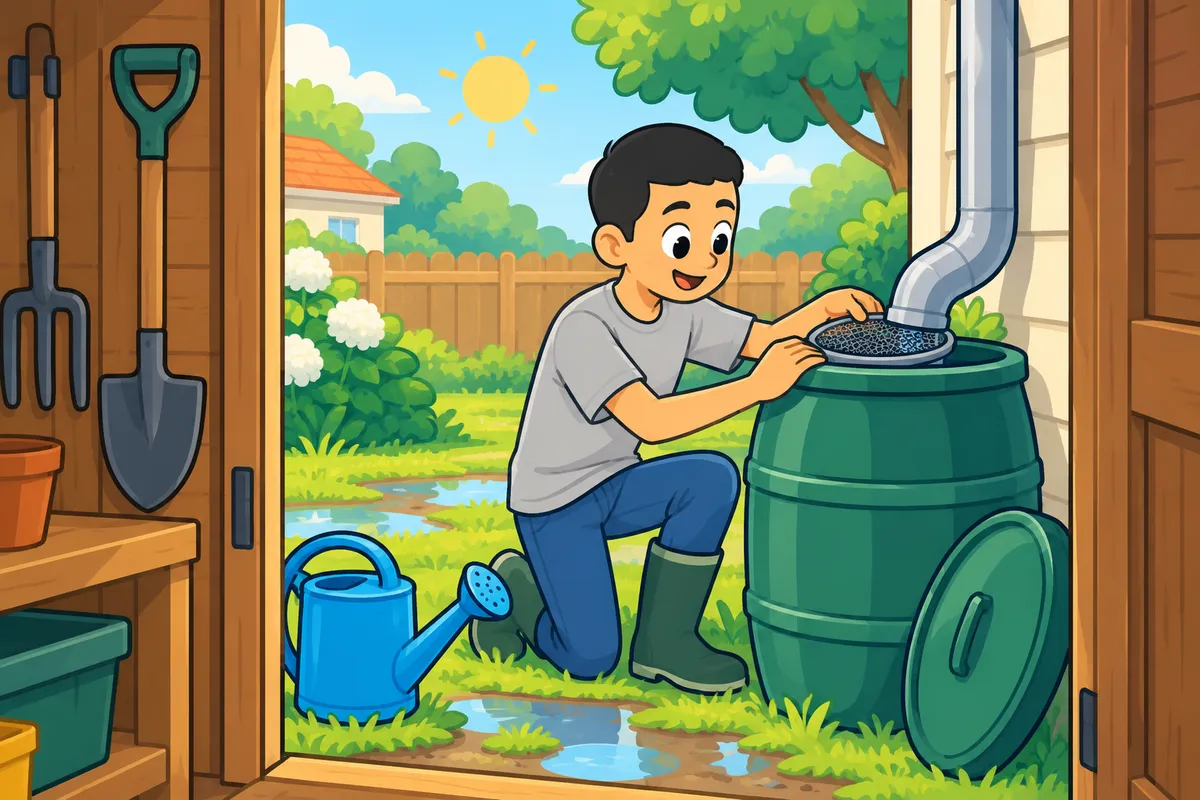
A first flush diverter sends the first rain of each storm away from your barrel, because that first flow picks up the most dirt, germs and chemicals. How much it should dump depends on the size of the roof that feeds it, so size the diverter to your roof area with its maker.
Keep the system clean, fix broken parts and empty barrels regularly. Against mosquitoes, add a screen where the water comes in, or empty the barrel at least every 10 days.
Step 2, Clear Cloudy Water
Pour it through a clean cloth, paper towel or coffee filter, or let it settle and draw off the clear water on top. This step only clears the water. It kills nothing, but it makes the next step work better.
Step 3, Kill the Germs
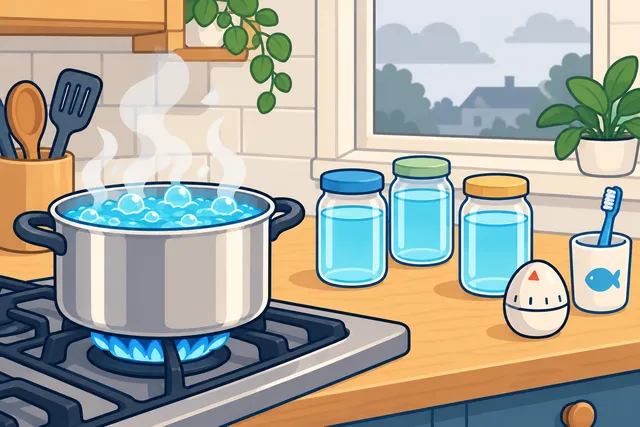
Boiling is the strongest option: bring the water to a rolling boil for 1 minute, or 3 minutes above 6,500 feet, let it cool, and store it covered. Without fuel, use unscented household bleach with 5 to 9 % sodium hypochlorite, stir it in and wait at least 30 minutes before you drink.
| Water | 5 to 9 % bleach | 1 % bleach | Cloudy, colored, very cold |
|---|---|---|---|
| 1 quart or liter | 2 drops (0.1 ml) | 10 drops (½ ml) | Double the dose |
| 1 gallon | 8 drops (½ ml) | 40 drops (2½ ml) | Double the dose |
| 5 gallons | 40 drops (2½ ml), about ½ teaspoon | 200 drops (12½ ml), 2½ teaspoons | Double the dose |
Bleach has a gap that matters for roof water. Disinfectants do not work as well as boiling against the parasites Cryptosporidium and Giardia, and both turn up in collected rain. Iodine and chlorine tablets will not kill Cryptosporidium; chlorine dioxide tablets will, used as the label says.
Step 4, Remove the Chemicals a Test Finds
Pick a treatment that removes the germs or chemicals that are actually in your rainwater. So the test result picks the equipment: a lead result calls for a filter certified for lead, a PFAS result for one certified for PFAS.
If the water smells of fuel or chemicals, stop there. You cannot make water with fuel, toxic chemicals or radioactive material safe by boiling or disinfecting it.
Is Rainwater Safe to Drink After Boiling?
It is free of live germs after a full minute at a rolling boil, which handles bacteria, viruses and parasites. Boiling leaves every chemical behind, and as water steams off, lead and nitrate end up more concentrated in what is left.
So boiled rainwater from a metal or old painted roof can still carry lead. A clean roof and a metals test do not settle it either: the CDC says to pick a treatment that removes the germs or chemicals actually in your water, and to ask your health department which chemicals to test for.
| Method | Germs | Lead, copper, PFAS | Fuel or toxic chemicals |
|---|---|---|---|
| Boiling, 1 minute | Kills bacteria, viruses and parasites | No | No |
| Bleach, 30 minutes | Weaker on Cryptosporidium and Giardia | No | No |
| Portable filter alone | No viruses | Only with a certified claim for that chemical | No |
| Filter, then a disinfectant | Bacteria, parasites and viruses | Only with a certified claim | No |
How Do You Filter Rainwater for Drinking?
Use a filter with an absolute pore size of 1 micron or smaller to catch Giardia and Cryptosporidium, and 0.3 micron or smaller to catch bacteria, then add a disinfectant such as chlorine, iodine or chlorine dioxide. Portable filters do not remove viruses, which is why the disinfectant follows.
Check that the pore size on the box is labeled absolute. A filter sold only for taste or clarity fixes neither germs nor metals, and a filter mounted where a tank's water enters the house needs the same two checks: the micron rating for germs, and a certified claim for the chemicals your test found.
Can You Purify Rainwater Naturally?
Not to a drinking standard. Each common "natural" method does one part of the job at most:
- settling lets grit sink, so you can pour off clearer water;
- a cloth or coffee filter catches particles and leaves the germs;
- a sand-and-gravel bucket filter clears cloudy water but does not reliably stop viruses or remove chemicals.
The accepted ways to kill germs remain boiling, a chemical disinfectant, or a filter followed by a disinfectant. Use the natural steps first, then one of those.
Is It Safe to Bathe in Rainwater?
For washing, the risk is lower, because you rarely swallow the water. The rainwater guidance keeps it to uses like that and names five jobs that should get public tap water or bottled water instead:
- drinking;
- cooking;
- brushing your teeth;
- rinsing fruit and vegetables;
- watering plants you plan to eat.
If you bathe in rainwater every day, test it regularly for germs and chemicals, the same as for drinking.
Should You Test Rainwater You Drink?
Yes, regularly. The agency says to test for germs and chemicals if you drink, cook or bathe with rainwater. Call your health department first: it can advise on which germs and chemicals to test for, and on treating and using your rainwater.
A state-certified lab gives you a number you can act on; finding a certified lab and reading a bacteria result works the same way for a tank as for a well. Test again after any change:
- A new roof.
- A repaired gutter.
- A cleaned tank.
- A storm that filled it with debris.
After a Storm or Flood
Do not drink from a rain tank that filled with storm debris or floodwater. The CDC's cistern guidance says disinfecting the water in such a cistern does not work well, and asks you to drink your stored emergency water instead.
If you have none, treat other safe water in small batches, a gallon or less at a time, and ask the health department whether the tank needs draining and cleaning. Keeping an emergency supply sized for your household before storm season means a dirty tank is never your only choice.
Is It Legal to Collect Rainwater?
In most US places, yes, but not everywhere and not for every use. The CDC notes that collecting rainwater is not allowed in all places, and that some states treat rain as state property and regulate its collection; your state environmental quality or health department has the local rule.
Colorado shows how narrow a rule can be. Colorado State University Extension explains that, for barrels, a household may:
- Keep two rain barrels with 110 gallons combined at most, each with a sealable lid.
- Use the water only on outdoor lawns, plants and gardens.
Drinking it and indoor use are not allowed under that rule.
A separate Rooftop Precipitation Collection System Permit from the state Division of Water Resources covers residents with exempt wells, limited to the uses their well permit allows, so check which route applies to you.
Before you buy a tank, check three things with your state:
- Whether the state lets you collect at all.
- How much you may store.
- Whether you may drink it or use it indoors.
Decide What Your Barrel Water Is For
Most people get more from a rain barrel by using it where nobody swallows it. Match the use to the treatment before you fill the first glass.
What Is Your Barrel Water For?
1Does it smell of fuel or chemicals?
YesDo not drink it. Boiling or disinfecting cannot make water with fuel or toxic chemicals safe. Use stored or bottled water.
No2Is it for flowers, lawn, or washing tools, with nothing eaten or swallowed?
YesUse it as it is. Keep a screen and a lid on the barrel.
No3Is it a short outage and you have no other water?
YesClear it, then boil 1 minute. Bleach, 30 minutes, is weaker against Cryptosporidium and Giardia. Boiling leaves chemicals, so ask your health department about them.
NoOtherwiseTest it before you rely on it. Ask your health department which germs and chemicals to test for, then choose a treatment that removes what the test finds.
Common Questions
Isn't rain naturally distilled?
No. Rain forms from evaporated water, but it gathers dust, soot and airborne chemicals on the way down, and a 2022 PFAS review of rain data from many countries found two forever chemicals over US advisory levels.
Can I water my vegetable garden with rain barrel water?
Use tap water for plants you will eat if you can; flowers, lawns and shrubs are fine with barrel water. The CDC groups edible plants with drinking and cooking.
General information for healthy adults, not medical advice. If a doctor has set your fluid amount, follow that.

More in Water at Home
Sources
- CDC. Collecting Rainwater and Your Health: An Overview, 2024.
- CDC. How to Make Water Safe in an Emergency, 2024.
- CDC. Cistern Safety and Disasters: Before, During, and After, 2024.
- Environmental Science & Technology (Cousins et al.). Outside the Safe Operating Space of a New Planetary Boundary for Per- and Polyfluoroalkyl Substances (PFAS), 2022.
- Journal of Environmental Quality (Ahmed et al.). Microbiological quality of roof-harvested rainwater and health risks: a review, 2011.
- Journal of Environmental and Public Health (Chubaka et al.). A Review of Roof Harvested Rainwater in Australia, 2018.
- Colorado State University Extension. Rainwater Collection in Colorado, 2025.
Sources checked by the Glubbo Editorial Team on Nov 2, 2026. General information, not medical advice. How we write and check our guides.

