Water at Home · Filters and Treatment
Do Water Filters Remove PFAS? What Claims to Verify
Compare plausible technologies, then verify a current PFAS-specific listing for the exact model.
 By the Glubbo Editorial Team · Updated Oct 24, 2026 · 2 min read
On This Page
Short answer
Some exact filter models carry verified PFAS claims.
- Granular activated carbon, ion exchange, and RO are treatment candidates.
- Verify a current PFAS-specific claim for the exact model.
- Replace media on schedule because capacity and conditions matter.

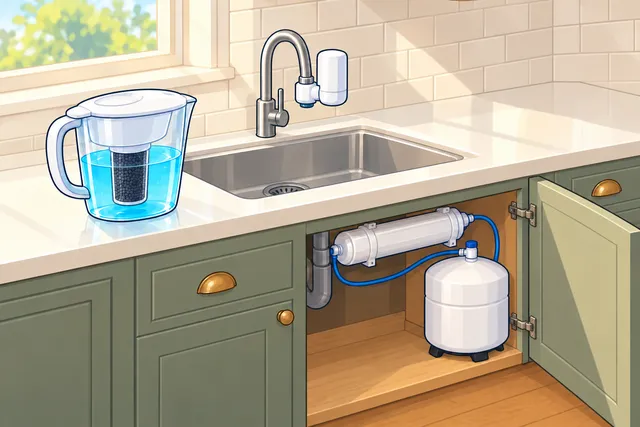
Some household filters can reduce PFAS, but the word “filter” is too broad to decide. EPA identifies granular activated carbon, ion exchange, and reverse osmosis as treatment approaches; a household purchase still needs an exact PFAS-specific listing and maintenance plan.
Three Treatment Paths to Verify
Granular activated carbon
Adsorption
- Can reduce selected PFAS
- Media life and PFAS mix matter
Suits you if a model with the exact current claim
Ion exchange
Specialized media
- Can bind selected PFAS
- Do not infer a household claim from the media name
Suits you if a verified system and service plan
Reverse osmosis
Membrane
- Can reduce selected PFAS
- Needs installation, upkeep, and reject water
Suits you if an exact listed RO model
Do Water Filters Remove PFAS?
Yes, selected models do. EPA's PFAS filter guidance directs consumers to certified products and explains that current certification does not necessarily mean reduction to the newest federal drinking-water limits. That limitation belongs in the decision.
| Evidence to collect | Why it matters |
|---|---|
| Exact model and cartridge | Similar products can carry different claims |
| PFAS named in the listing | Standard number alone is incomplete |
| Test endpoint and conditions | Certification has defined test conditions |
| Rated life and replacement trigger | Do not rely on exhausted media |
| Installation and flow requirements | Bypass or excess flow can defeat the intended operation |
Certification is a floor for verification, not a zero-PFAS promise
The claim says the model met a defined test. It does not promise:
- Removal of every PFAS compound.
- Identical results at every source concentration.
- Indefinite performance from neglected media.

What Type of Filter Removes PFAS?
Choose among verified models, rather than technology labels. The certification-number guide explains how to read standards without ranking them. The lead-filter guide is a separate claim example.
Nitrate treatment shows why one contaminant's answer cannot transfer to another. NSF's filter FAQ explains why certification and replacement details matter.
How Do I Verify a PFAS Filter Claim?
Close the Evidence Loop
5 items
Keep the Claim Working
Three habits keep the claim working:
- Install the selected model as directed.
- Prevent bypass.
- Replace its media before rated life expires.
If a local result or notice drives the purchase, ask the utility or relevant health authority what follow-up evidence is appropriate. A filter lowers exposure only while the verified system is correctly operated.
Common Questions
Does every carbon filter reduce PFAS?
No. Verify a PFAS-specific listing for the exact model and cartridge rather than relying on the media name.
Can an expired cartridge still reduce PFAS?
Do not rely on it. Replace the cartridge at the maker's rated interval because performance depends on capacity and operating conditions.
General information for healthy adults, not medical advice. If a doctor has set your fluid amount, follow that.

More in Water at Home


Sources
- US Environmental Protection Agency. Identifying Drinking Water Filters Certified to Reduce PFAS, 2026.
- NSF. Water Filters FAQs, 2026.
Sources checked by the Glubbo Editorial Team on Oct 24, 2026. General information, not medical advice. How we write and check our guides.

