Habits and Routines
How to Build a Habit: Five Steps From Cue to Automatic
Pick one small action, tie it to a moment you meet every day, and repeat it there until it runs itself.
 By the Glubbo Editorial Team · Updated Oct 19, 2026 · 10 min read
Short answer
Repeat one small action after the same daily cue.
- Pick an action you can do every day, and tie it to a time and place you always meet.
- Expect about two months of daily repeats before it runs on its own.
- One missed day did not materially set the habit back.

A habit is an action your surroundings start for you. You build one by picking a small action, tying it to a moment you meet every day, and repeating it at that moment until you no longer have to decide.
The research behind this is younger and smaller than the advice suggests: the best-known timing study followed 96 volunteers for 12 weeks, and a 2024 review found only four studies that measured time to habit.
How Do You Build a Habit?
Choose one simple action you can do daily, decide the exact time and place, and do it every time you meet that time and place. That is the method a team of habit researchers at University College London gave GPs to hand to patients, in a 2012 paper in the British Journal of General Practice.
Five Steps, as the Researchers Wrote Them
- Decide on a goal you care about
- Choose a simple action toward it that you can do every day
- Plan when and where, at a time and place you meet daily
- Every time you meet that time and place, do the action
- Expect it to get easier; about 10 weeks is the guide
The last step is the reward for the others. The paper says that within about 10 weeks “you should find you are doing it automatically without even having to think about it.”
A habit forms where the same action meets the same cue, again and again. Every other tip on this page serves that one rule.
What Is a Habit?
A habit is an action that your surroundings trigger without a decision. Gardner, Lally and Wardle describe habits as actions that a contextual cue starts automatically, once the cue and the action have gone together many times. The cue can be a place, a time of day, or the thing you just did.
Wood and Neal, in a 2007 review in Psychological Review, describe the same thing from the inside. Once a habit forms, seeing the context “triggers the associated response without a mediating goal”. You walk into the kitchen and the kettle goes on before you have thought about tea.
A Decision
- You weigh it up each time
- Fails on tired or busy days
- Needs motivation on the day
A Habit
- The cue starts it for you
- Runs on low-effort days too
- Keeps going when interest fades
That last point is why habits are worth the effort. Gardner and colleagues write that habits “are likely to persist even after conscious motivation or interest dissipates”.
Habit or Routine?
A routine is a set of steps you choose to do in order, such as a morning with a fixed wake time, shower and breakfast. A habit is one action that starts without a choice. Routines are built from habits: once each step triggers the next, the routine runs itself, which is why a morning routine built around one anchor starts with a single action.
Give a New Habit About Two Months
Count in months, not weeks: in the research, simple daily habits took around two months to run on their own, and harder ones longer. The famous 21 days traces back to Maxwell Maltz, and a 2024 review of the studies says the research “clearly refute[s]” it.
| Study | Who took part | How long habits took |
|---|---|---|
| Lally and colleagues, 2010 | 96 volunteers, one daily habit for 12 weeks; 82 sent enough data | 18 to 254 days to reach 95 % of their own top automaticity |
| Singh and colleagues, 2024 | 20 studies, 2,601 people | Medians of 59 to 66 days, means of 106 to 154 days; single people from 4 to 335 days |
The gap between the median and the mean comes from a few slow starters who pull the average up. Plan for two months and do not worry if yours takes five. The review's conclusions put typical habits at 2 to 5 months.
What Makes a Habit Stick?
Three things: a cue you meet every day, an action placed right after that cue, and a plan written in "if this, then that" form. Each one has its own line of research behind it.
A Cue You Meet Every Day
Pick a moment that happens daily, in the same way, whatever kind of day you have. Gardner and colleagues ask for a cue “sufficiently salient in daily life” that you meet “frequently and consistently”.
Three Kinds of Cue
A clock time
Same hour daily
- A glass of water at 9:00 each morning
- Weekends and travel move it
Suits you if your days run on a fixed timetable
Something you already do
After a routine
- A glass of water after breakfast
- Travels with you to any time zone
Suits you if your hours change but your morning steps do not
A place
Where it happens
- Pills kept by the toothbrush
- The place reminds you on sight
Suits you if the action needs an object you can leave out
The review by Singh and colleagues reports no significant difference between clock-time cues and routine cues. So pick the one that is most stable in your own week.
Do It Right After the Cue
Put the new action straight after the old one, not before it. In a study of 50 adults learning to floss, the people told to floss after brushing formed stronger flossing habits and, at the 8-month follow-up, still flossed more often than those told to floss before.
Linking a new action onto an old one has a popular name, and habit stacking examples for mornings, work and evenings show how far the idea goes.
Write It as an If-Then Plan
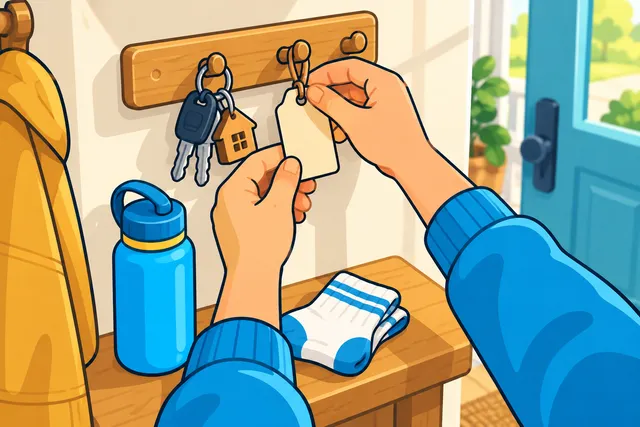
Write the plan as one sentence: "If it is 7 AM and I am pouring coffee, then I take my vitamin." Psychologists call this an implementation intention. A meta-analysis by Gollwitzer and Sheeran pooled 94 independent tests and found a medium-to-large effect (d = .65) on reaching goals.
Start Smaller Than Feels Useful
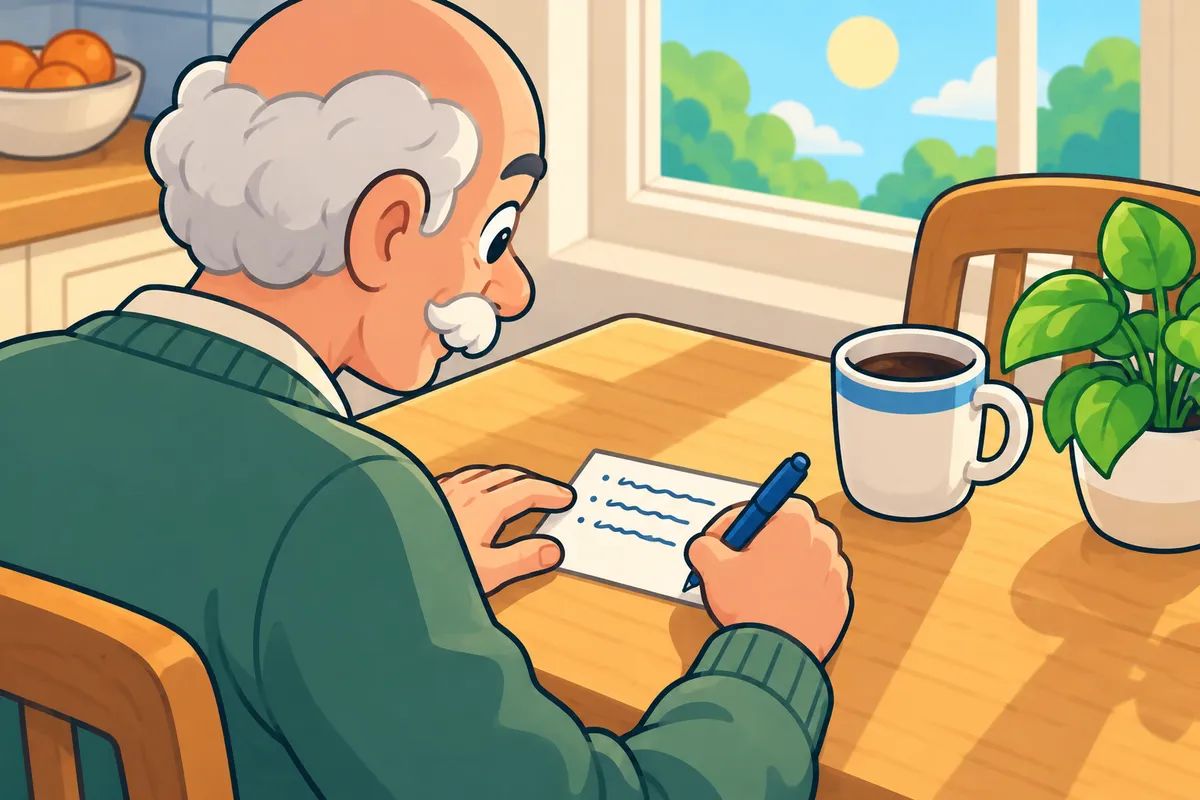
Choose an action so small you could do it on your worst day. Gardner and colleagues note that “simpler actions become habitual more quickly”, and the 2024 review found a large effect for flossing (SMD 1.11) against a moderate one for diet (0.57) and exercise (0.69).
Small does not mean pointless. The aim of the first two months is a cue that fires every day; you can grow the action once it does.
| Goal | Too big for day one | Small daily action | Cue |
|---|---|---|---|
| Read more | An hour every evening | One page | After you plug your phone in at night |
| Get fitter | A 45-minute gym session | Put on your sneakers and walk 5 minutes | When you get home from work |
| Floss | A full routine with mouthwash | Floss one tooth | Right after you brush at night |
| Drink more water | 64 oz (2 L) by a set hour | One glass | While the kettle boils |
| Write a journal | A page of reflection | One line | Right after you pour your first coffee |
These are our own examples of the researchers' rule: one simple action, one stable cue. Fill in your own row the same way.
How Many Habits Can You Build at Once?
Start with one. Each volunteer in Lally's study chose a single behavior, and no study on this page tested what happens with several at once. Add a second only after the first fires without effort, which is about the two-month mark.
If you track several, keep the page short: one to three rows is enough to see a pattern.
Change Your Surroundings, Then Rely Less on Willpower
Set up the place so the cue and the object meet. Duke psychologist Wendy Wood says “almost half of human behavior takes place in the same location pretty much every day”, and her advice is to change the context and the cues instead of relying on willpower, as Duke Today reported.
The same article describes students who moved to a new university. Those whose TV sat in a different spot at the new school broke their TV-watching habit more easily, the same lever that does most of the work when you drop a habit you no longer want.

Set Up the Cue Tonight
4 items- Keep the object where the cue happens, such as pills by the toothbrush
- Leave the first step ready: shoes by the door, a book on the pillow
- Use a place you pass every day, not a drawer you open once a week
- Keep the action the same each time while it is still new
The last line comes from the GP paper, which warns that changing the action while you learn it “is incompatible with development of automaticity”. Vary it later.
Does Motivation Matter for Habits?
It matters at the start and less as the habit grows. Motivation gets you to repeat the action; the repetition then builds the link to the cue, and Wood and Neal write that goals can direct habits “by motivating repetition that leads to habit formation”.
Two findings point to the kind of motivation that helps:
- The 2024 review found that self-selected habits and morning practice generally showed greater strength.
- In the flossing study, stronger automaticity was predicted by a more positive attitude as well as by how often people flossed.
So pick a habit you chose for your own reasons. A habit someone else assigned you starts with a handicap.
Why the First Weeks Need a Payoff
Wood and Rünger's review of habit research explains that reward signals promote habit learning while people first repeat a response, and fade as the reward becomes expected. In practice, pair the new action with something you notice and like at the moment you do it, such as the first sip of a cold drink, rather than a prize hours later.
What people call discipline follows the same pattern: those who look most disciplined lean on habits more than on resisting.
Should You Track Your Habits?
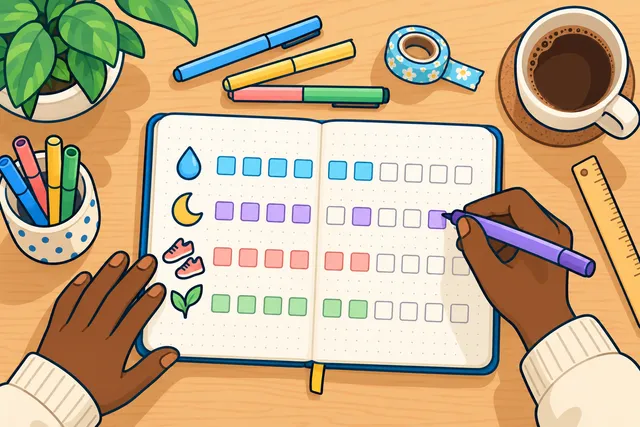
Yes, at least while the habit is new. A meta-analysis of 138 studies with 19,951 people found that monitoring progress helped people reach their goals (d = 0.40), and the effect was larger when people physically recorded it or shared it, per Harkin and colleagues.
The GP paper gives its patients a sheet with ten weeks of columns and counts a week as a success when the action was “Done on >5 days”.
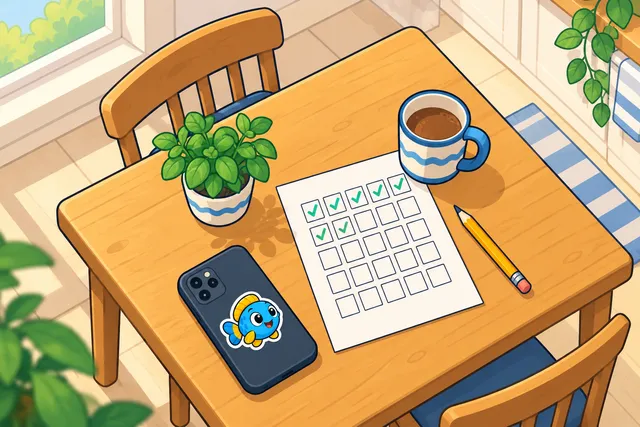
A tick on paper or in an app is enough, marked straight after the action rather than from memory at the end of the week. What matters is what you do on the day you miss: in Lally's 2010 study, “missing one opportunity to perform the behaviour did not materially affect the habit formation process”. If you are looking at a broken run of ticks right now, the next-day restart plan keeps one miss from turning into three.
Which Habit Should You Start With?
Start with the one you want for your own reasons and can shrink to under two minutes. Then match the cue to your week. Many good first habits fit on one tickable row, such as a 30-minute walk, lights out by 11 or five portions of fruit and veg.
Your Situation, Your First Habit Setup
- My days run like clockworkA clock-time cue, same hour every day
- My hours change with shifts or travelA routine cue: right after waking or after a meal
- I have tried big habits and burned outOne tiny action, grown after two months
- I keep forgetting even when I want toAn if-then sentence on a card where the cue happens
- I want an easy first winOne glass of water after an existing step
Water as Your First Habit
A glass of water is one of the simplest habits to start. In Lally's study, among the 39 volunteers whose curve fitted well, those who chose a drink did it on a median of 93 % of days, against 80 % for eating and 86 % for exercise, and their median time to plateau was 59 days. If that is the habit you want, tie each glass to a cue you already meet, from waking up to dinner.
To track it on paper, the printable water tracker gives you a grid of glasses to tick by the day.
Write the Card for Your Worst Day
Write "after I…, I will…" on a card for one action you could do on your worst day, and put the card and the object where the cue happens. Tomorrow, do it once at that cue and mark the sheet. Nothing else needs to change tonight.
General information for healthy adults, not medical advice. If a doctor has set your fluid amount, follow that.
All Guides in Habits and Routines
Every guide, A to ZHow Habits Work 5 guides
A habit is a cue that triggers the same action until you stop deciding. These guides report what the studies measured: how long that takes, which methods help it stick and how to undo one.
How Habits Work page How Long Does It Take to Form a Habit? What the Studies Found
 Habit Stacking Examples for Morning, Work and Evening
 Implementation Intentions Examples: If-Then Plans You Can Copy
 How to Break a Bad Habit: Six Steps the Research Supports
 How to Build Discipline That Lasts, From What the Research Shows
Trackers and Streaks 9 guides
A tracker works when it is small and you look at it. These guides cover what to put on the grid, how to build one and how to restart after a missed day.
Trackers and Streaks page What to Do When You Break a Streak: A Plan for the Next Day
 How to Use a Habit Tracker: Set It Up, Mark It, Review It
 Habit Tracker Ideas: What to Track and Five Layouts That Work
 Habit Tracker in Excel or Google Sheets: Build One in 15 Minutes
 Best Habit Tracker App: Eight Picks by Phone, Price and Limit
 Habit Stacking App: What Seven Apps Offer for Chaining Habits
 Habit Tracker Template: Free Weekly and Monthly Grids to Copy
 Daily Routine App: Seven Apps Compared by Free Limit and Price
 Self Care App: Eight Picks by Price, Phone and Data Label
Daily Routines 7 guides
A routine is a few habits in a fixed order. These guides build one for each part of the day and for the people for whom the usual advice does not fit.
Daily Routines page How to Build an Evening Routine, From Work to Lights Out
 How to Build a Morning Routine That Sticks, From Alarm to Door
 Self Care Routine Ideas That Fit Into an Ordinary Week
 Daily Routine for Kids: A School-Day Plan and a Chart That Works
 How to Build a Routine With ADHD That Holds on Hard Days
 How to Start Journaling: A Five-Minute Daily Habit That Sticks
 How to Stick to a Routine When Your Week Keeps Breaking It

Sources
- British Journal of General Practice (Gardner, Lally and Wardle). Making health habitual: the psychology of 'habit-formation' and general practice, 2012.
- European Journal of Social Psychology (Lally, van Jaarsveld, Potts and Wardle). How are habits formed: Modelling habit formation in the real world, 2010.
- Healthcare (Singh, Murphy, Maher and Smith). Time to Form a Habit: A Systematic Review and Meta-Analysis of Health Behaviour Habit Formation and Its Determinants, 2024.
- Psychological Review (Wood and Neal). A new look at habits and the habit-goal interface, 2007.
- Advances in Experimental Social Psychology (Gollwitzer and Sheeran). Implementation intentions and goal achievement: a meta-analysis of effects and processes, 2006.
- Psychological Bulletin (Harkin and colleagues). Does monitoring goal progress promote goal attainment? A meta-analysis of the experimental evidence, 2016.
- Duke Today, Duke University. Habits: A Repeat Performance, 2007.
- Annual Review of Psychology (Wood and Rünger). Psychology of Habit, 2016.
- British Journal of Health Psychology (Judah, Gardner and Aunger). Forming a flossing habit: An exploratory study of the psychological determinants of habit formation, 2013.
Sources checked by the Glubbo Editorial Team on Oct 19, 2026. General information, not medical advice. How we write and check our guides.

