Habits and Routines · Daily Routines
How to Build a Routine With ADHD That Holds on Hard Days
Start with one step, keep the same schedule every day, and use cues you can see instead of remember.
 By the Glubbo Editorial Team · Updated Oct 19, 2026 · 10 min read
On This Page
- How Do You Build a Routine With ADHD?
- Why Are Routines Hard With ADHD?
- Make Every Step Visible
- Does Body Doubling Help With a Routine?
- What Should an ADHD Morning Routine Include?
- What Does an ADHD Evening Routine Look Like?
- How Do You Make a Routine for a Child With ADHD?
- How Do You Stick to a Routine With ADHD?
- Does a Routine Replace ADHD Treatment?
- The 9 PM Row That Saves the Morning
- Sources
Short answer
Same schedule daily, cues you can see, tiny steps.
- NIMH, for adults: stick to a consistent routine and write reminders down.
- Keep bags, keys and clothes in the same place every day.
- Break large tasks into smaller, more manageable steps (NIMH).
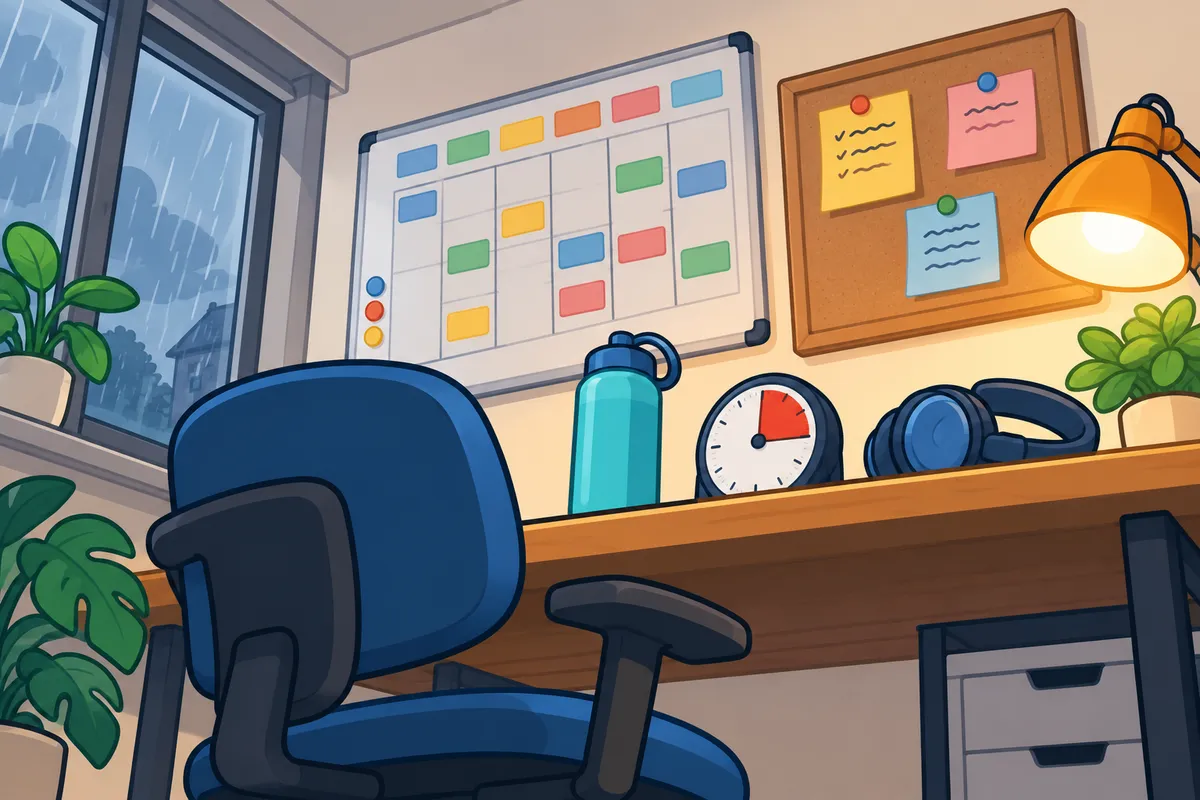
To build a routine with ADHD, keep one schedule every day, start with a single step, and move every reminder out of your head into something you can see or hear: a written list, a timer for each block and a tray by the door. NIMH gives adults that advice, and the CDC gives it to parents of children with ADHD.
You know the plan. You wrote it down last week, it was a good plan, and this morning you still left without your keys, ten minutes late, having started three things and finished none.
How Do You Build a Routine With ADHD?
Start with one stretch of the day, not the whole day. Pick the part that goes wrong most, usually the exit from the house, and give it a written list, one timer and one place for the objects it needs. Add the next stretch only when the first one runs without effort.
Build the First Block
- Pick the one stretch of the day that goes wrong most
- Write its steps in order and stick them where step one happens
- Give the slowest step its own timer
- Put every object that stretch needs where the steps happen
- Add the next stretch only when this one needs no effort
The advice from the public health bodies points the same way. For adults, NIMH advises sticking to a consistent routine, writing down appointments and reminders, and breaking large tasks into smaller, more manageable steps. The CDC's tips for parents of children with ADHD start with "Create a routine" and ask for "the same schedule every day, from wake-up time to bedtime" for daily tasks.
Why Are Routines Hard With ADHD?
A routine leans on the skills ADHD affects. NIMH defines ADHD as a developmental disorder marked by persistent symptoms of inattention, hyperactivity and impulsivity, and its signs include trouble organizing tasks, managing time and meeting deadlines.
A typical routine assumes you will:
- remember the next step
- notice the time
- start a dull task without a push
Each of those is a place where an ADHD morning slips, so the routine has to carry the reminders itself.
The research on routines is thinner than the advice. A 2026 scoping review of 31 studies found that most were about children, that none used a validated measure of routines, and that only six tested an intervention. Sleep was the problem area studied most, in more than half of them.
Adults often meet the problem late: in the CDC's 2023 survey, 55.9 % of adults with current ADHD had been diagnosed at 18 or older. That is why so many adults build routines for years before they have a name for what keeps breaking them.
Make Every Step Visible
Replace each "remember to" with an object, a sound or a picture placed where the step happens. Cues in the room keep the routine going on mornings when your attention does not.
Five Tools That Carry the Reminders
A launch pad
By the door
- Sits where your hand lands on the way out
- One tray holds keys, wallet and bag
Suits you if you lose keys or leave things behind
A visual timer
One per block
- A disc that shrinks as time runs out
- Blocks of 15 to 25 minutes
Suits you if time disappears without you noticing
A written schedule
On the wall
- Steps in order, five at a time
- Tick each one as you finish
Suits you if you stall wondering what comes next
Labeled alarms
On the phone
- Named for the step: "Leave in 10"
- Only for the switches you miss
Suits you if you hyperfocus and miss the next thing
One note per task
Where it happens
- "Pills" on the kettle, not in an app
- Taken down after you finish
Suits you if out of sight really is out of mind
A Launch Pad by the Door
The CDC's tip for parents, a child's things "in the same place every day", works for adults too as one tray or basket by the front door. Headphones, a water bottle and a packed lunch join the keys, and the evening routine ends with filling it.

A Timer for Each Block, an Alarm for Each Switch
Split the morning into blocks of 15 to 25 minutes, each with its own timer. The end of each block is the cue to start the next, and it fits NIMH's advice to take short breaks during tasks that need sustained attention.
Hyperfocus is the opposite problem: an hour vanishes into one absorbing job. A phone alarm named for the next step pulls you out at the switch you would otherwise miss.

Write It Down and Tick It Off
NIMH advises writing down assignments, messages, appointments, reminders and important thoughts. Keep one place for the schedule, such as a whiteboard or a notebook that lives by the door, and tick each step as you finish it. The tick gives a dull step the finish line it otherwise lacks.
Does Body Doubling Help With a Routine?
It helps some people, and the evidence is early. Body doubling means doing a task while another person is present, in the room or on a video call. The authors of a 2025 preprint say earlier work found no conclusive effect, and some people are uncomfortable with someone watching.
In their own test, 12 adults finished a virtual-reality bricklaying task faster with a human or an AI double than alone, and most preferred having one. That is a small sample on one task, so treat body doubling as something to test.
Use it on the single step you avoid most:
- Tell the other person the task and when you will stop.
- Work side by side for one timed block of 25 minutes.
What Should an ADHD Morning Routine Include?
The same steps as anyone's, with a fix at each point where attention usually slips. This weekday morning is for someone who leaves at 8:20, with the friction and the fix side by side.
| Time | Step | Where it usually slips | The fix |
|---|---|---|---|
| 7:20 | Alarm, out of bed | Snooze, then the phone in bed | Alarm across the room, phone charged in the kitchen |
| 7:25 | Meds or water with breakfast prep | Forgotten entirely | Note on the kettle; glass left out the night before |
| 7:30 | Shower and dress | 20 minutes become 40 | 20-minute visual timer; clothes laid out at night |
| 7:55 | Breakfast | Starting something else halfway | Same breakfast daily; sit to eat, no screen |
| 8:10 | Launch pad, shoes, coat | Hunting for keys | Tray filled at night; labeled alarm "Leave in 10" |
| 8:20 | Out of the door | Leaving late anyway | 10 minutes of slack built into the times above |
Change the clock times and keep the fixes. Every fix in the table moves a decision from the morning to the night before or onto an object. That pattern works for any part of your day.
What Does an ADHD Evening Routine Look Like?
An evening routine does two jobs: it ends the day on a fixed schedule and it sets up the next morning. This one is for someone who gets home at 6:00 PM and wakes at 7:20.
| Time | Step | Why it sits here |
|---|---|---|
| 6:00 PM | Keys, wallet and bag into the tray | The door is the cue |
| 6:15 PM | A walk or workout | NIMH suggests regular exercise, especially when restless |
| 7:00 PM | Dinner from a short rotation of meals | One less decision |
| 8:00 PM | One chore on a 15-minute timer | A short, visible finish |
| 9:00 PM | Lay out clothes, write tomorrow's five steps, charge the phone in the kitchen | Done before screens go off |
| 9:30 PM | Screens off | NIMH asks for 1 hour before bedtime |
| 10:15 PM | Teeth, bed | Phone alarm sits across the room |
| 10:30 PM | Lights out | About 9 hours before the alarm; adults need 7 or more |
The 9:00 PM row is the one that matters. It is the setup that the morning table above depends on.
How Do You Make a Routine for a Child With ADHD?
Use the same schedule every day, picture steps, clear rules in simple words, and praise each step done. The CDC passes on the American Academy of Pediatrics' advice that parent training in behavior management is the first treatment for children under 6, before medication is tried, and should be part of treatment for children up to 12.
NIMH's advice for parents has three parts:
- Explain rules and expectations in "clear, simple, direct language".
- Reward behaviors that meet them.
- Be patient, flexible and understanding.
In a routine that means a short picture chart, one step at a time, and praise the moment your child finishes a step rather than a lecture when a step gets missed.
Keep the child's things where the CDC says, "in the same place every day": the schoolbag on one hook, shoes in one basket.
A child with ADHD can follow the same school-day plan, with bedtimes worked back from the alarm, with fewer steps per chart and more praise. Start with the morning chart alone, since it has a fixed deadline and the fewest choices. Add the after-school chart once the morning one runs with a reminder or two.
What About Teenagers?
A teen can run the adult tools on their own phone and wall, with a parent checking the plan once a week instead of each step. The CDC asks for 8 to 10 hours of sleep at ages 13 to 17, so a teen who must be up at 6:30 needs lights-out between 8:30 and 10:30 PM.
How Do You Stick to a Routine With ADHD?
Expect it to break, plan the restart, and make the routine smaller before you give it up. A routine that holds on most days is working; a bad day is a reason to shrink a step, not to start over with a new system.
When It Slips, Change One Thing
- It worked for two weeks, then I got boredChange the look, not the order: a new chart, a new timer
- I keep running out of time in one stepGive that step its own timer and 10 extra minutes
- I forget the routine existsPut the first step's object where you will trip over it
- Weekends wreck itKeep the wake time and the first three steps at weekends
- I missed three days and quitRestart with the first step only, tomorrow
After a missed day, do the first step at its usual cue the next morning without making up for the gap, because one missed day changes little in how a habit forms. For the moments that keep failing, a written "if this, then that" sentence, such as "if the kettle clicks, then I take my pills", gives the cue a fixed action, the if-then plan in its plainest form.
Pairing the dull step with something you like helps it start. Put on a favorite playlist for the shower block, or save the good coffee for after you fill the tray.
Does a Routine Replace ADHD Treatment?
No. A routine is everyday support that can make days easier, and the CDC says good food, lots of physical activity and enough sleep can help keep ADHD symptoms from getting worse, but treatment for ADHD is a separate decision made with a health care provider. NIMH lists medication and psychosocial treatments such as cognitive behavioral therapy, parent training and school interventions.
The 9 PM Row That Saves the Morning
Tonight, do only the 9:00 PM row from the evening table: clothes out, five steps written on a list by the door, phone charging in the kitchen and the tray filled. In the morning, note the one step that still slipped and give it a timer or a new place. Fix that single step before you touch anything else.
General information for healthy adults, not medical advice. If a doctor has set your fluid amount, follow that.

More in Habits and Routines



Sources
- US Centers for Disease Control and Prevention. Treatment of ADHD, 2026.
- US Centers for Disease Control and Prevention. Parent Training in Behavior Management, 2026.
- US National Institute of Mental Health. Attention-Deficit/Hyperactivity Disorder: What You Need to Know, 2026.
- MMWR (Staley, Robinson, Claussen and colleagues). Attention-Deficit/Hyperactivity Disorder Diagnosis, Treatment, and Telehealth Use in Adults, National Center for Health Statistics Rapid Surveys System, United States, October–November 2023, 2024.
- US National Institute of Mental Health. Attention-Deficit/Hyperactivity Disorder, 2026.
- Behavioral Sciences (Almudayfir, Abdulkarim, Rosenstein and Yuen). Daily Routines and Habits in Individuals with Attention Deficit Hyperactivity Disorder: A Scoping Review, 2026.
- arXiv preprint (Ara and colleagues). You Are Not Alone: Designing Body Doubling for ADHD in Virtual Reality, 2025.
- US Centers for Disease Control and Prevention. About Sleep, 2026.
Sources checked by the Glubbo Editorial Team on Oct 19, 2026. General information, not medical advice. How we write and check our guides.

