Habits and Routines · Daily Routines
How to Build an Evening Routine, From Work to Lights Out
Work back from bedtime to set your cut-offs, then fill the evening in four blocks, with what sleep studies found.
 By the Glubbo Editorial Team · Updated Oct 19, 2026 · 9 min read
On This Page
- How Do You Build an Evening Routine?
- What Time Should You Start Your Evening Routine?
- What Should an Evening Routine Include?
- Can You Work Out in the Evening?
- Does Writing a To-Do List Before Bed Help You Sleep?
- Do Screens Before Bed Really Hurt Sleep?
- What Is a Good After-Work Routine?
- How Is an Evening Routine Different From a Bedtime Routine?
- How Long Does a New Evening Routine Take to Stick?
- Start With the Bedtime and One Step
- Sources
Short answer
Work back from bedtime, then fill four blocks.
- Close the workday, eat, prep tomorrow, then relax for the last hour (NHS).
- Screens off at least 30 minutes before bed, the CDC says.
- A 5-minute to-do list got young adults to sleep about 9 minutes sooner.
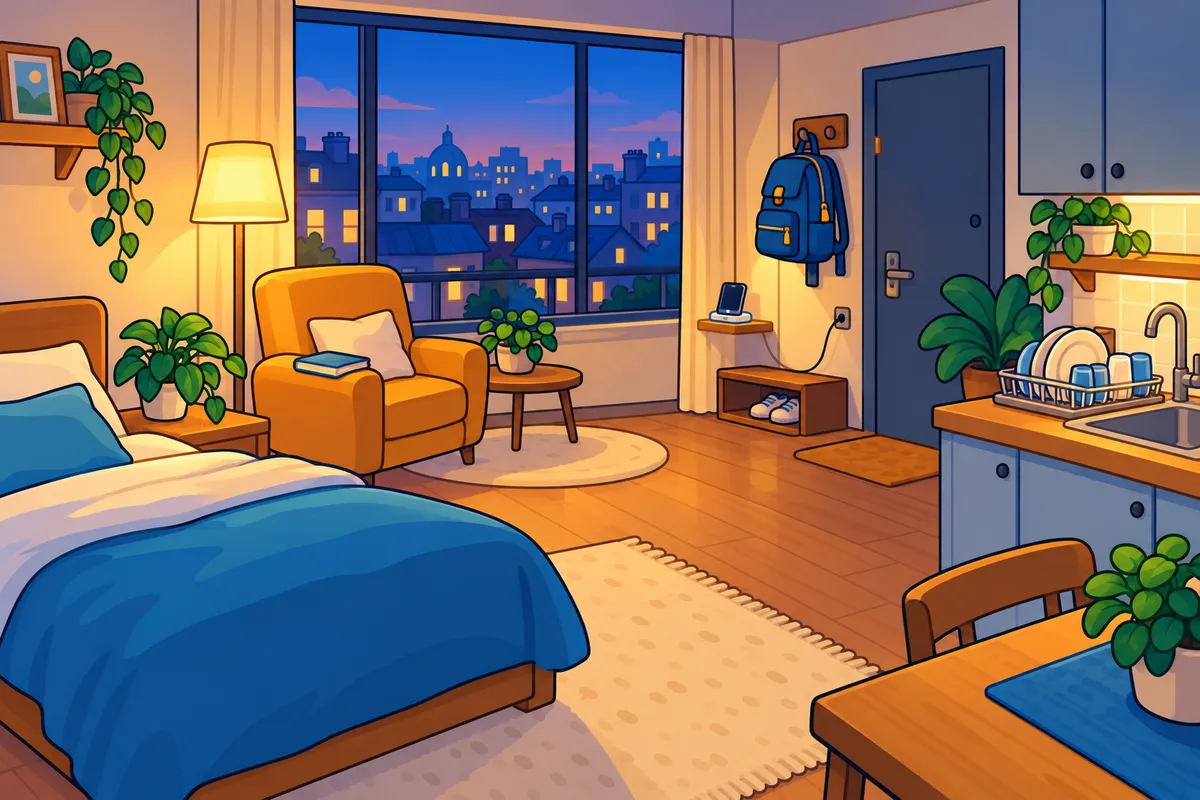
Work back from the time you want to be asleep. Close the workday, eat, prepare tomorrow, then relax for the last hour, with screens off at least 30 minutes before bed. Add one new step at a time.
You get home at 6:30, and somehow it is 11:45 and you are still on the sofa with the TV on, lunch for tomorrow unmade, and a vague feeling the evening went nowhere. An evening routine decides the shape of the evening before it starts.
How Do You Build an Evening Routine?
Choose your bedtime, count back the cut-offs from it, and fill the hours between work and bed with four blocks: close the workday, eat and reset the home, prepare tomorrow, and wind down for the last hour. Then add one step at a time.
The cut-offs come from two public health bodies. The NHS asks you to:
- Relax for at least 1 hour before bed.
- Avoid exercise in the 4 hours before bed.
- Avoid alcohol, tea or coffee in the 6 hours before bed.
The CDC adds turning electronic devices off at least 30 minutes before bedtime.
Pick the bedtime first; every other time in the evening follows from it.
What Time Should You Start Your Evening Routine?
Start the wind-down an hour before your bedtime, and start the whole routine when your workday ends. Your bedtime itself comes from your alarm and the hours you need: the CDC asks adults aged 18 to 60 for 7 or more hours a night.
The table does the arithmetic for three common bedtimes. Each column subtracts one gap from the time you want to be asleep.
| Bedtime | No coffee/tea/alcohol (6 h) | Exercise finished by (4 h) | Start winding down (1 h) | Screens off (30 min) |
|---|---|---|---|---|
| 10:00 PM | 4:00 PM | 6:00 PM | 9:00 PM | 9:30 PM |
| 11:00 PM | 5:00 PM | 7:00 PM | 10:00 PM | 10:30 PM |
| 12:30 AM | 6:30 PM | 8:30 PM | 11:30 PM | 12:00 AM |
Gaps from the NHS insomnia advice and the CDC. If your alarm moves, every column moves with it.
A shift worker with a 7 AM bedtime uses the same sums from the other end of the day. The rule is the gap, not the clock time.
What Should an Evening Routine Include?
Four blocks, in this order: something that closes the workday, dinner and a short reset of the home, ten minutes of prep for tomorrow, and an hour of quiet before bed. Fill each block with one or two small steps you will actually do.
Evening Routine Ideas, Block by Block, for an 11 PM Bedtime
Close the workday
6 to 7 PM
- Shut the laptop and put it out of sight
- Change out of work clothes
- A 10-minute walk around the block
Suits you if work leaks into your evening, especially at home
Eat and reset
7 to 8:30 PM
- Dinner early enough to avoid a big late meal
- Ten minutes of tidying the kitchen
- Start the dishwasher or the laundry
Suits you if you wake up to last night's mess
Prep tomorrow
8:30 to 10 PM
- Pack the bag and leave it by the door
- Lay out clothes
- Write tomorrow's to-do list
Suits you if your mornings start in a rush
Wind down
10 to 11 PM
- A bath or a book, the classic wind-down
- Devices off 30 minutes before bed
- Dim lights in a dark, quiet bedroom
Suits you if you lie awake or scroll late
You do not need all twelve. Pick one step per block for the first month, and the evening already has a shape.
Close the Workday
Make the end of work an event you can see: the laptop shut and put in a drawer, the work shoes off, a short walk. Working from home makes this block matter more, because nothing else marks the change.
Prep Tomorrow
Ten minutes on tomorrow takes pressure off the morning routine that starts at your alarm. A packed bag by the door and clothes on a chair are cues waiting for you when you wake.

Can You Work Out in the Evening?
Yes, if you finish before bed, though the NHS insomnia advice says to stop exercise at least 4 hours before. A 2022 network meta-analysis of 28 studies and 325 healthy adults found that evening exercise completed before bedtime did not disrupt the sleep that followed, whatever the intensity.
Hard sessions were the only ones with a measurable cost, a 1.95 percentage-point drop in REM sleep compared with no exercise. The studies covered healthy adults who already slept well, so the line you follow depends on how you sleep.
When You Train in the Evening
- I train at 7 PM and sleep wellKeep the slot and finish before the wind-down starts
- I have trouble sleeping most nightsFollow the 4-hour gap
- My evening session is hard intervalsMove it earlier, or make it moderate: only high intensity cost REM sleep
- I only walk or stretch after dinnerNo cost in the studies; low intensity showed no sleep penalty
Does Writing a To-Do List Before Bed Help You Sleep?
It helped in one sleep-lab study. Scullin and colleagues had 57 healthy adults aged 18 to 30 write for five minutes at bedtime, either about tasks they had to do in the next few days or about tasks they had already done; the to-do list group fell asleep significantly faster, measured by brain recordings, not self-report.
- 15.8 min
- to fall asleep after a to-do list (28 people)
- 25.1 min
- after a list of finished tasks (29 people)
- 9 min
- faster for the to-do group
The more items people wrote on the to-do list, the faster they fell asleep, while the opposite trend appeared for lists of finished tasks. Total sleep time did not differ between the groups, at about 8.2 hours each, so the list shortened the wait and did not lengthen the night.
The authors suggest writing "a very specific to-do list for five minutes at bedtime", though the study used healthy young adults and says less about people with insomnia. That five-minute list is also the easiest way into a nightly journaling habit.

Do Screens Before Bed Really Hurt Sleep?
Yes, in the hours before bed, and the effect reaches the next morning. In a study by Chang and colleagues, 12 healthy young adults lived in a lab for 14 days and read for about 4 hours before bed, five evenings on a light-emitting e-reader and five on a printed book.
Light-Emitting E-Reader
- Nearly 10 minutes longer to fall asleep
- Evening melatonin 55 % lower
- Body clock more than 1.5 hours later
- About 12 minutes less REM sleep
Printed Book
- Fell asleep sooner
- No drop in melatonin
- Melatonin rising at about 9 PM
- More alert the next morning
Each person read both ways in random order, from 6 PM to 10 PM, in a room dimmer than most living rooms (about 3 lux), so the difference came from the device and not the room. After the e-reader evenings, melatonin began rising at about 10:30 PM instead of 9 PM.
The same paper cites a survey of 1,508 US adults in which 90 % used some type of electronics at least a few nights a week within an hour of bed. So the phone in your hand at 10:45 PM is the norm, which is why it needs a plan, not a resolution.
A plan here can be one line: "If it is 10:30, then the phone goes on charge in the kitchen." Naming the time and the place is what makes an if-then plan stick better than a plain intention. Write it on the same note as your bedtime.
What Is a Good After-Work Routine?
One that marks the end of work within the first half hour home, then gets dinner and a little movement in before the evening fills with screens. Work-from-home days need the marker most, and a few minutes of self-care, such as a shower or a short walk, can be that marker.
When You Get Home Late
A late finish compresses the evening but does not remove a block. For a 9 PM arrival and an 11 PM bedtime, keep the cut-offs and shrink the middle.
| Time | What happens | Time left |
|---|---|---|
| 9:00 PM | Door, tray, change clothes | 2 h |
| 9:10 PM | Eat something light | 1 h 50 min |
| 9:40 PM | Five-minute to-do list and the bag by the door | 1 h 20 min |
| 10:00 PM | Wind-down starts (1 hour) | 1 h |
| 10:30 PM | Phone on charge in the kitchen (CDC 30 minutes) | 30 min |
| 11:00 PM | Lights out | 0 |
The big meal and the hard workout are what drop out. Both fall outside the gaps anyway.
How Is an Evening Routine Different From a Bedtime Routine?
An evening routine covers the hours from the end of work to bed; a bedtime routine is only the last 30 to 60 minutes before sleep. The wind-down block on this page is your bedtime routine.
For how many hours to protect and what cuts nights short, the guide to sleep hours by age gives the CDC and NHS detail. If a late glass of water wakes you at 3 AM, shifting most of your water to the daytime is the usual fix.
How Long Does a New Evening Routine Take to Stick?
Expect months, and longer than the same habit would take in the morning. In one stretching study reported by the 2024 review by Singh and colleagues, habits took a mean of 154 days in the evening against 106 days in the morning.
That does not mean evenings are a bad time for habits. It means you add one step at a time, hang each new step on the one before it, and give it a few months. Linking steps that way is habit stacking, and teeth, then pills, then lights out is one chain; expect around two months before a simple step runs on its own.
Start With the Bedtime and One Step
Start with the bedtime and one step per block. Add the next step only when the last one runs without you thinking about it.
Set Up Tonight
5 items- Write your bedtime: alarm time minus 7 or more hours
- Count back: wind-down at 1 hour, screens off at 30 minutes
- Pick one sign that work is over
- Write a specific to-do list for tomorrow, five minutes
- Choose where the phone charges, outside the bedroom
General information for healthy adults, not medical advice. If a doctor has set your fluid amount, follow that.
More in Habits and Routines

Sources
- NHS. Insomnia, 2026.
- US Centers for Disease Control and Prevention. About Sleep, 2026.
- Journal of Experimental Psychology General (Scullin, Krueger, Ballard, Pruett and Bliwise). The effects of bedtime writing on difficulty falling asleep: a polysomnographic study comparing to-do lists and completed activity lists, 2018.
- PNAS (Chang, Aeschbach, Duffy and Czeisler). Evening use of light-emitting eReaders negatively affects sleep, circadian timing, and next-morning alertness, 2015.
- Healthcare (Singh, Murphy, Maher and Smith). Time to Form a Habit: A Systematic Review and Meta-Analysis of Health Behaviour Habit Formation and Its Determinants, 2024.
- Nature and Science of Sleep (Yue, Liu, Gao and Wang). Different Intensities of Evening Exercise on Sleep in Healthy Adults: A Systematic Review and Network Meta-Analysis, 2022.
Sources checked by the Glubbo Editorial Team on Oct 19, 2026. General information, not medical advice. How we write and check our guides.

