Habits and Routines · How Habits Work
Implementation Intentions Examples: If-Then Plans You Can Copy
Two dozen if-then plans by life area, the one-line format, and what 94 studies say about when they work.
 By the Glubbo Editorial Team · Updated Oct 19, 2026 · 12 min read
On This Page
- What Is an Implementation Intention?
- How Is an Implementation Intention Different From a Goal?
- What Are Some Examples of Implementation Intentions?
- How Do You Write an If-Then Plan?
- Do Implementation Intentions Work?
- What One Line on a Flu Shot Letter Changed
- When Do If-Then Plans Not Work?
- If-Then Planning for Habits
- Test One If-Then Sentence for Seven Days
- Sources
Short answer
If [situation], then I will [action].
- Name a moment you will meet and the exact step you will take in it.
- Across 94 tests, if-then plans had a medium-to-large effect on goals (d = .65).
- Add a second plan for the obstacle most likely to stop you.
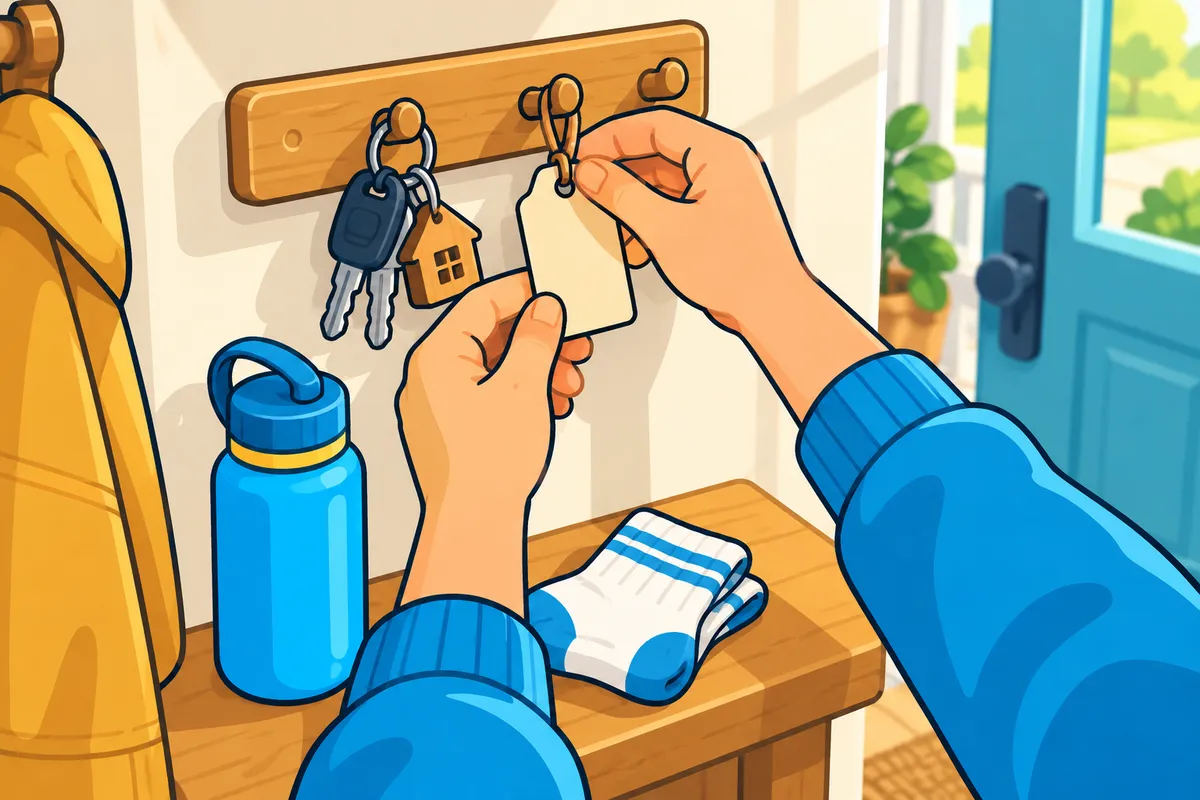
An implementation intention is a plan in if-then form that links a situation you will meet to one step you will take, such as "if it is 7 AM and I pour coffee, then I take my vitamin". Across 94 tests it helped people reach their goals more often than a goal alone, and it takes about one minute to write.
Most plans fail at the moment of action, not at the moment of deciding. You meant to go for a run after work, and then the sofa was right there. The sentence is written in advance so that moment already has an answer.
What Is an Implementation Intention?
An implementation intention is a plan in if-then form: if situation X happens, then I will do Y. Psychologist Peter Gollwitzer proposed it as a second step after setting a goal, a plan that says when, where and how you will act, as he and Paschal Sheeran describe in their 2006 meta-analysis.
The "if" part names a cue you will meet. The "then" part names one action, small and concrete enough that you do not have to think about what it means.
A Goal Intention
- I intend to exercise more
- Says what you want, not when
- Leaves the decision for later
An Implementation Intention
- If it is 6 PM on a weekday, then I put on my sneakers
- Names the moment and the step
- Makes the decision in advance
How Is an Implementation Intention Different From a Goal?
A goal says what you want to reach; an implementation intention says what you will do at a named moment to get there. You need both. The plan only works for a goal you already hold, and a goal on its own often stays a wish.
The gap between the two is large. Gollwitzer and Sheeran cite a review by Sheeran in which the median share of people who intended to act but did not was 47%, nearly half. Of the people who did not intend to act, only 7% acted anyway, so the intention matters; it just is not enough.
In 47 experiments that made people's goal intentions stronger (d = .66), the effect on actually reaching the goal was only d = .36, a small-to-medium change. An if-then plan moved goal achievement by d = .65.
A goal tells you where to go; the if-then plan tells you what to do when the moment arrives.
What Are Some Examples of Implementation Intentions?
If-then plans solve four problems: forgetting to act, missing the chance, putting it off, and getting pulled off track. Each card shows a plan from the research beside an everyday version.
Four Problems, Four Kinds of Plan
Remembering to act
You forget
- Paper: if I walk by the mail box, I drop in my card
- Ours: if I lock the car, I check the bin day
Suits you if you want to do it but it slips your mind
Seizing a chance
You miss it
- Paper: if I see the manager, I go over and complain
- Ours: if there are stairs, I take them
Suits you if the right moment passes before you notice it
Getting started
You put it off
- Paper: if it is Saturday 10 AM, I outline my essay
- Ours: if it is 7 PM Sunday, I open the tax folder
Suits you if you know what to do and keep delaying it
Staying on track
You get pulled off
- Paper: if I feel my anger rise, I tell myself to stay calm
- Ours: if a colleague offers cake, I take tea
Suits you if something in the moment derails you
24 If-Then Plans by Life Area
Each row below has one stable cue and one action small enough for a bad day. Copy the ones that match your week, then change the cue to a moment you actually meet.
| Area | If… | Then I will… |
|---|---|---|
| Exercise | it is 6 PM on a weekday and I get home | put on my sneakers before I sit down |
| Exercise | I park at the supermarket | park in the row farthest from the door |
| Exercise | my meeting runs past 5 PM | do the 10-minute video workout at home |
| Exercise | I take a phone call at my desk | stand up and walk while I talk |
| Food | I open the fridge after dinner | pour a glass of milk or eat a piece of fruit |
| Food | I order lunch out | ask for the side salad in place of fries |
| Food | I unpack the groceries | wash and cut the vegetables for two days |
| Water | the kettle goes on | fill and drink a glass of water while it boils |
| Water | I sit down in a meeting | take three sips from my bottle |
| Sleep | it is 10:30 PM | plug my phone in outside the bedroom |
| Sleep | I wake up before the alarm on a weekend | get up and open the curtains |
| Money | I want to buy something online after 10 PM | leave it in the basket until the morning |
| Money | my salary arrives | move the savings amount on the same day |
| Study | I sit down at my desk | write down the one task for this session |
| Study | I reach for my phone while studying | put it face down in the other room |
| Work | I finish a call | write the next step in my notebook |
| Work | it is Friday at 4 PM | list next Monday's first three tasks |
| Health | I brush my teeth at night | floss one tooth |
| Health | I pour my morning coffee | take my vitamin |
| Mood | I notice I am scrolling for more than 10 minutes | stand up and stretch for one minute |
| Mood | I feel my jaw clench in traffic | breathe out slowly three times |
| Home | I take off my shoes after work | hang my keys on the hook |
| Social | it is Sunday evening | text one friend I have not spoken to |
| Reading | I get into bed | read one page before I touch my phone |
The "if" in every row is a moment that happens without effort. That is the whole trick: you do not have to remember the plan, because the moment reminds you.
Some of these rows hang the new action on something you already do, like brushing or pouring coffee. That special case has its own name, habit stacking, and it works from the morning coffee to the evening teeth-brushing.
How Do You Write an If-Then Plan?
Pick the goal, find the moment where you usually fail, and write one sentence that names that moment and one action. Then say it to yourself a few times, so the moment and the action feel linked.
Write Your Plan in Four Moves
- Name the goal you already want, in a few words
- Find the moment where you usually fail
- Write: if [that moment], then I will [one action]
- Read it twice and picture the moment happening
Make the "If" a Moment You Can See
A good "if" names a place, a time or an event you will notice: "if I park the car at work", not "if I have time". In a study of employees offered a flu shot, a plan with a date and a time beat a plan with only a date (see the flu shot section below).
Make the "Then" One Step
A good "then" is one action you can start in seconds. "Then I will get fit" is a goal in disguise; "then I put my sneakers on" is a step.
Add a Plan for the Obstacle
Write a second sentence for the thing most likely to stop you. The meta-analysis tested plans for getting derailed, such as a bad mood, a distraction or pressure from other people, and found effects as large as the plans for getting started.
| The obstacle | If… | Then I will… |
|---|---|---|
| Tired after work | I feel too tired to start | do the smallest version for five minutes |
| A distraction | my phone buzzes while I work | leave it until the timer ends |
| Pressure from others | someone pushes a second helping | say "no thanks, I'm full" and sip water |
| A missed day | I missed yesterday | do today's usual version, with no catch-up |

Do Implementation Intentions Work?
Yes, in most of the studies so far. Gollwitzer and Sheeran pooled 94 independent tests with 8,461 participants and found a medium-to-large effect (d = .65). In plain terms, using the standard reading of a d value, the average person with a plan did better than about 74 % of the people without one.
The effect showed up in every area of life they could sort the studies into, though not at the same size.
Health goals, the area most people use these plans for, sat in the middle at d = .59, across 23 tests with 2,861 people. Consumer goals had the smallest effect, from only two tests.
How Well Do They Work for Exercise?
Less well than the 94-test average, once the studies are randomized trials. A 2018 review of such trials in adults found that the pooled effect on physical activity was 0.15, which was not statistically significant. The trials that reinforced the plan showed a clear effect of 0.25.
So for a workout habit, write the plan and then keep the cue in front of you: a note on the shoes, a repeat calendar entry, or a weekly look at how many times the "if" actually happened.
Which Problems They Solve Best
The paper also split the tests by the problem the plan targeted. The largest effects came from plans that keep you going while you are in a poor state, and from plans that block outside pressure.
| Problem the plan targets | Tests | Effect size (d) |
|---|---|---|
| Remembering to act | 11 | .54 |
| Seizing an opportunity | 20 | .61 |
| Overcoming the urge to put it off | 21 | .65 |
| Ignoring a distraction | 3 | .90 |
| Holding back an unwanted response | 5 | .54 |
| Staying on task in a detrimental state (such as ego-depletion) | 5 | 1.10 |
| Resisting pressure from the situation | 8 | .93 |
| Letting go of a goal that is failing | 3 | .47 |
Source: Gollwitzer and Sheeran, 2006, Table IV. Rows with three to five tests are early results.
What One Line on a Flu Shot Letter Changed
The clearest real-world test is a flu-shot mailing at a large US utility company. All 3,272 employees with a reason to get vaccinated received a letter with the clinic times; some letters also asked them to write down a plan, reported by Milkman and colleagues.
- 33.1%
- got the shot with the letter alone
- 35.6%
- when asked to write a date
- 37.1%
- when asked to write a date and a time
Only the date-and-time plan made a difference the authors could rule out as chance: 4.2 percentage points after adjusting for other factors. Asking for just a date added 1.5 points, which was not significant.
| The letter asked for | Raw gap vs letter alone | Gap after adjusting | Extra shots / 1,000 letters |
|---|---|---|---|
| A date | 2.4 points (P = .27) | 1.5 points | about 15, within chance |
| A date and a time | 4.0 points (P = .04) | 4.2 points | about 42 |
Source: Milkman and colleagues, 2011. The last column is our arithmetic from the adjusted gap.
In people, 4.2 points across all 3,272 employees comes to about 137 more flu shots, had every letter carried the date-and-time line, for the same cost of postage.
The effect was larger where the clinic ran on only one day, between 7.9 and 9.5 points. A short window punishes a vague plan most.
When Do If-Then Plans Not Work?
They struggle against strong habits, and they cannot rescue a goal you do not really hold. Psychologists Wendy Wood and Dennis Rünger note in their 2016 review that even if-then plans “are not successful at controlling many strong habits”.
A habit you have repeated for years fires from the cue before your plan gets a say. The same review adds that old memory traces are not necessarily replaced when you learn a new response, so a lapse can bring the old habit back.
Three other limits come up in practice:
- A vague cue. "If I have a free moment" never arrives. Name a place, time or event.
- Too many plans at once. Start with one or two, so each plan has a moment of its own.
- A goal someone else set. The plan carries out a goal you hold, so it adds little to one you do not.
For a long-standing habit, the plan works better as one part of a bigger change to your surroundings, such as taking the cue out of sight before you have to fight the urge.
If-Then Planning for Habits
Use the same cue every day and the plan turns into a habit over time. The plan gets you to repeat the action at the same moment; the repeats build the link between cue and action that, after weeks, lets the action start on its own.
That is why the five steps for turning any action into an automatic one put the if-then sentence right after choosing a cue. If your first plan is about water, a glass after each step you already take is the easiest start, and a day of drink cues from kettle to bedtime lays them out.
Test One If-Then Sentence for Seven Days
Write one sentence tonight and check it against real life for seven days before you add a second. The first week tells you whether the "if" is a moment you actually meet.
Seven Days With One Plan
- Tonight: write one if-then sentence on a card
- Put the card where the “if” happens: the door, the kettle, the desk
- Each day, mark whether the moment came and whether you acted
- Day 7: if the moment rarely came, change the “if”, not the action
- Then add one plan for the obstacle that stopped you most
A plan that fires most days is working. A plan whose moment never arrives was a bad cue, and fixing the cue is the whole job.
General information for healthy adults, not medical advice. If a doctor has set your fluid amount, follow that.
More in Habits and Routines
Sources
- Advances in Experimental Social Psychology (Gollwitzer and Sheeran). Implementation intentions and goal achievement: a meta-analysis of effects and processes, 2006.
- National Bureau of Economic Research, published in PNAS (Milkman, Beshears, Choi, Laibson and Madrian). Using implementation intentions prompts to enhance influenza vaccination rates, 2011.
- Annual Review of Psychology (Wood and Rünger). Psychology of Habit, 2016.
- PLOS ONE (da Silva, São-João, Brizon, Franco and Mialhe). Impact of implementation intentions on physical activity practice in adults: A systematic review and meta-analysis of randomized clinical trials, 2018.
Sources checked by the Glubbo Editorial Team on Oct 19, 2026. General information, not medical advice. How we write and check our guides.

