Habits and Routines · Trackers and Streaks
How to Use a Habit Tracker: Set It Up, Mark It, Review It
Set up a tracker in ten minutes, mark it at the right moment, and read it each week, with what the studies found.
 By the Glubbo Editorial Team · Updated Oct 19, 2026 · 10 min read
On This Page
- How Do You Use a Habit Tracker?
- How Do Habit Trackers Help?
- How Do You Begin Tracking Your Habits?
- When Should You Mark Your Habit Tracker?
- Should a Habit Tracker Send Reminders?
- Should You Count Streaks?
- What Do You Do When You Read the Week Back?
- Does a Paper Tracker or an App Last Longer?
- When Can You Stop Tracking a Habit?
- Sources
Short answer
Tick one clear action at the same moment daily.
- Track one to three actions you can answer with yes or no.
- Across 138 studies, monitoring progress helped people reach goals (d = 0.40).
- Mark it right after the action, and read the week back every Sunday.

Write one to three actions you can answer with yes or no, mark each one right after you do it, and read the whole week back once a week. That is the full method, and each part answers a way trackers fail.
A habit tracker can be a grid and a pen, a spreadsheet with a checkbox per day, or an app with a row of circles. Most people set one up on a Monday and stop looking at it by the second weekend, so the choices below are about friction.
How Do You Use a Habit Tracker?
Pick the format by the moment you will mark it, not by how it looks. Choose the action before you draw the grid: one you can answer with yes or no every day, such as a glass of water with lunch.
Which Tracker Fits Your Day
- I like paper and I am home at the same time dailyA printed grid on the fridge or by the kettle
- I want to see the month at a glanceA wall calendar with one tick per day
- My phone is always with meAn app, with the reminder off once the habit has a cue
- I keep a journal alreadyA small grid on the back page of the journal
- I keep going when someone else sees itA shared list or a tracker you show a friend weekly
How Do Habit Trackers Help?
They make you notice what you actually do, and that noticing moves you toward the goal. A meta-analysis of 138 studies with 19,951 people by Harkin and colleagues found that interventions which got people monitoring their progress helped them reach their goals.
- 138
- randomized studies pooled
- 1.98
- effect on how often people checked progress (d)
- 0.40
- effect on reaching the goal (d)
The size reads like this. An effect of d = 0.40 means the average person who monitored did better than about 66 % of the people who did not, using the standard conversion of a d value. The gain ran through how much more often people checked their progress, which is why the marking moment matters so much.
Writing It Down and Showing Someone
Monitoring helped more when people physically recorded their progress, and when the results were reported to someone else or made public. A tick you write beats a glance in your head; a tick someone else sees beats both.
A second, older review points the same way. Across 122 healthy eating and exercise programs with 44,747 people, Michie and colleagues found three things:
- A pooled effect of 0.31.
- Self-monitoring explained 13 % of the difference between programs, more than any other technique.
- Programs that paired it with at least one other self-control technique from the same theory did better (0.42 against 0.26).
Writing it down is the part that does the work, and reading the week back is the part most people skip.
What Each Study Means for Your Grid
The four sources on this page looked at tracking from different angles. Read across a row to see what each one means for your grid.
| Source | What it tested | What to do |
|---|---|---|
| Harkin and colleagues, 2016 | Monitoring goal progress, across experiments | Write the tick; show the grid to someone weekly |
| Michie and colleagues, 2009 | Self-monitoring inside eating and activity programs | Pair the tracker with a target and a review |
| Stawarz, Cox and Blandford, 2015 | A 4-week study of cue types, plus a review of 115 habit apps | Tie the action to an event, not a buzz |
| Wood and Rünger, 2016 | A review of habit research | Let the reminder go once the cue works |
How Do You Begin Tracking Your Habits?
Spend ten minutes setting it up so that marking it takes five seconds. Most trackers die from friction: a grid that lives in a drawer, or an action too vague to tick.
Set Up a Tracker in Five Moves
- Write each action as a yes or no: walked 10 minutes, read one page
- Keep it to one to three rows to start
- Put the tracker where you do the action, or where you end the day
- Decide your mark: a tick for done, a dot for a smaller version
- Pick one weekly moment to read it back, such as Sunday breakfast
Put the Grid Where the Action Happens
Keep the grid next to the thing you touch for the action:
- On the fridge for a glass of water.
- On the bathroom mirror for flossing.
- On the bedside table for the page you read before sleep.
A tracker in a drawer needs a second habit, remembering to open it, so it fails the way the first habit would have. If the action happens in several places, put the grid where the day ends, such as the kitchen counter by the phone charger.
Make Each Row a Yes or No
You cannot tick "eat better"; you can tick "vegetables at lunch". If you cannot decide whether to tick, rewrite the row until you can, the way a 30-minute walk or lights out by 11 each have a clear finish line.
Use a Second Mark for the Small Version
A dot or half tick for "did the two-minute version" keeps tired days on the grid. A tracker that only counts full days punishes the habits you kept alive on a bad evening.
| Mark | Means | Example: a 20-minute walk |
|---|---|---|
| Tick | Did the action | Walked 20 minutes |
| Dot | Did a smaller version | Walked once around the block |
| Blank | Did not do it | No walk |
| Dash | Planned rest day | Sunday, as set in advance |
| Question mark | Probably did it, forgot to mark it | Fill in only if you are sure |
These marks are our own suggestion. What counts is that you set them before you start, so you never argue with the grid at 11 PM.
When Should You Mark Your Habit Tracker?
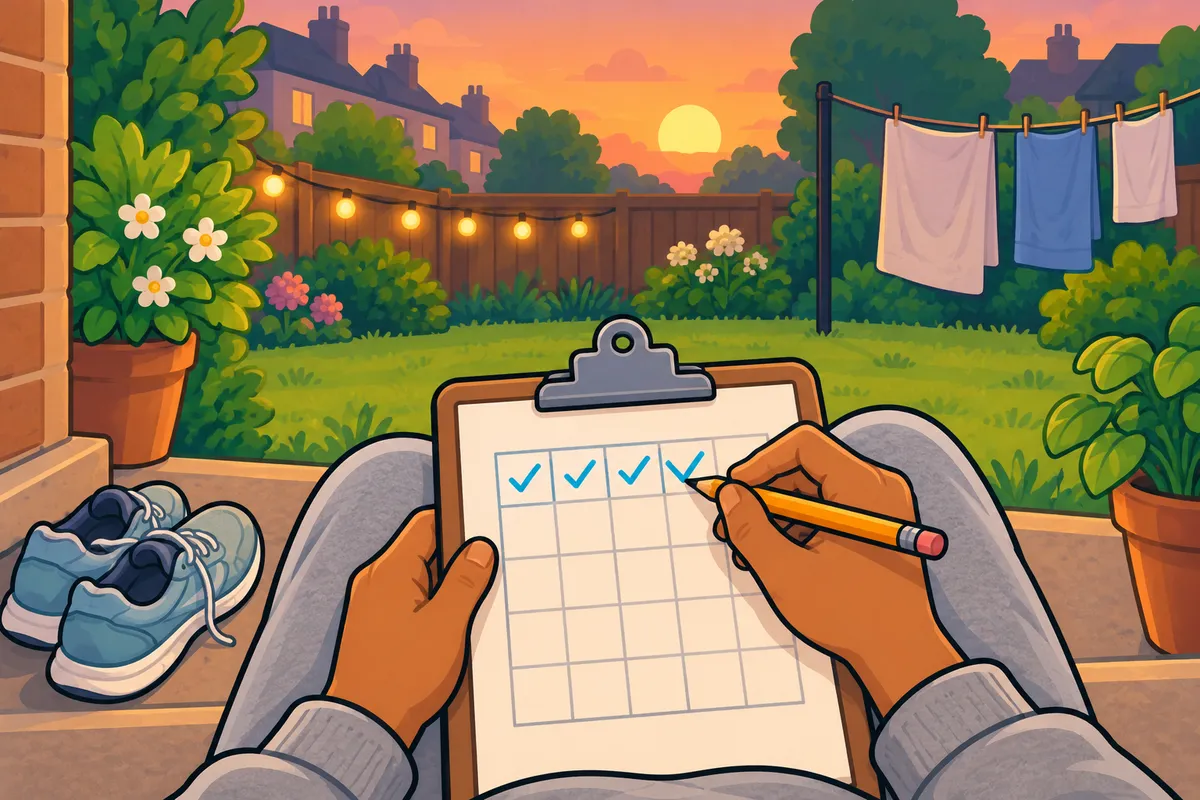
Right after you do the action, in the same place each time. A tick straight after the walk links the two; a catch-up session on Friday turns the tracker into a memory test. For a glass of water on an Android phone, a widget that logs the drink in one tap makes the tick as quick as the sip.
If you cannot mark at the moment, pick one fixed end-of-day moment instead, such as plugging your phone in at night, which already sits near the end of a planned evening. The tracker itself then becomes a small habit with its own cue.
Should a Habit Tracker Send Reminders?
Not for long. In a four-week study of cue types, Stawarz, Cox and Blandford found that reminders helped people repeat the action but hindered habit development, while event-based cues increased automaticity. The study also tested positive reinforcement, which did not help.
A Timed Reminder
- Helps you remember in week one
- You wait for the buzz
- Slowed habit development in the study
An Event Cue
- Tied to something you already do
- The event reminds you
- Increased automaticity in the study
Wood and Rünger reach the same conclusion in their 2016 review: reminders “increased repetition but also impeded automaticity”. They add that physical signs, such as a note on the fridge, also “lost potency over time”.
The same app study reviewed 115 habit apps and found most of them built around tracking and reminders, with no support for cues tied to events. So use the app to record, and let a moment in your day do the reminding. Writing the moment down as an if-then sentence turns it into a cue.
Should You Count Streaks?
Count the week instead of the run. A streak counter drops to zero on the day you miss, which tells you nothing true about the habit. In Lally's 2010 habit study, 140 missed opportunities across 55 volunteers did not materially affect how the habit formed: after a miss, automaticity still rose by a mean of 0.55 points over two days, against 0.79 after two days without one.
The GP paper from Gardner and colleagues uses a weekly line instead: a week is a success when the action was done on more than 5 days. The table shows how differently the two scorecards read the same week.
| The week | Ticks | Streak counter shows | Weekly line (over 5 days) |
|---|---|---|---|
| No misses | 7 of 7 | 7 | Success |
| One miss on Wednesday | 6 of 7 | 4 on Sunday, after a reset on Wednesday | Success |
| Two misses | 5 of 7 | 2 on Sunday | Not yet; the next week starts clean |
A missed week is the real warning sign: the authors of the 2010 study cite earlier research in which a lapse of a whole week cut future performance. Two blank days in a row are the point to change the cue, not to try harder.
What Do You Do When You Read the Week Back?
Look for the pattern in the blanks, not the ticks, and change the cue before you change your effort. The weekly review is where a tracker earns its place.
| What the blanks look like | What it usually means | What to change |
|---|---|---|
| Blank on the same weekday every week | The cue does not exist that day | Move the action to an event that happens daily |
| Blank on late or tired evenings | The action is too big or too late | Add a dot version, or move it earlier |
| Blank only on the first row | One row is too big | Shrink it to two minutes |
| Blank in the first days after a trip | The cue was missing for a few days | Restart at the usual cue, no catch-up |
| Ticked every day for two months | The cue may be doing the work alone | Retire the row |

Missed days will turn up on any honest grid. One blank does not undo the work, and what to do the morning after a miss keeps one blank from turning into a week.
Does a Paper Tracker or an App Last Longer?
Both work; what matters is whether the tracker meets you at the moment you act. Stawarz, Cox and Blandford reviewed 115 habit apps and found most built around tracking and reminders, with no support for event-based cues. A paper grid on the fridge has no reminder at all, but it sits where the action happens, which the same study found more effective for building automaticity.
| Format | Best when | The risk |
|---|---|---|
| Paper grid on the wall | The action happens at home, at one spot | A trip breaks the run because the grid stays behind |
| Pocket notebook | You move between places during the day | You forget to open it at the end of the day |
| Phone app | Your phone is always in reach | The app's buzz becomes the cue instead of the action |
| Spreadsheet | You want charts and weekly totals | Setup takes longer than the habit itself |
If an app sends a buzz and you log a drink you never took, the tracker is counting reminders, not habits. Switch to a paper grid for two weeks: the silence shows whether the action happens on its own.
When Can You Stop Tracking a Habit?
When you do it at the cue without thinking and would notice if you skipped it. For a simple habit, that took about two months in the best-known study, and longer for harder ones.
Stopping is fine. A tracker is there for the learning stage; once the cue does the work, retire the row and give the space to the next habit.
If water is one of your rows, the printable water tracker gives each day a row of glasses to tick, or you can log each glass on your phone.
A tracker works best on a habit that already has a cue and a plan; the five steps from cue to automatic put those in place first. Write your one to three rows tonight and put the grid where the first action happens. Next Sunday, find the row with the most blanks and change its cue, not your effort.
General information for healthy adults, not medical advice. If a doctor has set your fluid amount, follow that.

More in Habits and Routines


Sources
- Psychological Bulletin (Harkin and colleagues). Does monitoring goal progress promote goal attainment? A meta-analysis of the experimental evidence, 2016.
- Health Psychology (Michie, Abraham, Whittington, McAteer and Gupta). Effective techniques in healthy eating and physical activity interventions: a meta-regression, 2009.
- CHI 2015, ACM (Stawarz, Cox and Blandford). Beyond Self-Tracking and Reminders: Designing Smartphone Apps That Support Habit Formation, 2015.
- Annual Review of Psychology (Wood and Rünger). Psychology of Habit, 2016.
Sources checked by the Glubbo Editorial Team on Oct 19, 2026. General information, not medical advice. How we write and check our guides.

