Drinking Habits · Building the Habit
How to Track Water Intake With a Bottle, Paper or Your Phone
 By the Glubbo team · Updated Oct 16, 2026 · 7 min read
On This Page
- What Is the Easiest Way to Track Water Intake?
- Six Ways to Track, Compared
- Measure Your Glass Before You Count
- Do Time-Marked Water Bottles Work?
- What Goes in Your Log?
- Logging in Your Phone's Health App
- What a Large Tracking Trial Found
- How Do You Know Your Log Is Right?
- How Long Should You Keep a Log?
- Sources
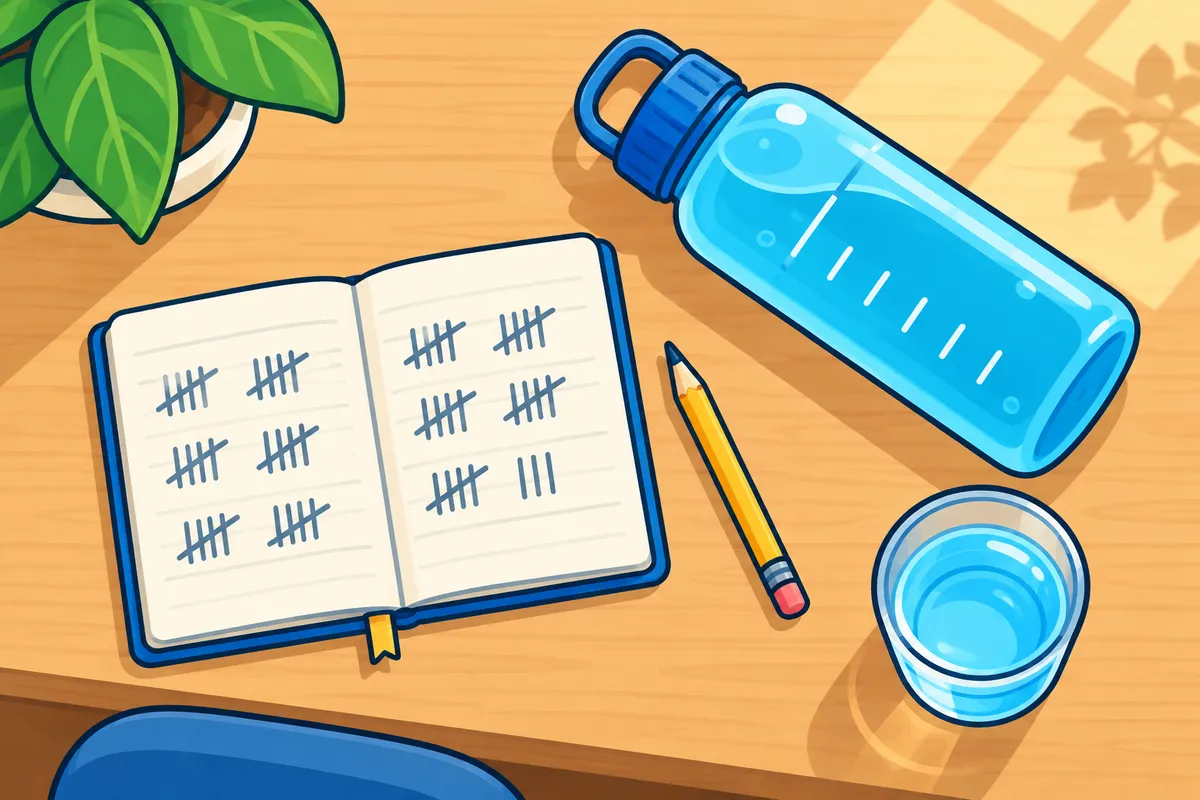
Count refills of one bottle.
and log coffee, tea and milk too
A guess at how much you drank today hides two errors. You forget the drinks that did not feel like drinks, and your "glass" holds more or less than you think.
Tracking closes that gap. This page covers the ways to log what you drink and what belongs in the log; for the daily cues that make drinking automatic, see our guide on how to drink more water.
What Is the Easiest Way to Track Water Intake?
Count refills of one container you know the size of. A 500 ml bottle emptied four times is 2 litres, with no app and no typing.
Track With One Bottle
- Pick the bottle or glass you use most
- Measure it once, with a measuring jug
- Tally each time you empty it
- Add coffee, tea and milk as you drink them
The trick is the single container. Logging a mug here, a can there and a café cup later is where most logs fall apart, because nobody knows what any of them held.
If you already know your goal, bottles per day turns it into refills of your own bottle, so the count you track is a small whole number.
Six Ways to Track, Compared
No method is best for everyone. The right one is the one you will still use on a busy Thursday.
| Method | Effort per drink | Counts other drinks | See the day at a glance | Suits |
|---|---|---|---|---|
| Tally marks on paper or a sticky note | One pen stroke | Yes, if you add a mark | Yes | People who like a desk ritual |
| Counting refills of one bottle | None while drinking | No, add them separately | Partly | Most people, most days |
| A bottle with time marks | None | No | Yes, against the clock | Desk days with a steady pace |
| Your phone's health app | A few taps | Yes | Yes | People already logging sleep or steps |
| A water tracking app | One tap | Yes | Yes, with reminders | People who forget without a nudge |
| A smart bottle that logs sips | None, once paired | No | Yes | People who drink from one bottle all day |
If you mostly forget to drink rather than forget to log, a reminder matters more than a log. Our pages on setting a water reminder on your phone and the best water reminder apps cover that side.
Measure Your Glass Before You Count
A log is only as good as the sizes in it. Fill your usual glass, mug and bottle from a measuring jug once, write the numbers on a note, and use them from then on.
US labels mix ounces and millilitres, and NIST gives the conversions to log them in one unit.
- 29.57 ml
- in one US fluid ounce
- 0.24 L
- in one US cup
- 500 ml
- in a 16.9 oz bottle; a 24 oz tumbler holds about 710 ml
Do Time-Marked Water Bottles Work?
They work as a visible cue: each line says how much should be gone by a given hour, so you see when you are behind. No study we found has tested marked bottles on their own, so treat them as a pacing aid. They only work if the marks match your goal and your day.
How to Mark Your Own Bottle
Most marked bottles assume one fill a day from 7 AM to 7 PM. If your goal is bigger than the bottle, or your day starts later, the printed times are wrong for you.
Jo weighs 72 kg (159 lb), is moderately active and lives somewhere hot, without giving a sex. Glubbo's habit formula gives a goal of 2,500 ml (85 oz). Jo uses a 1 L (34 oz) bottle, fills it twice, and drinks the last 500 ml with dinner and in the evening.
| Fill | Start full at | 250 ml gone by | 500 ml gone by | 750 ml gone by | Empty by |
|---|---|---|---|---|---|
| First | 7:00 AM | 8:15 AM | 9:30 AM | 10:45 AM | 12:00 PM |
| Second | 12:00 PM | 1:15 PM | 2:30 PM | 3:45 PM | 5:00 PM |
| Evening | 500 ml with dinner and after | 9:00 PM |
A strip of tape down the side and a marker do the job. When a line passes and the water is still above it, drink to the line, never past the next one; a bottle is a pace, and catching up in one go defeats it. Our guide on how often to drink water explains why sipping beats chugging.
What Goes in Your Log?
Log every drink, not only plain water. When the US National Academies set their water values, they found that "caffeinated beverages can contribute as much as noncaffeinated options", and the NHS counts water, lower-fat milk, tea and coffee as part of your daily intake.
So a log of only plain water can make you look a litre short when you are not. Our page on whether coffee counts as water works through a day of lattes and tea, and what counts toward your water intake goes through every other drink.
Leave Food Out
Food supplies water too, but you cannot measure it at the table. In US survey data, drinks gave about 81 % of total water and food about 19 %, the US National Academies found.
That matters when an app sets your goal. Google's own help page says the Google Health app defaults to 3.7 L for men and 2.7 L for women, which match the US total water values, food included. The drinks part of those totals is about 3.0 L and 2.2 L, so if you log only drinks, a 3.7 L target asks for more than you need.
A big salad or a bowl of watermelon still helps, and foods with the most water shows which ones carry the most.
Logging in Your Phone's Health App
Both phone makers have a place to log water, and the steps are short once you find the screen. Use the health app if you already log sleep or steps there; otherwise paper or a counted bottle is quicker.
Apple Health on iPhone
Apple's steps for adding Health data by hand are the same for every category. Open Health, tap the Browse tab, open the category and subcategory you want, tap Add Data, enter the date, time and amount, then tap Done.
Apps you allow can write to Health too. Under your profile, then Apps, you can let a water app share its log so everything sits in one place.
Google Health on Android
In the Google Health app, Google's help page says to open the Health tab, tap Nutrition under "Focus areas", then Add Hydration. You enter the amount, choose the date and time, and can pick a preset such as Glass, Bottle or Large bottle.
Set your own goal instead of the default. The 3.7 L and 2.7 L presets count food, as the section above explains.
What a Large Tracking Trial Found
Tracking plus rewards raised how much people drank, but the extra faded over two years. The largest test we found is the PUSH trial, which followed 1,658 people aged 12 and over with a history of kidney stones at six US centres.
Everyone got a Bluetooth bottle that "measured and recorded fluid intake". The intervention group also had a personal fluid target, a $1.50 daily reward for meeting it, coaching when they fell short, and optional text messages.
| Intervention group | Control group | |
|---|---|---|
| Daily urine volume at 6 months, adults | Up about 600 ml | Up about 360 ml |
| Stone events over 2 years | 19 % | 20 % |
| Bladder symptoms (frequency, urgency) | Higher at 6 and 12 months | Lower |
The gap between the groups shrank over time, the authors note. The trial was funded by the US National Institute of Diabetes and Digestive and Kidney Diseases and tested people with stones, so it tells you about effort and follow-through rather than about healthy adults.
The lesson for an ordinary log is modest. Measuring what you drink helps while you pay attention to it, and the habit has to carry you once the novelty is gone.
How Do You Know Your Log Is Right?
Check it against your body. The NHS says most people should drink enough that their pee is "a clear pale yellow colour"; if your log says you hit your goal and your pee is still dark, the sizes in your log are probably off.
Workouts are the other blind spot. A log built for a normal day misses what you sweat out in a long session, and how to calculate your sweat rate shows how to measure it with a scale.
How Long Should You Keep a Log?
We suggest two to four weeks, long enough to learn your sizes and the hours you slip. After that, a spot check now and then catches drift: one tracked weekday and one tracked weekend day a month.
If you want a set start and finish, the 30-day water challenge turns that month into a plan, and drinking more water at work covers the hours when most logs go quiet.
General information for healthy adults, not medical advice. If a doctor has set your fluid amount, follow that.
More in Drinking Habits

Sources
- NIST. Approximate Conversions from U.S. Customary Measures to Metric, 2024.
- National Academies of Sciences. Dietary Reference Intakes for Water, Potassium, Sodium, Chloride, and Sulfate: Summary, 2005.
- National Academies of Sciences. Report sets dietary intake levels for water, salt, and potassium (press release), 2004.
- NHS. Water, drinks and hydration, 2023.
- Apple Support. Manage Health data on your iPhone, iPad, or Apple Watch, 2026.
- Google Health Help. Track your nutrition and hydration with the Google Health app, 2026.
- The Lancet (Desai and colleagues, Urinary Stone Disease Research Network). Prevention of urinary stones with hydration: a randomised clinical trial of an adherence intervention, 2026.
Sources checked by the Glubbo team on Oct 16, 2026. General information, not medical advice.