Drinking Habits · Building the Habit
How to Drink More Water at Work, From Desk Jobs to Long Shifts
 By the Glubbo team · Updated Oct 16, 2026 · 6 min read
On This Page
- How Can I Remember to Drink Water at Work?
- How Much Water Should I Drink During a Workday?
- Does Your Employer Have to Provide Drinking Water?
- What to Keep at Your Desk or in Your Locker
- Meetings, Calls and Bathroom Trips
- Coffee, Sparkling Water and the Office Fridge
- Turn It Into a Plan for Next Week
- Sources
Refill at fixed points in your shift.
at the start, after lunch, mid-afternoon
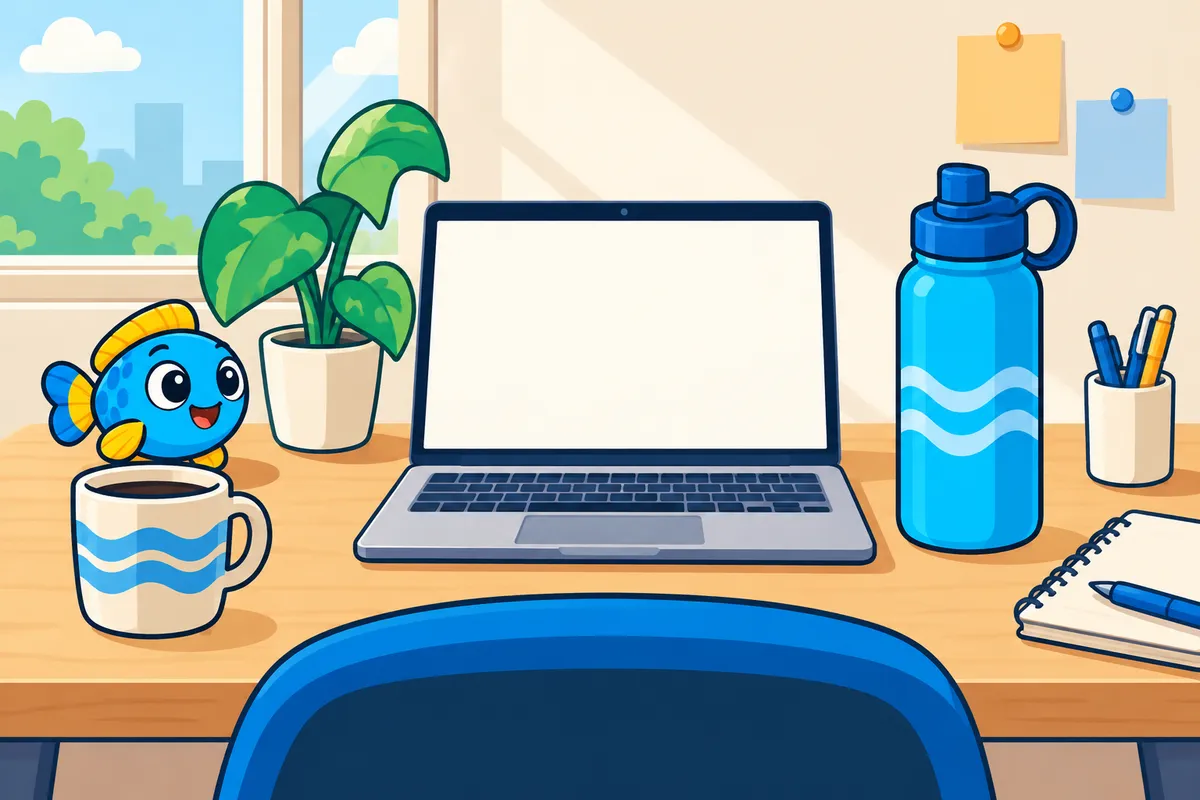
Work is where many people's drinking stops. You sit down at 9 with a coffee, look up at 1, and the bottle on the desk is still full.
The fix is the same one that works at home: tie each drink to something your workday already does. Our guide on how to drink more water covers those cues for the whole day; this page is about the eight to twelve hours you spend at work.
How Can I Remember to Drink Water at Work?
Tie refills to fixed points in your shift instead of relying on memory: when you sit down, after lunch and at your mid-afternoon break. Keep the bottle in sight, not in your bag, and drink at moments that repeat every day, such as the start of a call or the end of a task.
Pick three or four of these, not all of them:
- Fill a bottle as you take your coat off, before you open email.
- Take a few sips at the start of every video call, while people join.
- Drink a glass with lunch. Harvard Health suggests "a drink at each meal" as one of the easiest ways to keep up.
- Refill on the way back from the bathroom, so one trip sets up the next drink.
- Finish the bottle before you leave, and leave it by the door to refill at home.
If cues alone do not stick, a phone reminder can back them up for the first few weeks. The steps for iPhone, Android and Apple Watch are on setting a water reminder on your phone.
How Much Water Should I Drink During a Workday?
About the share of your day you spend at work. If you are awake 16 hours and work 8, roughly half your daily goal falls in work hours: for a 2,400 ml (81 oz) goal, that is 1,200 ml, or two and a half 500 ml bottles. Long or hot shifts need more.
Three people, three jobs. Their daily goals come from Glubbo's habit formula, which uses weight, activity, climate and sex.
| Worker | Daily Glubbo goal | Hours at work | Share in work hours | As 500 ml (16.9 oz) bottles |
|---|---|---|---|---|
| Sam, 78 kg (172 lb) man, desk job, low activity, mild climate | 2,400 ml (81 oz) | 8 of 16 waking | about 1,200 ml | about 2½ |
| Ana, 62 kg (137 lb) woman, nurse, on her feet, high activity, mild climate | 2,000 ml (68 oz) | 12 of 16 waking | about 1,500 ml | 3 |
| Diego, 90 kg (198 lb) man, warehouse in summer, high activity, hot climate | 3,400 ml (115 oz) | 8 of 16 waking | about 1,700 ml, plus the heat pace below | 3½ or more |
Desk Jobs
Sam's problem is time, not thirst. He drinks two coffees by 11 and nothing else until lunch, then tries to make up for it at 4 PM.
His two coffees count too, on top of that plan. Our page on whether coffee counts as water explains why the mug goes in the total.
Twelve-Hour Shifts
Long shifts squeeze most of the day's drinking into work hours, and breaks are short. For Ana, three-quarters of her goal has to happen between handovers.
Plan the drink around the break, not the thirst. A 500 ml bottle at the start of the shift, another at the meal break, and a third two hours before handover keeps her on track; drinking early in the shift also means fewer bathroom trips in the last hours. Our page on the best time to drink water explains which moments carry the most weight.
Outdoor and Hot Work
Heat changes the numbers. NIOSH sets a pace for moderate work in the heat that lasts under two hours, and a cap for any hour.
- 1 cup
- (8 oz) of water every 15–20 minutes
- 6 cups
- (48 oz, about 1.4 L) an hour at most
On a hot shift, Diego's formula goal is a floor. Three to four cups an hour while he works in the heat comes to about 0.7 to 0.95 L an hour, and NIOSH adds that if sweating lasts several hours, he should "drink sports drinks containing balanced electrolytes".
Our guides on how much water to drink in hot weather and when you need electrolytes give the full numbers for heat and long sweaty days.
Does Your Employer Have to Provide Drinking Water?
In the US, yes. The OSHA sanitation standard says that "potable water shall be provided in all places of employment, for drinking", among other uses, and it bans shared drinking cups. Portable dispensers must be closable, kept sanitary and fitted with a tap.
The rule is in 29 CFR 1910.141, the general industry standard. If the only water at your site is a warm tap in a back room, a bottle you fill at home and one refill at work may be the realistic plan.
What to Keep at Your Desk or in Your Locker
A few small things remove the excuses:
- A bottle you like, sized so two or three fills cover your work share. A 750 ml (25 oz) bottle filled twice covers Sam's.
- A second, smaller bottle or a glass for meetings, so you do not carry the big one.
- A sticky note with your sizes: "bottle 750 ml, mug 300 ml". It makes a quick tally possible.
- Tea bags or sugar-free flavour drops if plain water bores you by mid-afternoon.
The Centers for Disease Control and Prevention lists the simplest version: "Carry a reusable water bottle with you", and "Opt for water when eating out", which covers the team lunch.
Meetings, Calls and Bathroom Trips
Many people drink less at work because they do not want to leave a meeting. Front-load instead: drink more in the first half of the morning and the first hour after lunch, when your calendar is lighter, and less in the last hour before a long meeting.
Expect more trips at first. Most people pee about seven to eight times a day, Cleveland Clinic notes, and going more often "may still be normal" if you are drinking lots of fluids.
Use the trip: a walk to the bathroom is also a walk past the water cooler, which turns one break into the next refill.
If your job ties you to a station, ask for a bottle holder at the counter or the till rather than a rule to drink only on breaks. A 30-minute break every four hours leaves room for two drinks in a shift; a bottle within reach leaves room for twenty sips.
Coffee, Sparkling Water and the Office Fridge
What you drink at work counts, not only plain water. The NHS counts water, lower-fat milk, tea and coffee toward your daily fluid, and asks you to keep fruit juice and smoothies to one small 150 ml glass a day.
If the office fridge is full of sparkling water, that counts too; is sparkling water bad for you covers teeth and bloating. If plain water is the problem, our ideas for drinking water when you don't like it help more than willpower.
Turn It Into a Plan for Next Week
Three steps turn the ideas above into a routine by Friday.
One Week to a Work Habit
- Choose three refill points: the start, after lunch, mid-afternoon
- Write them on a sticky note with your bottle size
- Track only your work hours for five days
The water drinking schedule turns your goal and hours into a list of times you can copy.
A simple tally of bottles is enough for that week; how to track water intake compares the ways to do it. If you want a firmer start, the 30-day water challenge builds the same refills into a month, a week at a time.
General information for healthy adults, not medical advice. If a doctor has set your fluid amount, follow that.
More in Drinking Habits
Sources
- Harvard Health Publishing. How much water should you drink?, 2024.
- CDC. About Water and Healthier Drinks, 2026.
- CDC NIOSH. Heat Stress, Workplace Recommendations, 2026.
- US Department of Labor, OSHA. 29 CFR 1910.141, Sanitation, 2026.
- Cleveland Clinic. Frequent Urination, 2025.
- NHS. Water, drinks and hydration, 2023.
Sources checked by the Glubbo team on Oct 16, 2026. General information, not medical advice.