Habits and Routines · Trackers and Streaks
Habit Tracker Ideas: What to Track and Five Layouts That Work
Twenty-one rows worth tracking, ten with a clear finish line, and the layouts and formats that suit how many you keep.
 By the Glubbo Editorial Team · Updated Oct 19, 2026 · 10 min read
On This Page
- What Are Good Habits to Track?
- How Many Habits Should a Tracker Have?
- Should You Track Actions or Results?
- How Do You Track a Habit You Do Weekly or Monthly?
- How Do You Track a Habit You Want to Quit?
- What Are Good Bullet Journal Habit Tracker Ideas?
- What Should You Not Put on a Habit Tracker?
- When Is It Time to Retire a Row?
- Which Format Fits Your Tracker?
- Sources
Short answer
Track a few small actions tied to a goal you care about.
- Pick 1 to 3 yes-or-no actions, such as a 30-minute walk or lights out by 11.
- Tracking helped people reach goals in 138 studies (d = 0.40).
- Pair each row with a specific goal and a weekly review.
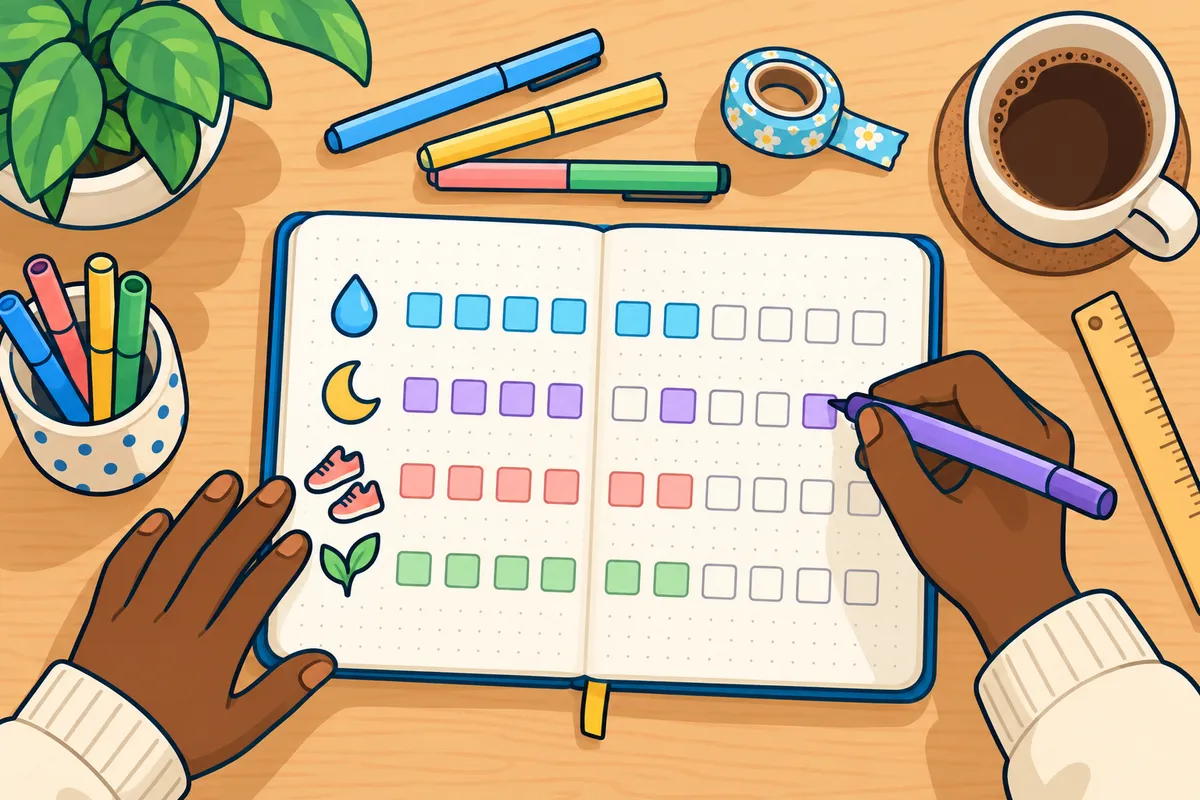
The best habit tracker ideas are small actions with a plain yes-or-no answer, tied to a goal you care about this month: walked 30 minutes, lights out by 11 PM, one page read. Pick one to three of them. Treat the lists below as a menu, not a to-do list.
A blank tracker page invites you to fill every row: water, steps, reading, meditation, no sugar, journaling, budget, skincare. By the second week most of those rows are empty, and the empty squares start to feel like a report card.
What Are Good Habits to Track?
Track small daily actions that move a goal you actually care about, written so the answer is a plain yes or no. "Walked 30 minutes" works; "be healthier" does not. Pick your goal first, then the one action that serves it most directly.
Habit Tracker Ideas, by Life Area
Body
Movement and food
- Stretched for five minutes
- Took the stairs
- Cooked dinner at home
Suits you if your goal is fitness or energy
Sleep
Evening and morning
- Phone charged outside the bedroom
- Up at the same time
- No caffeine after 2 PM
Suits you if you wake up tired
Mind
Calm and focus
- Three slow breaths before email
- One thing I am grateful for
- No phone in the first 30 minutes
Suits you if you feel scattered or low
Home
Small resets
- Kitchen cleared before bed
- One load of laundry started
- Tomorrow's bag packed
Suits you if the mess builds up through the week
Money
Daily or weekly
- No takeout coffee
- Account balance checked
- Weekly budget reviewed
Suits you if money leaks without you noticing
Learning
Little and often
- Ten minutes of a language app
- Practiced the instrument
- Watched one lesson
Suits you if you keep meaning to learn something
Work and study
Focus on the job
- One 25-minute focus block
- Tomorrow's top three written
- Notifications muted while working
Suits you if your days disappear into small tasks
Choose from the area where a goal is already pulling at you. A row nobody asked for, copied from a pretty spread online, is the first one you will stop filling in.
What Counts as Done on a Habit Tracker?
"Done" is the line you draw in advance, so you never argue with yourself at 11 PM. The table turns ten common goals into rows you can tick, with the target behind each one where a public body sets one.
| Goal | Row on the tracker | Counts as done | Target behind it |
|---|---|---|---|
| Move more | Walked 30 min | 30 minutes, in one go or three walks of 10 | CDC: 150 min a week, e.g. 30 min on 5 days |
| Get stronger | Strength session | Any session that works the main muscles | CDC: 2 days a week |
| Eat better | 5 a day | Five portions of 80 g (about 3 oz) of fruit or veg | NHS: at least 5 portions a day |
| Sleep more | Lights out by [time] | Asleep-time set 7 h before the alarm | CDC: 7 or more hours (18 to 60) |
| Sleep better | Screens off at [time] | Devices off 30 min before bed | CDC: at least 30 minutes |
| Drink more water | Water with each meal | A glass at breakfast, lunch and dinner | Your own daily goal |
| Calm | Ten minutes outside | Any ten minutes outdoors, any weather | No set target |
| Read more | One page | At least one page of a book | No set target |
| Journal | One line | One sentence, any time of day | No set target |
| Save money | Spending written down | Every purchase noted that day | No set target |
Few habits come with an official number. For the rest, set your own floor and keep it low enough to reach on a bad day.
How Many Habits Should a Tracker Have?
Start with one to three rows, and add one only when the others run without effort. Each row is a decision you have to remember every day, and new habits each need their cue to fire on its own, which takes about two months for a simple action.
- 138
- experiments on monitoring progress
- 19,951
- people in those experiments
- d = 0.40
- effect of monitoring on reaching the goal
Tracking helps, modestly. A meta-analysis by Harkin and colleagues found that monitoring progress improved goal attainment, and the effect was larger when progress was physically recorded or reported to others. Even so, one row you fill in every day records more than ten you abandon.
Write each row at the size you can finish on your worst day: one page, not a chapter; five minutes of stretching, not a workout. You can raise the bar after a few weeks, but a row that is always reachable keeps the page full.
Three rows you fill in daily beat ten rows you fill in on Mondays.
Should You Track Actions or Results?
Track the action, and check the result now and then. "Walked 30 minutes" is in your control today; "lost 5 lb" is not, and a row you cannot control turns into a row of red marks. Results belong in a weekly or monthly check instead.
A meta-regression of 122 healthy-eating and exercise interventions with 44,747 people backs this pairing. Michie and colleagues found that programs combining self-monitoring with at least one related technique, such as setting a specific goal, reviewing it or getting feedback, had an effect size of 0.42 against 0.26 for the rest.
Action Rows (Daily)
- Walked 30 minutes
- Lights out by 11 PM
- Wrote down spending
- You control them today
Result Rows (Weekly at Most)
- Weight, step totals, savings
- Move for reasons outside your day
- Fine as a Sunday check
- Discouraging as a daily tick
So a good page has daily action rows and one weekly line for the result. Reviewing the page is itself one of the techniques that raised the effect in Michie's analysis, so put the review in your calendar as a repeating event.

How Do You Track a Habit You Do Weekly or Monthly?
Give a weekly or monthly habit its own line with its own unit. A daily grid hides it, because six of every seven squares stay empty and look like misses. Choose the unit that matches how often the habit really happens.
| How often | Example row | How to mark it |
|---|---|---|
| Every day | Lights out by 11 PM | One square a day |
| A set number of days | Walked 30 min, 5 days a week | Five boxes per week; fill one each time and stop at five |
| Once a week | Weekly review, laundry, call a relative | One box per week, on a fixed day |
| Once a month | Pay bills, check the budget | One box on a fixed date, such as the 1st |
The first CDC target in the table above works well as a count. "Walked 30 minutes" on five of seven days meets the 150 minutes a week the CDC advises, so two empty squares are part of the plan, not a lapse.
How Do You Track a Habit You Want to Quit?
Rewrite it as something you do, or count it. A "no sugar" or "no social media" row turns one slip into a red square for the whole day, and the next day starts with a mark against you.
| The "never" row | The action row | The count row |
|---|---|---|
| No sugar | Fruit after dinner | Number of sweet snacks, noted at night |
| No social media | Phone in the drawer by 9 PM | Minutes from the phone's screen time report |
| No late snacking | Kitchen cleared and light off by 8 PM | Evenings with a snack after dinner, out of 7 |
A count shows whether the habit is shrinking even on days it is not zero. The action row works better when the slip always happens at the same moment, since you are planning that moment. For a bigger habit, the plan in breaking a bad habit goes further.
What Are Good Bullet Journal Habit Tracker Ideas?
Six layouts cover almost every bullet journal tracker: a monthly grid, a weekly row, a one-line-a-day list, a year in pixels, a mood row and a themed drawing. Choose by how many habits you keep and how often you open the journal.
Six Bullet Journal Layouts
Monthly grid
3 to 8 habits
- Habits down, days 1 to 31 across
- Shows every empty Friday
Suits you if you open the journal every day
Weekly row
Fresh each Monday
- Seven boxes per habit
- A clean page after a bad week
Suits you if you plan week by week
One line a day
Least space
- A date and a few symbols
- Sits atop a daily entry
Suits you if you journal as well as track
Year in pixels
One habit
- 365 small squares
- Shows a dark February
Suits you if you want the long view of one thing
Mood row
Beside the habits
- Five colors, one per day
- Links habits to good days
Suits you if you want to know which habit pays off
Themed drawing
Low pressure
- Color one petal or leaf a day
- A seven-petal flower per week
Suits you if a plain grid bores you
The mood row earns its place because it is the only layout that answers a question: did the days you walked or slept well also feel better? Put it beside your habit rows for a month, then compare the two.

What Should You Not Put on a Habit Tracker?
Leave off anything you cannot answer yes or no, anything you already do without thinking, and any row that holds two actions. Those rows add ticks without adding a decision. Results, weekly habits and "never" rows have their own treatment in the sections above.
Rows to Leave Off
5 items- Vague goals: "be healthier", "be productive"
- Habits already automatic, such as brushing your teeth
- Two actions in one row, such as "gym and meal prep"
- Rows copied from someone else's spread
- Targets set for your best week, such as 10,000 steps when you now average 3,000
When a row does go empty for a day or two, the gap matters less than what you do next. A single miss did not set habits back in the research; the restart the next morning is the part to plan.
When Is It Time to Retire a Row?
Stop ticking a row once you notice you did the habit before you thought about the tracker. A simple action can take about two months to run on its own and a complicated one longer, so judge by the feeling, not the calendar.
Retire the row in three steps:
- Take it off the daily grid for a month.
- Check it in your Sunday review.
- Bring it back if it slips twice.
That frees a row for the next small habit, which is how a three-row page can serve you for years.
Which Format Fits Your Tracker?
Pick the place you will see the tracker without trying, then start with your one to three rows tonight.
Where to Keep the Tracker
- I want no screen at allA notebook grid beside the kettle or the bed
- I live in spreadsheetsA grid of checkboxes in Excel or Google Sheets
- My phone is always in my handAn app with a lock-screen reminder
- My first habit is drinking waterA printed grid of glasses by the kettle
For the spreadsheet option, checkboxes, a running total and green-on-done cells take about fifteen minutes to set up. How to mark and review whichever tracker you choose, from the moment of the tick to the weekly read-back, is the subject of using a habit tracker well.
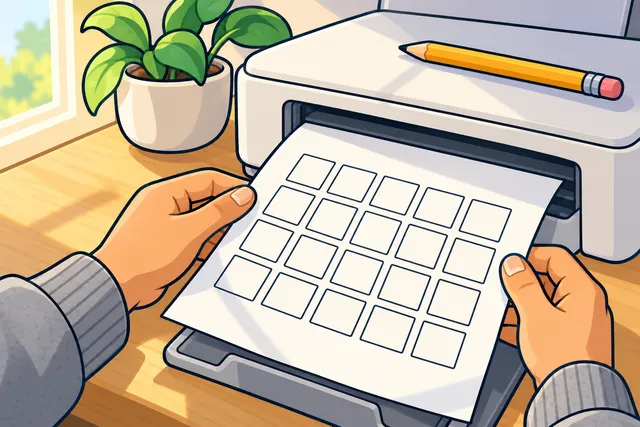
If water is your first row, the printable water tracker is a ready-made grid of glasses to tick, or you can mark each glass on a lined bottle instead.
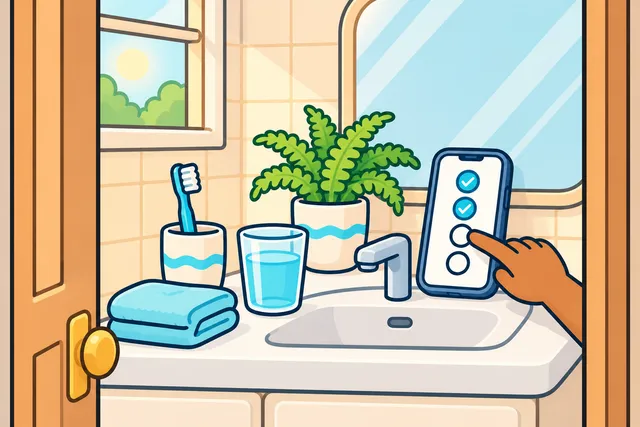
A phone app can hold the same row for nothing, though most free water trackers pay for it with ads, and some keep only your last 30 days.
General information for healthy adults, not medical advice. If a doctor has set your fluid amount, follow that.

More in Habits and Routines

Sources
- Psychological Bulletin (Harkin, Webb, Chang and colleagues). Does monitoring goal progress promote goal attainment? A meta-analysis of the experimental evidence, 2016.
- Health Psychology (Michie, Abraham, Whittington, McAteer and Gupta). Effective techniques in healthy eating and physical activity interventions: a meta-regression, 2009.
- US Centers for Disease Control and Prevention. Adult Activity, An Overview, 2026.
- US Centers for Disease Control and Prevention. About Sleep, 2026.
- NHS. Why 5 A Day?, 2026.
Sources checked by the Glubbo Editorial Team on Oct 19, 2026. General information, not medical advice. How we write and check our guides.

