Habits and Routines · Trackers and Streaks
What to Do When You Break a Streak: A Plan for the Next Day
One missed day did not set habits back in the research. Two weeks off is a restart, and that has its own plan.
 By the Glubbo Editorial Team · Updated Oct 19, 2026 · 9 min read
On This Page
Short answer
Do it tomorrow, at the usual cue and size.
- In Lally's study, one missed opportunity did not materially affect habit formation.
- Skip the make-up session; do the normal amount at the normal moment.
- After weeks off, restart with a smaller action on the same cue.

A missed day costs a habit very little, and the day after decides what happens next. Do the habit at its usual cue and size, with no make-up session.
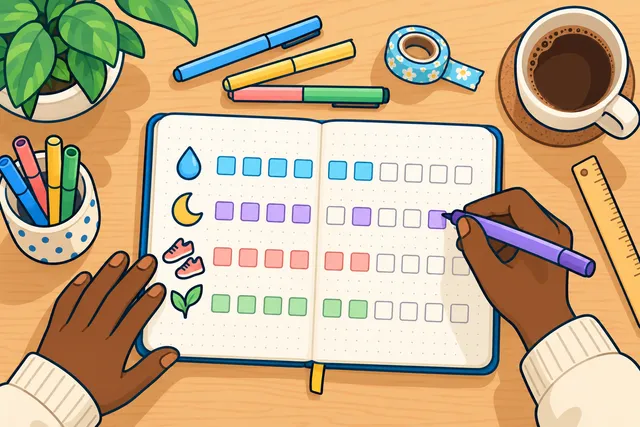
The chart had 23 ticks in a row, and now there is a gap. That gap feels bigger than it is, and the empty square can make stopping feel like the honest choice.
What Should You Do When You Break a Streak?
Do the habit tomorrow, at its usual cue, at its usual size, and leave yesterday's square empty. No double session, no punishment, no new start date. In Lally's 2010 study, missing one opportunity to perform the behavior "did not materially affect the habit formation process."
- 1 miss
- did not materially affect habit formation
- 138
- studies found tracking progress helps reach goals
- d = 0.40
- average effect of progress monitoring on goals
The tracker still earns its place. Harkin and colleagues pooled 138 experiments with 19,951 people and found that monitoring progress helped people reach goals, more so when they physically recorded it or reported it to someone else. A blank square is part of that record, and reading the blanks back each week shows which cue keeps failing.
The habit lives in the cue and the action; the streak is only a count of them.
Does Missing One Day Ruin a Habit?
No. The study behind the 66-day figure tracked 96 volunteers who each chose an eating, drinking or activity behavior to do daily in the same context for 12 weeks, and a single missed day did not knock their progress back in any meaningful way.
There is a limit to what that shows. The finding covers a single missed opportunity. Lally also found that volunteers who did the behavior more consistently fitted the habit curve better, so a run of misses is a different matter.
How Many Volunteers the Finding Rests On
Fewer than the headline number. Of the 96 people who started, 82 sent in enough daily ratings over the 84 days, and the habit curve could be drawn for 62 of them, with a good fit for 39, the study abstract reports.
Among them, reaching 95 % of their own top automaticity took anywhere from 18 to 254 days. So a streak of 23 days is early for almost everyone, and one blank square early on is normal.
What Is the Never Miss Twice Rule?
It is a popular rule of thumb: you may miss a day, but never two in a row. No study tested the rule itself, but it fits the research well on two counts:
- One miss did no material harm in Lally's study.
- Consistent repetition was what predicted a good habit curve.
Read it as a plan for tomorrow, not a threat. On the day after a miss, the habit gets a protected slot: do it first, before anything that could crowd it out.

What If You Miss Two Days in a Row?
Treat two misses as a signal to check the setup, not as a lost habit. The research tested one missed opportunity and found no material harm; it did not test two. What it did find is that steadier repetition went with a better habit curve, so the second miss is the one to stop.
| How long the gap was | What the research covers | What to do next |
|---|---|---|
| One day | One missed opportunity did not materially affect habit formation (Lally 2010) | Do it at the usual cue tomorrow; change nothing |
| Two or three days | Not tested; consistent repetition predicted a better fit | Check the cue and the object; shrink the action for a week |
| One to two weeks | Not tested | Restart on the same cue with a two-minute version |
| A month or more | Not tested | Treat it as a new habit; pick a cue from your current routine |
Everything below the first row is our practical guidance, built on what the studies did show: simple actions and steady repeats in a stable context build habits fastest.
Why Did the Streak Break?
The fix depends on the cause, so name it before you restart. Here are five common reasons and the fix for each.
Why You Missed, and What to Do Tomorrow
- I was sick or hurtRest; restart with a smaller version when you are well
- I was traveling or my schedule changedFind the same anchor in the new day, such as brushing your teeth
- I simply forgotCheck the cue: put the object where the cue happens
- It felt too big that dayShrink it to a two-minute version and keep the cue
- I have stopped caring about itAsk if you still want it; drop it or pick a new reason
Travel and Changed Routines
A new place removes the cues that started your habit. Duke psychologist Wendy Wood found that students who moved to a new university broke their TV habit more easily when the TV sat somewhere different, according to Duke Today.
The same effect works against the habits you want. On a trip, attach the habit to an anchor that travels with you, such as your first drink or brushing your teeth, instead of a room or a clock.
Sick, Sore or Hurt
Rest comes first when you are ill or injured, and the habit waits. Soreness is different: if your legs still hurt from the last workout, soreness that peaks two or three days after a new or harder session is a reason to go lighter, not to stop.
Cheung's 2003 review advises cutting the intensity and length of sessions for 1 to 2 days after a session that left you sore, or working other muscles meanwhile. A 20-minute easy walk at the usual time keeps the cue alive.
You Simply Forgot
Forgetting usually means the cue was weak. A habit tied to "sometime in the morning" has no moment to fire on; one tied to "after I switch the kettle on" does.
Think back to where you stood when the habit should have happened. If the book, the pills or the shoes were somewhere else, move them to that spot tonight. When forgetting is the pattern of most days rather than one, a routine built around ADHD-style reminders you can see uses the same idea in more places.
How Do You Restart a Habit After Quitting?
After a week or more off, treat it as a new start on an old cue. Shrink the action, keep the cue you used before if it still happens daily, and give it the same patience as the first time.
Restart in Four Moves
- Decide you still want it, for your own reason
- Shrink the action to two minutes or less
- Put it back on a cue you meet every day
- Repeat daily; grow it only once it runs itself
The research gives a reason to start small again. Lally's automaticity curve rises steeply at first and then levels off, so the earliest repeats count most. The 2024 review by Singh and colleagues reports that drinking-water habits came out stronger than exercise habits in two of the studies it covers, which suggests a tiny, easy version rebuilds the cue link fastest.

| Habit before the break | Two-minute restart version | Grow it back when |
|---|---|---|
| A 30-minute run | Shoes on and a walk to the end of the street | You start it without deciding, for a week or more |
| 20 pages of reading | One page after plugging in your phone | Same |
| A 15-minute stretch routine | One stretch on the mat | Same |
| A daily language lesson | One flashcard after your first coffee | Same |
The size is small on purpose: the first days of a restart rebuild the cue link, and the distance or the page count can come back later.
A month back to full size can follow this pattern. The weeks are our own schedule, and each step waits until the one before it runs without deciding.
| Week | Size of the habit | Cue | Move on when |
|---|---|---|---|
| 1 | The two-minute version | The old cue, every day | You start it without negotiating |
| 2 | About a quarter of the old size | Same | Seven days in a row feel ordinary |
| 3 | Half of the old size | Same | You forget it is a restart |
| 4 | Full size | Same | Keep it there for a week before adding anything |
A restart can also be the moment to fix the cue. If the old one broke because your life changed, choose an anchor from your new routine: something you already do every day at the new time.
Should You Start Your Streak Count Over?
Your app may reset the number, and that is fine; what matters is how you read it. Count the days you did the habit out of the days you could have, and the miss stops looking like a fall to zero.
Unbroken-Streak Count
- 23 days, then 0
- One miss erases the visible record
- Tempts you to quit after the gap
Days Done Out of Days Possible
- 23 of 24 days done
- Shows the miss as one square
- Rewards coming back the next day
Both views hold the same facts. The second one matches what the research measured: consistency over weeks, with an occasional miss doing no material harm.
For a water habit, the same idea applies when you mark today's glasses: log what you drank today and leave the gap alone.
Planned Rest Days and How to Count Them
A habit that is meant for five days out of seven never had a seven-day streak to break. Count it as weeks with five of seven done, so a rest day on Wednesday is part of the plan and not a hole in the chart.
Harkin and colleagues found that progress monitoring worked better when people recorded it physically or reported it to someone. If you share the count, share it by the week: "5 of 7 this week".
What About a Streak Freeze?
Some habit apps let you protect a streak for a day you know you will miss. It changes the counter, not the habit; the research above is about the action you repeat, so a planned day off with a freeze is still one missed opportunity.
The Morning-After Checklist
Run through this the first morning after a miss. It takes a minute.
Before Your Usual Cue Today
5 items- Leave yesterday empty; do not double up today
- Do the habit at its usual cue, first thing in that slot
- Check the object sits where the cue happens
- If it felt too big, do the two-minute version
- Tick today the moment you finish
When the habit has run for weeks, a miss matters even less, because automaticity climbs fastest in the first weeks and then levels off.
General information for healthy adults, not medical advice. If a doctor has set your fluid amount, follow that.

More in Habits and Routines

Sources
- European Journal of Social Psychology (Lally, van Jaarsveld, Potts and Wardle). How are habits formed: Modelling habit formation in the real world, 2010.
- Healthcare (Singh, Murphy, Maher and Smith). Time to Form a Habit: A Systematic Review and Meta-Analysis of Health Behaviour Habit Formation and Its Determinants, 2024.
- Psychological Bulletin (Harkin and colleagues). Does monitoring goal progress promote goal attainment? A meta-analysis of the experimental evidence, 2016.
- Duke Today, Duke University. Habits: A Repeat Performance, 2007.
- Sports Medicine (Cheung, Hume and Maxwell). Delayed onset muscle soreness: treatment strategies and performance factors, 2003.
Sources checked by the Glubbo Editorial Team on Oct 19, 2026. General information, not medical advice. How we write and check our guides.

