Habits and Routines · Daily Routines
How to Build a Morning Routine That Sticks, From Alarm to Door
Fix the wake time, count back from the moment you leave, and add one small step a week.
 By the Glubbo Editorial Team · Updated Oct 19, 2026 · 10 min read
On This Page
- How Do You Build a Morning Routine That Sticks?
- What Time Should You Wake Up for a Morning Routine?
- What Should a Morning Routine Include?
- How Long Should a Morning Routine Be?
- Is Hitting Snooze Bad for You?
- Why Do Morning Habits Stick Faster Than Evening Ones?
- What Should You Do After a Bad Night's Sleep?
- Healthy Morning Routine Ideas for Two Real Schedules
- What Changes When You Work From Home?
- Sources
Short answer
Fix your wake time, then add one step at a time.
- Get up at the same time every day, as the NHS and CDC both advise.
- Count back from when you leave: leave time minus routine length is your alarm.
- Morning stretching became a habit in 106 days on average, evening in 154.
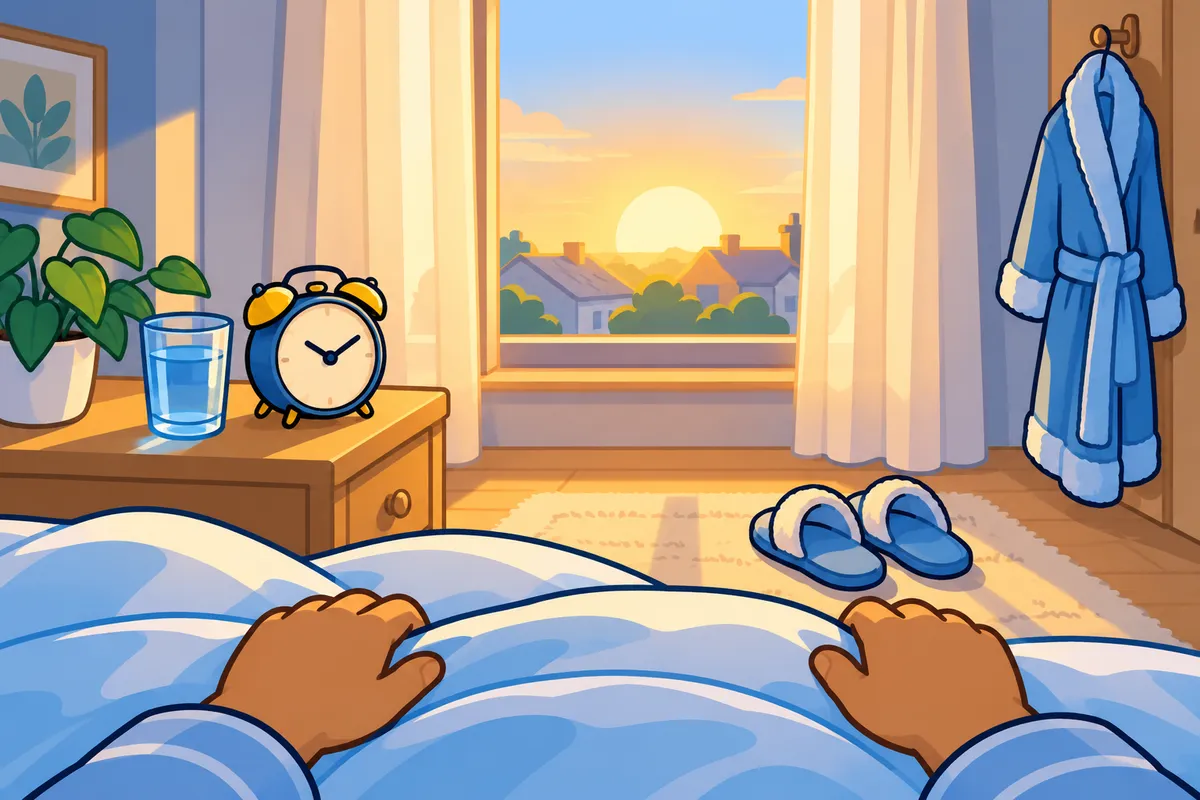
Fix your wake time first, count back from the moment you leave the house, and fill that gap with three small steps in a set order. Add a fourth step only when the first three happen without a decision. The NHS asks you to get up at the same time every day, and that fixed time is what every other step hangs on.
A chaotic morning is rarely too little time. If your alarm goes at 6:45 and you leave at 7:30, the 45 minutes in between usually vanish into the phone, a search for keys and a coffee drunk standing up, because they have no order.
How Do You Build a Morning Routine That Sticks?
Start from the two times you cannot move, the alarm and the front door, and build inward. The order you decide the night before matters more than which steps you choose.
Build It in Five Moves
- Fix one wake time for every day of the week
- Count back 7 or more hours of sleep to your bedtime
- Note the time you leave, and the minutes in between
- Choose three small steps for those minutes
- Add one new step a week, never three at once
Once "get up, open the curtains, fill the kettle" runs in the same sequence each day, each step becomes the cue for the next, which is how any habit forms around a cue you meet daily.
What Time Should You Wake Up for a Morning Routine?
Wake up at the time that leaves your routine's minutes before you have to leave, and keep it the same on weekends. The CDC lists "going to bed and getting up at the same time every day" among its sleep habits and asks adults aged 18 to 60 for 7 or more hours a night.
So the wake time sets the bedtime, not the other way round. The table does the subtraction for four common leave times and routine lengths.
| You leave at | Routine length | Alarm at | In bed, asleep by (7 h) |
|---|---|---|---|
| 7:00 AM | 30 minutes | 6:30 AM | 11:30 PM |
| 7:30 AM | 60 minutes | 6:30 AM | 11:30 PM |
| 8:30 AM | 90 minutes | 7:00 AM | 12:00 AM |
| 6:00 AM (early shift) | 45 minutes | 5:15 AM | 10:15 PM |
Falling asleep takes time too, so lights go out a little before the last column.
If a 5 AM alarm only works with a midnight bedtime, the routine is too long, not your willpower too short. Cut the routine before you cut the sleep.
Why the Weekend Counts
Both the NHS and the CDC write "every day", weekends included. A routine also needs its cue to repeat: an alarm at 6:30 on weekdays and 9:30 on Saturday gives the first step two different starting points. Keep the alarm, and spend the weekend's extra time on a slower breakfast instead.
What Should a Morning Routine Include?
Four kinds of step cover most good mornings: getting up and into daylight, a drink and breakfast, some movement, and a two-minute plan for the day. Pick one from each to start. The first two do the most for the hours after.
Morning Routine Ideas, by Kind of Step
Get up and get light
First 5 minutes
- Out of bed at the alarm, curtains open
- Two minutes outside or by a bright window
Suits you if you feel groggy for the first hour
Drink and eat
Next 15 minutes
- A glass of water while the kettle boils
- A breakfast you can make half asleep
Suits you if you skip breakfast and crash by 11
Move a little
5 to 20 minutes
- A walk around the block or to the bus
- Five minutes of stretches by the bed
Suits you if you sit for most of the day
Plan the day
2 minutes
- Write the three things that matter today
- Check the calendar before the inbox
Suits you if the day runs you instead of the other way
Get Up and Get Light
Light is the strongest signal your body clock reads. The National Institute of General Medical Sciences says light and dark “have the biggest influence on circadian rhythms”, and that a master clock in the brain controls melatonin based on the amount of light the eyes receive.

In practice that means curtains open as you get up, and a few minutes outside or by the brightest window while the kettle boils.
Drink and Eat
A glass of water fits best right after a step you never skip, such as filling the kettle. Whether the timing of that glass matters, and what it does for you, is a question the morning-glass page answers from the studies.
How Long Should a Morning Routine Be?
As long as the gap between your alarm and the door allows, with ten minutes spare. For most people that is 30 to 60 minutes; a short routine you keep daily beats a long one you keep twice a week. The table shows a 90-minute window with a 6:30 alarm and an 8 AM departure.
| Time | Step | Minutes |
|---|---|---|
| 6:30 AM | Up, curtains open | 5 |
| 6:35 AM | Water, kettle on | 15 |
| 6:50 AM | Walk | 20 |
| 7:10 AM | Shower and dressed | 30 |
| 7:40 AM | Breakfast and the two-minute plan | 10 |
| 7:50 AM | Bag, keys, shoes; the rest is slack | 10 |
The slack is for the morning something goes wrong. Shorten the routine from the middle: the walk can shrink to five minutes, but the first and last steps stay, because they hold the chain together.
Is Hitting Snooze Bad for You?
Probably not, in the amounts most people use, according to the one lab study that tested it. In Sundelin and colleagues' 2024 study, 30 minutes of snoozing cost habitual snoozers about 6 minutes of sleep and did not harm their thinking right after they got up.
- 1,732
- adults surveyed about how they wake up
- 31
- habitual snoozers tested in the sleep lab
- 30 min
- of snoozing compared with getting up at once
- ~6 min
- of sleep lost to the snoozing
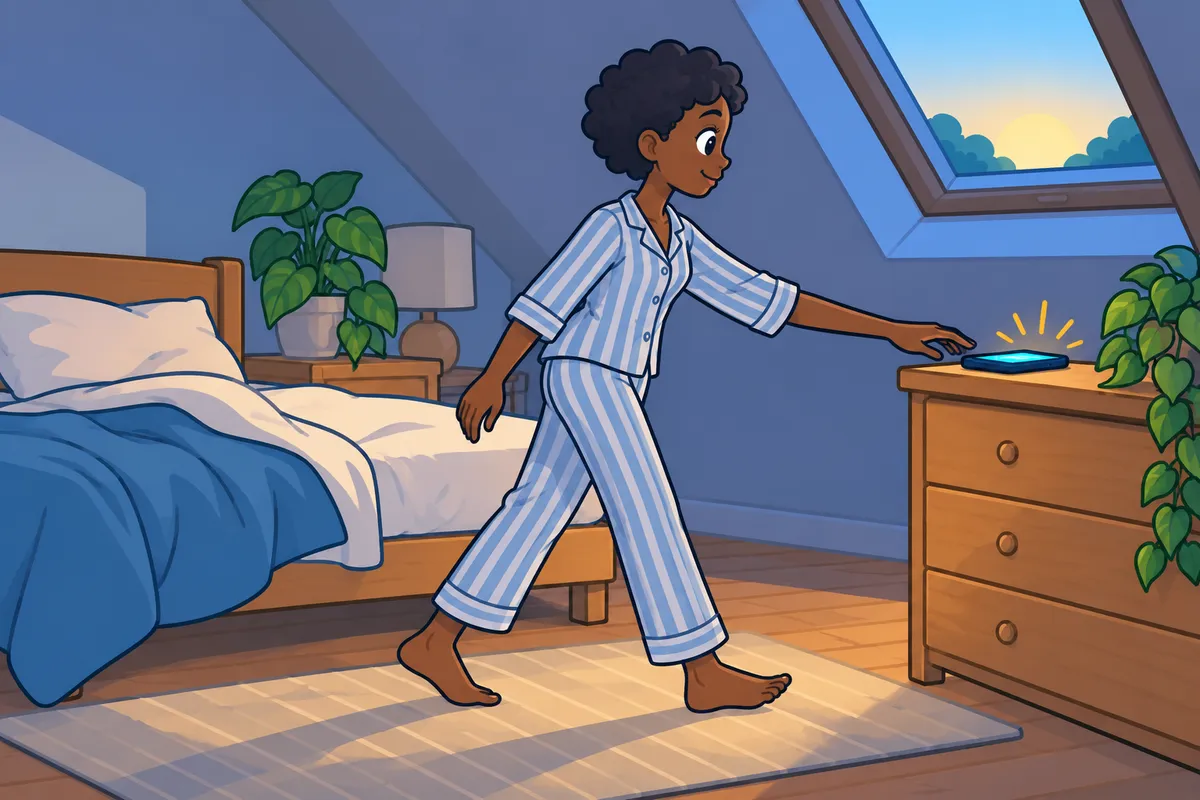
The study had two parts:
- In the survey, the snoozers tended to be younger, later chronotypes who reported more morning drowsiness and shorter sleep.
- In the lab, snoozing did not clearly change cortisol on waking, sleepiness, mood or the night's sleep, and nobody was woken out of deep sleep.
The study tested one 30-minute snooze in people already used to it. It says nothing about an hour of alarms. And if you need the snooze button every single day, the CDC's reading applies: your night may be shorter than the 7 hours adults need.
Why Do Morning Habits Stick Faster Than Evening Ones?
In the one study that compared them, the same habit became automatic sooner when people did it in the morning. A stretching study reported in the 2024 review by Singh and colleagues found means of 106 days in the morning against 154 days in the evening.
The review lists morning practice among the factors linked to stronger habits, next to frequency, the type of habit and whether people chose it themselves. One reason that fits the finding: mornings repeat more exactly than evenings, which bend around dinners, late meetings and tiredness, so the cue arrives in the same way more often.
That gives the morning a job: put the habit you most want to keep at the start of the day, and expect roughly two months before even a simple one runs on its own.
What Should You Do After a Bad Night's Sleep?
Keep the alarm and shrink the routine. The NHS lists “do not sleep in after a bad night's sleep – stick to your regular sleeping hours instead” and “do not nap during the day” among its tips for insomnia, because a moved wake time moves every later cue with it.
On a short night, run the smaller version of the same order, so the sequence survives even when the energy does not.
- Short, 30 minutes: drop the walk and the shower, keep light, a drink, breakfast and the plan.
- Minimum, 10 minutes: up at the alarm, curtains open, a glass of water, out of the door.
Both versions keep the first step and the last step, which are the two that hold the chain together. If a week of travel or illness breaks the routine entirely, restart with the minimum version and add the rest back one at a time. Restarting the day after a missed day works the same way for a whole routine as for one habit.
Healthy Morning Routine Ideas for Two Real Schedules
The same four kinds of step fit very different mornings. Here they are in two schedules, with the clock times worked out.
Neither routine is long, and neither is clever. Both start at the same time every day and run in the same order.
When a school run is part of your morning, a picture chart by the door lets your child run their own five steps.
Your Morning, Your First Change
- I lose the first 20 minutes to my phoneCharge it outside the bedroom and use an alarm clock
- I am always rushing out of the doorPack the bag the night before; move the alarm 15 minutes
- I feel foggy until mid-morningCurtains open and two minutes outside at once
- I hit snooze every single dayAn earlier bedtime before an earlier routine
- My days start at different timesKeep the same order of steps, even when the clock moves
The bag and the evening prep belong to the night before, in an evening worked back from bedtime with ten minutes kept for them.
What Changes When You Work From Home?
The alarm and the front door disappear, and with them the two anchors the routine hangs on. Replace them. Pick a start time for your work day, as fixed as a commute, and use a short walk outside as the boundary the door used to be.
The NIGMS says light and dark are the strongest signals your body clock reads, so a walk to the end of the street at your alarm time does the job the commute used to:
- bright light
- a change of air
- a clear line between sleeping and working
Without it, the first hour drifts into the phone on the sofa, and the routine never fires.
Keep the same order of steps as on an office day: up, light, drink, eat, plan, then sit down. The only change is that the walk replaces the commute, and the desk replaces the door. If you share the house with a partner or children whose morning runs on a different clock, a pair of noise-canceling headphones at the kitchen table is a cheaper fix than a separate room.
To fit your drinks around the same alarm, the water drinking schedule spreads your glasses from wake time to bedtime.
General information for healthy adults, not medical advice. If a doctor has set your fluid amount, follow that.

More in Habits and Routines


Sources
- NHS. Insomnia, 2026.
- US Centers for Disease Control and Prevention. About Sleep, 2026.
- US National Institute of General Medical Sciences. Circadian Rhythms, 2026.
- Journal of Sleep Research (Sundelin, Landry and Axelsson). Is snoozing losing? Why intermittent morning alarms are used and how they affect sleep, cognition, cortisol, and mood, 2024.
- Healthcare (Singh, Murphy, Maher and Smith). Time to Form a Habit: A Systematic Review and Meta-Analysis of Health Behaviour Habit Formation and Its Determinants, 2024.
Sources checked by the Glubbo Editorial Team on Oct 19, 2026. General information, not medical advice. How we write and check our guides.

