Can Dehydration Cause Sweating? How Sweat and Thirst Really Link
Which way the link runs, how fast heavy sweating reaches the 2 % line, and when sweat or its absence means get help.
 By the Glubbo Editorial Team · Updated Oct 19, 2026 · 9 min read
On This Page
- Can Dehydration Cause Sweating?
- Can You Be Dehydrated and Still Sweat?
- Why Is My Sweat Saltier on Hot, Hard Days?
- Do You Sweat More When Hydrated or Dehydrated?
- How Much Sweat Causes Dehydration?
- Why Do I Sweat So Much When I Am Not Hot?
- Can Dehydration Cause Night Sweats?
- What Does It Mean If You Stop Sweating in the Heat?
- Drink Back What You Sweat
- Your Drink Plan for the Next Hot Afternoon
- Sources
Short answer
No. Heavy sweating causes dehydration, not the reverse.
- A dry body tends to sweat later and may sweat less, a 2019 review of sweat glands says.
- Losing 2 % of your weight in sweat is where NATA sees performance fall.
- Heavy sweat with dizziness or nausea in heat points to heat exhaustion: stop and cool.
Dehydration does not make you sweat. It does the opposite: a body short of water starts sweating later and may sweat less, and it is heavy sweating that you do not drink back that dries you out.
People type "can dehydration cause sweating" after a day when they felt clammy, dizzy and parched all at once. The three often arrive together, which is why the cause looks backwards.
Heavy Sweat Leads to Dehydration
- Adults sweat 0.5 to 4.0 L (17 to 135 oz) an hour in exercise
- Not drunk back, it adds up hour by hour
- At 2 % of body weight, performance falls
Dehydration Leads to Less Sweat
- Past 2 % lost, sweat rate and onset drop
- Salty blood delays the start of sweating
- Less sweat means you heat up faster
Can Dehydration Cause Sweating?
No. Being short of water delays your sweating and may reduce it, according to a 2019 review of sweat gland physiology by Lindsay Baker. Heavy sweating is one of the main ways people become dehydrated in the first place, and the NHS lists sweating a lot after exercise among the situations that make it more likely.
Why a Dry Body Sweats Less
Two things change when you run short, according to Baker:
- Saltier blood raises the body temperature at which sweating switches on.
- A smaller blood volume may make the sweat glands respond less strongly, a second finding that has not been consistent across studies.
The NATA position statement puts a size on it: more than 2 % hypohydration, meaning 2 % of body weight lost, decreases sweat rate and delays the start of sweating.
That is your body protecting its blood volume, and it has a price. Core temperature rises about 0.15 to 0.20 °C for every 1 % of body weight lost, so a dry body runs hotter at the same effort.
When Sweat, Dizziness and Thirst Come Together
That trio on a hot day usually means heat exhaustion, not dehydration making you sweat. The CDC's NIOSH page describes heat exhaustion as the body's response to losing too much water and salt, usually through heavy sweating, with headache, nausea, dizziness and thirst along the way.
If you feel it coming on:
- Stop what you are doing.
- Get into shade.
- Loosen your clothing.
- Sip cool water.
Someone with heat exhaustion should be checked at a clinic or emergency room, and NIOSH adds to call 911 if medical care is not available.
Can You Be Dehydrated and Still Sweat?
Yes. Sweating carries on until the loss passes about 2 % of your body weight, so a wet shirt at 1 % tells you nothing about how much water you have left. The sweat itself is what put you there.
Two checks tell you more than the shirt:
- Away from sport, dark pee and a dry mouth are the signs that matter.
- In a hot job, a weigh-in before and after the shift is the quickest check, since KSI counts body weight as one of its three markers.
Why Is My Sweat Saltier on Hot, Hard Days?
Because the faster you sweat, the less salt your sweat ducts get to pull back. Baker reports a direct link between sweat rate and the sodium in the sweat, and whole-body sweat sodium runs from about 20 to 80 mmol/L between people, so the salt cost of one hard session differs a lot from person to person.
That is why a long, heavy sweat costs salt as well as water. After one, a sports drink can beat plain water, and a salty meal does the same job.
Do You Sweat More When Hydrated or Dehydrated?
Hydrated, as a rule. Two sources agree:
- NATA says that past 2 % body weight lost, both sweat rate and the start of sweating suffer.
- Baker's review describes dehydration delaying the sweating response.
A well-watered body starts sweating sooner and keeps sweating for the same heat.
Sweat cools you only when it evaporates, so drinking less to sweat less trades a wet shirt for a hotter, slower body, the opposite of what you want on a hot run or shift.
How Much Sweat Causes Dehydration?
Losing about 2 % of your body weight in sweat is the line that matters. NATA reports that performance falls consistently at 2 % or more, and the Korey Stringer Institute (KSI) says thirst appears earlier, at about 1 to 2 %.
How fast you get there depends on your weight and your sweat rate. The table shows the time it takes to reach 2 % if you drink nothing at all.
| Your weight (2 % of it) | Sweating 0.5 L an hour | 1.0 L an hour | 1.5 L an hour |
|---|---|---|---|
| 60 kg / 132 lb (1.2 L) | 2 h 24 min | 1 h 12 min | 48 min |
| 70 kg / 154 lb (1.4 L) | 2 h 48 min | 1 h 24 min | 56 min |
| 80 kg / 176 lb (1.6 L) | 3 h 12 min | 1 h 36 min | 1 h 04 min |
| 90 kg / 198 lb (1.8 L) | 3 h 36 min | 1 h 48 min | 1 h 12 min |
| 100 kg / 220 lb (2.0 L) | 4 h | 2 h | 1 h 20 min |
The 2 % line is NATA's; the times are our arithmetic, counting 1 kg of sweat as 1 L as KSI does. The right-hand column is far from the worst case, since NATA's range for adults during exercise tops out at 4.0 L an hour.
What Each Extra Percent of Sweat Costs You
The 2 % line is only one step on a scale the research maps quite well. Each row is a loss of body weight through sweat you have not drunk back, with what the sources report at that point.
| Body weight lost | What happens | Source |
|---|---|---|
| About 1 to 2 % | Thirst appears | Korey Stringer Institute |
| About 1.6 % | Some people feel faint when they stand up | US National Academies |
| 2 % or more | Performance falls consistently in endurance exercise | NATA |
| Every 1 % | Core temperature rises about 0.15 to 0.20 °C | NATA |
| 3 to 4 % in the heat | The heart pumps less blood with each minute | US National Academies |
| Over 4 % | The stomach empties more slowly, so drinks sit and slosh | NATA |
For a 70 kg person, 1 % is 0.7 kg, so the scale moves from first thirst to real trouble across little more than 2 liters of sweat. A hot afternoon of hard work can cover that distance.
Excessive Sweating and Dehydration
The more you sweat, the harder it is to keep up. KSI warns that people who sweat more than 2 liters an hour will find it difficult to replace all of it while they work or train, so they should drink steadily from the start and keep drinking afterwards. For everyday heavy sweaters, a hot day can cost several liters of sweat.
Why Do I Sweat So Much When I Am Not Hot?
Sweating when your body does not need to cool down is called excessive sweating, or hyperhidrosis, and it is a question for a doctor, not a drink. The NHS says it can happen for no obvious reason, because of another condition, or as a side effect of a medicine.
Book a visit if the sweating:
- has lasted 6 months or more
- happens at least once a week
- stops you getting on with your day
- happens at night, or runs in your family
Can Dehydration Cause Night Sweats?
Dehydration is not one of the causes the NHS gives. Its night sweats page names these as the common reasons:
- menopause symptoms
- anxiety
- some medicines, such as certain antidepressants, steroids and painkillers
- low blood sugar
- alcohol or drug use
- hyperhidrosis
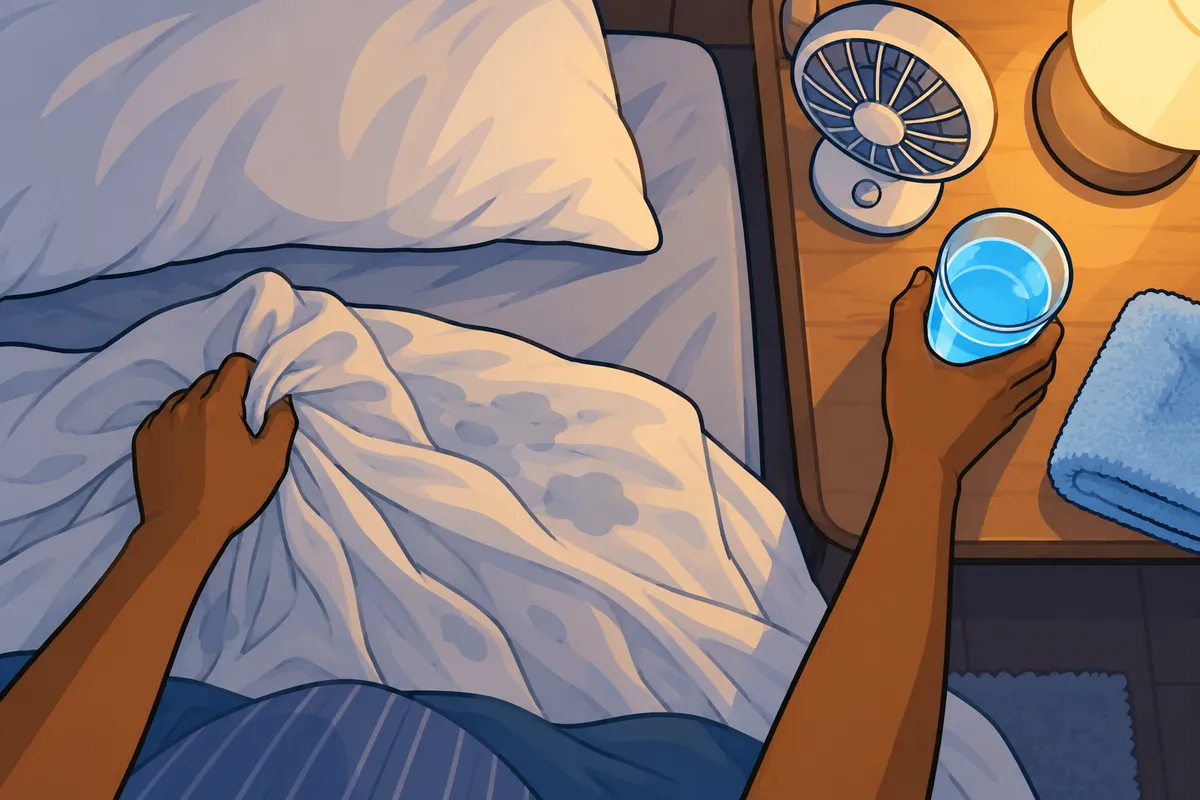
Night sweats do cost you water, though. A soaked sheet means you lost fluid overnight, so a glass of water when you wake makes sense, and so does a fan or lighter bedding.
The NHS says to get regular night sweats checked by a doctor, and sooner if they come with weight loss for no reason, a very high temperature, a cough or diarrhea. Alcohol in the evening is a cause you can test yourself by skipping it for a week.
What Does It Mean If You Stop Sweating in the Heat?
It can mean you are running dry, or that your body is overheating, and neither is safe. NIOSH lists "hot, dry skin or profuse sweating" for heat stroke, so dry skin is one warning but sweat does not rule it out; confusion is the sign that decides.
Drink Back What You Sweat
After a Sweaty Day or Session
- Weigh yourself before and after to see what you lost
- Drink back about 150 % of the loss within 2 hours
- Eat something salty with it: sweat carries sodium
- Check that your pee turns pale yellow again
The 150 % comes from KSI: you keep peeing while you drink, so you need a little more than you lost. For a day that went too far, the fastest way to rehydrate starts with small, steady drinks.
Runners get their own early warning: thirst, then a pace that suddenly feels harder, long before dizziness.
Your Drink Plan for the Next Hot Afternoon
Start with pale yellow pee and a bottle within reach, and sip on a clock instead of waiting for thirst. NATA suggests that about 200 ml (7 oz) every 15 to 20 minutes may be ideal, which adds up to roughly 0.6 to 0.8 L (20 to 27 oz) an hour. Weighing yourself once on a hot day shows what you really lose, and the calculator turns that weigh-in into a number you can plan around.
A 2 PM to 4 PM outdoor job
- 1:30 PM
- 2 PM
- 2:20 PM
- 2:40 PM
- 3 PM
- 3:20 PM
- 3:40 PM
- 4 PM
General information for healthy adults, not medical advice. If a doctor has set your fluid amount, follow that.
More in Exercise and Heat
Sources
- Temperature (Baker). Physiology of sweat gland function: The roles of sweating and sweat composition in human health, 2019.
- Journal of Athletic Training (National Athletic Trainers' Association). National Athletic Trainers' Association Position Statement: Fluid Replacement for the Physically Active, 2017.
- Korey Stringer Institute, University of Connecticut. Hydration, checked 2026.
- NHS. Dehydration, 2026.
- US Centers for Disease Control and Prevention (NIOSH). Heat-related Illnesses, 2026.
- National Academies of Sciences. Dietary Reference Intakes for Water, Potassium, Sodium, Chloride, and Sulfate, Chapter 4: Water, 2005.
- NHS. Night sweats, 2026.
- NHS. Excessive sweating (hyperhidrosis), 2023.
Sources checked by the Glubbo Editorial Team on Oct 19, 2026. General information, not medical advice. How we write and check our guides.

