Exercise and Heat · Running, Cycling and Other Sports
How Much Water to Drink for Hot Yoga, Before, During and After
What a 40 °C class costs in sweat and salt, a drink plan for the day, and the mistake that ends in hospital.
 By the Glubbo Editorial Team · Updated Oct 19, 2026 · 10 min read
On This Page
- How Much Do You Sweat in a Hot Yoga Class?
- How Much Water Should You Drink Before Hot Yoga?
- Should You Drink Water During Hot Yoga?
- Why Do I Feel Dizzy or Get a Headache After Hot Yoga?
- How Much Water Should You Drink After Hot Yoga?
- Do You Need Electrolytes for Hot Yoga?
- Can You Drink Too Much Water After Hot Yoga?
- Hot Pilates, Sculpt and Other Heated Classes
- Weigh In Around Your Next Class
- Sources
Short answer
Arrive hydrated, sip in class, refill over hours.
- A 90-minute class at 40 °C cost 5 women 1.54 L of sweat on average; they drank 0.38 L.
- Keep your loss under 2 % of body weight: about 1.2 kg for a 60 kg person.
- Spread the refill over hours: one woman who drank 3.5 L at once had seizures.
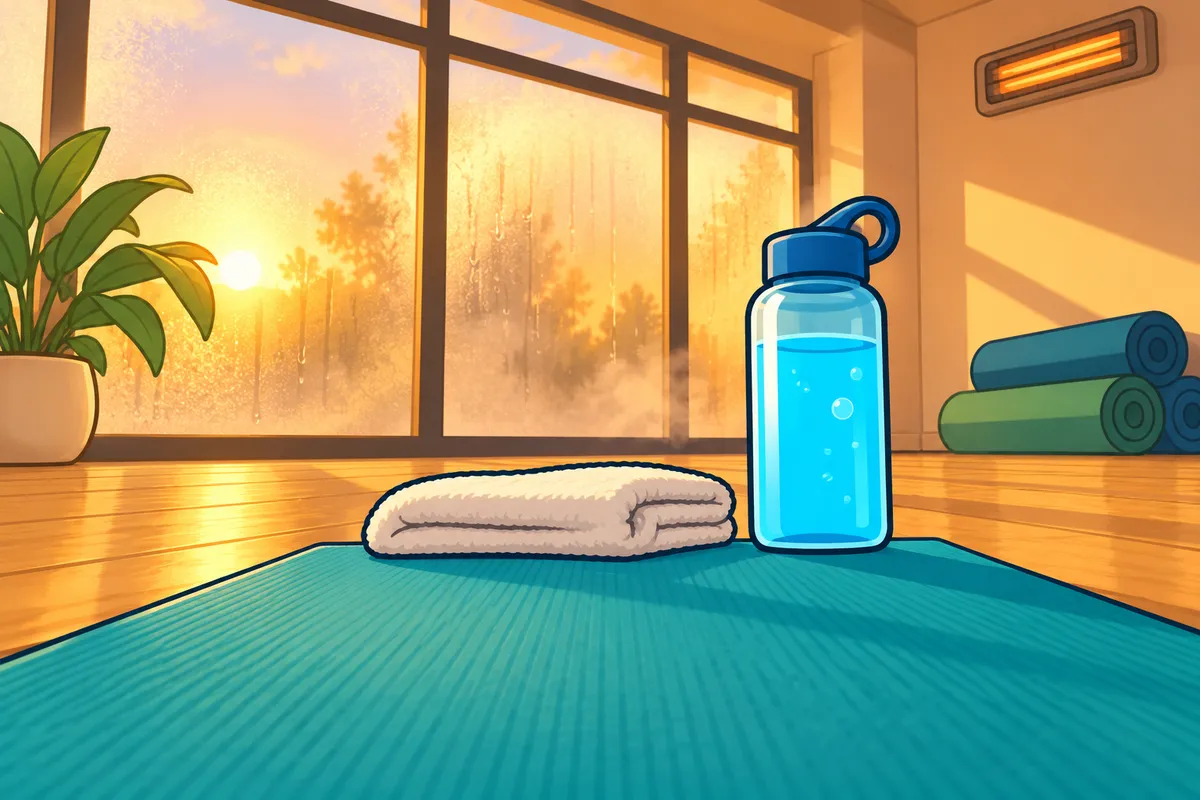
Arrive with pale pee, sip water through class, and replace the rest over the next few hours with food and drinks, not in one big jug. Studies of hot yoga rooms show students lose about 0.9 to 1.5 L of sweat per class and drink only a fraction of it, so the sipping has to be on purpose.
A Bikram room runs at 105 °F (40.6 °C) and 40 % humidity for 90 minutes. You stand still for long stretches, there is no breeze, and your towel is soaked before the first floor pose. That makes hot yoga a different drinking problem from a run, where you carry every sip:
- You lose a lot of water in one place.
- You can drink whenever you like.
- The risk sits on both sides.
A Drink Plan Around a 6 PM Class
- 7:30 AM
- 12:30 PM
- 3:30 PM
- 5:15 PM
- 6:45 PM
- 7:45 PM
- 9 PM
How Much Do You Sweat in a Hot Yoga Class?
About 1 to 1.5 liters in a 90-minute class, depending on how fit and how used to the heat you are. Five women measured in a lab during a standard Bikram class lost 1.54 L (52 oz) of sweat on average and drank only 0.38 L, about a quarter of what they lost, in the Alrefai study.
- 1.54 L
- sweat lost in one 90-minute Bikram class (5 women)
- 0.38 L
- what the same women drank during class
- 6.8 g
- salt lost in that sweat
- 1.1 kg/h
- sweat rate of experienced students (novices 0.6)
The sweat was salty too: 82 mmol/L of sodium chloride, about 6.8 g of salt in one class. That holds more sodium than the FDA's daily limit of 2,300 mg, which is about 1 teaspoon of table salt. The authors call what happened volume depletion more than dehydration: the fluid outside the cells fell by about 10 %, but blood sodium stayed put.
Why Regulars Sweat More Than Beginners
Experience raises the sweat rate, and the harder effort shows in the heart too. In a lab study of 24 students, Pate and Buono split the group at 20 classes.
Newer to Hot Yoga
- Fewer than 20 classes
- Sweat about 0.6 kg an hour
- About 0.9 L in a 90-minute class
- Heart rate about 72 % of predicted maximum
Regular Student
- 20 classes or more
- Sweat about 1.1 kg an hour
- About 1.65 L in a 90-minute class
- Heart rate about 86 % of predicted maximum
So the more often you practice, the more you need to drink, the opposite of what many regulars assume. A body used to the heat starts sweating sooner and harder; that is how it keeps cool, and it means a bigger refill afterwards.
A Shorter, Cooler Class
A 60-minute class costs less. In a conference study of 21 people in a 60-minute hot hatha class at 38.7 °C (102 °F), sweat averaged 0.9 L an hour, but they drank only 0.2 L, and a third drank nothing. They finished about 0.9 % lighter on average, and about half lost at least 1 % of their body weight.
How Much Water Should You Drink Before Hot Yoga?
Enough to arrive with pale yellow pee, then a normal glass in the last hour or so. The NATA position statement asks active people to start exercise euhydrated, within 1 % of their usual body weight, and to finish having lost less than 2 %.
Most hot yoga students already do this part. In a survey of 700 students, 82.7 % drank water before class, and those who did were less likely to report heatstroke symptoms or confusion. The survey cannot prove cause, because people who drink before class may differ in other ways, but the pattern runs in the safe direction.
What to skip is the big jug on the drive to the studio. A large drink sets off extra urine, as NATA notes for big refills, and you cannot leave the room easily once the door closes.
Should You Drink Water During Hot Yoga?
Yes, in sips, whenever the teacher allows a pause. In the 700-student survey, drinking during class was linked to fewer reports of dehydration symptoms, yet only 63.4 % of students did it, and 91 % said their teacher encouraged it.
You will not keep up with your sweat, and you do not need to. The aim is to keep your total loss under the 2 % line NATA sets, because in temperate and hot rooms performance drops once you pass 2 % of body weight, and your heart works harder for every kilo you lose.
What Your Heart Does in a 40 °C Room
It speeds up a lot. In 16 regular Bikram students, average heart rate over the whole class was 126.6 beats a minute, peaking at 168, while the lower blood pressure number fell by about 10 %, most of all in the floor poses near the end.
Dehydration adds to that strain. NATA notes that heart rate rises 3 to 5 beats a minute for every 1 % of body weight you lose, so a student down 2 % carries up to 10 extra beats a minute on top of the heat.
Why Do I Feel Dizzy or Get a Headache After Hot Yoga?
Check which cause it is before you reach for the bottle. Standing up fast is the first: heat widens the blood vessels in your skin, and NATA describes heat syncope as dizziness or a faint after standing for long in the heat or changing posture suddenly. The US National Academies tie fainting on standing to a water loss of about 1.6 % of body weight.
Drinking helps that kind: in their review, 0.5 L of water markedly improved standing tolerance compared with 0.05 L. Get up slowly after the final rest and sit if your vision narrows.
A headache is the other. NATA lists it under both low body water and low blood sodium, and it is the sign to take seriously when it keeps worsening after you drank a lot.
How Much Water Should You Drink After Hot Yoga?
Replace what you lost, plus some, over the next few hours. NATA says that with less than 4 hours to recover, you may need 100 to 150 % of the fluid you lost, because a large drink makes you pee part of it out again; with 12 hours or more, normal meals and drinks bring you back.
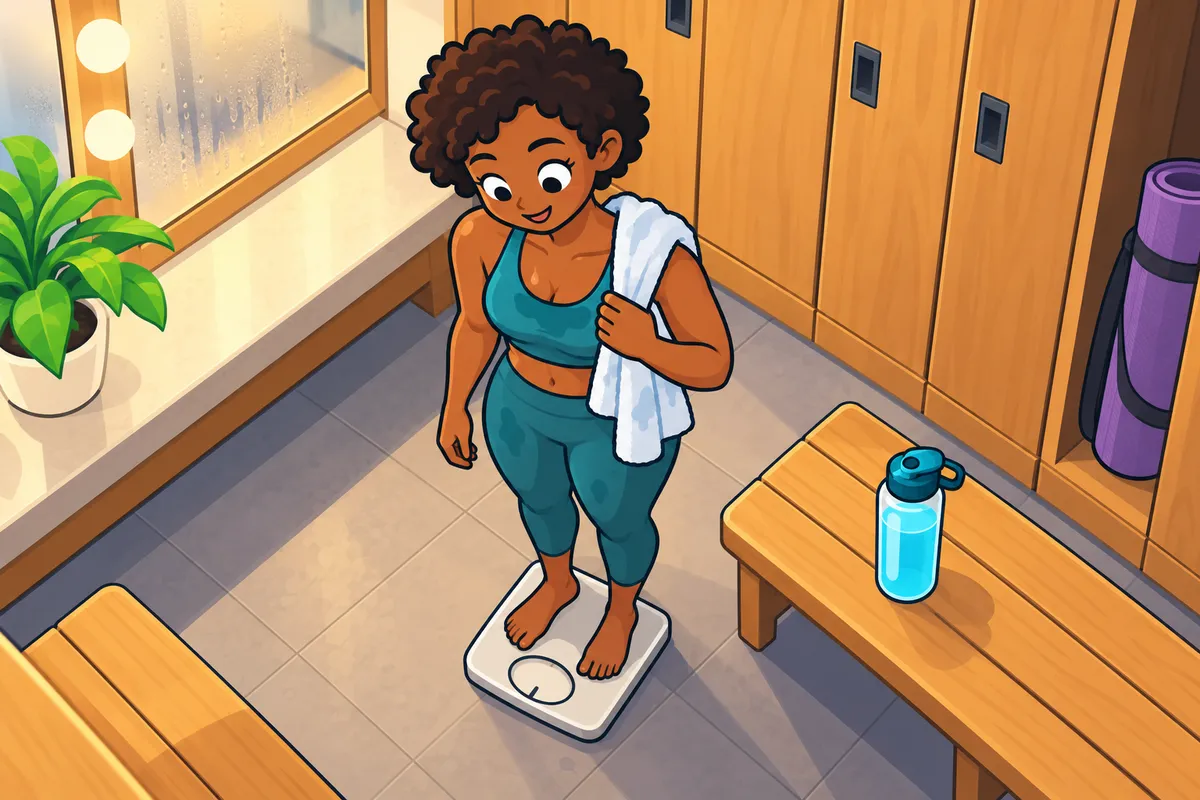
To know what you lost, weigh yourself before and after one class in the same clothes. The Korey Stringer Institute puts the rule simply: every 2.2 pounds lost equals 1 liter of fluid. Add whatever you drank in class and you have your sweat for that session, which the sweat rate calculator turns into liters per hour.
What a Class Costs by Body Weight
The table shows each loss as a share of body weight, using the two sweat rates Pate and Buono measured, over a 90-minute class. Your own rate can sit well above or below these, so treat a row as a first guess until you have weighed yourself once.
| Body weight | Your 2 % line | Newer, no sips (0.9 L) | Regular, no sips (1.65 L) | Regular, 0.5 L sipped |
|---|---|---|---|---|
| 50 kg (110 lb) | 1.0 kg | 1.8 % | 3.3 % | 2.3 % |
| 60 kg (132 lb) | 1.2 kg | 1.5 % | 2.75 % | 1.9 % |
| 70 kg (154 lb) | 1.4 kg | 1.3 % | 2.4 % | 1.6 % |
| 85 kg (187 lb) | 1.7 kg | 1.1 % | 1.9 % | 1.4 % |
The same sweat costs a lighter student a bigger share of body weight. A 50 kg regular who sips nothing loses 1.65 kg, past her 1.0 kg line, while an 85 kg regular stays just under his. In the 60 kg row, 100 to 150 % of the 1.15 kg a regular loses after sipping 0.5 L is 1.15 to 1.7 L over the next 3 hours.
Do You Need Electrolytes for Hot Yoga?
For a class of 60 minutes or less, water is enough; for 90 minutes at 40 °C, salt starts to matter. NATA says activity under an hour needs nothing but water, while sessions longer than an hour in extreme heat may benefit from added carbohydrate or electrolytes, or both.
In the survey, the 46 % who drank an electrolyte drink before, during or after class were less likely to report an adverse reaction, including heatstroke. You do not need a sachet to get that salt: a normal salted meal or a salty snack after class does the same job, and the foods that put sodium and potassium back are ordinary ones.
The Alrefai study found something reassuring. Although the women replaced only 25 % of their sweat in class, the sodium level in their blood did not change, and their bodies raised the salt-saving hormone aldosterone 3.5-fold to hold on to sodium over the following day. That is your kidneys rebuilding the loss for you.
Can You Drink Too Much Water After Hot Yoga?
Yes, and it is the most serious mistake on this page. After a 90-minute Bikram class, a 34-year-old woman drank 3.5 liters of water, then developed breathlessness, severe cramps and nausea; her blood sodium had fallen to 120 mmol/L, and she had seizures and spent time in intensive care before a full recovery over 5 days.
Plain water in a large volume dilutes the sodium you just sweated out. The doctors who reported the case called it "overzealous fluid replacement", and because of the kidneys' hourly limit, spreading the refill matters more than its total.
Hot Pilates, Sculpt and Other Heated Classes
The same plan works, because the physics is the same: heat, no breeze, and a bottle you must choose to pick up. The measured numbers on this page come from yoga rooms at 38.7 to 40.6 °C. A 60-minute class in a cooler room will cost you less, and a 75-minute power class with weights may cost more.
Your own scale beats any table: weigh yourself around one class of each kind you take, and you will know which needs a bigger bottle.

The class most likely to catch you out is the one after a few days off in hot weather, or the first one back after an illness. Start that week with shorter or cooler classes and take your bottle to the mat every time.
On a heat-wave day outside, your baseline is already higher before you reach the studio, and the pace for hot days in general adds to the plan above rather than replacing it.
Weigh In Around Your Next Class
- Weigh yourself in dry clothes before the class and again right after it.
- Note how much you sipped, then add that to the weight difference to get your sweat for the class.
- Divide your loss by your starting weight: under 2 % means your sips are enough, and 2 % or more means a bigger bottle next time.
- Drink back 100 to 150 % of the loss over the next few hours, with a salty meal or snack.
General information for healthy adults, not medical advice. If a doctor has set your fluid amount, follow that.
More in Exercise and Heat



Sources
- Physiological Reports (Alrefai and colleagues). Salt and water balance after sweat loss: A study of Bikram yoga, 2020.
- Alternative Therapies in Health and Medicine (Pate and Buono). The physiological responses to Bikram yoga in novice and experienced practitioners, 2014.
- International Journal of Yoga (Mace Firebaugh and Eggleston). Hydration and Hot Yoga: Encouragement, Behaviors, and Outcomes, 2017.
- Journal of Alternative and Complementary Medicine (Miranda Hurtado and colleagues). Acute Cardiovascular Responses to a Session of Bikram Yoga: A Pilot Uncontrolled Trial, 2019.
- BMJ Case Reports (Reynolds, Cleaver and Finlay). Exercise associated hyponatraemia leading to tonic-clonic seizure, 2012.
- National Athletic Trainers' Association (Journal of Athletic Training). Position Statement: Fluid Replacement for the Physically Active, 2017.
- International Journal of Exercise Science, conference proceedings (Campbell and colleagues). Fluid Intake and Sweat Rate During Hot Yoga Participation, 2014.
- National Academies of Sciences. Dietary Reference Intakes for Water, Potassium, Sodium, Chloride, and Sulfate, Chapter 4: Water, 2005.
- Korey Stringer Institute, University of Connecticut. Hydration, checked 2026.
- US Food and Drug Administration. Sodium in Your Diet, 2024.
Sources checked by the Glubbo Editorial Team on Oct 19, 2026. General information, not medical advice. How we write and check our guides.

