Exercise and Heat · Heat, Cold and Altitude
How Long Does Heat Acclimatization Take? A Day-by-Day Schedule
The schedules workers and athletes use, what changes in your body, how fast it fades, and why you need more water after.
 By the Glubbo Editorial Team · Updated Oct 19, 2026 · 9 min read
On This Page
- How Long Does Heat Acclimatization Take?
- Can You Acclimatize to Heat in 5 Days?
- What Is a Heat Acclimatization Schedule for Exercise?
- How Do You Get Used to Exercising in the Heat?
- How Long Does Heat Acclimatization Last?
- Does Heat Acclimatization Change How Much You Drink?
- Can a Sauna Help You Acclimatize to Heat?
- A Pre-Session Check for the First Hot Week
- Sources
Short answer
About 7 to 14 days of gradual heat exposure.
- NIOSH ramps work in the heat over 7 to 14 days: 50, 60, 80, 100 % for experienced workers.
- Athletes: 60 to 90 minutes a day in the heat for at least 2 weeks (IOC 2023).
- Unused, the gains fade within about 3 weeks (NATA).

Heat acclimatization takes about 7 to 14 days of gradually longer or harder exposure to heat, and it fades within about 3 weeks once the heat stops. Over that time you sweat sooner, keep your core cooler and spare your heart.
The first hot day of summer feels worse than the tenth, even when the thermometer reads the same. You do not get there by sitting in air conditioning and waiting; you build it with a little more heat each day.
How Long Does Heat Acclimatization Take?
For workers and athletes alike, the standard answer is 7 to 14 days. The NIOSH heat stress recommendations tell employers to increase time in hot conditions gradually over 7 to 14 days, and the NATA position statement on heat illness gives athletes the same 7 to 14 days.
Fitness speeds it up. NATA says a better conditioned athlete will acclimatize more quickly, and NIOSH warns that workers who are not physically fit need more time.
Four sets of guidance cover most people, and their numbers line up closely; they differ mainly in who they are written for.
| Who it is for | Source | How long | How it builds |
|---|---|---|---|
| New outdoor workers | NIOSH | 7 to 14 days | 20 % of the usual time on day 1, then no more than 20 % more each day |
| Experienced workers back from a break | NIOSH | 4 days | Full usual time by day 4 |
| Athletes in general | NATA 2015 | 7 to 14 days | Longer and harder sessions, protective gear phased in |
| Competitive athletes | IOC 2023 | At least 2 weeks | 60 to 90 minutes a day in the heat, 4 or more sessions a week |
| High school athletes, fall preseason | Adams 2021 | 14 consecutive days or more | Practice length, sessions per day and rest set by the school |
Sources: NIOSH, NATA 2015, IOC 2023, Adams 2021.
What Changes in Your Body
Your sweat starts earlier and pours faster, and your heart works less. NATA lists the changes over 10 to 14 days as a bigger stroke volume and sweat rate, and a lower heart rate, core temperature, skin temperature and salt loss in sweat.
Day 1 in the Heat
- Sweating starts late
- Heart rate climbs fast
- Core and skin run hotter
- Sweat is saltier
After 10 to 14 Days
- More sweat, and sooner
- Bigger stroke volume, lower heart rate
- Core and skin stay cooler
- Less salt lost in each liter
A review by Périard, Racinais and Sawka adds better skin blood flow and better fluid balance to the list, and links the whole package to a lower risk of serious heat illness and better endurance in hot weather.
Can You Acclimatize to Heat in 5 Days?
Partly. A 2018 review of heat-acclimation protocols found that trained athletes adapt well within 5 to 7 days, but 8 to 14 day protocols gave more effective and longer-lasting adaptations, and many experts want at least 10 to 14 days. The shorter the protocol, the faster the benefit fades.
- 5–7 days
- trained athletes adapt well
- 8–14 days
- more effective, longer-lasting adaptation
- 60–90 min
- of exercise in the heat per day
If your race or job starts in a week, use the 5-to-7-day plan and expect the gains to fade sooner. If you have two weeks, spend them all.
What Is a Heat Acclimatization Schedule for Exercise?
Train in heat like your event for 60 to 90 minutes a day, at least four days a week, for two weeks. The IOC consensus calls that the optimal dose, and it defines a real heat session as a core temperature between 38.5 and 39.8 °C (101.3 to 103.6 °F) for at least 60 minutes.
Shorter sessions still help. The IOC authors say that shorter or different exposures should not be discarded on the grounds that they are not optimal.

The Two-Week Plan for a Hot Race
If race week does not leave room, the IOC has a fix. Athletes can acclimatize up to a month before, then hold the gains with two heat sessions a week and take a few days of heat again just before the event, because the gains fade more slowly than they build.
How Workers Ramp Up
NIOSH gives new workers 20 % of the usual time in the heat on day 1 and no more than 20 % more on each day after, with close supervision for the first 14 days. A new landscaper on 8-hour days would start with about 1.6 hours on the hot jobs and spend the rest on cooler tasks, then add about 1.6 hours a day until the full shift.
Experienced workers back from time away start at 50 % and reach a full day on day 4. Breaks in air conditioning do not undo the process, NIOSH says.
| Day back | NIOSH limit | 8-hour shift | 10-hour shift | 12-hour shift |
|---|---|---|---|---|
| Day 1 | 50 % | 4 h in the heat | 5 h | 6 h |
| Day 2 | 60 % | 4.8 h | 6 h | 7.2 h |
| Day 3 | 80 % | 6.4 h | 8 h | 9.6 h |
| Day 4 | 100 % | 8 h | 10 h | 12 h |
Source: percentages from NIOSH; hours are our arithmetic. The rest of each shift goes to cooler, indoor or shaded tasks.
While working in the heat, NIOSH's pace for moderate work under two hours is one cup (8 oz) of water every 15 to 20 minutes, and no more than 6 cups an hour.
How Do You Get Used to Exercising in the Heat?
Go out a little more each day, slow down at first, and drink on a plan. School sports show the same idea in detail: the secondary school guidelines allow only one practice of up to 3 hours a day on days 1 to 5, a helmet as the only protective gear on days 1 and 2, and full gear from day 6.
Your First Two Weeks in the Heat
- Days 1 to 3: short, easy sessions in the heat; keep hard work for cool hours
- Days 4 to 7: add time before pace, aiming at 60 minutes
- Week 2: 60 to 90 minutes in the heat, 4 or more days a week
- After that: 2 heat sessions a week to hold it
Days you sit out do not count. In the school guidelines, days missed for a rest day, injury or illness do not count toward the acclimatization period, so an athlete who misses days 3 and 4 resumes as if on day 3.
Treat the first hot week as training for the heat itself, not for speed. Your times come back once your sweat and heart rate have caught up.
How Long Does Heat Acclimatization Last?
About 3 weeks without heat, then it is gone.
- NATA says the benefits decay within 3 weeks if you do not keep up the exposure.
- NIOSH says acclimatization holds through a few days away from the heat.
The 2018 review gives a sense of the slope: after two weeks without heat, end-of-exercise heart rate, sweat rate and core temperature are expected to decay by about 35 %, 30 % and 6 %. It also found that in one group a 120-minute heat session every 5 days maintained the heart rate and core temperature adaptations for a month.
The IOC puts the maintenance dose at two heat sessions a week and notes that a second round within a month builds faster and goes further than the first.
Does Heat Acclimatization Change How Much You Drink?
Yes, upward. A body used to the heat sweats more, so the same workout costs you more water in week two than in week one, even though it feels easier. NATA also lists a smaller salt loss in each liter of sweat.
The IOC suggests a simple daily check while you train in the heat, the weight-urine-thirst principle: morning body weight within 1 to 2 % of your usual, plus urine color and thirst. On top of that, it keeps the familiar line to avoid losing 2 % of body weight or more in a session.
As a first guess before you know your own sweat rate, the IOC gives two rules of thumb:
- 6 ml of fluid per kg of body weight every 2 to 3 hours.
- 2 L (68 oz) a day plus 1 to 2 L for each hour of exercise plus 1 L for every 5 °C above 21.5 °C.
For a 70 kg (154 lb) runner that first rule means about 420 ml (14 oz) every 2 to 3 hours. Your sweat loss in liters per hour replaces those guesses after one weigh-in, and on a working shift the pace is a cup every 15 to 20 minutes.
Can a Sauna Help You Acclimatize to Heat?
It can help, as a second choice. The IOC says training in heat like your event works best, and lists passive heat exposure and overdressed training as alternatives when you cannot; a sauna is passive heat.
Passive heat costs water like any other. Two 10-minute rounds already take about 1 lb (0.4 to 0.5 kg) of sweat, so refill after every sauna session the same way you would after a run.
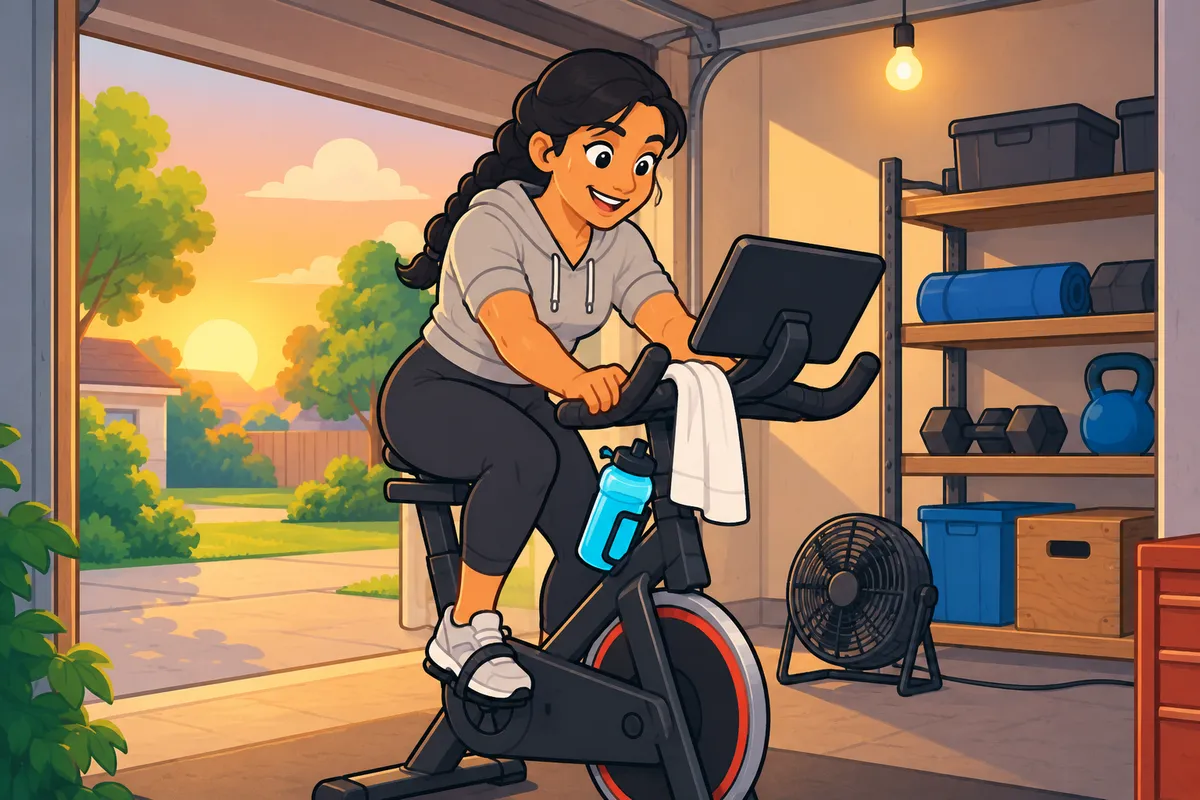
Heat training is hard on the body, so change one thing at a time: never add heat, more distance and a new diet in the same week.
People new to hot climates after a move face the same 7 to 14 days. A nurse transferred to a hot city or a student on a summer job should expect their first fortnight to feel harder and plan more breaks and more water for it.
A Pre-Session Check for the First Hot Week
Before Each Session in Week One
5 items- Pale pee and your usual morning weight
- Time in the heat no longer than your schedule allows today
- Hard efforts moved to the cool hours
- A bottle you can reach, and shade nearby
- No fever, cold or stomach bug; skip the heat if you have one
General information for healthy adults, not medical advice. If a doctor has set your fluid amount, follow that.
More in Exercise and Heat

Sources
- CDC NIOSH. Workplace Recommendations, 2026.
- National Athletic Trainers' Association (Journal of Athletic Training). Position Statement: Exertional Heat Illnesses, 2015.
- British Journal of Sports Medicine (Racinais and colleagues). IOC consensus statement on recommendations and regulations for sport events in the heat, 2023.
- Journal of Athletic Training (Adams and colleagues). Roundtable on Preseason Heat Safety in Secondary School Athletics: Heat Acclimatization, 2021.
- Journal of Athletic Training (Casa and colleagues). Preseason heat-acclimatization guidelines for secondary school athletics, 2009.
- Scandinavian Journal of Medicine and Science in Sports (Périard, Racinais and Sawka). Adaptations and mechanisms of human heat acclimation: Applications for competitive athletes and sports, 2015.
- Temperature (Pryor, Johnson, Roberts and Pryor). Application of evidence-based recommendations for heat acclimation: Individual and team sport perspectives, 2018.
Sources checked by the Glubbo Editorial Team on Oct 19, 2026. General information, not medical advice. How we write and check our guides.

