Exercise and Heat · Heat, Cold and Altitude
Hydration for Firefighters, Before the Call, in Rehab and After
How much to drink on shift, when rehab starts, what to drink there, and how to catch up after a working fire.
 By the Glubbo Editorial Team · Updated Oct 19, 2026 · 10 min read
On This Page
- How Much Water Should Firefighters Drink?
- How Much Do Wildland Firefighters Need to Drink?
- How Should Firefighters Prehydrate Before a Shift?
- When Does a Firefighter Have to Go to Rehab?
- How Much Should Firefighters Drink During Rehab?
- What Should Firefighters Drink in Rehab?
- How Much Should Firefighters Drink After a Fire?
- Stock the Rig Before Your Next Shift
- Sources
Short answer
Drink before the call, at every bottle change, and after.
- Self-rehab: at least 2 to 4 oz for every 20 minutes of work (USFA, citing NFPA 1584).
- Formal rehab: 12 to 32 oz on average over at least 20 minutes, USFA says.
- After: 450 to 675 ml per lb lost, 100 to 150 % of it, a 2024 review advises.
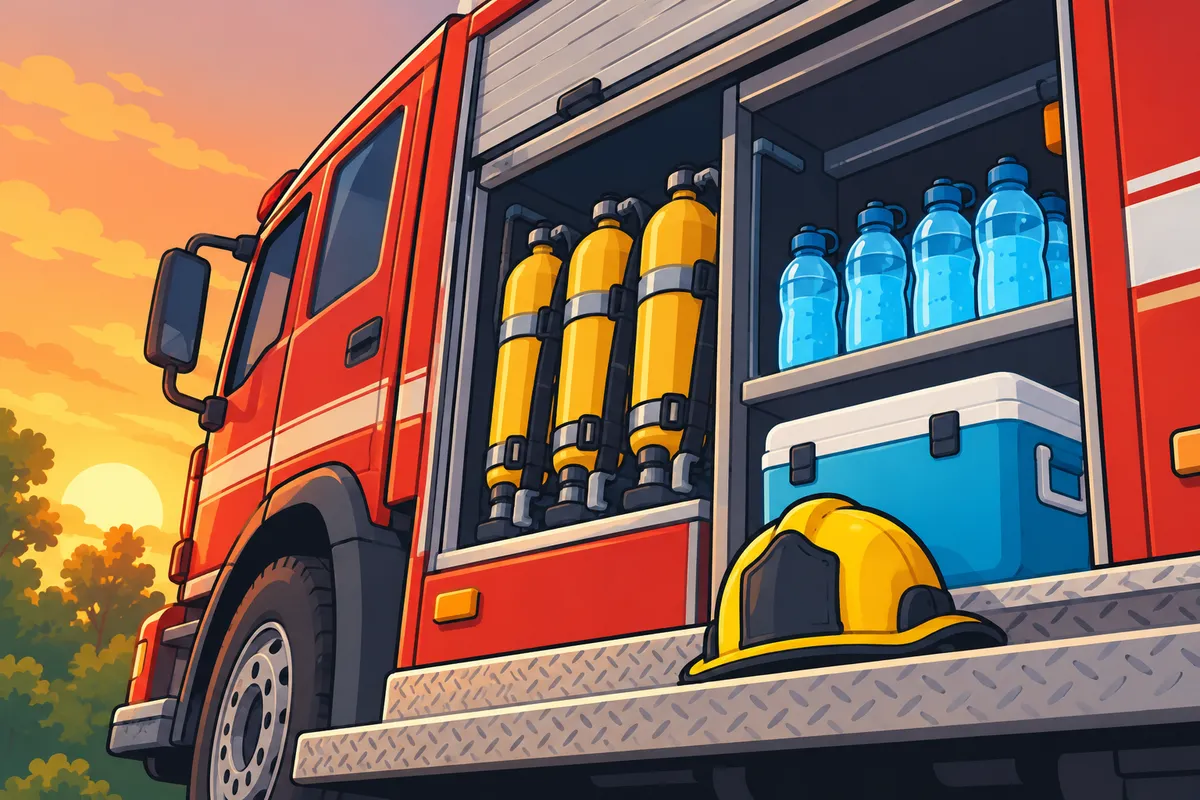
Firefighters should arrive on shift hydrated, drink at every break, and drink back what they lost after the call. The US Fire Administration (USFA) sets the minimum at 2 to 4 oz for every 20 minutes of work, 12 to 32 oz in a formal rehab period, and another 12 to 32 oz of electrolyte-and-carbohydrate fluid within 2 hours of the incident. A 2024 review puts the after-call amount at 100 to 150 % of the weight lost.
Turnout gear is built to keep heat out, and it keeps your own heat in just as well. The review notes the gear weighs 50 to 60 pounds and stops sweat from evaporating, so every minute of hard work inside it costs water you cannot feel leaving.
How Much Water Should Firefighters Drink?
On a rest day, about what any adult needs; on a call, small drinks at every break and a larger catch-up after. The 2024 review quotes the US Institute of Medicine's 3.7 liters a day for men and 2.7 for women as rest-day totals, and says needs rise with heat and workload.
On the fireground the target is a number on the scale, not a volume. The review says to drink during breaks so that you lose less than 2 % of your body mass, the point where heat strain and performance start to suffer.
| When | How much | Who says |
|---|---|---|
| Through the shift, before any call | At least 6 to 8 oz every 6 hours, plus fluids with meals; most need more | USFA 2008 |
| Self-rehab (10 minutes) | At least 2 to 4 oz for every 20 minutes of work; more in heat | USFA 2008, citing NFPA 1584 |
| Formal rehab (20 minutes or more) | 12 to 32 oz on average, more in extreme heat or cold | USFA 2008 |
| Ceiling in rehab | No more than the stomach empties: about 1.0 to 1.5 L (34 to 51 oz) an hour | USFA 2008 |
| After the incident | 12 to 32 oz of electrolyte and carbohydrate fluid within 2 hours (USFA); 450 to 675 ml per lb lost, about 100 to 150 % (2024 review) | USFA 2008, 2024 review |
Why Turnout Gear Changes Everything
Gear turns a moderate workload into a heavy one. The US Fire Administration manual says that during extreme exertion some people lose as much as 1 liter of sweat an hour, and the US National Academies report 1 to 2 liters an hour for even light exercise in protective clothing in hot weather.
The heat builds faster when you are dry. NATA puts the rise in core temperature at about 0.15 to 0.20 °C for every 1 % of body weight lost, and the USFA warns that serious consequences can follow a loss of as little as 4 % of body weight.
Why Dehydration Raises the Cardiac Risk
How Much Do Wildland Firefighters Need to Drink?
At least one quart (32 oz) of fluid per hour on the fireline, the NWCG says, citing studies of wildland crews during fire suppression. Before the shift, it recommends one to two cups of water, juice or a sports drink.
Wildland crews wear lighter gear than structural teams and rarely rotate through a formal rehab tent, so they drink on the move instead. The NWCG adds two points:
- Rapid loss of several pounds is "a certain sign of dehydration", and the firefighter should rehydrate fully before returning to work.
- Excessive water intake can cause hyponatremia, a dangerously low blood-sodium level, so mixing in a sports drink or electrolyte fluid after the first hour lowers that risk.
The Marguerite example further down works through a 12-hour wildland shift using the NFPA 1500 supply rule and NIOSH's drinking pace.
How Should Firefighters Prehydrate Before a Shift?
Drink steadily all day so a call never finds you short. The USFA's minimum is 6 to 8 ounces every 6 hours on top of drinks with meals, and it adds that most firefighters need more than that.
The manual's prehydration advice comes down to four habits:
Four prehydration habits from the USFA
4 items- Check your pee: dark or strong-smelling means drink more
- Avoid excessive caffeinated drinks while on duty
- Remember that heavy drinking in the previous 24 hours often leaves you dehydrated
- Drink after station workouts and training, so you start any call topped up
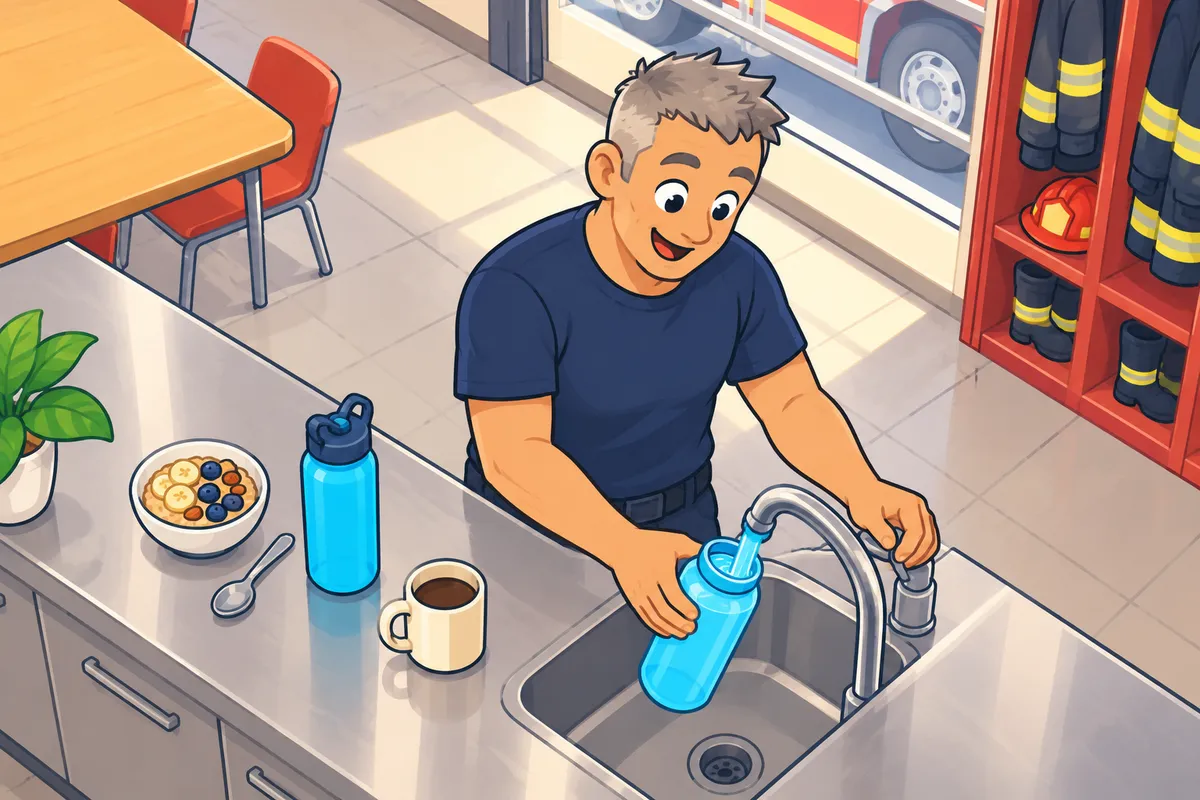
For planned training, the review adds a measured top-up: 2 to 3 ml of fluid per pound of body weight at least 4 hours before, part of the hydration protocol the review credits to the American College of Sports Medicine. For a 200-pound firefighter that is 400 to 600 ml (14 to 20 oz) with breakfast before a morning live-fire drill.
The USFA is blunt about thirst: it says thirst alone is not an accurate guide to how hydrated you are, and that urine is the more reliable check. That holds even more in gear, because thirst lags behind sweat when you are busy.
When Does a Firefighter Have to Go to Rehab?
At every air-cylinder change, by NFPA 1584's two guidelines as the USFA summarized them in 2008. Self-rehab comes after one 30-minute cylinder; formal rehab with a medical check after two. The two parts are progressive, not optional choices.
| Trigger | Rehab | Minimum rest |
|---|---|---|
| One 30-minute SCBA cylinder used | Self-rehab: rest with hydration | 10 minutes |
| 20 minutes of intense work without SCBA | Self-rehab | 10 minutes |
| Two 30-minute cylinders used | Formal rehab: fluids and a medical evaluation | 20 minutes |
| One 45- or 60-minute cylinder used | Formal rehab | 20 minutes |
| Encapsulating chemical protective clothing worn | Formal rehab | 20 minutes |
| 40 minutes of intense work without SCBA | Formal rehab | 20 minutes |
The cylinder rule exists because air bottles are easier to track than time on a busy scene. The USFA says firefighters almost always know how many cylinders they have used, while time compresses in an emergency and crews lose track of it, so a time recorder may be needed to rotate crews out.
How Much Should Firefighters Drink During Rehab?
2 to 4 ounces in self-rehab and 12 to 32 ounces in a formal rehab period, the USFA manual says, with more in extreme heat or cold. Start drinking as soon as you have checked in, had your evaluation and taken off your coat.
More is not always better. The USFA notes that most adults can empty only 1.0 to 1.5 liters an hour from the stomach, and less when they are hot, worn out or already dry, so forcing a full gallon only leaves you bloated and sick.
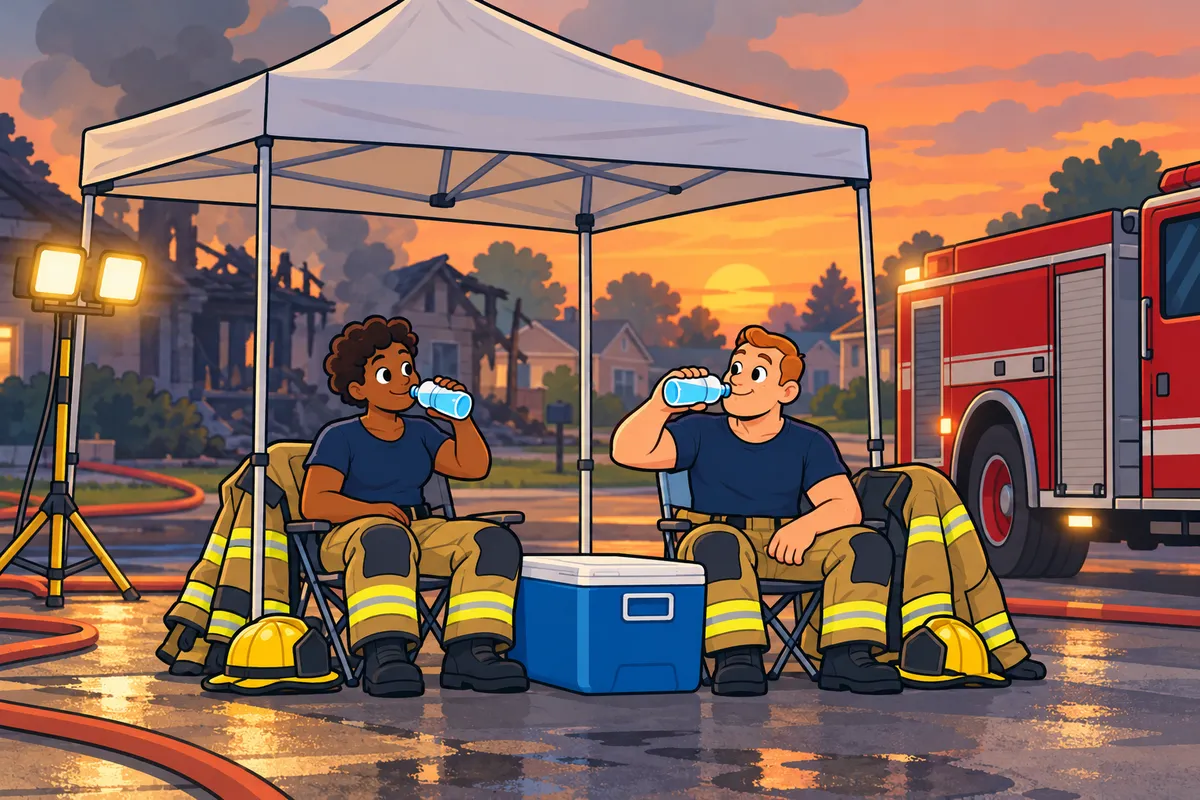
Two Rehab Plans, Worked Out
The NIOSH pace comes from its workplace heat recommendations, which also ask employers to make cool water available near the work area. For new crew members in summer, the 2024 review recommends passive heat sessions of at least 30 minutes on 6 to 7 consecutive days to build heat tolerance, which it says lowers core temperature and heart rate during later work in the gear.
What Should Firefighters Drink in Rehab?
Water for short, light work; a sports drink once heavy work runs past an hour. The USFA says plain water is fine for low-intensity work of an hour or less, but that it replaces none of the salt and carbohydrate lost on a long, hard incident.
Rehab Drinks, as the USFA Rates Them
Cool water
The base drink
- Enough for light work up to an hour
- Serve at 50 to 60 °F, not ice cold
Suits you if the incident is short or the work is light.
Sports drink
Long, hard incidents
- 5 to 7 % carbohydrate preferred
- Dilute it if too concentrated
Suits you if heavy work runs past an hour.
Field mix
When nothing else is there
- 1½ tsp salt per gallon of water
- Add 1¼ cups sugar for about 6 %
Suits you if you have water and a kitchen, but no sports drink.
Energy drinks
Not for rehab
- Too much sugar and caffeine
- Not balanced for heavy work
Suits you if never in rehab, the USFA says.
The field mix is the US Army recipe the USFA quotes. Juice absorbs slowly and thick drinks such as milkshakes can bring on bloating or nausea during hard work, the manual adds, and beer has no place at any point. The same logic decides whether a cyclist or runner needs electrolytes off the fireground.
Should Firefighters Drink Ice-Cold Water?
Cool, not ice cold, is the USFA's rule. Drinks served ice cold in hot conditions can cause painful spasms of the esophagus or even slow the heart rate, so it asks for 50 to 60 °F.
The 2024 review leans the other way for cooling and suggests cold fluid and popsicles to bring down a core temperature raised by the gear and the fire. Your department's rehab SOP decides which applies on your rig.
How Much Should Firefighters Drink After a Fire?
Replace 100 to 150 % of the weight you lost, and keep drinking for up to 2 hours. The 2024 review gives 450 to 675 ml for every pound lost, which is 1 to 1.5 liters for every kilogram; the USFA asks for at least 12 to 32 oz of electrolyte and carbohydrate fluid in those 2 hours, and notes that even well-rehabbed crews often leave the scene slightly dehydrated.
- Weigh before the shift and after the call, in the same dry clothes, because wet gear weighs more.
- The USFA's check that the balance is back is a reasonable volume of urine that is "relatively clear and odor-free"; if it stays dark or strong-smelling, keep drinking.
- A salty snack or meal helps replace the electrolytes.
Stock the Rig Before Your Next Shift
Four habits that keep your crew hydrated
- Fill a large bottle at the start of the shift and finish it before lunch
- Keep individual bottles with the spare air cylinders
- Drink at every cylinder change, even on a short fire
- Weigh in the same dry clothes before and after, so you know your number
Off duty, the same body needs the baseline water any adult needs on an ordinary day, and the scale shows how much each shift adds to it.
General information for healthy adults, not medical advice. If a doctor has set your fluid amount, follow that.
More in Exercise and Heat


Sources
- US Fire Administration (FEMA). Emergency Incident Rehabilitation, 2008.
- Journal of Functional Morphology and Kinesiology (Holland-Winkler and Hamil). Hydration Considerations to Improve the Physical Performance and Health of Firefighters, 2024.
- US Centers for Disease Control and Prevention (NIOSH). Workplace Recommendations, 2026.
- US Centers for Disease Control and Prevention (NIOSH). Heat-related Illnesses, 2026.
- Journal of Athletic Training (National Athletic Trainers' Association). National Athletic Trainers' Association Position Statement: Fluid Replacement for the Physically Active, 2017.
- National Academies of Sciences. Dietary Reference Intakes for Water, Potassium, Sodium, Chloride, and Sulfate, Chapter 4: Water, 2005.
- National Wildfire Coordinating Group (NWCG). 6 Minutes for Safety: Hydration, 2026.
Sources checked by the Glubbo Editorial Team on Oct 19, 2026. General information, not medical advice. How we write and check our guides.

