Water Bottles · Cleaning and Care
How to Clean a Water Bottle and Keep Bacteria Out of It
A daily wash, a bleach sanitize you can do in a minute, and what three studies found inside people's bottles.
 By the Glubbo Editorial Team · Updated Oct 19, 2026 · 10 min read
On This Page
- How Do You Clean a Water Bottle?
- How Often Should You Wash Your Water Bottle?
- How Dirty Does a Reusable Water Bottle Get?
- Is Rinsing a Water Bottle With Water Enough?
- Can You Clean a Water Bottle With Bleach?
- Can You Clean a Water Bottle With Vinegar or Baking Soda?
- Can You Put a Water Bottle in the Dishwasher?
- How Do You Clean a Water Bottle With a Narrow Mouth?
- Which Part of the Bottle Needs What
- What Washing Cannot Fix
- Sources
Short answer
Wash it with soap and a brush every day you use it.
- In one study, 70 % of 90 bottles in daily use held more than 100 bacteria per ml.
- To sanitize: 1 teaspoon of unscented bleach in 1 quart of water, 30 seconds, CDC.
- Let the bottle and lid air-dry apart before the next fill.
Wash it with hot soapy water and a brush every day you use it, and let the bottle and lid air-dry apart. Once a week, or after anything but water, sanitize it with 1 teaspoon of unscented bleach in 1 quart of water.
Most people rinse their bottle and call it clean. A rinse moves the water around; it does not take off the slick film that bacteria build on the inside wall, under the lid seal and in the straw.
How Do You Clean a Water Bottle?
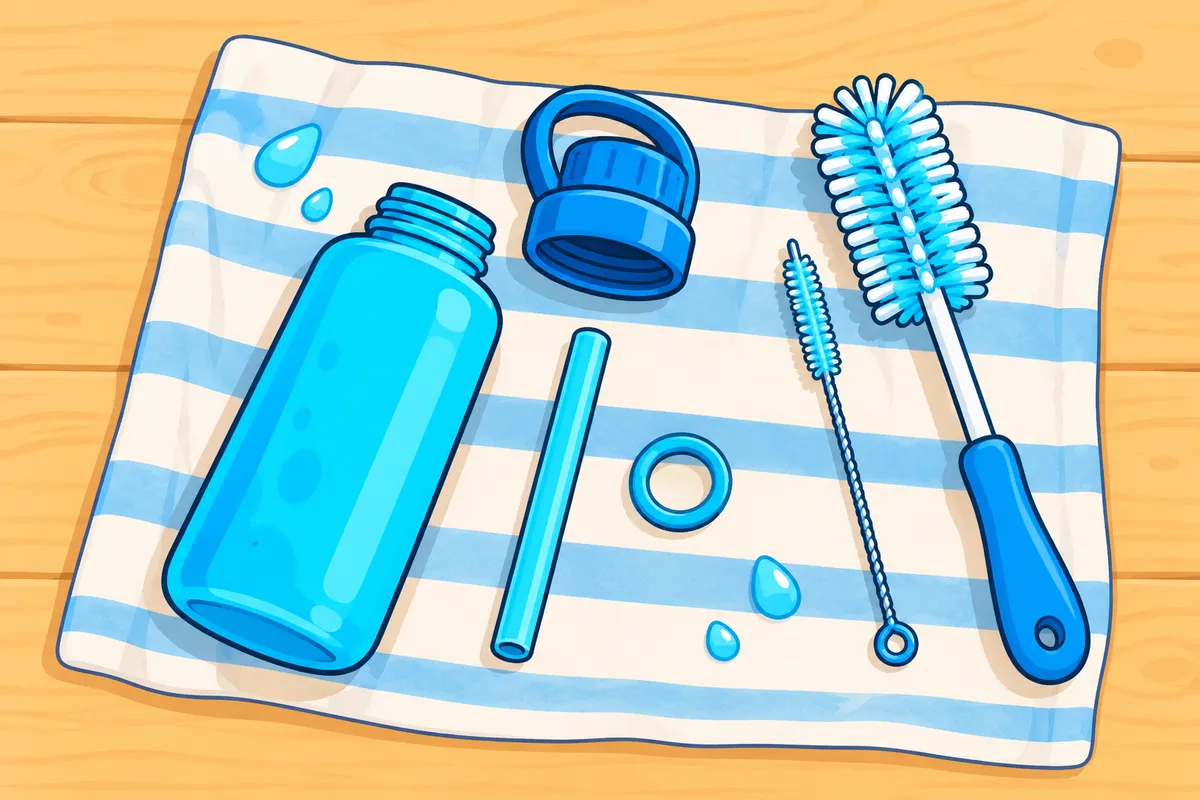
Take the lid apart, scrub the bottle and each lid part with hot soapy water and a brush, rinse, and let everything air-dry apart. The brush matters: it reaches the bottom of the bottle and the threads of the lid, where a sponge and a quick shake do not.
What you need
4 items- Hot water and ordinary dish soap
- A long bottle brush that reaches the bottom
- A thin straw brush for straws and spouts
- Unscented household bleach, for sanitizing
The daily wash, about two minutes
- Empty the bottle and take the lid apart: cap, seal, straw, spout
- Scrub the inside wall and bottom with hot soapy water and the brush
- Push the straw brush through the straw and spout, and wipe the seal
- Rinse every part until no soap smell is left
- Stand everything upside down, apart, until fully dry
Drying is the step people skip. A lid screwed onto a wet bottle keeps the inside damp all night, which is exactly what bacteria need. Dry the parts apart, and assemble the bottle only when you fill it.
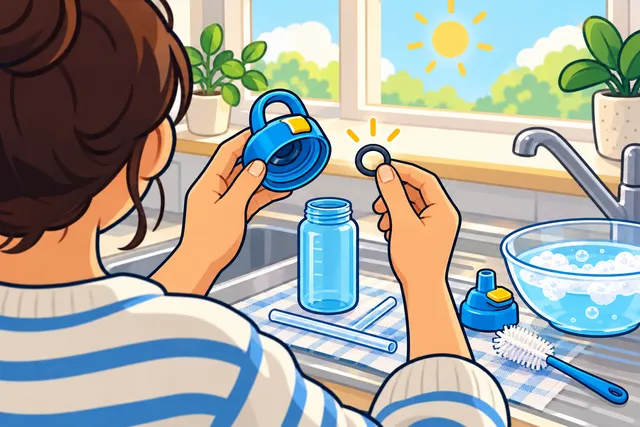
The seal inside the lid deserves its own minute. Pull it out with a fingernail or the end of a spoon, wash it on both sides, and put it back only when dry; black spots on it mean mold, which needs more than this routine.
How Often Should You Wash Your Water Bottle?
Every day you use it. No public health body sets a schedule, and the authors of one 2024 study note there are no guidelines for cleaning reusable bottles. The daily wash is a precaution the evidence supports, not a proven threshold: the one test of washing found it works fast, and the surveys that asked about wash frequency were too small to tie it to cleaner water.
- In a 2024 study of 30 medical students, bacteria inside plastic bottles rose by 70 % after only 3 hours of use, and by 23 % in steel bottles, Hariharan and Sankar report.
- In a 2025 study of 37 bottles, water from bottles washed that day had a median of 1,610 bacteria per ml, against 5,945 for bottles washed within the past week, Wong and colleagues found; with so few bottles the difference was not statistically significant.
- In the 2017 Purdue study, 40 % of the people who washed their bottles did so once a month, and 15.56 % never cleaned them at all.
Wash more often, not less, when the bottle held anything but water. In the Purdue study, the 16 bottles that had held coffee, tea, juice, sports drinks or soda carried far more bacteria than the 72 water-only bottles: an average of about 554,000 per ml against about 7,070.
How Dirty Does a Reusable Water Bottle Get?
Dirtier than most owners expect. In the Purdue study of 90 bottles in daily use, 70 % held more than 100 bacteria per ml, a limit some European countries use for drinking water, and 23 % carried coliforms above the FDA's limit for bottled water. Two new bottles from a store had almost none.
- 70 %
- of 90 bottles above 100 bacteria per ml (2017)
- 23 %
- of those 90 with coliforms above the FDA bottled-water limit
- 46 %
- of 37 bottles with coliforms in the water (2025)
Most of these bacteria are harmless types that live in any damp place, and a high count does not mean you will get sick, the 2025 authors note. Coliforms are the warning sign: they point to contamination from hands, mouths or worse.
What Each Bottle Study Found
Each study looked at different people and bottles, so each adds something.
| Study | Bottles | What it found | What it means for you |
|---|---|---|---|
| Sun et al. 2017, US | 90 in daily use, college students and staff | 70 % above 100 bacteria per ml; drinks other than water raised counts | Wash after any drink but water |
| Hariharan 2024, India | 30 medical students | Counts rose 70 % in 3 hours in plastic; a wash cut them to 11.2 per ml | A wash works, and it works fast |
| Wong et al. 2025, Malaysia | 37 medical students | Narrow-neck bottles 13 times more likely to have coliforms | Pick a mouth your brush fits |
Sources: Sun et al., Hariharan and Sankar, Wong et al..
Is Rinsing a Water Bottle With Water Enough?
No. A rinse removes loose drops but not the film on the walls, and refilling on top of old water adds to it. In the 2024 study, 90 % of the students refilled their bottles without washing or rinsing, and a proper wash cut the bacteria count to a mean of 11.2 per ml.
How you drink matters too. In the same study, bottles drunk from by mouth carried 234 bacteria per ml on average, against 132 for bottles drunk from without the lips touching; sharing a bottle adds another person's mouth.
Can You Clean a Water Bottle With Bleach?
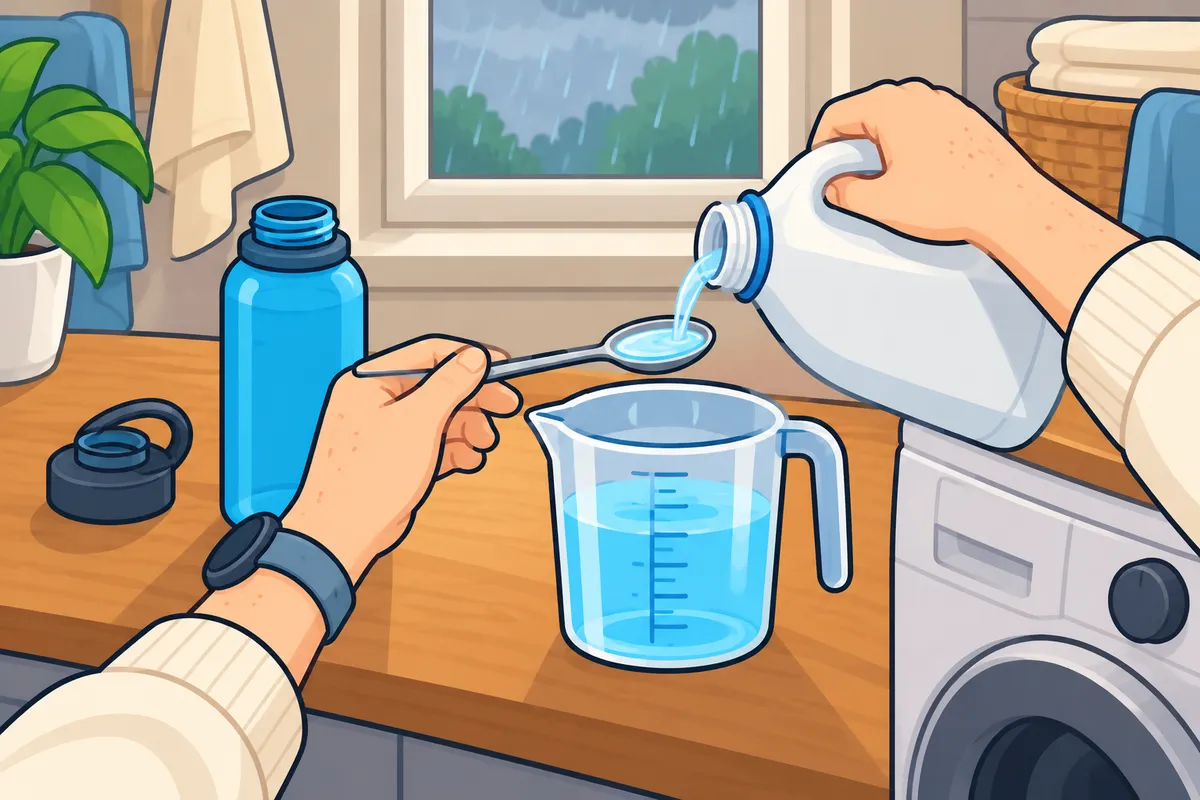
Yes, if your bottle's maker allows it, and you dilute it and rinse it out. The CDC's method for sanitizing water containers mixes 1 teaspoon of unscented household bleach with 1 quart (4 cups) of water; you shake it over every inside surface, wait at least 30 seconds, pour it out and let the container air-dry. Use bleach with 5 to 9 % sodium hypochlorite.
Sanitize with bleach in four cases:
- After the bottle held juice or a sports drink.
- After anyone using it was sick.
- When you get a bottle second-hand.
- Once a week as a habit.
Wash with soap first: bleach works on a clean surface, not through a film.
Sanitize a bottle the CDC way
- Wash the bottle and lid with soap and rinse well
- Mix 1 teaspoon of unscented bleach into 1 quart of water
- Pour some in, close the lid, shake so it wets every surface
- Wait at least 30 seconds, then pour it out through the lid
- Let the bottle and lid air-dry apart
Makers disagree about bleach. Owala's FAQ says "Do not use harsh chemicals (such as bleach, abrasives, etc.)", while Nalgene's own soak uses a few drops in warm water for an hour. A filter bottle needs its filter taken out first, so read the care page for your bottle before you reach for the bleach.
Can You Clean a Water Bottle With Vinegar or Baking Soda?
Yes, and they are the usual bleach-free choices. Two care pages name the methods:
- Owala's care blog gives a paste of baking soda and water for stains and odors, and a distilled white vinegar soak left on for several hours for a deep clean.
- A Nalgene care guide lists white vinegar in warm water, a spoonful of baking soda in warm water and effervescent cleaning tablets as ways to freshen a bottle.
None of these pages measured how many bacteria the methods remove, so treat vinegar and baking soda as smell and stain fixes and keep the bleach mix for sanitizing a bottle that allows it. Rinse well after either one, and do not mix vinegar with bleach in the same bottle. On an unlined copper bottle vinegar also lifts tarnish, so keep rinsing a copper bottle until no vinegar smell is left.
Can You Put a Water Bottle in the Dishwasher?
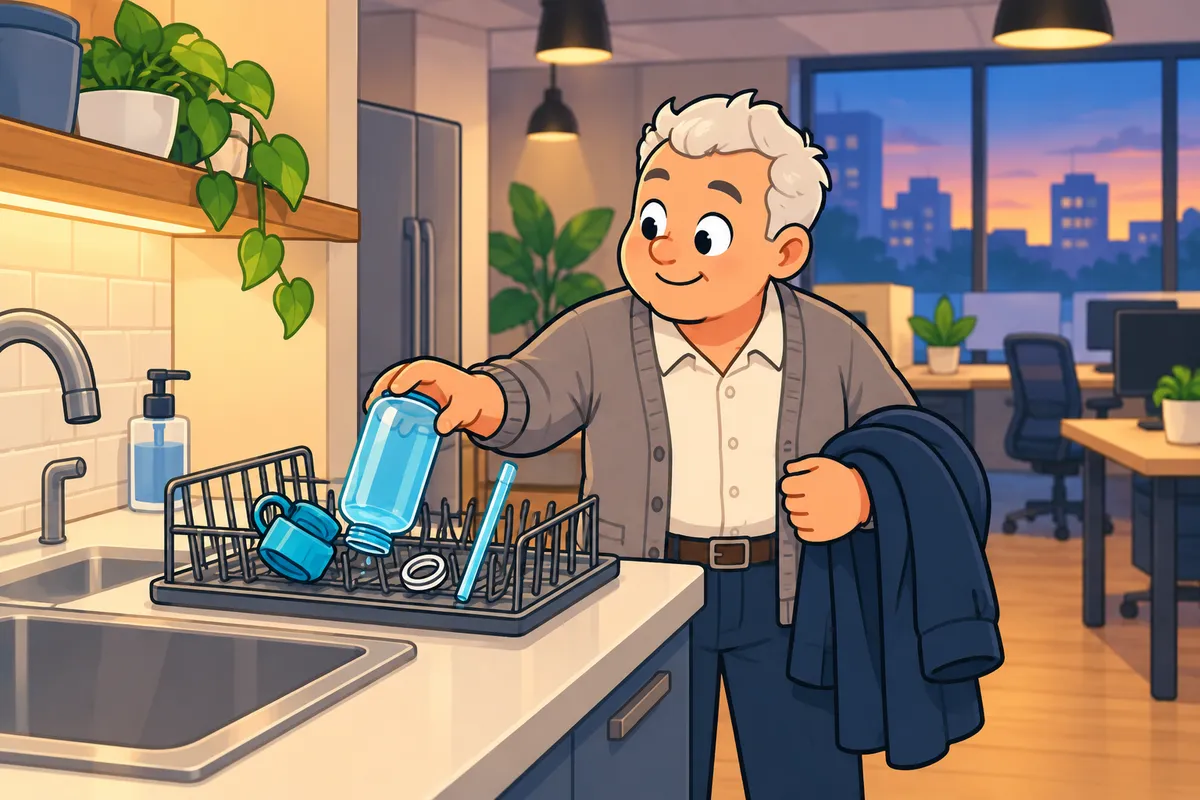
Sometimes. Dishwasher rules differ by bottle, so check the base or the maker's page, and take lids, seals and straws apart first.
- Nalgene says all its bottles are top-rack safe, away from the heating element.
- Owala puts its lids on the top rack but recommends hand-washing the steel cup.
- Any bottle without a label: wash it by hand, which always works.
The Purdue authors note that many home dishwashers have a sanitizing cycle, which would reach the bacteria a quick hand wash leaves. Without that cycle, a dishwasher cleans but may not sanitize.
How Do You Clean a Water Bottle With a Narrow Mouth?
Use a long, thin bottle brush, then let soapy water do the rest: fill a third of the bottle with hot soapy water, close it, shake hard for 30 seconds, and scrub. The neck is where bacteria hide, because a hand and a sponge cannot get in.
The 2025 study shows why it matters. Bottles with a neck too narrow for a hand had coliforms in 59.3 % of cases (16 of 27), against 10 % (1 of 10) for wide-mouth bottles, odds about 13 times higher.
If you are still choosing a bottle, a wide mouth that fits your brush makes daily washing much easier; the main bottles guide compares lid types.
Which Part of the Bottle Needs What
Each part fails in its own place. The bottom corner and the shoulder of a narrow neck hold a film, the threads of the cap trap drips, and the seal and the straw stay damp longest, so give each one its own few seconds.
| Part | Where the film builds | Every day | Weekly or after juice |
|---|---|---|---|
| Bottle body | The bottom corner and under the neck | Long brush, hot soapy water | Shake the bleach mix inside for 30 seconds |
| Screw cap | The threads and the inside of the top | Brush the threads | Fill the cap with the mix for 30 seconds |
| Rubber seal | Both faces and the groove it sits in | Pull it out, wash both sides | Dip it in the mix for 30 seconds |
| Straw | The inside, end to end | Push the straw brush through twice | Pour the mix through it |
| Spout or bite valve | The slit and the hinge | Brush it, open and close it under water | Open it in the mix, then rinse |
The CDC method covers containers, so the weekly column is a sensible extension of its 1 teaspoon per quart and 30 seconds to lids and seals, not a step the CDC tested on them. Branded lids add parts of their own: Owala's spout has a gasket you pull out by its tab, and Hydro Flask, which warns against bleach on its lids, twists its sip lids apart.
Mistakes That Keep Bacteria in the Bottle
Most dirty bottles belong to people who do clean them, just not in the way that removes the film. These six habits come up again and again in the studies above.
| Mistake | Why it fails | Do this instead |
|---|---|---|
| Topping up yesterday's water | 90 % of students in the 2024 study refilled without washing | Empty it, wash it, then refill |
| Closing the lid on a wet bottle | The inside stays damp all night | Dry every part apart |
| Rinsing with water only | The film on the wall stays put | Hot soapy water and a brush |
| Sharing the bottle | Mouth contact raised counts from 132 to 234 per ml | One bottle per person |
| Using bleach on a dirty bottle | The CDC method starts with soap and a rinse | Wash first, then sanitize |
| Using scented bleach | The CDC asks for unscented bleach | Plain bleach with 5 to 9 % sodium hypochlorite |
Sources: Hariharan and Sankar 2024, CDC.
What Washing Cannot Fix
Some bottles need more than a wash. Three signs say a part has reached the end of its life:
- Black spots in a seal or straw are mold, which needs its own steps.
- A smell that stays after washing has its own causes.
- A plastic bottle with deep scratches or a cracked lid is harder to get clean, so replace those parts.
For any bottle, take it apart first and look at the seal under a bright light before you decide to keep it.
General information for healthy adults, not medical advice. If a doctor has set your fluid amount, follow that.

More in Water Bottles
Sources
- Food Protection Trends (Sun, Kim, Behnke et al., Purdue University and NSF International). The Cleanliness of Reusable Water Bottles: How Contamination Levels are Affected by Bottle Usage and Cleaning Behaviors of Bottle Owners, 2017.
- Journal of Environmental Health (Wong et al.). Bacterial Water Quality in Personal Reusable Water Bottles of Undergraduate Medical Students at a Malaysian University, 2025.
- Journal of Pharmacy and Bioallied Sciences (Hariharan and Sankar). Daily Use Water Bottles as a Hub for Microbial Population: A Comparative Study of PET vs. Stainless Steel Water Bottles and Outcome of Washing Strategy Intervention, 2024.
- US Centers for Disease Control and Prevention. How to Create an Emergency Water Supply, 2025.
- Owala. How To Clean a Stainless Steel FreeSip Water Bottle, 2026.
- Great Outdoors. How to Clean a Nalgene Bottle, 2026.
Sources checked by the Glubbo Editorial Team on Oct 19, 2026. General information, not medical advice. How we write and check our guides.

