Water Bottles · Cleaning and Care
How to Clean an Owala: FreeSip Lid, Spout Gasket and Steel Cup
The FreeSip lid taken apart step by step, the vinegar and baking soda clean, and what to do about mold on the seal.
 By the Glubbo Editorial Team · Updated Oct 19, 2026 · 7 min read
On This Page
- How Do You Clean an Owala Bottle?
- How Do You Clean the Owala Lid?
- How Do You Remove the Owala Spout Gasket?
- Why Is There Mold on My Owala Rubber Seal?
- Is an Owala Dishwasher Safe?
- Can You Put Milk or Coffee in an Owala FreeSip?
- What Your Owala Held, and the Clean It Needs
- Do Owala's Cleaning Tablets Work?
- Sources
Short answer
Pull the gasket, soak the lid, hand-wash the steel cup.
- Every lid is top-rack dishwasher safe; the steel cup is best washed by hand.
- Pull the spout gasket out by its tab and wash it on its own.
- A vinegar soak first loosens buildup where a brush cannot reach.
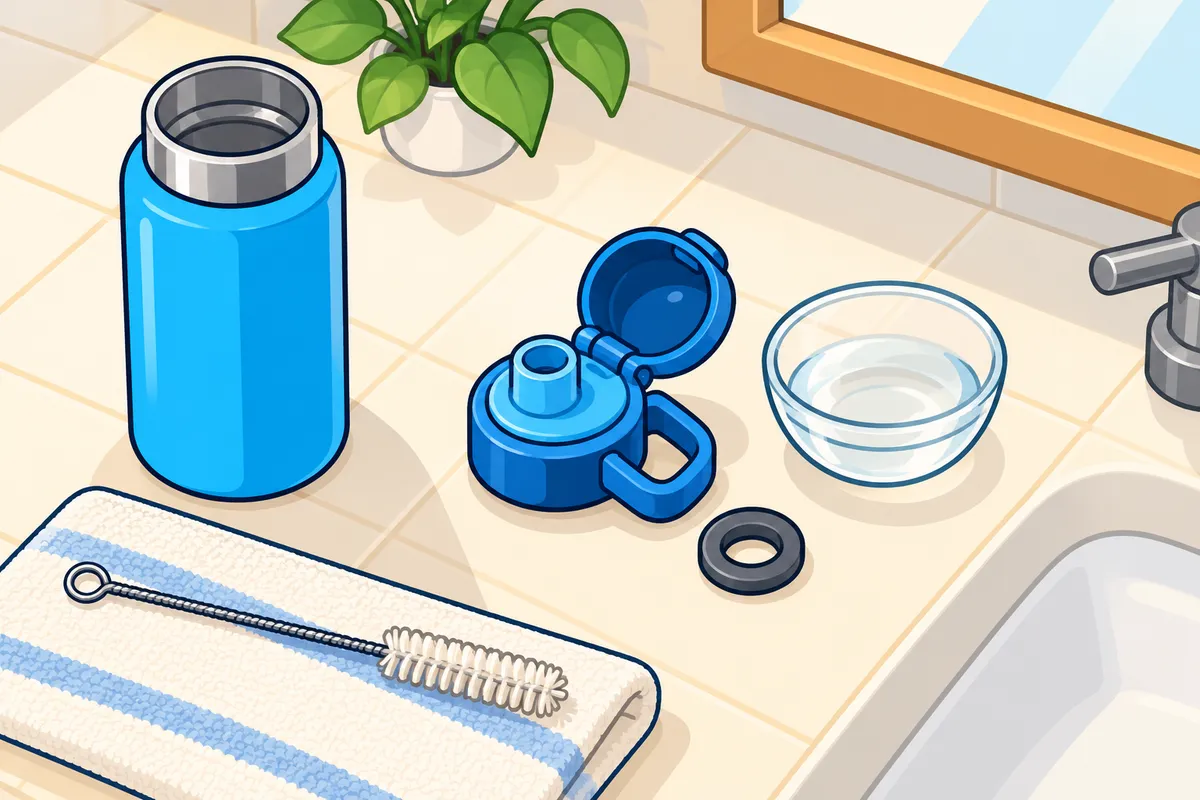
Clean an Owala in three parts:
- Wash the steel cup by hand.
- Pull the spout gasket out of the lid by its tab.
- Soak the lid parts in distilled white vinegar.
The lid and straw can ride in the dishwasher, and the routine takes a few minutes.
The FreeSip lid is why people buy an Owala, and also why some of them write in about a smell or black spots. The spout, the straw and a small rubber gasket meet inside the lid, and water left there in the dark is what goes off first.
How Do You Clean an Owala Bottle?
Wash the stainless steel cup by hand with warm, soapy water and a bottle brush, then clean the lid apart from it. The maker recommends hand washing steel cups "to maintain that beautiful finish", while every lid and straw can go in the dishwasher. A Tritan plastic cup can go on the top rack too.
The cup itself rarely causes trouble. It is a smooth steel tube with a wide opening "for cleaning and adding ice", so a bottle brush reaches the bottom easily. Use a soft brush or sponge, because a metal brush scratches the steel.
How Often Should You Clean an Owala?
Every day, in practice. The FAQ puts it this way: "How often do you shower? Daily seems like a good idea… but that's up to you."
The care blog adds a weekly deeper clean, and it says to wash more often if the bottle held anything but water.
- Every day: warm soapy water, a bottle brush, a rinse, and every part dried apart.
- After juice, a shake or any non-water drink: the same day, with the gasket out.
- Once a week at least: a baking soda paste or a vinegar soak for the lid parts.
- When you smell it or see spots: a vinegar soak for several hours, then a new gasket if the spots stay.
How Do You Clean the Owala Lid?
Pull out the spout gasket, then wash the lid and the gasket apart. All lids are top-rack dishwasher safe, the gasket "should be removed by using the convenient pull tab and cleaned separately", and a sponge or straw brush reaches the nook and small spaces.
The FreeSip lid, step by step
- Pull the straw out of the lid
- Pull the spout gasket out by its tab
- Soak lid, gasket and straw in distilled white vinegar
- Scrub the spout nook with a straw brush or sponge
- Top rack or rinse, then dry every part apart
The vinegar soak has one job: "Soaking the parts in distilled white vinegar beforehand will help breakup buildup in inaccessible areas." The care blog says to leave the vinegar on for several hours. Rinse well afterward so the next sip does not taste of vinegar.
For spots the soak leaves behind, the blog gives a fizzing paste: mix 1 to 2 tablespoons of baking soda with 2 to 3 tablespoons of distilled white vinegar, scrub it into the spots, then rinse with warm water. Baking soda and water alone make a thick paste for odors.
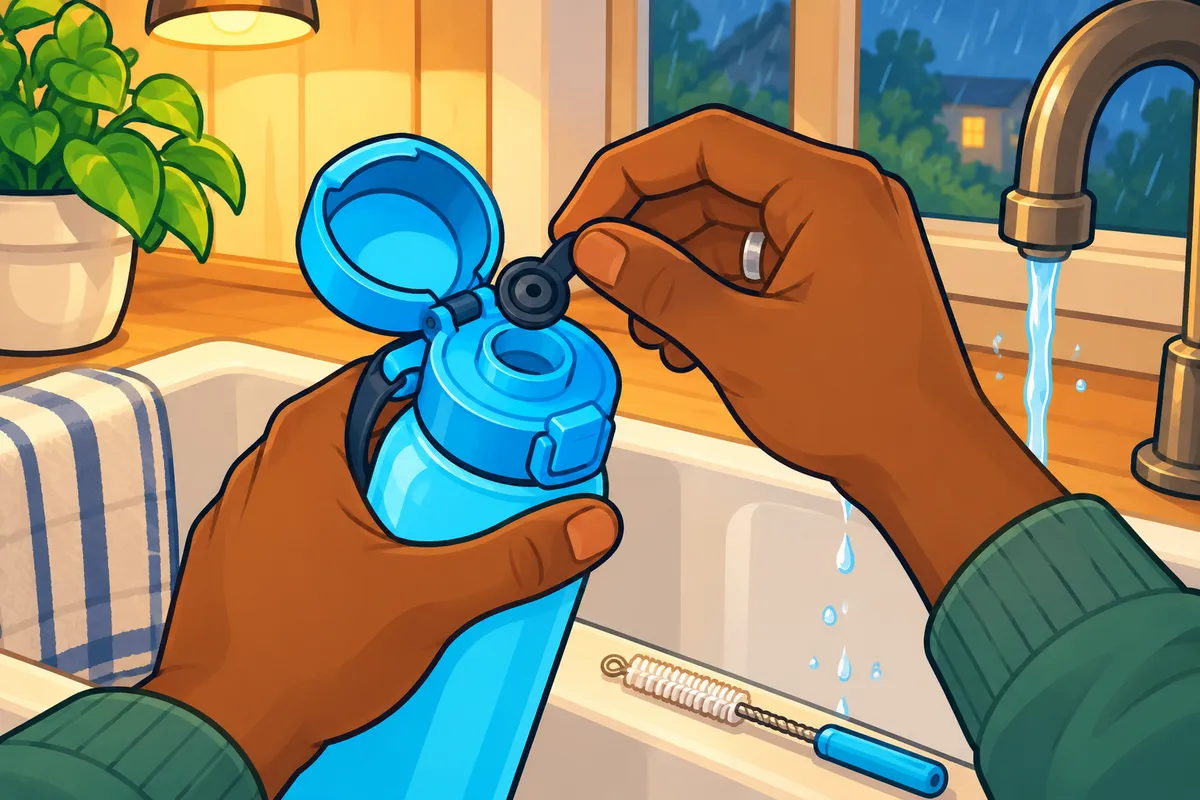
How Do You Remove the Owala Spout Gasket?
Find the small tab on the gasket inside the spout and pull it straight out. The tab is built for this, and the FAQ asks you to clean the gasket separately every time you clean the lid. Push it back fully when it is dry, or the spout can leak.
The gasket is small and dark, so mold on it is easy to miss. Check both faces and the hole in the middle.
Cleaning the Straw
The FreeSip straw pulls out of the lid and can go in the dishwasher's silverware bin. By hand, push a straw brush through it twice with warm soapy water and let it dry hanging or standing, so water drains out of both ends.
A straw you cannot see through, or one with dark marks inside that a brush will not move, is worth replacing. The maker sells replacement straws and lids on its own site.
Taking Apart the FreeSip Twist
The Twist comes apart differently:
- Twist off the lid, then the spout.
- Pull the straw out of the spout.
- Remove the carry loop.
- Take out the gasket around the key mechanism and the ring gasket around the spout piece.
The key mechanism needs a hard twist and pull, the Twist page warns.
Why Is There Mold on My Owala Rubber Seal?
Because water or a drink sat in the lid for long enough in the dark. A gasket left in place keeps a damp ring behind it, and anything but water, from juice to milk, feeds mold faster. The FreeSip is labeled "not for use with hot, carbonated, or perishable liquids", and a perishable drink left in the spout is a common start.
What to do depends on how far it went:
- A few dark specks that scrub off: soak the gasket in vinegar, scrub it with a straw brush, rinse and dry it apart.
- Spots that stay after scrubbing: replace the gasket. A replacement FreeSip spout gasket costs $1.99.
- Mold inside the straw or across the lid: soak and brush every part; replace any part you cannot get clean.

Is an Owala Dishwasher Safe?
Yes for the lid and the straw: lids go on the top rack and straws in the silverware bin. The steel cup is "technically dishwasher safe", but the maker strongly recommends hand washing it to keep the finish, so treat that as the rule.
Tritan plastic cups are top-rack safe as a whole.
The rules change from one product to the next, so the table sorts each part by what its own page says.
| Part | Where it goes | Source page |
|---|---|---|
| FreeSip lid (24, 32 and 40 oz) | Top rack | FreeSip, FAQ |
| FreeSip straw | Silverware bin | FAQ |
| Stainless steel cup | By hand, warm soapy water | FAQ |
| Tritan plastic cup | Top rack | FAQ |
| Twist bottle and lid | By hand | FreeSip Twist |
| Twist spout, key, both gaskets, straw | Utensil basket | FreeSip Twist |
| SmoothSip lid, sliding lock, gaskets | Dishwasher | SmoothSip Slider |
| SmoothSip cup | By hand, to keep its color | SmoothSip Slider |
Sources: the FAQ, the FreeSip, FreeSip Twist and SmoothSip Slider pages, as of 19 October 2026. The Twist is the odd one out: its page recommends washing the bottle and lid by hand, even though its small parts can ride in the utensil basket.
Can You Put Milk or Coffee in an Owala FreeSip?
No. The FAQ lists the steel FreeSip, the plastic one and the Kids' FreeSip as "not for use with hot, carbonated, or perishable liquids", and coffee is hot while milk is perishable. The straw also draws liquid from the bottom of the bottle, where a hot drink is hottest, and pressure can build inside.
The exception is the tumbler line. The FAQ says the 40 oz and 24 oz Tumblers hold "cold, carbonated, and hot drinks", with a note to use caution with hot ones. Coffee is also what the SmoothSip mug is for.
All the bottles share three more rules from the instructions:
- No microwave.
- No boiling.
- No freezing. For a colder drink in a steel bottle, a few ice cubes do the job; plastic bottles may crack when frozen.
What Your Owala Held, and the Clean It Needs
The clean depends on what was in the bottle and how long it sat. A bottle that held only water needs the routine; a perishable drink or a closed, damp week needs more.
What your Owala held, and the clean it needs
- Water only, refilled every dayBrush the cup daily; pull the gasket and do a vinegar or baking soda clean once a week
- A shake or milk left in it overnightEmpty it now, pull gasket and straw, vinegar soak, scrub the spout nook
- Black spots after it sat closed on holidaySoak for several hours and scrub; if spots stay, a $1.99 replacement gasket
Mistakes That Bring the Smell Back
| Mistake | Why it fails | Do this instead |
|---|---|---|
| Washing the lid with the gasket still in | A damp ring stays behind it | Pull it out by the tab every time |
| Soaking in bleach | The maker calls it too harsh, and residue is hard to rinse | Vinegar, then baking soda for spots |
| Scrubbing with a metal brush | It scratches the steel | Soft brush or sponge |
| Closing the lid on a wet bottle | The spout stays damp all night | Dry parts apart, assemble when you fill |
| Keeping a spotted gasket | Spots that stay can come back | Replace it for $1.99 |
Do Owala's Cleaning Tablets Work?
They are an alternative to the vinegar soak, not a required step. Fill the bottle with hot water, drop in one EcoBrite tablet, wait 5 to 10 minutes (or overnight for a deeper clean), then empty and rinse well. The tablets are sold as chlorine-free, phosphate-free and biodegradable.
A tablet works on the inside of the bottle, so the gasket and the spout nook still come out by their tab and get the brush.
General information for healthy adults, not medical advice. If a doctor has set your fluid amount, follow that.

More in Water Bottles

Sources
- Owala. Frequently Asked Questions, 2026.
- Owala. How To Clean a Stainless Steel FreeSip Water Bottle, 2026.
- Owala. FreeSip, product page, 2026.
- Owala. Replacement FreeSip Spout Gasket, 2026.
- Owala. EcoBrite Bottle Cleaning Tablets, 2026.
- Owala. SmoothSip Slider, 2026.
- Owala. Replacement Straws, 2026.
- Owala. FreeSip Twist, 2026.
Sources checked by the Glubbo Editorial Team on Oct 19, 2026. General information, not medical advice. How we write and check our guides.

