Water Bottles · Cleaning and Care
How to Clean a Filter Bottle Without Ruining the Filter Inside
Brita and LifeStraw bottles taken apart as their makers show, which parts take soap, and how to care for the filter.
 By the Glubbo Editorial Team · Updated Oct 19, 2026 · 8 min read
On This Page
- How Do You Clean a Filter Bottle?
- How Do You Clean a Brita Filter Bottle?
- Can You Put a Filter Water Bottle in the Dishwasher?
- How Do You Clean a LifeStraw Go Bottle?
- Can You Wash the Filter in a Filter Bottle?
- How Do You Clean the Straw and Mouthpiece?
- What Can You Put in a Filter Bottle?
- How Do You Clean a Filter Bottle Without Hot Water?
- How Do You Get Mold Out of a Filter Bottle?
- Does a Clean Bottle Make the Water Safe?
- Sources
Short answer
Take the filter out, then wash by the maker's rule.
- Brita: steel bottles by hand only; hard plastic bottles on the top rack.
- LifeStraw: ¼ tsp bleach in 2 cups of water disinfects the membrane in 5 minutes.
- Never put soap or a dishwasher on the filter itself; replace it on schedule.
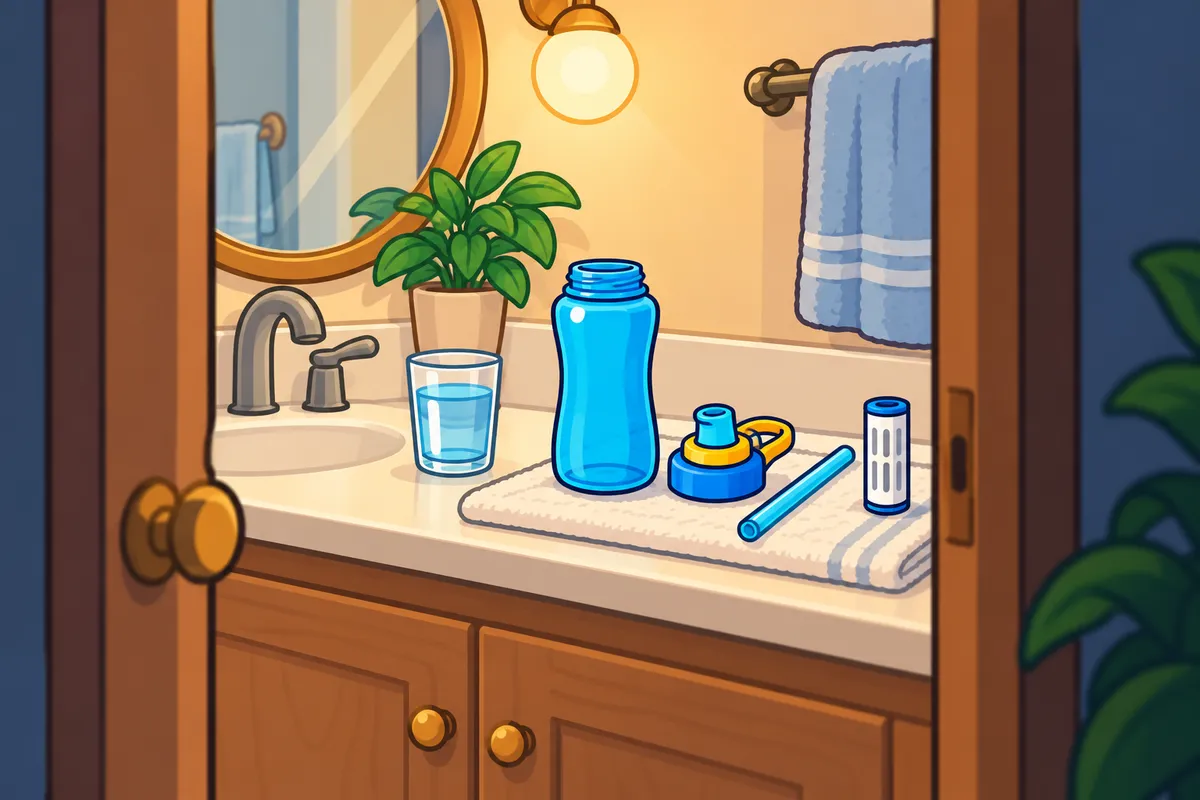
Take the filter out first, then wash the bottle, cap and straw with mild dish soap, by hand or in the dishwasher if the maker allows it. The filter never gets soap: you rinse a carbon filter with water and replace it on schedule, and you disinfect a membrane filter with a weak bleach mix.
A filter bottle is two things in one: a bottle that needs washing like any other, and a filter that soap, heat and the dishwasher can spoil. Most mistakes come from treating them as one part. The two best-known makers, Brita and LifeStraw, publish care steps for their bottles, and they agree on the first move and differ on almost everything after it.
How Do You Clean a Filter Bottle?
Clean the bottle and the filter on separate clocks. The bottle takes soap and a brush; the filter takes a rinse, a disinfecting soak or a replacement, depending on its kind.
| When | Job | The maker's rule |
|---|---|---|
| Every night | Empty the bottle and leave the cap open so the parts dry | Brita: leave the cap open when not in use to remove moisture |
| Weekly | Disinfect the membrane filter | ¼ tsp bleach in 2 cups of water, 5 minutes |
| Monthly | Deep clean the membrane | The same mix, for an hour or more |
| Every 2 months or 40 gallons | Replace the carbon filter in the steel or plastic bottle, whichever comes first | The bottle FAQ |
| About every 60 days or 26 gallons | Replace the carbon filter in the Go Series | The membrane lasts up to 1,000 gallons |
Sources: Brita bottle FAQ, LifeStraw Go page, LifeStraw cleaning guide.
Those numbers explain why cleaning a filter bottle mostly means cleaning the bottle. The parts that wear out get replaced every couple of months, so you never have to scrub them back to new.
How Do You Clean a Brita Filter Bottle?
Remove the filter, then wash by material:
- The maker says to wash its stainless steel bottle by hand with mild dish soap, and never with abrasive detergents or a dishwasher.
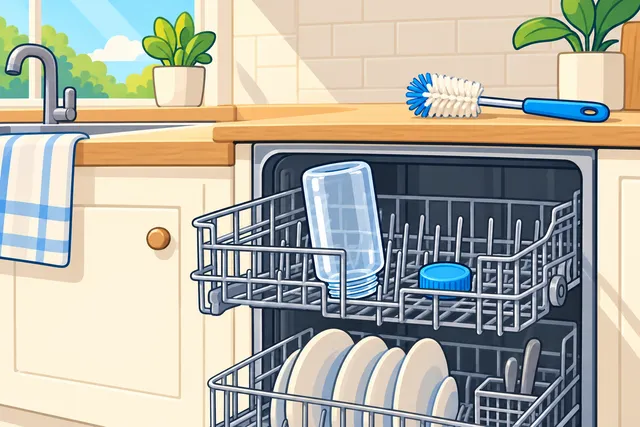
- Its hard-sided plastic bottles are dishwasher safe on the top rack only, bottle and lid included.
Two limits protect the filter between washes:
- Do not fill the bottle with water over 100 °F (38 °C).
- Do not run anything but water through it: the maker lists alcohol, juice and non-potable water among the liquids to keep out, along with well water that is not regularly tested as microbiologically safe.
Setting Up a New Brita Filter
A new filter needs a rinse once. The bottle instructions say to hold it under a strong stream of water for 15 seconds, running water through every side, the inside included, to wash out loose carbon. Then push it in until it sits flush with the straw and fill with cold water to the Max Fill line.
Keep spare filters sealed in their bag in a cool, dry place until you need them. An opened filter left in a drawer is not one you want to start using months later.

Can You Put a Filter Water Bottle in the Dishwasher?
Sometimes, and never with the filter inside.
- A hard plastic bottle can go on the top rack.
- A Go Series bottle is dishwasher safe "after removing the filters", with no heated dry setting.
- A steel filter bottle cannot go in at all, the same hand-wash rule Owala gives for its steel cups.
The maker of the Go Series still prefers hand washing even though the dishwasher is allowed. Heat is one reason to keep any filter out of the machine: the maker of the plastic bottle caps the water that passes through it at 100 °F.
How Do You Clean a LifeStraw Go Bottle?
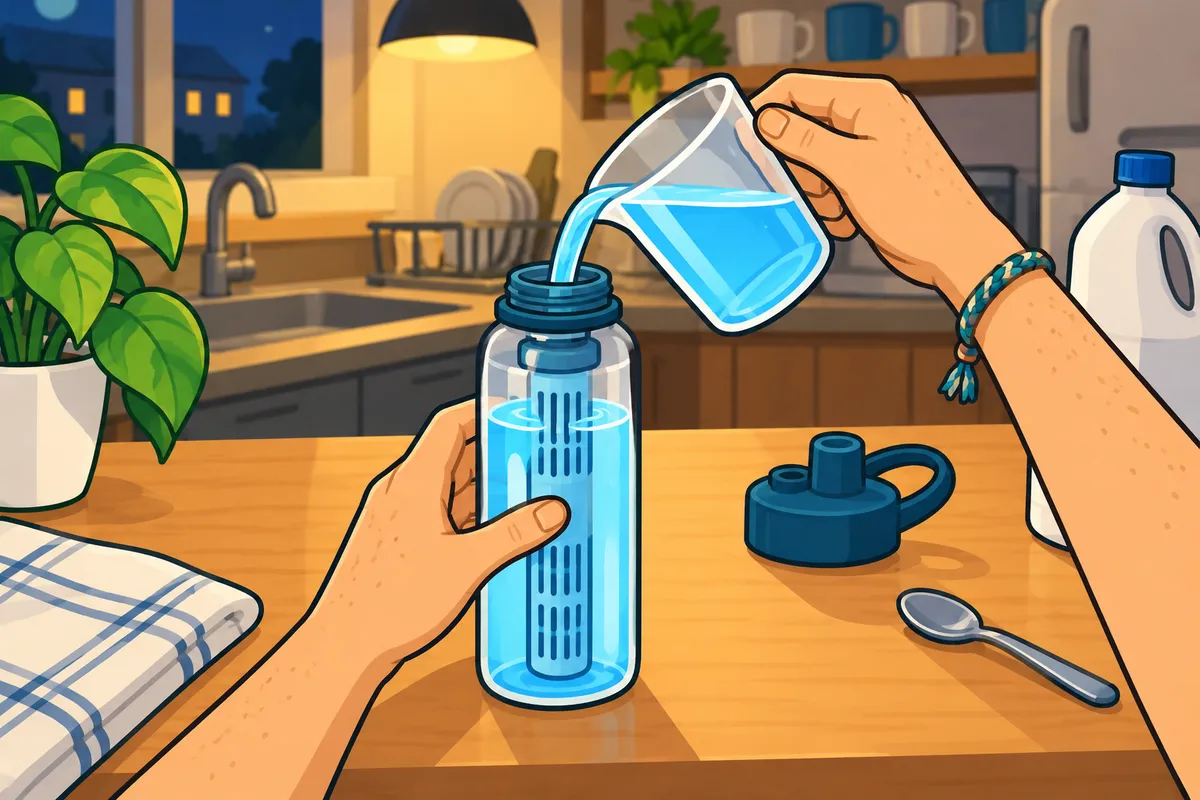
Take out both filters, wash the bottle, cover and mouthpiece in warm soapy water, and let the carbon filter air-dry for 30 minutes before storing it in a sealed bag. To disinfect the membrane filter, the support center mixes ¼ teaspoon (1.25 ml) of bleach into 2 cups (0.5 L) of clean water.
Disinfecting the membrane
- Mix ¼ tsp (1.25 ml) bleach into 2 cups (0.5 L) clean water
- Pour it into the bottle and close the lid
- Let it sit 5 minutes, or an hour or more for a deep clean
- Rinse twice with clean water, shaking 30 seconds each time
- Blow through the filter to clear leftover bleach
The ratio is gentle: a quarter teaspoon in half a liter is about half the strength of the CDC's 1 teaspoon per quart for sanitizing water containers. That stronger mix suits the bottle body, filter out; for the membrane, the two rinses and the blow-through get the last of the weak one out.
Storing the Go Series Between Trips
The two filters store differently, by the storage guide:
- The membrane stays wet in salt water: 1 teaspoon of salt in 0.5 liters of water, in a non-metal container or a zip-lock bag, never a steel bottle, because salt water rusts stainless steel.
- The carbon filter goes in a sealed bag inside the bottle, and after more than 3 months in storage the maker recommends replacing it.
- Do not freeze the bottle or the filters, the product page says, though ice cubes in the water are fine.
Can You Wash the Filter in a Filter Bottle?
Not with soap or in a dishwasher.
- Rinse a new carbon filter once under running water for 15 seconds, then replace it on its schedule.
- Disinfect the Go Series membrane with its weak bleach mix.
- Replace its carbon filter when the water starts to smell or taste different, about every 60 days.
A filter that has reached the end of its life does not need cleaning, it needs replacing. The membrane makes that obvious: it stops allowing water to flow through when it is spent, after up to 1,000 gallons.
Brita and LifeStraw Care Side by Side
| Care point | Brita Premium Bottle | LifeStraw Go Series |
|---|---|---|
| Dishwasher | Plastic: top rack; steel: never | Bottle only, filters out, no heated dry |
| Soap on the filter | No; rinse 15 seconds on first use | No; the membrane gets a bleach mix |
| Disinfecting | Not described | ¼ tsp bleach in 2 cups water, 5 minutes |
| Water temperature | Nothing over 100 °F (38 °C) | Ice is fine; do not freeze |
| Storage | Spare filters sealed, cool and dry | Membrane in salt water; never in a steel bottle |
How Do You Clean the Straw and Mouthpiece?
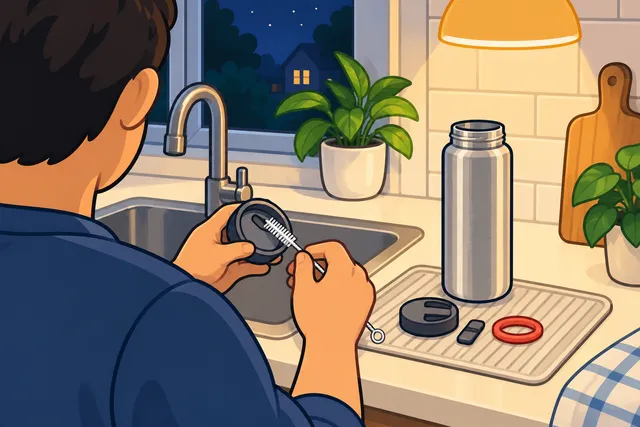
Wash them by hand with mild dish soap and rinse well, the maker's instructions say for the bottle, cap and straw of a steel model, and use a bottle brush for the straw if it has room. The Go Series mouthpiece is washed with the bottle and lid in warm soapy water, and soaked in a similar diluted bleach solution when mold appears.
The mouthpiece and straw are the parts your lips touch, so they pick up film first. Take them off and wash them every time you wash the bottle.
What Can You Put in a Filter Bottle?
Cold, drinkable water and nothing else. The makers draw the same line from two sides, and between them the list of things to keep out is long.
Keep Out of a Filter Bottle
5 items- Juice, soda and milk, which can clog the filter
- Alcohol and any non-potable water
- Well water that is not regularly tested as microbiologically safe
- Water over 100 °F (38 °C) in a plastic or steel model
- Anything you will let freeze in the bottle or filter
A filter bottle is not a shaker or a flask. Drinks with sugar also feed film in the bottle itself, so flavored drinks belong in a bottle without a filter.
How Do You Clean a Filter Bottle Without Hot Water?
Use soap and the water you have, let the parts dry, and wipe them with a disinfecting wipe. The Go Series FAQ suggests this routine for travel without hot water, ideally with a disinfecting soap, and the same rule keeps the filter out of the wash.
How Do You Get Mold Out of a Filter Bottle?
Take the filter out and wash the bottle thoroughly by hand with hot, soapy water, and put the white cap on the dishwasher's top rack if it is a plastic model. The maker says mold can occur in any environment with moisture, especially humid climates, and that leaving the cap open when the bottle is not in use helps.
For the Go Series, the support center's mold page gives three moves:
- Soak the membrane in the bleach mix for 20 minutes and rinse it thoroughly.
- Wash the bottle, lid and mouthpiece with dish detergent.
- Fit replacement lids when a part keeps building up.
A filter with mold on it is one to replace, since neither maker gives a way to wash a carbon filter. Empty the bottle at night and leave the parts apart to dry.
Does a Clean Bottle Make the Water Safe?
No. A filter bottle carries its maker's claims about what it removes, and cleanliness does not change them.
The Go Series, for one, removes bacteria and parasites but not viruses, the maker's FAQ says. Whether a filter suits water you worry about for lead depends on that model's own certification, not on how clean you keep it.
Write the install date of each new filter on the bottle's base with a marker, and swap it on its own schedule.
The date is the one part of filter care that no soap, rinse or soak can do for you, and it is the part most owners skip.
General information for healthy adults, not medical advice. If a doctor has set your fluid amount, follow that.

More in Water Bottles
Sources
- US Centers for Disease Control and Prevention. How to Create an Emergency Water Supply, 2025.
- Brita. Water Bottle FAQs, 2026.
- Brita. Water Bottle Support and Instructions, 2026.
- LifeStraw. LifeStraw Go Series 22 oz, product page and FAQ, 2026.
- LifeStraw Support Center. Cleaning and Maintaining your Go Series Bottle and Tumbler, 2026.
- LifeStraw Support Center. How to Clean Mold or Mildew, 2026.
- LifeStraw Support Center. How to Store Your Go Series Waterbottle or Tumbler Filters, 2026.
- LifeStraw. Frequently Asked Questions, 2026.
Sources checked by the Glubbo Editorial Team on Oct 19, 2026. General information, not medical advice. How we write and check our guides.

