Too Little, Too Much · Signs and Checks
Can Dehydration Cause a Fast Heart Rate? Normal Ranges and Red Flags
Why your heart speeds up when you are low on fluid, how many beats it adds, and the signs that need help today.
 By the Glubbo Editorial Team · Updated Oct 19, 2026 · 9 min read
On This Page
- Why Is My Heart Rate High When I Am Dehydrated?
- How Much Does Dehydration Raise Your Heart Rate?
- What Is a Normal Resting Heart Rate?
- Can Dehydration Also Lower Your Blood Pressure?
- Can Dehydration Cause Heart Palpitations?
- Why Does My Heart Race When I Stand Up?
- When Is a Fast Heart Rate an Emergency?
- Sip, Rest and Recheck Your Pulse
- Sources
Short answer
Yes, and it climbs with the size of your fluid loss.
- Heart rate climbs 3 to 5 beats a minute for each 1 % of body weight lost (NATA).
- A normal adult resting pulse is 60 to 100 beats a minute (MedlinePlus).
- Fast heart rate with dehydration signs: call your doctor or nurse line today.
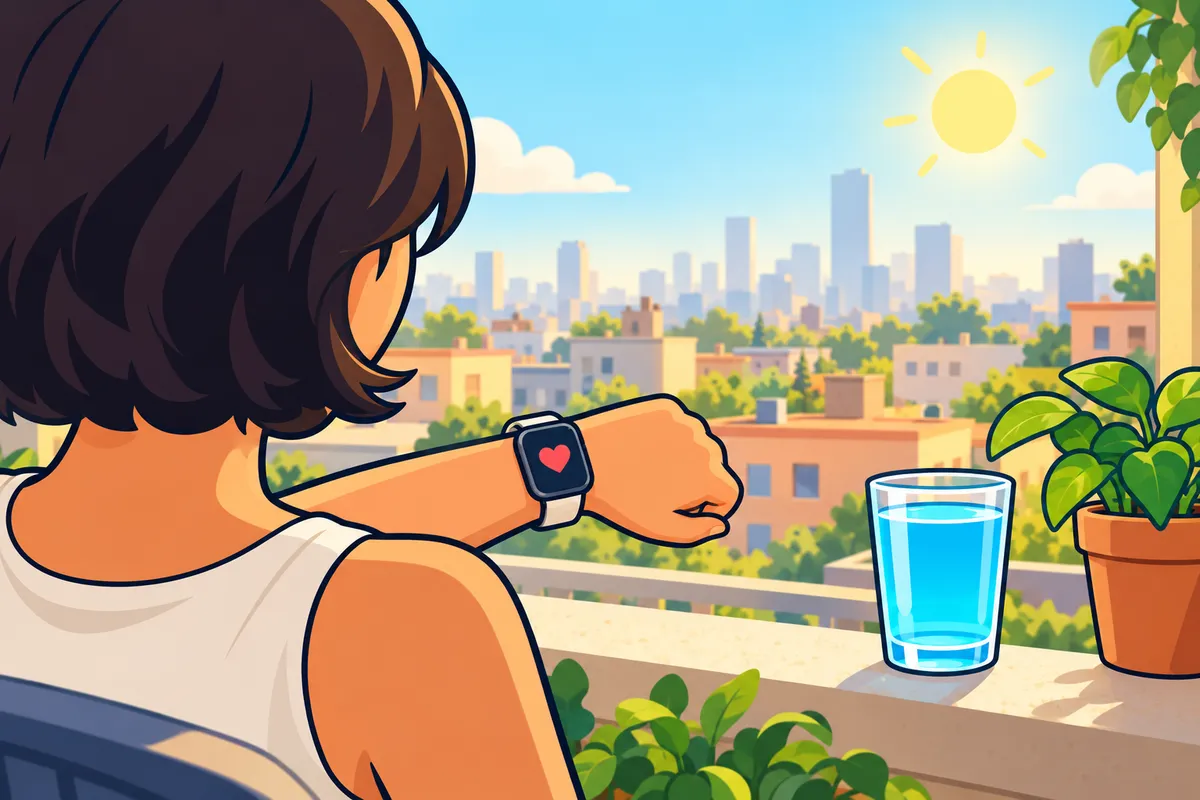
Yes. Losing fluid makes your heart beat faster, and in exercise studies each 1 % of body weight lost added about 3 to 5 beats a minute. Your watch shows 95 when you normally sit at 70, you feel your pulse thumping in your neck, and you have barely drunk anything since breakfast: dehydration is a real cause of that.
It is not the only cause, and a racing heart is one of the dehydration signs the NHS asks you not to sit on. How much fluid loss moves your pulse, and where "drink and rest" ends and "get help" begins, comes down to a few numbers.
Why Is My Heart Rate High When I Am Dehydrated?
Because there is less blood to pump. When you lose fluid:
- Your blood volume falls.
- Less blood returns to your heart.
- Each beat pushes out less, so your heart beats faster to keep the flow going.
The NATA position statement traces the smaller beat to lower pressure in the veins that fill the heart, caused by the lower blood volume.
Your blood also gets more concentrated. The IOC consensus on heat explains that a fall in body water lowers plasma volume and raises the concentration of the blood, which "decreases cardiac filling and challenges blood pressure regulation".
What Else Changes in Your Blood Vessels
A review in Nutrients by Watso and Farquhar found that short-term dehydration may weaken the lining of your blood vessels. In one study it cites, volunteers:
- walked for 100 minutes at 31 °C,
- lost about 2 % of their body weight,
- were limited to 500 ml of water for the rest of the day.
Their arteries widened less in a standard test.
The same review reports that 24 hours without extra water raised the activity of the sympathetic nerves that tighten blood vessels, in a small human study. Most of the nerve data come from animals, so treat that part as a likely mechanism, not a settled one.
How Much Does Dehydration Raise Your Heart Rate?
About 3 to 5 beats a minute for each 1 % of body weight you lose, NATA reports, and the change grows with the size of the loss. A 70 kg person who is 1.4 kg down, 2 %, can expect a pulse about 6 to 10 beats higher than usual during activity.
The NATA figure comes from studies of exercise, where heat and effort add their own rise. At rest the extra beats may be fewer, but the direction is the same, and a pulse that sits well above your normal after a hot day is worth a glass of water and a recheck.
| Fluid lost | 60 kg person | 80 kg person | Extra heart rate |
|---|---|---|---|
| 1 % of body weight | 0.6 kg (about 0.6 L) | 0.8 kg (about 0.8 L) | +3 to 5 beats a minute |
| 2 % | 1.2 kg | 1.6 kg | +6 to 10 |
| 3 % | 1.8 kg | 2.4 kg | +9 to 15 |
The 3 to 5 beats per 1 % come from NATA 2017; the kilograms and beats per row are our arithmetic. A kilo of lost weight is about a liter of fluid.
Does a Workout Push Your Pulse Higher When You Are Dry?
Yes. In the studies the Nutrients review pulls together, people who lost about 3 % of their weight cycling in the heat saw a bigger rise in heart rate than when they replaced half or all of the loss. The IOC consensus sets the goal at avoiding a loss of more than 2 % of body weight during training in the heat.
What Is a Normal Resting Heart Rate?
60 to 100 beats a minute for adults, including older adults, according to MedlinePlus. It adds that a fast pulse "may signal an infection or dehydration". Your own normal matters more than the range, so a pulse 15 beats over your usual is worth noticing even when it sits inside the band.
Normal Resting Pulse for Children and Adults
Children's hearts beat faster, so a number that worries you in an adult can be normal in a child. A sick child who is short of fluid can sit above these ranges.
| Age | Normal pulse (beats/min) |
|---|---|
| Children 1 to 2 years | 80 to 130 |
| Children 3 to 4 years | 80 to 120 |
| Children 5 to 6 years | 75 to 115 |
| Children 7 to 9 years | 70 to 110 |
| 10 years and older, adults and seniors | 60 to 100 |
| Well-trained athletes | 40 to 60 |
Take Your Resting Pulse
- Rest for at least 10 minutes first
- Two fingers on the inside of the wrist, below the thumb
- Count for 30 seconds and multiply by 2
- Note it, drink a glass of water, check again later
A 15-second count multiplied by 4 is usually accurate too. A fitness watch works for trends; for a single worrying number, count by hand as well.

Two Hours of Digging in July
Can Dehydration Also Lower Your Blood Pressure?
It can make blood pressure harder to hold steady. Less blood returns to the heart, so each beat pushes out less, and your body speeds the pulse and tightens vessels to compensate. In the Nutrients review, moderate dehydration of about 5 % dulled the usual rise in blood pressure during exercise, mainly because the heart pumped less blood per minute.
At home you will notice this as feeling dizzy or light-headed on standing. Dizziness on standing that does not go away is a reason to get urgent advice, and a pulse that stays fast while you feel dizzy is a reason to call a doctor rather than keep sipping.
Can Dehydration Cause Heart Palpitations?
It can make your heartbeat feel faster and more noticeable, which is what many people mean by palpitations. The NHS page on palpitations does not name dehydration among its causes, though; it lists strenuous exercise, lack of sleep, stress and anxiety, medicines, and alcohol, caffeine, nicotine and recreational drugs.
What Palpitations Can Feel Like
4 items- racing or beating very fast
- irregular, with skipped or extra beats (ectopic beats)
- pounding or thumping
- fluttering
Hot days often stack several causes. An afternoon of yard work, two coffees and a beer in the sun can each push your pulse up, so drink water first and cut the caffeine and alcohol before you judge what is left. Palpitations can last seconds, minutes or longer.
Telling Dehydration Apart From Other Causes
Look at what came with the racing heart. The table lines up the common causes with the clues that point to each and the first thing to try.
| Likely cause | Clues that point to it | First thing to try |
|---|---|---|
| Too little fluid | Thirst, dark pee, dry mouth | Drink steadily and rest; a fast pulse with these signs needs your doctor or nurse line today |
| Heat or hard exercise | Hot day, just finished a workout | Cool down, drink, rest 10 minutes before counting |
| Caffeine, alcohol or nicotine | Coffee, energy drinks, a few drinks, smoking | Skip the next one; water instead |
| Infection or fever | Feeling unwell, high temperature | See a doctor if it lasts or you feel worse |
| Stress, poor sleep, a medicine | Anxious day, short night, new prescription | Check the medicine leaflet; talk to your doctor if it repeats |
| A heart rhythm problem | Irregular beats that keep coming back, chest pain | Doctor visit; 911 with chest pain or fainting |
The clues come from the NHS pages on dehydration and palpitations and from MedlinePlus, which notes a fast pulse can signal infection.
Why Does My Heart Race When I Stand Up?
Standing pulls blood toward your legs, and your heart speeds up to keep blood reaching your head. How you lost the fluid changes how much: in a study the Nutrients review cites, a 3 % loss caused by a diuretic made the jump in heart rate on standing larger, while the same 3 % lost by exercising in 40 °C heat did not.
If it happens day after day, even when you drink well, ask your doctor. The NHS describes postural tachycardia syndrome (PoTS), when your heart rate rises after getting up from sitting or lying down, and lists not drinking enough, getting too hot and alcohol among the things that make it worse. A doctor can check your blood pressure and heart rate before and after you stand.
What to Do If You Feel Faint
- Lie down and raise your legs until you feel better, the NHS PoTS page advises.
- If you cannot lie down, it suggests crossing your legs, rocking on your toes, and clenching your buttocks, tummy muscles or fists.
- Afterward, sit for a while before you stand again.
A glass of water by the bed on hot nights or during an illness puts your first drink of the day before your first stand. Thirst, dark pee and peeing less often tell you whether the loss is mild or serious.
When Is a Fast Heart Rate an Emergency?
When it comes with chest pain, shortness of breath, fainting, confusion or cold, blotchy skin. A fast heart rate with signs of dehydration is urgent, and a racing heart with any of those is an emergency.
Do not drive yourself if you feel faint. Have someone else drive you or call an ambulance, and bring any medicines you take.
Sip, Rest and Recheck Your Pulse
Drink steadily, not all at once, and rest. A pulse that stays fast along with signs of dehydration needs your doctor or nurse line today, as the NHS asks. For mild fluid loss, sipping your way back over a few hours works better than a liter in one go, and an oral rehydration solution suits vomiting or diarrhea; a pharmacist can recommend one.
Your Pulse, Your Next Drink
- A few beats above your normal after heat or exercise, no other symptomsA 250 ml (8 oz) glass now, rest in the cool, recheck in an hour
- Racing after coffee, energy drinks or alcohol on a hot dayWater instead, and skip the next caffeine
- A pulse above your normal after vomiting or diarrheaSmall sips, then an oral rehydration solution from a pharmacist
General information for healthy adults, not medical advice. If a doctor has set your fluid amount, follow that.
More in Too Little, Too Much



Sources
- National Athletic Trainers' Association (Journal of Athletic Training). Position Statement: Fluid Replacement for the Physically Active, 2017.
- MedlinePlus (US National Library of Medicine). Pulse, checked 2026.
- NHS. Dehydration, 2026.
- NHS. Heart palpitations, 2026.
- NHS. Postural tachycardia syndrome (PoTS), checked 2026.
- Nutrients (Watso and Farquhar). Hydration Status and Cardiovascular Function, 2019.
- British Journal of Sports Medicine (Racinais and colleagues). IOC consensus statement on recommendations and regulations for sport events in the heat, 2023.
Sources checked by the Glubbo Editorial Team on Oct 19, 2026. General information, not medical advice. How we write and check our guides.

