Do Cats Prefer Running Water? What the Fountain Studies Found
Some cats pick moving water, most drink about the same; what the studies measured and a home test for your cat.
 By the Glubbo Editorial Team · Updated Nov 2, 2026 · 11 min read
On This Page
- Do Cats Prefer Running Water?
- Do Cats Drink More From a Fountain Than From a Bowl?
- Why Might Cats Like Running Water?
- Are Cat Water Fountains Worth It?
- How Can You Test Whether Your Cat Prefers a Fountain?
- Can a Cat Water Fountain Cause Problems?
- How Do You Keep a Cat Fountain Clean?
- When Is This a Vet Question?
- What to Do This Week With Your Cat
- Sources
Short answer
Some cats do; on average they drink about the same.
- In 14 lab cats, still and flowing bowls gave the same intake (Robbins 2019).
- A 12-cat home study saw more from a fountain; not significant once one cat was left out.
- Test your own cat: a settling week, then two stations measured over four days.
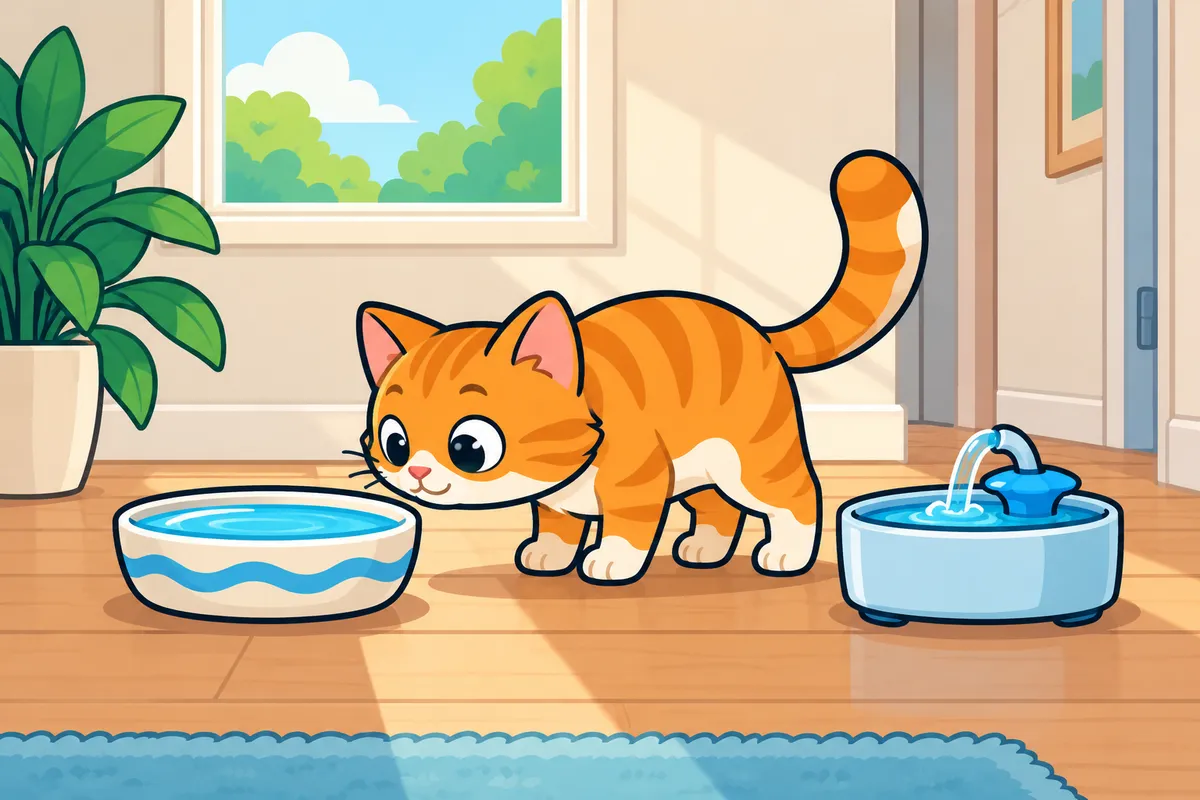
Some cats do prefer running water, but cats as a group do not drink measurably more from a fountain. In the best two studies, one in 12 home cats and one in 14 laboratory cats, a fountain did not clearly raise how much they drank.
The popular line that cats are built to prefer moving water is not supported as a rule: some cats play with a fountain or drink more from it, and group averages show no gain. A fountain is a reasonable thing to try, and measuring is how you learn whether it works for your cat. The test further down takes about two weeks and ends with a no-cat control day for each station.
General information for healthy adult cats, not veterinary advice. A cat that drinks much less than usual, or seems unwell, needs a vet, and the sooner the better.
Do Cats Prefer Running Water?
Some do, and some clearly drink more from a still bowl. In the 14-cat laboratory study, each cat had one bowl type at a time, and only 3 cats drank significantly more from one bowl than from another.
They did not agree: one drank more from the circulating bowl than the still one, one more from the free-falling bowl than the circulating one, and one more from the still bowl than the circulating one. The study measured how much each cat drank, not which bowl it would pick if it could choose.
The Cornell Feline Health Center says the same in one line: some cats drink more when they have a fountain, and individual preferences vary.
Do Cats Drink More From a Fountain Than From a Bowl?
Not by a margin the studies can defend.
One 2010 home study found more intake from a fountain over two days, and one 2019 laboratory study found no difference between still and flowing bowls. A 2026 review of 32 papers on everything that changes how much cats drink concluded that water source type (static or flowing) did not affect intake. That review most likely rests on trials like these two, so it is a summary, not a third independent test.
The three differ in size, setting and funding.
| Study | Cats | Design | Water intake | Who paid |
|---|---|---|---|---|
| Grant 2010 | 13 enrolled, 12 analyzed; client-owned, indoor, at home | Crossover; 7 days to get used to the fountain, then 48 hours measured per water source, 14 days apart | Fountain 31.6, bowl 22.9 ml per kg a day (P = 0.0381) | A college research grant; Veterinary Ventures donated the fountains |
| Robbins et al. 2019 | 16 enrolled, 14 finished; laboratory cats on dry food | Crossover; 7 days to get used to the setup, then 14 days per bowl type | Still 27.5, circulating 26.3, free-falling 26.1 ml per kg a day (P = 0.942) | A bowl maker, Radio Systems Corporation |
| Kosmal et al. 2026 | Review of 32 papers, 1975 to 2025 | Scoping review of every factor studied in cat water intake | Water source type (static or flowing) did not affect intake | Review, no new cats; not an independent test |
The 2010 Home Study
David Grant's study is the one that points toward fountains, and it is smaller than it sounds. In the full text, the 12 cats drank 31.6 ml per kg a day from the fountain against 22.9 from the bowl, with a P value of 0.0381.
The paper also says that when one cat with an inconsistent diet was removed, neither intake nor urine concentration differed significantly. Urine osmolality, the measure of how concentrated the urine is, was the same either way, and the author concluded the fountain "failed to substantially increase water intake and dilute urine."
Owners judged that 10 of the 12 cats liked the fountain. Five played with it, against 3 that played with the bowl.
The 2019 Laboratory Study
Robbins and colleagues gave 14 cats on one dry diet, housed alone, three bowl types one at a time in random order, and measured how much each cat drank from the bowl it had. Average intake was within about 1.4 ml per kg of each other, and the difference was not significant.
The urine result needs care. Urine was more concentrated with the circulating bowl (2,585 mOsm/kg against 2,176 for the still bowl), yet intake did not differ, and the authors call the meaning of that unknown. They also list limits: healthy, confined colony cats, no moisture or calorie intake measured, and funding from the bowl maker.
The 2026 Review
A scoping review in the Journal of Animal Science pulled together 32 papers and found that diet format moved water intake more than the water source did. Across five groups of healthy cats, total water intake ran from 23 to 51 ml per kg a day, and cats on dry food generally took in less.
That is a different lever. If your cat eats only kibble, the water in food matters more than the water in the bowl, and the page on what a cat that rarely drinks needs works the arithmetic.
Why Might Cats Like Running Water?
No source I opened gives a proven reason, and what the papers say is small.
The 2019 laboratory authors started from the idea that the curious nature of cats would attract them to moving water, and then found no difference in how much the cats drank. The 2010 author wrote that fountains "may provide a source of enjoyment for some cats," and in that study 5 of 12 cats played with the fountain or its water against 3 of 12 with the bowl.
Popular explanations are unproven ideas here, because none of the vet-school or journal pages above tests them:
- Fresher water.
- Whiskers touching the bowl sides.
- Cooler water.
- Wild-cat instinct.
The one related point with a source is bowl shape. The 2022 ISFM and AAFP guidelines say flatter, low-sided bowls, plates or saucers are generally preferred, and that preferences vary with temperament, age, breed and health.
Are Cat Water Fountains Worth It?
For a healthy cat that already drinks, probably not for the extra water, because the studies do not show a reliable gain. A fountain is worth a trial when your cat clearly likes moving water and you will keep it clean.
A Wide Bowl
- No pump, filter or cord to maintain
- Lost about 25 ml a day in Grant's control bowl
- Same average intake as flowing water in 14 lab cats
A Fountain
- Some cats drink more from it, and owners thought 10 of 12 liked it
- Lost about 108 ml a day in Grant's control fountain, so it needs topping up
- Parts to wash and a filter to replace, on the maker's schedule
Two cats in the same house can disagree, so a fountain suits some and not others. If one cat in a multi-cat home loves it, you still cannot tell from the bowl level which cat is drinking.
How Can You Test Whether Your Cat Prefers a Fountain?
Put both stations out for a settling week, then measure what is gone from each for four days, swapping their positions after day 2. The studies gave each cat one water source at a time; this test offers both together, so it shows which one your cat drinks from more, which is what the group averages cannot tell you.
We built this method from how the studies measured; it works best with one cat. Both studies gave cats 7 days to get used to the setup before measuring, so the test does too, and both corrected for evaporation with a control of the same type, so each station here gets its own no-cat control day.
A settling week, then four days
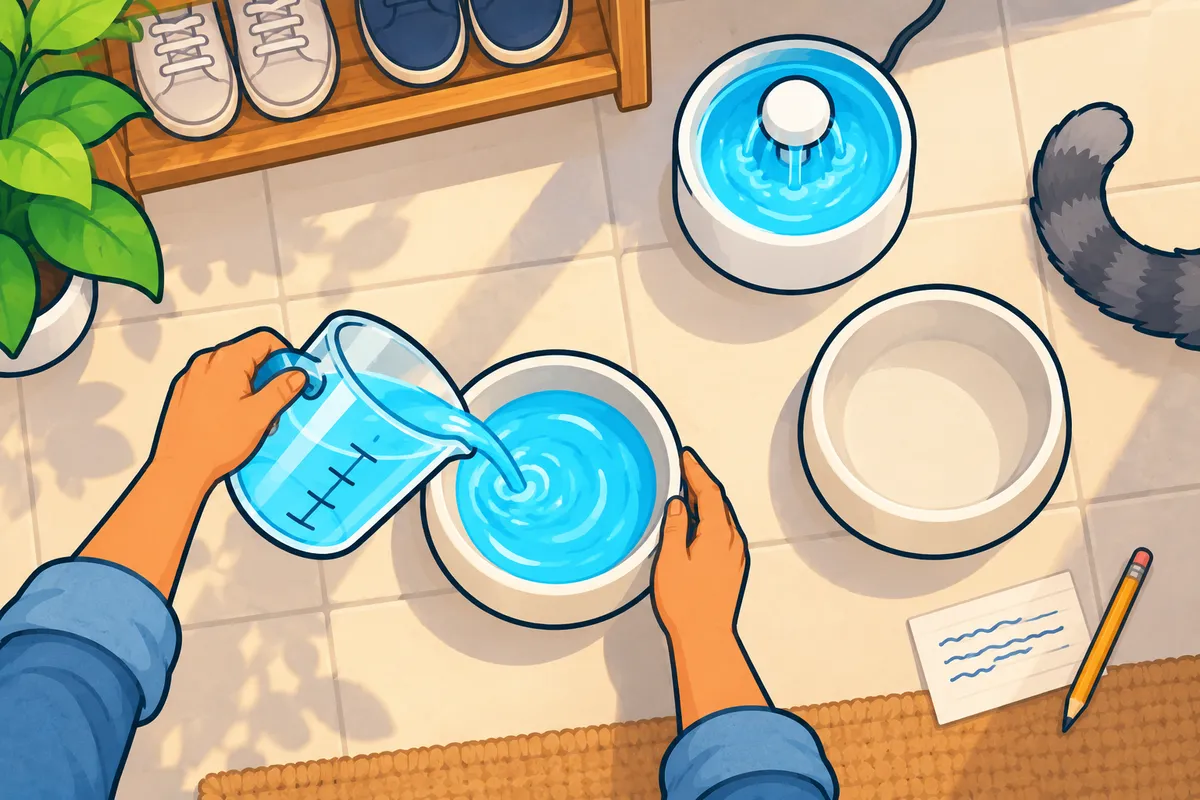
- Days 1 to 7: set out the fountain, running, and a wide bowl, 3 feet (1 m) apart in the same quiet room away from the food and litter tray. Do not measure yet
- Start of test day 1: fill each to a line you can find again, pouring a measured amount into each
- At the same time each day for four days, measure what is left in each station, then refill to the line
- After the day 2 reading, swap the two stations' positions so a favorite corner cannot decide the result
- Day 5, the no-cat control: refill both to the line, shut the cat out of the room for 24 hours, and measure what each lost on its own
Reading the Result
Subtract each station's own control-day loss from its daily loss: the bowl's from the bowl, the fountain's from the fountain, then add up each station's days.
A fountain loses far more to evaporation and spills than a bowl, so one shared control would hand the fountain credit it did not earn. Count a station as the one your cat favors only if it came out ahead both before and after the swap.
A small gap between stations is the likely result, since the largest average difference between bowl types in the 2019 study was about 1.4 ml per kg. A large gap that holds after the swap is worth acting on. A cat that ignores both needs a closer look.
Can a Cat Water Fountain Cause Problems?
Rarely, but a few cats react badly. In the 2010 home study, one of the 13 cats developed excessive barbering, vomiting, aggression toward the fountain and refusal to drink water offered from the fountain. The signs resolved when the fountain was removed, and the cat left the study.
If your cat stays away from a new fountain, go back to the bowl it used before and keep it filled. A cat that is refusing water altogether is a different matter, and it helps to know how long a cat can safely go without water.
Does the Bowl Matter as Much as the Water?
It may, though the evidence comes from clinic guidance and no home trials. The same 2022 guidelines, written for cat-friendly hospitals, advise stocking a variety of bowls because preferences vary.
The same guidelines keep food, water and the litter tray in different areas where possible. Cornell adds that a cat drinks more when fresh water is in places it can reach easily and no other pet blocks the way.
How Do You Keep a Cat Fountain Clean?
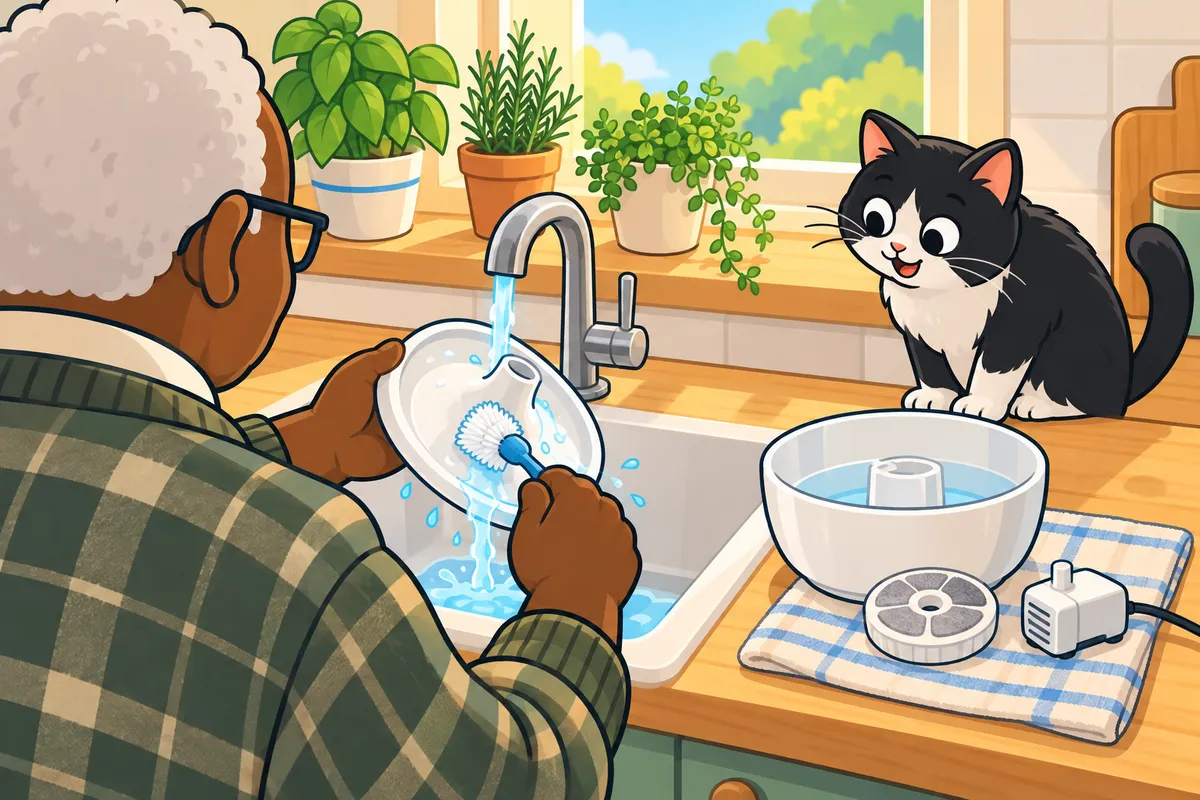
Follow the maker's manual for your model, because intervals differ by model. Two PetSafe pages show the range. For its Drinkwell Original, the cleaning page says to clean at least once a month, and that multi-pet households may need to clean every two weeks.
That page says to clean the fountain and removed parts, excluding the pump, with unscented soap and warm water, and to clean all parts of the pump the same way with a small brush. The bowl and tower are dishwasher safe on the top rack only, and the page recommends changing the filter when you clean.
For its Platinum model, the filter page says to replace the filter every 2 to 4 weeks and to take the fountain apart and clean it at the same time. The filter itself gets a rinse in plain water: never soap, because the residue seeps in and cannot be removed, and never the dishwasher. A slimy or smelly fountain has outrun its schedule, so clean it early.
When Is This a Vet Question?
When your cat drinks clearly less than before, whichever dish it uses, or looks unwell. A fountain tells you what a cat likes and cures nothing, and lethargy, weakness, a poor appetite or dry gums are reasons to call.
The home checks for signs of dehydration in cats show what to look for while you wait to speak to the vet.
What to Do This Week With Your Cat
Pick the line that fits your cat and try one change at a time, so the measured water tells you which one worked.
Your two-station week
4 items- Cat hangs around the tap: run the settling week and four-day test with a bowl and a fountain
- Cat drinks without fuss: keep a wide, low-sided bowl and skip the fountain
- Several cats: put a second station on another floor so none can guard it
- Cat backs away from the fountain: put the old bowl back and wait a week
General information for healthy adults, not medical advice. If a doctor has set your fluid amount, follow that.

More in Pets

Sources
- Journal of Feline Medicine and Surgery (Grant, PubMed). Effect of water source on intake and urine concentration in healthy cats, 2010.
- Journal of Feline Medicine and Surgery (Grant, full text on PubMed Central). Effect of water source on intake and urine concentration in healthy cats, 2010.
- Journal of Feline Medicine and Surgery (Robbins et al., PubMed Central). Quantified water intake in laboratory cats from still, free-falling and circulating water bowls, and its effects on selected urinary parameters, 2019.
- Journal of Animal Science (Kosmal et al., PubMed). Diet format, protein, amino acids, salt, and osmolytes, as well as water viscosity, affect water consumption in domestic cats, a scoping review of 32 publications, 2026.
- Cornell Feline Health Center. Hydration, 2021.
- ISFM and AAFP (Taylor et al., PubMed Central). 2022 ISFM/AAFP Cat Friendly Veterinary Environment Guidelines, 2022.
- PetSafe support. How to Clean Your Drinkwell Original Pet Fountain, 2026.
- PetSafe support. How to Replace the Filter in My PetSafe Drinkwell Platinum Fountain, 2026.
Sources checked by the Glubbo Editorial Team on Nov 2, 2026. General information, not medical advice. How we write and check our guides.

