How Much Water to Drink on Ozempic, and What the FDA Label Says
See how dehydration on Ozempic can harm your kidneys, what to drink on a sick day, and when to get help.
 By the Glubbo Editorial Team · Updated Oct 19, 2026 · 10 min read
On This Page
- Is There an Official Amount of Water to Drink on Ozempic?
- Does Ozempic Make You Dehydrated?
- Can Ozempic Cause Kidney Problems?
- Does Age or Kidney Disease Change the Advice?
- Do Wegovy and Zepbound Carry the Same Warning?
- Does Eating Less Mean You Get Less Water?
- Does Ozempic Make You Thirsty?
- What Should You Drink if Ozempic Makes You Sick?
- How Do You Know You Are Falling Behind on Fluids?
- Questions to Bring to Your Prescriber
- Sources
Short answer
No set amount, so ask your prescriber for one.
- Nausea hit 20.3 % of people on 1 mg in the label's trials, against 6.1 % on placebo.
- Take the most care when you start the medicine or raise the dose.
- If you feel sick, start with small sips and then drink more (NHS).
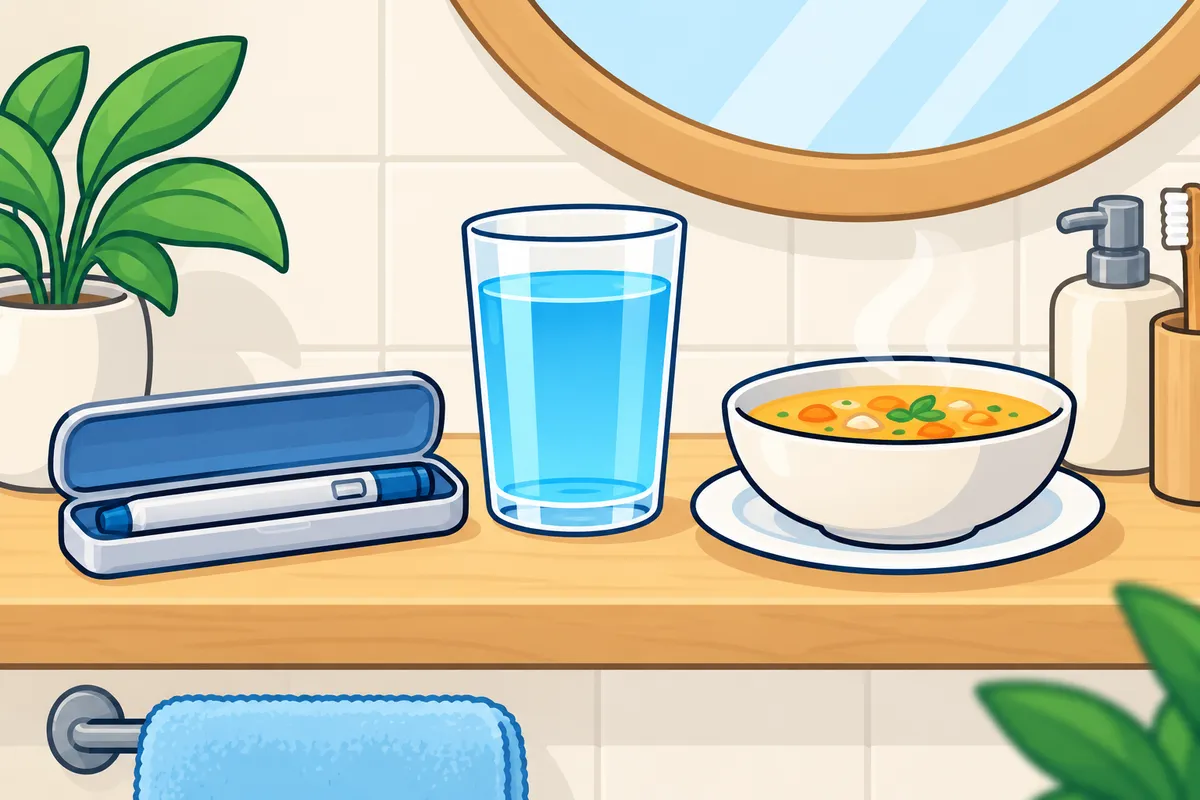
No official amount exists. The FDA-approved label for Ozempic tells you to drink fluids to lower your chance of dehydration, and it gives no number in milliliters or cups. Your prescriber is the person who sets that amount for you.
The label does spell out why fluids matter on this medicine. Stomach side effects can drain water fast, and dehydration has led to kidney injury in some people.
Is There an Official Amount of Water to Drink on Ozempic?
No. Neither the FDA label nor the NHS semaglutide page gives a daily water amount. The label's Medication Guide says, "It is important for you to drink fluids to help reduce your chance of dehydration," and stops there.
Ask your prescriber or pharmacist for a number that fits your weight, your other medicines and your kidneys. If the question never came up, bring it to your next refill.

Where the Numbers You See Online Come From
Pages that give a number for everyone on a GLP-1 medicine, such as 2.7 or 3.7 liters or a gallon, are borrowing from the general reference for healthy adults, not from the label. The US National Academies set the adequate intake of total water, from drinks and food together, for adults aged 19 to 30.
- 2.7 L
- total water a day for women 19–30 (91 oz)
- 3.7 L
- total water a day for men 19–30 (125 oz)
- 20 %
- of a healthy adult's water comes from food
In US surveys, women of that age drank about 2.2 liters (74 oz) of fluids a day and men about 3.0 liters (101 oz). Those are intakes of healthy adults who do not have vomiting, diarrhea or a medicine that changes how much food they eat, so your prescriber may set yours higher or lower. Glubbo's goal formula is built for the same healthy adults and does not account for Ozempic, diabetes or kidney health.
Once you have your number, spread it into small, even drinks from morning to evening, or count it in refills of the bottle you carry.
Does Ozempic Make You Dehydrated?
Not directly. The risk comes from its stomach side effects: nausea, vomiting and diarrhea make you lose fluid or drink less. In the label's placebo-controlled trials, 20.3 % of people on the 1 mg dose had nausea, against 6.1 % on placebo, and most of it came while the dose was being raised.
The label's Table 1 comes from two trials in adults with type 2 diabetes. They followed 521 people on Ozempic for an average of 32.9 weeks; the mean age was 56.
At the 0.5 mg dose, the label reports nausea in 15.8 %, vomiting in 5.0 % and diarrhea in 8.5 %. Taken together, stomach side effects hit 36.4 % of people on 1 mg and 15.3 % on placebo, and 3.8 % of people on 1 mg stopped the medicine because of them.
Constipation is on the same table, at 3.1 % on 1 mg against 1.5 % on placebo, and there fluid helps most when it comes with fiber.
Can Ozempic Cause Kidney Problems?
It can, through dehydration. Section 5.6 of the label, titled "Acute Kidney Injury Due to Volume Depletion", reports kidney injury after approval, in some cases needing dialysis, mostly in people whose nausea, vomiting or diarrhea dried them out. "Volume depletion" means your body has lost too much fluid.
These are reports sent in after the medicine went on sale, so the label cannot say how often this happens. It asks prescribers to:
- check kidney function in patients whose side effects could dry them out, most of all when the medicine starts or the dose goes up
- tell you to "take precautions to avoid fluid depletion."
The Medication Guide puts it in plain words: "Diarrhea, nausea, and vomiting may cause a loss of fluids (dehydration) which may cause kidney problems." Tell your prescriber right away about nausea, vomiting or diarrhea that does not go away.
When Is the Risk Highest?
At the start and at every dose increase. The label's schedule raises the dose in steps of at least 4 weeks, and most reports of nausea, vomiting and diarrhea in its trials came during those steps.
Ozempic dose steps, the moments to drink with most care
4 items- Weeks 1 to 4: 0.25 mg once weekly
- Week 5 on: 0.5 mg once weekly
- After at least 4 more weeks, if needed: 1 mg
- After at least 4 more weeks, if needed: 2 mg
Plan your drinking and your sick-day phone call around the first week of each new dose.
Does Age or Kidney Disease Change the Advice?
Not the dose, but it can change how careful you need to be.
- Section 8.6 of the Ozempic label recommends no dose adjustment for kidney impairment, including kidney failure, because the medicine's levels in the blood did not change in those studies. That is a statement about the dose, not about fluid loss, and section 5.6 still asks for kidney checks when side effects could dry you out.
- For older adults, section 8.5 reports no overall difference in safety or efficacy, in a trial pool where 744 patients (23.6 %) were 65 or older, but adds that "greater sensitivity of some older individuals cannot be ruled out."
If you are 65 or older or have kidney disease, tell your prescriber so, and ask how much to drink on a sick day.
Do Wegovy and Zepbound Carry the Same Warning?
Yes. The Wegovy label, semaglutide at its weight-loss dose, and the Zepbound label, tirzepatide, both have a section titled "Acute Kidney Injury Due to Volume Depletion".
Both Medication Guides repeat Ozempic's line, "It is important for you to drink fluids to help reduce your chance of dehydration." Neither one gives an amount.
What differs is how often the stomach side effects came up in each label's trials:
| Medicine and dose | Nausea | Vomiting | Diarrhea |
|---|---|---|---|
| Ozempic 1 mg, adults with type 2 diabetes | 20.3 % (placebo 6.1 %) | 9.2 % (placebo 2.3 %) | 8.8 % (placebo 1.9 %) |
| Wegovy 2.4 mg, adults losing weight | 44 % (placebo 16 %) | 24 % (placebo 6 %) | 30 % (placebo 16 %) |
| Zepbound 15 mg, adults losing weight | 28 % (placebo 8 %) | 13 % (placebo 2 %) | 23 % (placebo 8 %) |
The Ozempic row comes from Table 1 of its label, the Wegovy row from its Table 3 and the Zepbound row from its Table 1. Each row comes from different trials with different people, so compare a medicine with its own placebo, not one row with another. Read that way, the weight-loss doses brought more vomiting and diarrhea than placebo in their trials, and those are the side effects the kidney warnings name.
The Wegovy label also reports a trial in children and teens, where 42 % on Wegovy had nausea against 18 % on placebo, and 36 % had vomiting against 10 %. If a teenager in your family takes it, their doctor sets the fluid plan, and the same sick-day signs apply.
Does Eating Less Mean You Get Less Water?
A little, yes. About 20 % of a healthy adult's water comes from food, the National Academies estimate. A medicine that shrinks your appetite also shrinks that share, so the same glasses of water leave you with slightly less in total than before you started.
The gap is small on a good day. On a day with vomiting or diarrhea it adds to the fluid you are already losing, which is one more reason to bring the question to your prescriber with your new eating pattern in mind.
Does Ozempic Make You Thirsty?
The label does not list thirst as a side effect. Its common side effects are stomach ones, and it also names fatigue, a changed sense of taste and dizziness. Feeling very thirsty while you vomit or have diarrhea is a sign of fluid loss, and the NHS lists it among the symptoms of acute kidney injury.
If your thirst stays high even when you are not sick, mention it to your prescriber. Ozempic treats type 2 diabetes, and steady thirst has other causes that a doctor should check.
What Should You Drink if Ozempic Makes You Sick?
Small, steady sips of water. The NHS dehydration page says that if you feel sick or have been sick, "start with small sips and then gradually drink more." If you keep losing fluid through vomiting or diarrhea, a pharmacist can recommend an oral rehydration solution to put back salts and sugar.

A Sick Day on a GLP-1 Medicine
- Start with small sips, then drink more as you can
- Ask a pharmacist about an oral rehydration solution
- Watch your pee: dark or scanty means you are behind
- Call your prescriber if the sickness does not stop
What Counts on a Sick Day?
The NHS adds that you should skip caffeine and alcohol while you recover. If you also have diabetes, MedlinePlus's sick-day advice names:
- water
- club soda
- caffeine-free diet soda
- tomato juice
- chicken broth
That page keeps sugary drinks for when your blood sugar is under 100 mg/dL or falling quickly.
It also sets a general diabetes rule of at least twelve 8-ounce cups of fluid, about 3 liters, on a sick day, with a trip to the emergency room if you cannot keep food or liquids down. It is a diabetes rule, not a GLP-1 rule, so your prescriber's number still comes first.
Semaglutide's common side effects also include feeling tired, which can blur with dehydration. Your pee and your thirst help tell the two apart, and the first sign to act on is dark yellow pee. If the sickness has already cost you a lot of fluid, work out how much to drink back, and how fast.
How Do You Know You Are Falling Behind on Fluids?
Dark yellow, strong-smelling pee, peeing less often than usual, thirst and a dry mouth are the first signs on the NHS list of dehydration symptoms. On a sick day, check your pee each time you go. Dizziness and tiredness tend to come later, once you have lost more.
Questions to Bring to Your Prescriber
Ask your prescriber or pharmacist these before the next dose increase, and keep the Medication Guide that came with your pen.
- How much should I drink a day on this dose, in ounces or cups?
- What should I do on a day I am sick: how many hours of vomiting or diarrhea before I call?
- Is a kidney check due around this dose increase?
- Do my other medicines change how much I should drink?
General information for healthy adults, not medical advice. If a doctor has set your fluid amount, follow that.

More in Water and Health


Sources
- US Food and Drug Administration (Novo Nordisk label). OZEMPIC (semaglutide) injection: Prescribing Information and Medication Guide, revised 05/2026, 2026.
- NHS. Semaglutide, 2026.
- NHS. Dehydration, 2026.
- NHS. Acute kidney injury, 2026.
- US Food and Drug Administration (Novo Nordisk label). WEGOVY (semaglutide) injection and tablets: Prescribing Information and Medication Guide, 2026.
- Eli Lilly (US prescribing information). ZEPBOUND (tirzepatide) injection: Prescribing Information and Medication Guide, 2026.
- MedlinePlus (US National Library of Medicine). Diabetes - when you are sick, 2024.
- US National Academies. Dietary Reference Intakes for Water, Potassium, Sodium, Chloride, and Sulfate, Chapter 4: Water, 2005.
Sources checked by the Glubbo Editorial Team on Oct 19, 2026. General information, not medical advice. How we write and check our guides.

