How Much Water to Prevent Kidney Stones, in Glasses and Liters
See what two trials found about stones coming back, which drinks help, and when a stone needs a doctor fast.
 By the Glubbo Editorial Team · Updated Oct 19, 2026 · 10 min read
On This Page
- How Much Water Should You Drink to Prevent Kidney Stones?
- Does Drinking More Water Stop Kidney Stones From Coming Back?
- What Drinks Help Prevent Kidney Stones?
- How Do You Know You Are Drinking Enough to Prevent Stones?
- Who Falls Short of 2.5 Liters After a Stone
- Is Too Much Water a Risk When You Drink for Stones?
- When Is a Kidney Stone an Emergency?
- Bottles Across the Day, Then a Urine Test
- Sources
Short answer
2.5 to 3 liters of water a day, by NHS advice.
- The NIDDK figure: six to eight 8-oz glasses a day, unless you have kidney failure.
- Count it in bottles: five 500 ml (17 oz) bottles make 2.5 liters.
- Had a stone? Ask your doctor for a 24-hour urine test to set your own amount.
To prevent kidney stones, the NHS tells adults to drink 2.5 to 3 liters (85 to 101 oz) of water a day. The US NIDDK says six to eight 8-ounce glasses a day, unless you have kidney failure. The NIDDK calls water the most important thing you can do to prevent stones, and once you have had a stone, a doctor may test your urine and set your own amount.
How Much Water Should You Drink to Prevent Kidney Stones?
About 2.5 to 3 liters of water a day for an adult, by the NHS kidney stones page. The NIDDK gives a lower figure: six to eight 8-ounce glasses a day, which is 48 to 64 oz, or about 1.4 to 1.9 liters. If you have had a stone, your doctor may test your urine and set a number for you.
Two of the figures are drinks; the third, from urologists, is urine.
- 2.5–3 L
- of water a day for adults (UK advice)
- 6–8 glasses
- of 8 oz a day, unless you have kidney failure (US advice)
- 2.5 L
- of urine a day, the target stone guidelines set
Why the Numbers Differ
Both health bodies advise the general public, so they speak in drinks. Urologists who treat people with repeat stones aim at urine instead. The 2026 PUSH trial paper states that the American and European urology guidelines recommend enough fluid to make at least 2.5 liters of urine a day.
You lose water through sweat and breath as well as urine. So making 2.5 liters of urine usually takes more than 2.5 liters of drinks, and more again on a hot day. The NIDDK says that if you live, work or exercise in hot weather, "you may need more liquid to replace the fluid you lose through sweat."
When a Doctor Sets a Different Number
The NIDDK treatment page describes how this works. A health care professional may:
- Ask you to collect your urine for 24 hours.
- Measure how much you make and what minerals it carries.
- Tell you to drink more if the volume is too low.
Two groups get different advice:
- People who have had cystine stones "may need to drink even more".
- People with kidney failure get a separate plan.
If another illness keeps you from drinking the usual amount, the NIDDK says to talk with a health care professional.
What About Children?
The NHS gives children 1 to 2 liters (34 to 68 oz) to prevent stones, against 2.5 to 3 liters for adults. Stones in a child are a reason for a doctor to set the amount, because size, age and the kind of stone all change it.
Does Drinking More Water Stop Kidney Stones From Coming Back?
It helps, but drinking more is hard to keep up, and the trials show both sides. In a five-year Italian trial, people told to drink a lot of water had fewer second stones than people given no advice. In a 2026 US trial, a program built to make people drink more raised their urine a little and did not cut repeat stones.
Stones do tend to return. The NIDDK says you are more likely to get kidney stones again if you have had them once. About 11 % of men and 6 % of women in the United States have a stone at least once in their lives.
The Five-Year Water Trial
Borghi and colleagues followed 199 adults after their first calcium stone, randomly split into two groups. One group drank a large amount of water with no change to their diet. The other got no treatment.
High Water Intake
- Stone came back in 12 of 99 people
- 38.7 months to a new stone, on average
- Urine became less concentrated
No Treatment
- Stone came back in 27 of 100 people
- 25.1 months to a new stone, on average
- Urine stayed concentrated
Before the trial began, the stone formers made less urine than 101 people without stones. Men with calcium oxalate stones made about 1,057 ml a day against 1,401 ml in men without stones; for women it was 990 ml against 1,239 ml.
The authors called water "the initial therapy for prevention of stone recurrences". The trial dates from 1996 and its abstract does not name a funder.
The 2026 Trial That Pushed People to Drink More
The PUSH trial enrolled 1,658 people aged 12 and over at six US medical centers, all with past stones and low urine volume. Half got a fluid prescription, cash rewards, health coaching and reminders such as text messages; the other half got standard advice. The US National Institute of Diabetes and Digestive and Kidney Diseases paid for it.
After two years, the program made no clear difference to stones that caused symptoms:
The program group's urine volume was higher at every check from 6 to 24 months, but only modestly.
The trial also showed the cost of drinking more. The program group reported more frequent and urgent peeing, and more trips at night, at 6 and 12 months, the same price a trial of water against repeat bladder infections counted in bathroom trips. Twelve people in it (1.5 %) had low blood sodium with no symptoms, against two in the control group, and nobody needed hospital care for it.
What the Two Trials Tell You
In the Italian trial, a high water intake cut repeat stones; in the US program, people drank only a little more and repeat stones did not fall. The US program had coaching and money behind it, so the hard part is drinking that much every day for years.
So build the habit around cues you already have, and check it with your pee color rather than your memory. If you have had a stone, keep the urine test your doctor offers: it tells you whether your habit reaches the volume you need.
What Drinks Help Prevent Kidney Stones?
Water first. The NIDDK says "water is best", and that citrus drinks such as lemonade and orange juice may also help, because they contain citrate, which "stops crystals from turning into stones." The NHS also suggests adding fresh lemon juice to water.
On the other side, the NHS advises you to "avoid drinking lots of fizzy, caffeinated or alcoholic drinks". The NIDDK adds diet steps that sit beside water, for people who have had a stone:
| Step | What the source says |
|---|---|
| Salt | Your chance of stones rises with sodium; the US aim for adults is less than 2,300 mg a day, and UK advice is less than 6 g of salt |
| Calcium | Keep eating it: "In the right amounts, calcium can block other substances in the digestive tract that may cause stones" |
| Animal protein | A health care professional may tell you to eat less of it, while you still get enough protein |
| Oxalate | If you have had calcium oxalate stones, your doctor may tell you which high-oxalate foods to cut |
| Diet changes | Do not change your diet without speaking to your doctor first |
Lemonade from a powder often carries sugar. The CDC's table of drinks lists 3 teaspoons of sugar and 55 calories in 12 oz of powdered lemonade; fresh lemon squeezed into water gives you the citrus without them.
Do Coffee and Tea Count?
Large Harvard cohorts say they may help, which sits oddly beside the advice to avoid lots of caffeinated drinks. For every 8-ounce serving a day:
- Caffeinated coffee came with about 10 % lower risk of a first stone in 45,289 men and in 81,093 women.
- Tea came with 14 % lower risk in the men and 8 % lower in the women.
- Grapefruit juice went the other way, with 37 % and 44 % higher risk.
These are links in people who had not yet had a stone, not trials in stone formers. Count coffee and tea as part of your fluid, keep them in the range you already drink, and let water stay the main drink.
What to pour when you are drinking for stones
- Your everyday drinkWater: the NIDDK says it is best
- You want some tasteFresh lemon juice in water, for the citrate
- You like lemonadeFresh lemon, not powdered (3 teaspoons of sugar in 12 oz)
- Fizzy, caffeinated or alcoholic drinksNot lots of them
How Do You Know You Are Drinking Enough to Prevent Stones?
Check the color of your pee each day. Dark pee means you are dehydrated and need to drink more, the NHS says; pale yellow through the day is the aim. If you have had a stone, a 24-hour urine collection from your doctor is the real test, because it measures the volume your habit produces.
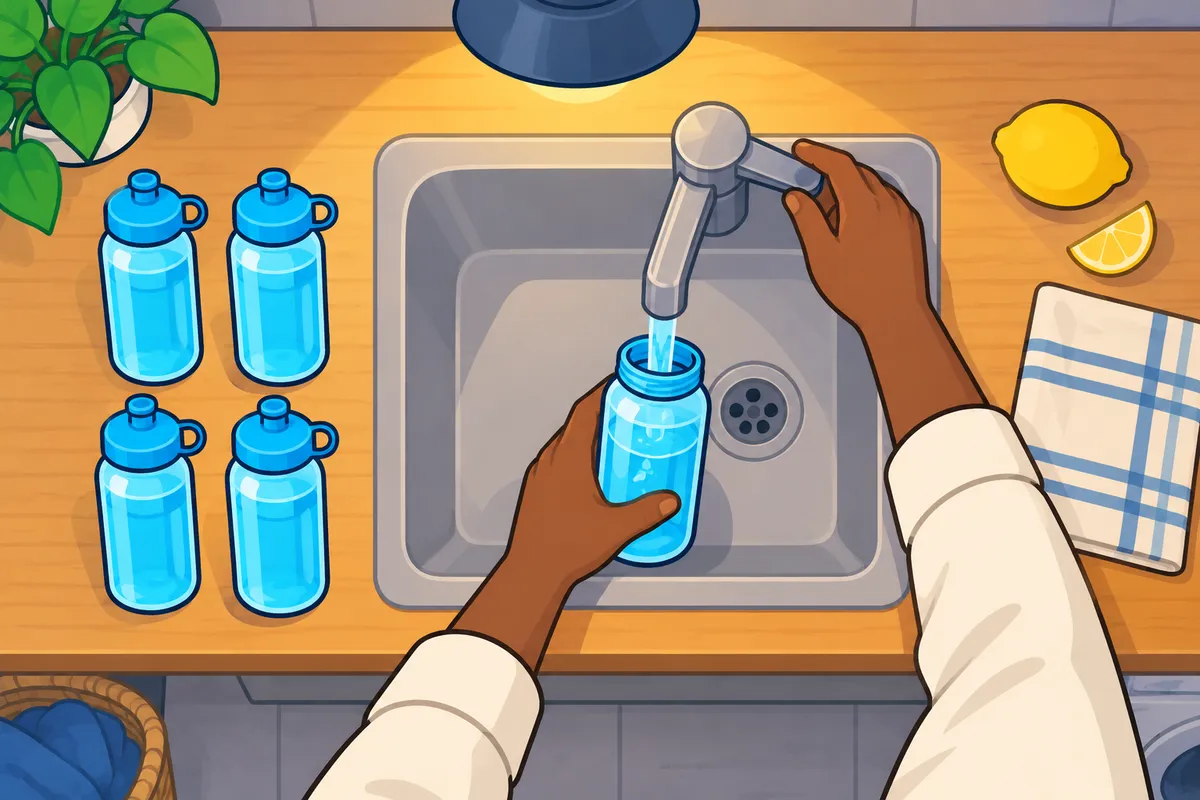
At home, count by bottles. Five 500 ml (17 oz) bottles make 2.5 liters and six make 3. If yours holds a different amount, turn any goal into refills of the bottle you own.
Count the bottles you finish by bedtime, not the ones you fill. Pale yellow is easier to judge once you have seen the shades side by side, from clear to dark.
Who Falls Short of 2.5 Liters After a Stone
Glubbo's habit formula sets a daily goal from your weight, activity, climate and sex. It is a habit for healthy adults, built without stones in mind. The table sets it against the stone advice of 2.5 to 3 liters.
| Person | Weight | Activity | Climate | Sex | Glubbo goal | Against 2.5–3 L |
|---|---|---|---|---|---|---|
| Patrick, had one stone | 85 kg (187 lb) | Moderate | Mild | Male | 2,800 ml (95 oz) | Inside the range |
| Brigid, had one stone | 60 kg (132 lb) | Low | Mild | Female | 1,600 ml (54 oz) | 900 ml short |
| Ray, works outdoors, had one stone | 75 kg (165 lb) | High | Hot | Male | 2,950 ml (100 oz) | Near the top, before sweat |
Ray's case shows the gap between drinks and urine. His 2,950 ml covers an ordinary day, but a hot morning of hard work can cost him far more in sweat. On those days he drinks to keep his pee pale, well past his goal.
If you have had a stone, the number from your doctor or the stone advice wins over any habit formula, ours included. Use Glubbo for the reminders, and set the goal by hand.
Is Too Much Water a Risk When You Drink for Stones?
For healthy kidneys, the 2.5 to 3 liters a day advised for stones is a normal amount. In the PUSH trial, low blood sodium in 1.5 % of the program group showed up on blood tests only, without symptoms, against 0.2 % of the control group.
Water overload has early signs of its own, and some people run a higher risk than others.
Drinking for stones also means more trips to the bathroom, often at night; if they wake you, ask the doctor who reads your 24-hour urine test how to spread your drinks.
When Is a Kidney Stone an Emergency?
Larger stones can cause severe pain, often starting in the side of your belly or your lower back. Small stones may pass without you noticing. The NIDDK lists these symptoms, and says to see a health care professional right away if you have any of them:
Symptoms of a Kidney Stone
6 items- sharp pains in your back, side, lower abdomen, or groin
- pink, red, or brown blood in your urine, also called hematuria
- a constant need to urinate
- pain while urinating
- inability to urinate or can only urinate a small amount
- cloudy or bad-smelling urine
Bottles Across the Day, Then a Urine Test
Five 500 ml bottles across a waking day
- 7 AM
- 10:30 AM
- 1:30 PM
- 4:30 PM
- 7:30 PM
If you have had a stone, ask your doctor about a 24-hour urine test and write down the volume it shows, then set your goal by hand to the amount that reaches it, so your reminders aim at the right number.
General information for healthy adults, not medical advice. If a doctor has set your fluid amount, follow that.
More in Water and Health
Sources
- National Institute of Diabetes and Digestive and Kidney Diseases (NIDDK). Eating, Diet, and Nutrition for Kidney Stones, 2017.
- National Institute of Diabetes and Digestive and Kidney Diseases (NIDDK). Treatment for Kidney Stones, 2017.
- National Institute of Diabetes and Digestive and Kidney Diseases (NIDDK). Symptoms and Causes of Kidney Stones, 2017.
- National Institute of Diabetes and Digestive and Kidney Diseases (NIDDK). Definition and Facts for Kidney Stones, 2017.
- NHS. Kidney stones, 2026.
- American Journal of Epidemiology (Curhan GC et al.). Prospective study of beverage use and the risk of kidney stones, 1996.
- Annals of Internal Medicine (Curhan GC et al.). Beverage use and risk for kidney stones in women, 1998.
- CDC. Rethink Your Drink, 2026.
- Journal of Urology (Borghi and colleagues). Urinary volume, water and recurrences in idiopathic calcium nephrolithiasis: a 5-year randomized prospective study, 1996.
- The Lancet (Desai and colleagues, PUSH trial). Prevention of urinary stones with hydration: a randomised clinical trial of an adherence intervention, 2026.
Sources checked by the Glubbo Editorial Team on Oct 19, 2026. General information, not medical advice. How we write and check our guides.

