Is Drinking Water Good for Your Kidneys? What the Trials Show
What your kidneys do with water, what a one-year trial in kidney disease found, and who must not drink more.
 By the Glubbo Editorial Team · Updated Oct 19, 2026 · 8 min read
On This Page
- Is Drinking Water Good for Your Kidneys?
- Do Kidneys Need Water to Work?
- Does Drinking More Water Slow Kidney Decline?
- Should You Drink More Water If You Have Kidney Disease?
- Who Should Get Their Kidneys Checked?
- Can Not Drinking Enough Water Damage Your Kidneys?
- How Much Water Is Enough for Healthy Kidneys?
- Kidney Habits Worth Keeping This Month
- Sources
Short answer
Yes, enough of it; extra did not slow kidney disease.
- Kidneys filter about 150 quarts of blood a day into 1 to 2 quarts of urine (NIDDK).
- Coaching 631 adults with kidney disease to drink more did not slow decline in a year.
- With kidney disease, your care team sets the amount; damaged kidneys may need a limit.
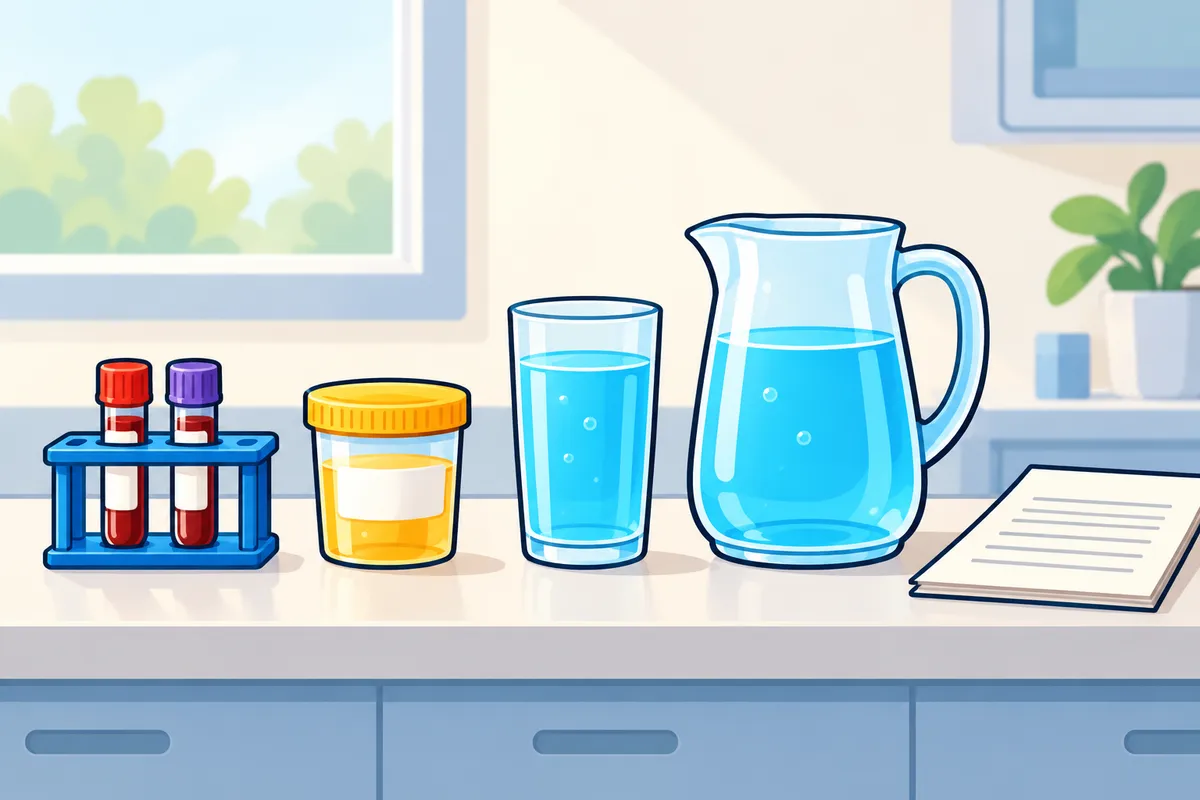
Yes, in the amount your body needs; more than that has not been shown to protect them. Your kidneys cannot work without water, but whether drinking well past thirst guards them over the years is a different question, and one large trial tested it directly.
"Drink more water and your kidneys will thank you" is one of the most repeated health tips. Half of it holds up.
Is Drinking Water Good for Your Kidneys?
Healthy people who make more urine lose kidney function a little more slowly in long studies, but in the one trial that coached people with kidney disease to drink more, kidney function fell just as fast as in the group that kept its usual habits.
The best everyday picture comes from a Canadian community study. Clark and colleagues collected 24-hour urine from 2,148 adults with normal kidney function and followed them for about six years:
People who made 3 liters or more had about half the odds of rapid decline of those making 1 to 1.9 liters (odds ratio 0.46, 95 % confidence interval 0.23 to 0.92). Only 7.7 % of the group made that much. A study like this shows a link and cannot show a cause: people who drink more may differ in many other ways.
Do Kidneys Need Water to Work?
Yes. The NIDDK explains that your kidneys:
- Remove waste and extra fluid.
- Keep water, salts and minerals in balance.
- Make hormones that help control blood pressure.
They send most of the water they filter back into your blood and let the rest leave as urine.
- 150 qt
- of blood filtered by your kidneys in a day
- 1–2 qt
- of that becomes urine
- 1 million
- filtering units (nephrons) in each kidney
The urine carries the waste out, so on a day you drink little your kidneys make less of it, and it comes out darker and more concentrated. The NHS lists dark yellow, strong-smelling pee among the signs of dehydration.
Does Drinking More Water Slow Kidney Decline?
Not in the one trial that tested it. The CKD WIT trial coached adults with stage 3 chronic kidney disease to drink more water for a year, and their kidney function fell at the same rate as a group coached to keep their usual habits.
Inside the One-Year Water Trial
The trial ran at 9 centers in Ontario from 2013 to 2017 and enrolled 631 adults, average age 65, with an eGFR of 30 to 60 and protein in their urine. The hydration group was coached to drink 1 to 1.5 liters (34 to 51 oz) a day more than usual, depending on sex and weight.
Coached to Drink More
- 316 people
- Urine up 0.6 L a day more than the other group
- eGFR fell 2.2 points in a year
Kept Usual Habits
- 315 people
- Urine about the same as before
- eGFR fell 1.9 points in a year
The difference between the groups, 0.3 points, could easily be chance (P = .74). Copeptin, a marker of the water-holding hormone vasopressin, fell more in the hydration group, and creatinine clearance was a little higher. The authors note the trial may have been too small to pick up a meaningful difference.
What 1 to 1.5 Liters More Looks Like
So even with coaching, people drank about half of what they aimed for. Nobody with kidney disease should add that much on their own; the trial ran under a kidney team's eye.
Why the Cohort and the Trial Disagree
The community study followed healthy adults and saw a link; the trial tested people who already had kidney damage and saw no effect over one year. Both can be true. Healthy kidneys and damaged ones may respond differently, and a year may be too short to see a change.
A third study points the same way as the first. In a US survey of 3,427 adults, Sontrop and colleagues linked kidney disease with drinking little plain water (odds ratio 2.36), but not with drinking little of other drinks. A snapshot like that cannot show which came first.
Should You Drink More Water If You Have Kidney Disease?
Only if your care team says so; some people need less. The NIDDK eating page says people with chronic kidney disease may need to limit how much liquid they drink, because damaged kidneys cannot remove extra fluid, and that a dietitian or health care professional can work out the right amount with you.
It asks you to contact your health care professional if you notice swelling in your face, arms, legs or abdomen. Salt matters too: too much sodium makes your blood hold on to fluid, which can raise blood pressure and cause swelling, and many people with kidney disease need to keep sodium below the 2,300 mg a day the Dietary Guidelines set for adults.

Kidney disease is common and quiet. More than 35 million US adults, about 1 in 7, have it, the NIDDK says, and most people in the early stages have no symptoms. Diabetes and high blood pressure can lead to it, and the NIDDK says managing them may help prevent kidney disease or slow it down.
Who Should Get Their Kidneys Checked?
Only blood and urine tests show whether you have kidney disease. The NIDDK says these people need this check:
- People with diabetes, who need it every year.
- People with high blood pressure.
- People with heart disease.
- People with a family history of kidney failure.
The urine test looks for albumin, a protein that leaks through damaged filters. It comes as a dipstick, or as a urine albumin-to-creatinine ratio that compares albumin with creatinine in one sample. Ask your doctor how often the others on that list should repeat it.
Can Not Drinking Enough Water Damage Your Kidneys?
Yes, a sudden shortage can. The NHS lists dehydration, low blood pressure or blood loss among the causes of acute kidney injury, when the kidneys suddenly stop working as well as they should. It is more common in people 65 or older, people who have had it before and people who recently had surgery.
Symptoms of acute kidney injury
6 items- peeing a lot less than usual
- feeling very thirsty
- feeling sick (nausea) or being sick (vomiting)
- swollen feet or legs
- feeling tired, dizzy, confused or sleepy
- feeling breathless, especially when you lie down
Many people with mild kidney injury have no symptoms. For people at higher risk, the advice is to stay hydrated so that your pee is pale and regular through the day, and to speak to a doctor before taking new medicines or supplements; long-term use of NSAID painkillers, ACE inhibitors and diuretics are among the causes it names.

Hot days, a stomach bug and hard physical work are when that shortage builds fastest. If you are vomiting or have diarrhea and cannot keep fluids down, that is the time to call for advice, not to wait for your kidneys to tell you.
Older adults on a water pill or a blood pressure tablet carry the most risk on those days, since age 65 and over and diuretics sit in the same list. People at higher risk should drink enough to keep their pee pale especially in hot weather or while vomiting or with diarrhea, and know the warning signs; never stop a prescribed medicine on your own.
How Much Water Is Enough for Healthy Kidneys?
Enough to keep your pee pale through the day; no study gives a separate kidney number for healthy adults. Your daily total comes from your size, activity and climate.
Kidney stones are the exception with their own target: 2.5 to 3 liters a day by NHS advice for adults who want to prevent them. If you have kidney disease, heart failure or a fluid limit from your doctor, that limit wins over any app goal, Glubbo's included. Use reminders to spread your doctor's amount across the day, and count it in bottles you actually own.
Kidney Habits Worth Keeping This Month
Water and your kidneys, in practice
- Your pee is dark mid-morning or mid-afternoonDrink until it is pale again
- You have diabetes or high blood pressureAsk for a kidney blood and urine test
- You take NSAID painkillers long termAsk a pharmacist before you continue
- You catch up on drinks at nightSpread them across the day instead
General information for healthy adults, not medical advice. If a doctor has set your fluid amount, follow that.

More in Water and Health


Sources
- National Institute of Diabetes and Digestive and Kidney Diseases (NIDDK). Your Kidneys and How They Work, 2018.
- National Institute of Diabetes and Digestive and Kidney Diseases (NIDDK). What Is Chronic Kidney Disease?, 2023.
- National Institute of Diabetes and Digestive and Kidney Diseases (NIDDK). Eating Right for Chronic Kidney Disease, 2023.
- National Institute of Diabetes and Digestive and Kidney Diseases (NIDDK). Tests and Diagnosis for Chronic Kidney Disease, 2023.
- JAMA (Clark WF et al., CKD WIT). Effect of Coaching to Increase Water Intake on Kidney Function Decline in Adults With Chronic Kidney Disease: The CKD WIT Randomized Clinical Trial, 2018.
- Clinical Journal of the American Society of Nephrology (Clark WF et al.). Urine volume and change in estimated GFR in a community-based cohort study, 2011.
- American Journal of Nephrology (Sontrop JM et al.). Association between water intake, chronic kidney disease, and cardiovascular disease: a cross-sectional analysis of NHANES data, 2013.
- NHS. Acute kidney injury (AKI), 2026.
- NHS. Dehydration, 2026.
Sources checked by the Glubbo Editorial Team on Oct 19, 2026. General information, not medical advice. How we write and check our guides.

