Does Dehydration Cause Gout? Water, Flares and What to Drink
Why too little water can set off a gout flare, what to drink and what to cut, and the signs that need a doctor fast.
 By the Glubbo Editorial Team · Updated Oct 19, 2026 · 9 min read
On This Page
Short answer
No, but it can set off a flare.
- Gout comes from urate building up and forming crystals in joints, NIAMS says.
- The NHS lists dehydration among flare triggers and asks you to drink plenty of fluids.
- Hot, dry days doubled the odds of a flare in a US study of 632 people with gout.
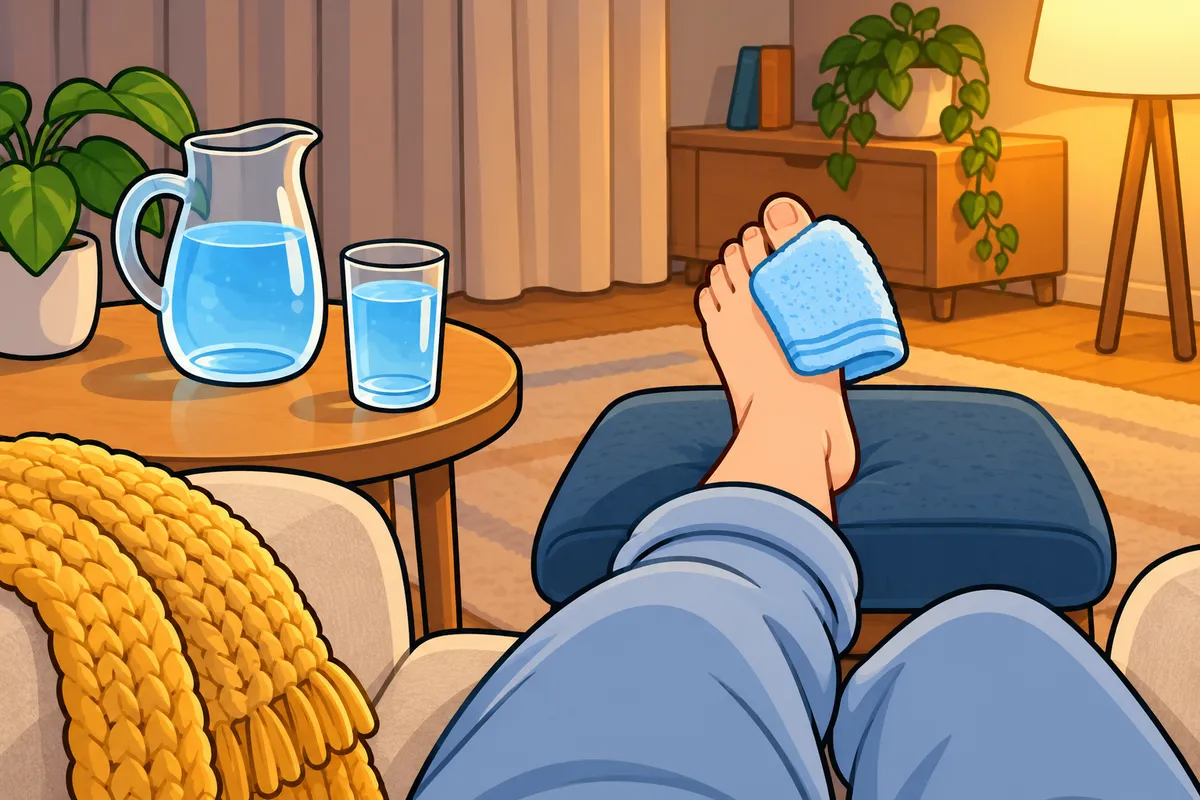
No. Dehydration does not give you gout, but it can set off a flare when you already have it. The cause is urate that has built up for years.
Picture a hot afternoon at a barbecue with two beers and not much water. By Monday your big toe cannot stand the weight of the sheet.
Does Dehydration Cause Gout?
No. The NIAMS explains that gout comes from urate building up over a long period and forming needle-shaped crystals in and around a joint. Urate comes from purines in your body's tissues and many foods, and it builds up when your body makes too much or your kidneys remove too little.
Its risk list is about urate, weight, age and health:
- High urate levels and a family history.
- Being male or past menopause.
- Alcohol and sugar-sweetened drinks such as soda.
- A diet high in purine-rich foods.
- Overweight.
- High blood pressure.
- Chronic kidney disease.
- Some medicines.
Dehydration is not on it as a cause. Many people with high urate never get gout, NIAMS adds.
Dehydration tips the balance in someone who already has gout, and it is one of five triggers the NHS names:
- An illness with a high temperature.
- Too much alcohol or a very large meal.
- Dehydration.
- An injured joint.
- Certain medicines.
Why Can Dehydration Trigger a Gout Flare?
The idea is that less body water leaves the same urate in less fluid, so crystals form more easily. Researchers still call that a hypothesis, and hot weather gives the clearest clue. In a US study of 632 people with gout, Neogi and colleagues tested weather because it can drain body fluid, which they called volume depletion.
- 632
- people with gout followed for a year, online
- ≈ 40 %
- higher odds after hot days, a trend that was not statistically clear
- 2.04
- odds ratio for hot and dry together, the strongest link
Higher temperatures over the previous 48 hours came with about 40 % higher odds of an attack than moderate ones, a trend whose range still included no effect. Hot days with dry air were the clear link, with about twice the odds (95 % confidence interval 1.26 to 3.30).
Each person was compared with themselves, attack days against calm days, which removes differences between people. A hot afternoon can bring dehydration, too much alcohol and a very large meal together, and all three are on the NHS trigger list.

Does Drinking Water Help Gout?
It helps you avoid one trigger: drink plenty of fluids to avoid getting dehydrated. During an attack the advice is to drink lots of water unless a doctor tells you not to, alongside your medicine, rest, a raised limb and a cool joint.
Water does not replace treatment. The CDC points people with gout to a health care provider for medicines that ease a flare and prescription drugs that lower uric acid, along with activity and fewer sugary drinks and alcohol.
What the Water and Gout Study Found
The same Boston team asked people with gout how many glasses of water they drank in the 24 hours before an attack and before calm periods. The American College of Rheumatology described the work in a 2009 press release on its annual meeting abstract: 535 people (78 % men, average age 53), grouped by 0–1, 2–4, 5–8 and more than 8 glasses a day.
More water in the previous day went with a significantly lower risk of an attack, even after the team accounted for other drinks, water pills, alcohol and purines. The press release does not give the size of the effect.
Two limits matter. A meeting abstract is shorter and less checked than a full paper. And people may drink less on days they feel off, which a study like this cannot fully untangle.
What Should You Drink If You Have Gout?
Water first, and fewer sugary drinks and less alcohol. The NHS says to:
- Skip lots of sugary drinks and snacks.
- Keep some alcohol-free days each week.
- Stay under 14 units of alcohol a week (UK units).
The large cohort studies line up behind that.
Your drinks, side by side
Water
Best everyday drink
- Drink plenty to avoid dehydration
- Lots during an attack, unless told not to
Suits you if you want the one drink every source supports
Diet soft drinks
No link found
- Not linked to gout in 46,393 men
- No link in 78,906 women either
Suits you if you miss fizzy drinks and want a swap
Sugary soda
Linked to more gout
- Men, 2+ a day: 1.85 times the risk
- Women, 2+ a day: 2.39 times the risk
Suits you if you drink it daily and want the biggest cut
Fruit juice
Fructose-rich
- Men, 2+ glasses: 1.81 times the risk
- Women, 1 orange juice a day: 1.41
Suits you if you drink it by the glass rather than as a small treat
Alcohol
Flare trigger
- 1–2 drinks in a day: 1.36 times the odds
- Wine, beer and spirits all counted
Suits you if you are deciding how many alcohol-free days to keep
Sugary Soda and Gout Risk in Numbers
Two long Harvard cohorts measured this. In 46,393 men followed for 12 years, Choi and Curhan found the risk of gout climbed with sugar-sweetened soft drinks, while diet soft drinks showed no link at all.
Women showed the same pattern. In 78,906 nurses followed for 22 years, one sugary soda a day came with 1.74 times the risk and two or more with 2.39 times, though gout is uncommon in women, so the number of extra cases is modest: 68 more per 100,000 person-years at two or more a day. Orange juice behaved much like soda in the same group, at 1.41 times for one a day and 2.42 for two or more.
Alcohol in the 24 Hours Before a Flare
In 724 people with gout, Neogi and colleagues found attack odds 1.36 times higher after more than 1 to 2 drinks in the previous day (a result right at the edge of statistical significance), and 1.51 times higher after more than 2 to 4, compared with none. Wine, beer and spirits each raised the risk. The authors advise limiting alcohol of every type.
Do Coffee, Milk or Cherries Help?
Observational studies say they might, with a clear limit: most of this evidence is about getting gout in the first place, not about the next flare, and it comes from large groups of men. These studies show links, not effects, and none tested these drinks as a treatment.
| Food or drink | Study | What it found | Limit |
|---|---|---|---|
| Coffee | 45,869 men, 12 years | 4–5 cups a day: 0.60 times the risk of new gout; 6 or more: 0.41 | Men only; no link for tea or total caffeine |
| Dairy | 47,150 men, 12 years | Highest dairy intake: 0.56 times the risk of new gout | Men only; compares top and bottom fifths |
| Cherries | 633 people with gout, 1 year | Cherry intake over 2 days: 0.65 times the odds of a flare; cherry extract 0.55 | Self-reported; association only |
Decaf coffee showed a link too (1 to 3 cups: 0.67), so caffeine does not look like the reason. Cherries are the one item studied for flares, and the odds were lowest (0.25) when cherry intake came on top of allopurinol, so keep taking your prescribed medicine either way.
Can Medicines That Make You Pee Raise Gout Risk?
Yes. NIAMS lists these among the medicines that raise gout risk:
- Diuretics, the medicines that help your body get rid of extra fluid.
- Low-dose aspirin.
- Large amounts of niacin.
- Cyclosporine.
Water tablets and blood pressure medicines such as ACE inhibitors are on the NHS list too.
Never stop one of these on your own; many of them protect your heart or kidneys. Ask your doctor whether your gout and your medicine list fit together, and what to drink while you take a water pill.
Does Gout Raise the Risk of Kidney Stones?
It is on the list. The NIDDK names gout among conditions that make stones more likely, and describes uric acid stones, which can form when urine holds too much acid. It adds that you are more likely to get a stone if you do not drink enough liquids.
No health body sets a separate water amount for gout, so the NHS line above applies: drink plenty to avoid getting dehydrated. If you have also had a stone, the stone-prevention target is set for stone formers and belongs in a talk with your doctor.
A Hot Saturday, Planned Around Gout
The plan covers three triggers: dehydration (the bottle), alcohol (one beer) and the very large meal (a glass of water at the plate and no second helping). The cola is not a trigger, but lots of sugary drinks are what the NHS asks people with gout to avoid, so it goes too.
Kwame's barbecue Saturday: when the water goes in
- 9 AM
- 11 AM
- 1 PM
- 3 PM
- 5 PM
- 7 PM
If a Flare Starts Anyway
Kwame keeps his medicine as prescribed; the drinks are the part he controls. Gout attacks usually affect one joint, often the big toe, and last about a week or two, NIAMS says.
What to do during an attack
4 items- Take your prescribed medicine as soon as possible; it should start to work within 2 days
- Rest, raise the joint and keep pressure off it
- Cool it with an ice pack or frozen peas in a cloth, up to 20 minutes at a time
- Drink lots of water, unless a doctor has told you not to
General information for healthy adults, not medical advice. If a doctor has set your fluid amount, follow that.

More in Water and Health
Sources
- National Institute of Arthritis and Musculoskeletal and Skin Diseases (NIAMS). Gout, 2024.
- NHS. Gout, 2023.
- US Centers for Disease Control and Prevention. Gout, 2024.
- American Journal of Epidemiology (Neogi T et al.). Relation of temperature and humidity to the risk of recurrent gout attacks, 2014.
- American College of Rheumatology, press release on Newswise (meeting abstract by Neogi T et al.). Sip Water to Prevent Gout Attacks, 2009.
- American Journal of Medicine (Neogi T et al.). Alcohol quantity and type on risk of recurrent gout attacks: an internet-based case-crossover study, 2014.
- BMJ (Choi HK, Curhan G). Soft drinks, fructose consumption, and the risk of gout in men: prospective cohort study, 2008.
- JAMA (Choi HK, Willett W, Curhan G). Fructose-rich beverages and risk of gout in women, 2010.
- Arthritis and Rheumatism (Zhang Y et al.). Cherry consumption and decreased risk of recurrent gout attacks, 2012.
- Arthritis and Rheumatism (Choi HK, Willett W, Curhan G). Coffee consumption and risk of incident gout in men: a prospective study, 2007.
- New England Journal of Medicine (Choi HK et al.). Purine-rich foods, dairy and protein intake, and the risk of gout in men, 2004.
- National Institute of Diabetes and Digestive and Kidney Diseases (NIDDK). Definition and Facts for Kidney Stones, 2017.
Sources checked by the Glubbo Editorial Team on Oct 19, 2026. General information, not medical advice. How we write and check our guides.

