Can Dehydration Cause Weight Loss? Why the Scale Moves Every Day
Why a liter of sweat shows as 2.2 lb on the scale, how much daily swing is normal, and when a fast change is a warning.
 By the Glubbo Editorial Team · Updated Oct 19, 2026 · 8 min read
On This Page
- Can Dehydration Cause Weight Loss?
- Does Drinking Water Raise the Number on the Scale?
- How Much Water Weight Is Normal in a Day?
- Can Dehydration Cause Weight Gain?
- How Much Weight Do You Lose in a Sweaty Workout?
- How Should You Weigh Yourself So Water Does Not Fool You?
- When Is a Sudden Weight Change a Warning Sign?
- Learning Your Own Range, Morning by Morning
- Sources
Short answer
Yes, on the scale; it is water, and it comes back.
- A liter of water weighs about a kilogram (2.2 lb), so sweat shows on the scale at once.
- Active men's morning weight swung about 0.5 kg a day, under 1 %, in a 65-man study.
- Losing over 2 % of body weight as water hurts performance, ACSM says; drink it back.
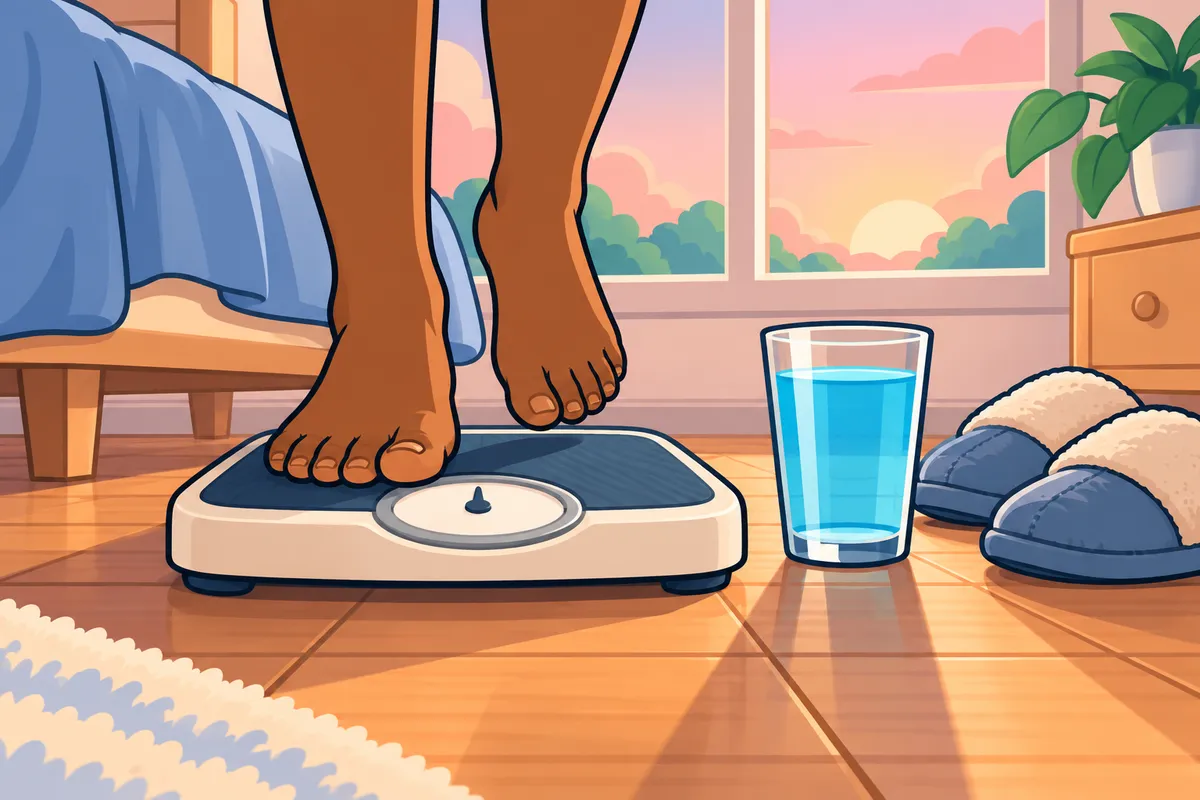
Yes, on the scale, and only until you drink again. Dehydration lowers the number because water has weight, and that loss is fluid, not fat. Most of what moves your scale from one day to the next is water.
Say you weigh yourself after a long run on a hot morning and you are 1.5 kg (3.3 lb) lighter. Two days later, after a salty takeaway, you are 1 kg (2.2 lb) heavier than last week. Neither number tells you much about fat.
Can Dehydration Cause Weight Loss?
Yes, but only on the scale, and only until you drink again. Water has weight: a liter weighs about a kilogram, so every liter (34 oz) you sweat out and do not replace shows as about 2.2 lb lost. The National Athletic Trainers' Association treats a change in body mass as the same amount of water lost, which is how you work out a sweat rate.
Water Weight
- Lost in hours, through sweat and pee
- Back after you drink and eat
- Follows heat, salt, carbs and hormones
Fat Loss
- Lost over weeks
- Stays off while habits hold
- Follows the food and activity you keep up
The NATA position statement writes its sweat formula with kilograms of weight change and liters of fluid on the same line. A 1.5 kg drop after a run is about 1.5 liters (51 oz) of sweat you have not yet replaced.
That is also why weight lost by drinking less is never real progress. Whether drinking water helps the slower, lasting kind of loss is a separate question, and what the trials found about water and weight loss answers it.
Does Drinking Water Raise the Number on the Scale?
Yes, for as long as it stays in you.
The weight leaves as pee and sweat over the next hours, which is why a before-breakfast weigh-in beats a bedtime one.
This is the same arithmetic as the sweat rate, run in reverse: kilograms in, liters in. It tells you a bigger glass of water is not a bigger body; it is a heavier one for a short while.
How Much Water Weight Is Normal in a Day?
Up to about 1 % of your body weight. In a study of 65 active men training in the heat, Cheuvront and colleagues found that first-morning weight varied by about half a kilogram a day (0.51 kg), or 0.66 % of body weight, while the men replaced their sweat.
- 0.51 kg
- average day-to-day swing in morning weight, 65 active men
- 0.66 %
- that swing as a share of body weight
- ± 1 %
- the range NATA calls minimal variation in hydration
NATA describes staying within +1 % to −1 % of your usual weight as keeping hydration steady. So before you read anything into a change, check its size against your own weight:
| Your weight | 1 % of it | Smaller change: likely water |
|---|---|---|
| 55 kg (121 lb) | 0.55 kg (1.2 lb) | Up to about half a kilo |
| 70 kg (154 lb) | 0.7 kg (1.5 lb) | Up to about three-quarters of a kilo |
| 85 kg (187 lb) | 0.85 kg (1.9 lb) | Up to almost a kilo |
| 100 kg (220 lb) | 1 kg (2.2 lb) | Up to a kilo |
The 1 % line comes from studies of active adults, so treat it as a guide, not a rule. A bigger swing can still be water after a hot day, a long flight or a salty meal.
Can Dehydration Cause Weight Gain?
Not directly; the things that make your body hold water can. Some websites claim a dehydrated body hoards water, yet the NIDDK and NHS pages below name salt, not thirst, as what makes you hold fluid. Salt first: the NIDDK says too much sodium causes your blood to hold on to fluid, which can raise blood pressure and cause swelling.
The NHS edema page adds these common reasons for puffy feet, ankles or legs:
- standing or sitting in one position for too long
- eating too much salty food
- pregnancy
- some blood pressure medicines
It does not list "not drinking enough", so drinking less to lose water weight is the wrong fix, and the same goes for a bloated belly, which is most often gas.
PMS is another cause. The NHS also lists bloating among the physical symptoms of PMS in the weeks before a period, and many women see the scale rise in those days and fall again after.
Why Do You Lose Weight So Fast at the Start of a Low-Carb Diet?
Much of the first drop is water stored with glycogen, the carbohydrate your muscles keep for fuel. Muscle stores each gram of glycogen with at least 3 grams of water, a 2015 study of muscle biopsies confirmed.
Fernández-Elías and colleagues had nine trained people ride a bike for 150 minutes in a hot, dry room, losing about 4.6 % of their body weight, then took small samples of thigh muscle. They found:
- Glycogen fell by 44 % and muscle water by 13 %.
- As glycogen came back, the water came back with it.
So when you cut carbohydrate and use up glycogen, its water goes too: every 100 g of glycogen you burn takes at least 300 g of water with it, which is why the scale falls fast in week one and slows after.
How Much Weight Do You Lose in a Sweaty Workout?
It depends on heat, effort and your own sweat rate, and every kilo lost is about a liter of water. The ACSM position stand asks you to drink during exercise to avoid losing more than 2 % of body weight as water, and says weighing before and after exercise estimates your sweat rate.
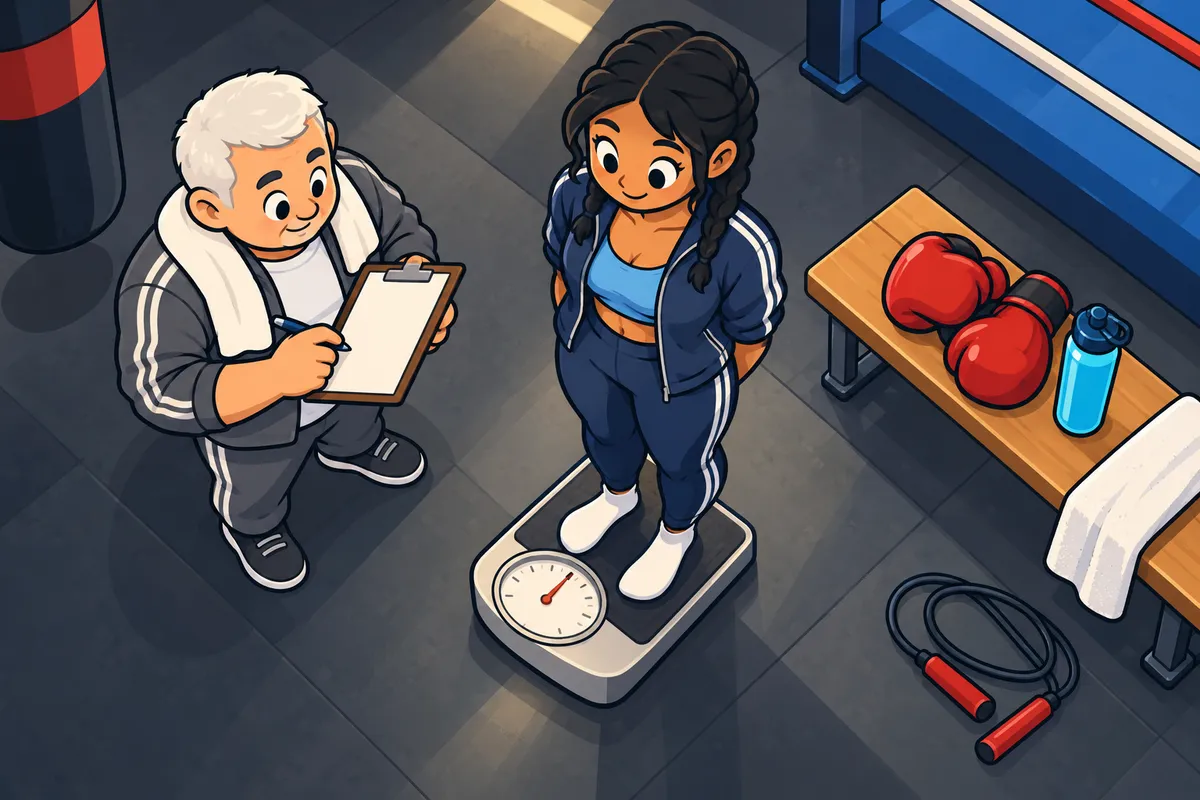
For refilling afterwards, the NATA statement says weight lost in exercise generally needs replacing with 100 % to 150 % of the fluid lost, especially when you have less than 4 hours before you train again. Sip it over a few hours with a meal rather than downing it in ten minutes, and check that your pee has turned pale again by evening.
To turn your own before and after numbers into a drinking plan for the next session, the sweat rate calculator does the arithmetic.
How Should You Weigh Yourself So Water Does Not Fool You?
Weigh at the same time each morning and judge the trend, not a single day. NATA says body mass is best measured at the same time each morning for valid comparisons, that a usual weight needs 3 days in a row of readings while well hydrated, and that a good scale reads to about 0.1 kg (0.2 lb).
A morning weigh-in water cannot fool
5 items- Weigh at the same time each morning, after the toilet and before breakfast
- Take 3 mornings in a row to find your usual weight
- Use a scale that reads to 0.1 kg, on a hard floor
- Note heat, salty meals, travel and your cycle next to each reading
- Compare weekly averages, not single days
Cheuvront's team found 3 days gave a variability estimate close to 6 or 9 days, though 9 days was more precise. A week's average smooths out a salty dinner, a long run and a hot night.
When Is a Sudden Weight Change a Warning Sign?
When it comes with swelling, breathlessness or illness, or when you lose weight without trying. The NHS heart failure page asks people with heart failure to weigh themselves regularly, because a build-up of fluid can cause sudden weight gain that may need treatment.
Losing weight without trying is a symptom to check too. The NHS lists it among the common symptoms of type 2 diabetes, alongside peeing more than usual and feeling thirsty all the time.
Learning Your Own Range, Morning by Morning
Multiply your usual weight by 0.01 to find your 1 % line, and write it on a note by the scale. At 70 kg (154 lb) it is 0.7 kg (1.5 lb).
Weigh yourself on three mornings in a row, before breakfast, and average them. A later reading inside your 1 % line is most likely water. If it jumps beyond the line, check the day before: heat, a hard session, a salty meal, a long flight or your cycle.
See a doctor for a gain with swelling or breathlessness, or a loss you did not try for. With heart failure, call your doctor the same day for any sudden weight gain, as the NHS advises.
General information for healthy adults, not medical advice. If a doctor has set your fluid amount, follow that.
More in Water and Health


Sources
- Medicine and Science in Sports and Exercise (American College of Sports Medicine, Sawka MN et al.). American College of Sports Medicine position stand. Exercise and fluid replacement, 2007.
- Journal of Athletic Training (McDermott BP et al.). National Athletic Trainers' Association Position Statement: Fluid Replacement for the Physically Active, 2017.
- International Journal of Sport Nutrition and Exercise Metabolism (Cheuvront SN et al.). Daily body mass variability and stability in active men undergoing exercise-heat stress, 2004.
- European Journal of Applied Physiology (Fernández-Elías VE et al.). Relationship between muscle water and glycogen recovery after prolonged exercise in the heat in humans, 2015.
- National Institute of Diabetes and Digestive and Kidney Diseases (NIDDK). Eating Right for Chronic Kidney Disease, 2023.
- NHS. Oedema (swelling), 2026.
- NHS. Premenstrual syndrome (PMS), 2024.
- NHS. Living with heart failure, 2025.
- NHS. Symptoms of type 2 diabetes, 2025.
Sources checked by the Glubbo Editorial Team on Oct 19, 2026. General information, not medical advice. How we write and check our guides.

