Can Dehydration Cause Low Blood Pressure? Signs and What to Do
Why a fluid shortfall drops your pressure when you stand, what it does at rest, and what water does to the reading.
 By the Glubbo Editorial Team · Updated Oct 19, 2026 · 8 min read
On This Page
- Can Dehydration Cause Low Blood Pressure?
- How Far Does Your Blood Pressure Fall When You Stand?
- How Does Your Body Hold Blood Pressure When You Are Short of Water?
- Does Dehydration Raise Blood Pressure?
- Can Drinking Water Help High Blood Pressure?
- Who Is Most Likely to Get Low Blood Pressure From Dehydration?
- Sit, Sip, Then Stand Up Slowly
- Sources
Short answer
Yes, especially when you stand up.
- The NHLBI lists dehydration among the causes of low blood pressure.
- A drop of 20 points systolic on standing counts as orthostatic hypotension.
- Water does not replace blood pressure medicine; take it as your doctor set.
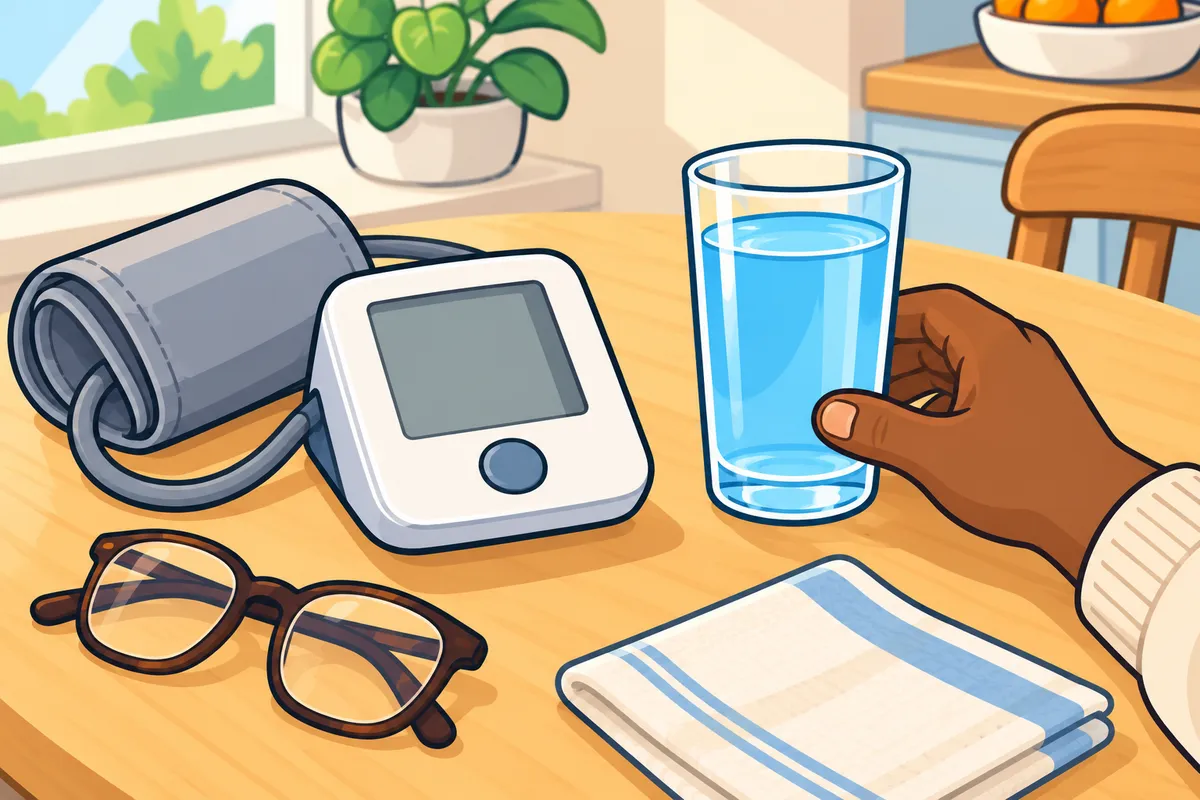
Yes. Dehydration can lower your blood pressure, and you feel it most in the seconds after you stand up. It does not usually raise your pressure, and drinking extra water is not a treatment for high readings.
Picture standing up from weeding the garden on a hot afternoon. The edges of your sight go grey for a moment, you grab the fence, and it passes. Often the heat, your blood pressure and the water you did not drink are all part of it.
Can Dehydration Cause Low Blood Pressure?
Yes. The National Heart, Lung, and Blood Institute lists dehydration among the causes of low blood pressure, and MedlinePlus names "not drinking enough fluids." Less fluid in your blood vessels leaves less volume to push blood up to your head, so the drop shows most when you stand.
- < 90/60
- mmHg: the NHS line for low blood pressure
- 22 %
- of 4,596 adults over 50 had a sustained 20/10 drop on standing
- 1.42
- odds of unexplained falls for those adults, against those with no drop
Low blood pressure on its own is not always a problem. For many people it goes unnoticed, and it matters when it brings symptoms such as lightheadedness, blurred vision or fainting. Dehydration is one of the causes you can fix.
How Far Does Your Blood Pressure Fall When You Stand?
Far enough to count as orthostatic hypotension once it drops at least 20 mmHg systolic or 10 mmHg diastolic and stays down. In the Irish Longitudinal Study of Ageing, that sustained drop within about 3 minutes of standing was found in 22 % of adults aged 50 and over.
Over 8 years those adults had 31 % higher odds of fainting or unexplained falls (odds ratio 1.31, 95 % confidence interval 1.04 to 1.66). The link was clear for unexplained falls and not clear for fainting alone. The study did not measure how much people drank.
A home monitor shows what the grey-out costs your pressure; it cannot tell you the cause. When it comes with thirst and dark pee, those signs together point to fluid loss.
How Does Your Body Hold Blood Pressure When You Are Short of Water?
With thirst, hormones and tighter blood vessels. A 2019 review in Nutrients by Watso and Farquhar explains that low body water:
- raises thirst;
- releases the water-saving hormone vasopressin;
- switches on the renin-angiotensin-aldosterone system, which holds on to salt and water.
That defence works well while you sit still. It shows its limits when you stand, exercise in the heat or lose fluid fast through vomiting or diarrhea.
What Happened in a 24-Hour Water Restriction
In one human study the review describes, people went 24 hours without water. Their nerve signals that tighten blood vessels rose, but their resting blood pressure did not change: the extra nerve activity kept it steady.
On vasopressin the review reports conflicting results. Rat studies disagree on whether blocking it lowers blood pressure after water deprivation, and in people it made only a minor difference, so the authors call for more research before giving it a clear role.
Why the Drop Shows Up When You Stand
Standing moves blood toward your legs, and your body has to squeeze the vessels harder to keep blood flowing to your brain. The review says acute dehydration may worsen orthostatic tolerance, the ability to stay upright without symptoms. When your pressure is not held during standing, you can faint, and a faint can end in an injury.
How Much Fluid Loss Does It Take?
The review links bigger losses to bigger effects. Body-mass loss is the yardstick researchers use, and the numbers are easy to convert:
| Fluid loss (body mass) | For a 70 kg (154 lb) person | What the review reports |
|---|---|---|
| About 0.5 % | 0.35 kg (0.8 lb) | No change in blood pressure response to a handgrip exercise |
| About 2 % (a 24-hour fluid restriction) | 1.4 kg (3.1 lb) | Only minor drops in diastolic pressure when vasopressin was blocked |
| About 5 % (cycling in the heat) | 3.5 kg (7.7 lb) | A smaller rise in blood pressure during exercise, because the heart pumped less blood |
The authors add that evidence for mild dehydration is less consistent than for mild-to-moderate loss, especially once exercise, heat or water pills come into it. A glass of water that you skipped at lunch is not the problem; a day of heat, sweat or sickness can be.
Does Dehydration Raise Blood Pressure?
Not in the short term, as far as the studies show.
- In the 24-hour water restriction described above, resting pressure stayed the same while nerve activity rose.
- Watso and Farquhar call long-term low water intake a "proposed" factor in high blood pressure that still needs testing in people with hypertension.
What the review does report is a link over the years. It says observational studies have tied habitually low water intake to a higher future risk of heart and blood vessel disease, though such studies cannot show that the water itself was the cause.
So a missed bottle will not push your reading up. A body that runs short every day is the open question.
Can Drinking Water Help High Blood Pressure?
No study in the review shows that drinking extra water lowers high blood pressure, so keep to the treatment your doctor set. A glass of water can actually push a reading up for a short while: a Circulation study found tap water raised systolic pressure by about 11 mmHg in older adults, though not in young ones.
| Group (2000 Circulation) | Systolic rise after water |
|---|---|
| Patients with multiple system atrophy | About 33 mmHg, peaking after 30 to 35 minutes |
| Patients with pure autonomic failure | About 37 mmHg |
| Older healthy adults | About 11 mmHg |
| Young healthy adults | No rise |
The water raised norepinephrine, a nerve signal that tightens blood vessels, as much as caffeine or nicotine do, the authors wrote.
If You Check Your Own Pressure
In the study, older adults' systolic pressure rose about 11 mmHg after drinking tap water, and in the patients the rise peaked 30 to 35 minutes later. Ask your doctor how to time a home reading around a drink.
The same effect has a use. The authors noted it can ease the symptoms of orthostatic hypotension in people whose nerves cannot hold their pressure, and that is a treatment decision for a doctor.
Who Is Most Likely to Get Low Blood Pressure From Dehydration?
Older adults, people on blood pressure medicines and anyone losing fluid fast. The NHLBI says older adults have a higher risk of falls, fainting and dizziness from low blood pressure and are more likely to get it as a side effect of medicines.
Other causes of low blood pressure the NHLBI names
5 items- Heart arrhythmias
- Certain medicines for high blood pressure, depression or Parkinson's
- Diabetes
- Pregnancy
- Blood loss from an injury
Weight-loss injections can stack up with these when they make you sick, since vomiting and diarrhea are among the NHS's causes of dehydration; the warning on the GLP-1 drug labels has its own page. If you also feel tired and foggy, low fluid can dull your focus too.
Sit, Sip, Then Stand Up Slowly
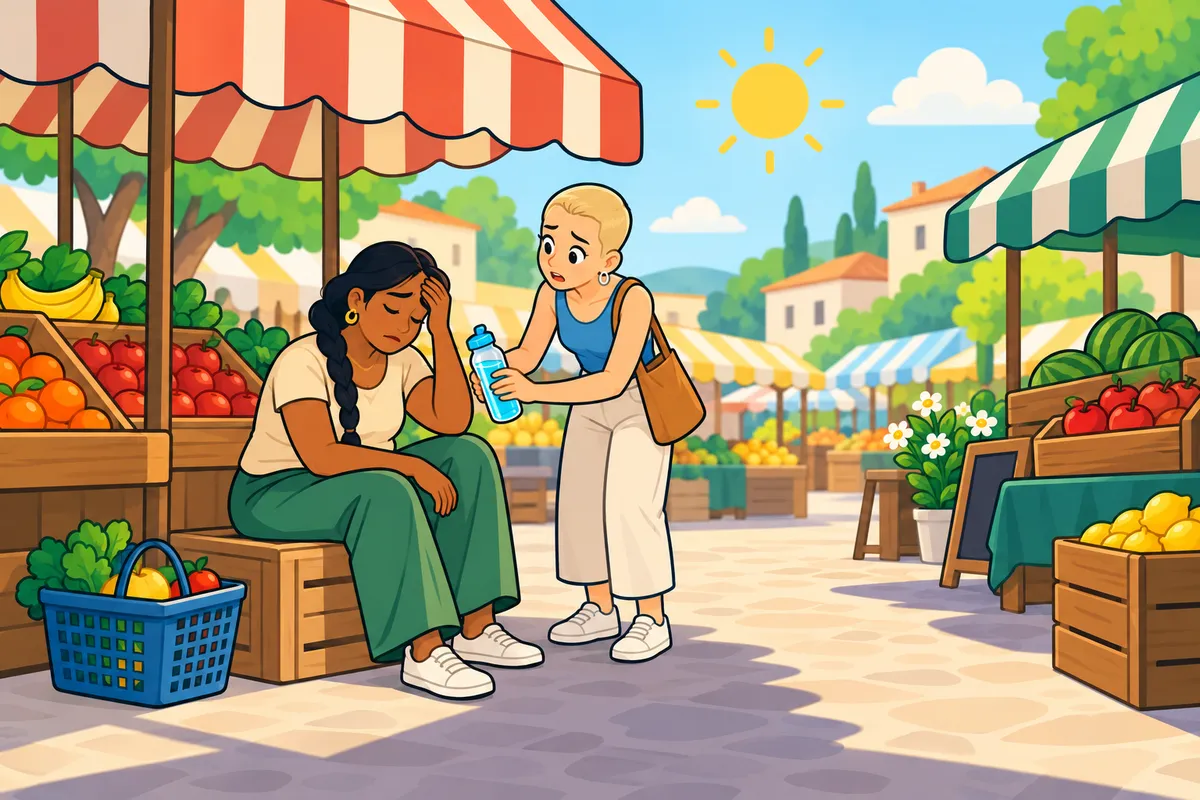
Sit or lie down, then drink, then stand up slowly. MedlinePlus lists drinking more fluids, getting up slowly after sitting or lying down, avoiding alcohol and compression stockings as self-care for low blood pressure, and the NHS adds small, frequent meals and more water.
When your pressure runs low
- You feel lightheadedSit or lie down at once
- The feeling easesSip a glass of water
- You are ready to standGet up slowly, sitting on the edge first
- You are tempted by a drink or a quick bendSkip alcohol and sudden posture changes
- The dizzy spells keep coming backSee your doctor
If you are sick, the NHS says to take small sips and build up, to skip caffeine and alcohol, and to ask a pharmacist for oral rehydration powders after vomiting or diarrhea. If your readings drop on every hot afternoon, take them to your doctor along with a note of what you drank.
General information for healthy adults, not medical advice. If a doctor has set your fluid amount, follow that.

More in Water and Health
Sources
- US National Heart, Lung, and Blood Institute. Low Blood Pressure, 2022.
- MedlinePlus, US National Library of Medicine. Low blood pressure, 2025.
- NHS. Low blood pressure (hypotension), 2025.
- NHS. Dehydration, 2026.
- Nutrients (Watso JC, Farquhar WB). Hydration Status and Cardiovascular Function, 2019.
- Age and Ageing (Reddin C, Briggs R, Knight SP, Kenny RA). Does immediate orthostatic hypotension in adults have clinical implications for syncope and falls? An analysis of the Irish longitudinal study of ageing, 2026.
- Circulation (Jordan J et al.). The pressor response to water drinking in humans: a sympathetic reflex?, 2000.
Sources checked by the Glubbo Editorial Team on Oct 19, 2026. General information, not medical advice. How we write and check our guides.

