Water and Health · Energy and Focus
Can Dehydration Make You Tired? What Studies Show About Focus
See how much water loss dulls your focus, what the studies could not test, and how to keep your energy up.
 By the Glubbo Editorial Team · Updated Oct 19, 2026 · 7 min read
On This Page
- Can Dehydration Make You Tired?
- Does Dehydration Affect Concentration?
- How Much Water Loss Affects Your Focus?
- Does Dehydration Cause Brain Fog or a Bad Mood?
- Can Drinking More Water Give You More Energy?
- Is My Tiredness From Dehydration or Something Else?
- How to Keep Your Energy Up With Water
- Test It on Yourself in Two Days
- Sources
Short answer
Yes, even mild dehydration can make you tired.
- Losing about 1.5 % of body weight in water raised fatigue in two small lab studies.
- For a 70 kg (154 lb) adult, a 2 % loss is about 1.4 liters (47 oz) of water.
- Spread your drinks through the day; the NHS says drink enough that your pee is pale.

Yes. Feeling tired is one of the symptoms of dehydration on the NHS list, beside thirst, a headache and dark yellow pee. In lab studies, young adults who lost about 1.5 % of their body weight in water reported more fatigue and found it harder to concentrate.
The effect is real but modest, and most of the research is small. Water helps most when you were behind to begin with; if you already drink enough, tiredness usually has another cause.
Can Dehydration Make You Tired?
Yes. The NHS names "feeling tired" among the symptoms of dehydration in adults and children, and it lists feeling unusually tired as one reason to ask for an urgent doctor's appointment.
Tiredness rarely arrives alone. If it comes with any of these, water is a likely part of the cause:
- thirst
- a dry mouth
- dark yellow, strong-smelling pee
- a headache or light-headedness
Dizziness when you stand up points the same way, and the milder and the more serious signs tell you how worried to be.
Does Dehydration Affect Concentration?
A little, and mostly in attention. Two lab studies from the same team found that a water loss of about 1.4 to 1.6 % of body weight lowered concentration or vigilance in young adults. A 2018 meta-analysis of 33 studies found a small effect overall, larger for attention and once the loss passed 2 % of body weight.
Each study answers a narrow question. The cards give the short version before the details:
Three studies at a glance
Men's lab study
26 men, 1.59 % loss
- More vigilance errors
- Slower working memory
- More fatigue and tension
Suits you if you want the clearest test results of the three.
Women's lab study
25 women, 1.36 % loss
- Lower vigor, more fatigue
- Harder tasks, less concentration
- Most test scores unchanged
Suits you if you notice mood and headaches before mistakes.
Meta-analysis
33 studies, 413 people
- Attention took the biggest hit
- Twice the effect above 2 % loss
- Different tests in every study
Suits you if you want the overall size of the effect.
The Men's Study (2011)
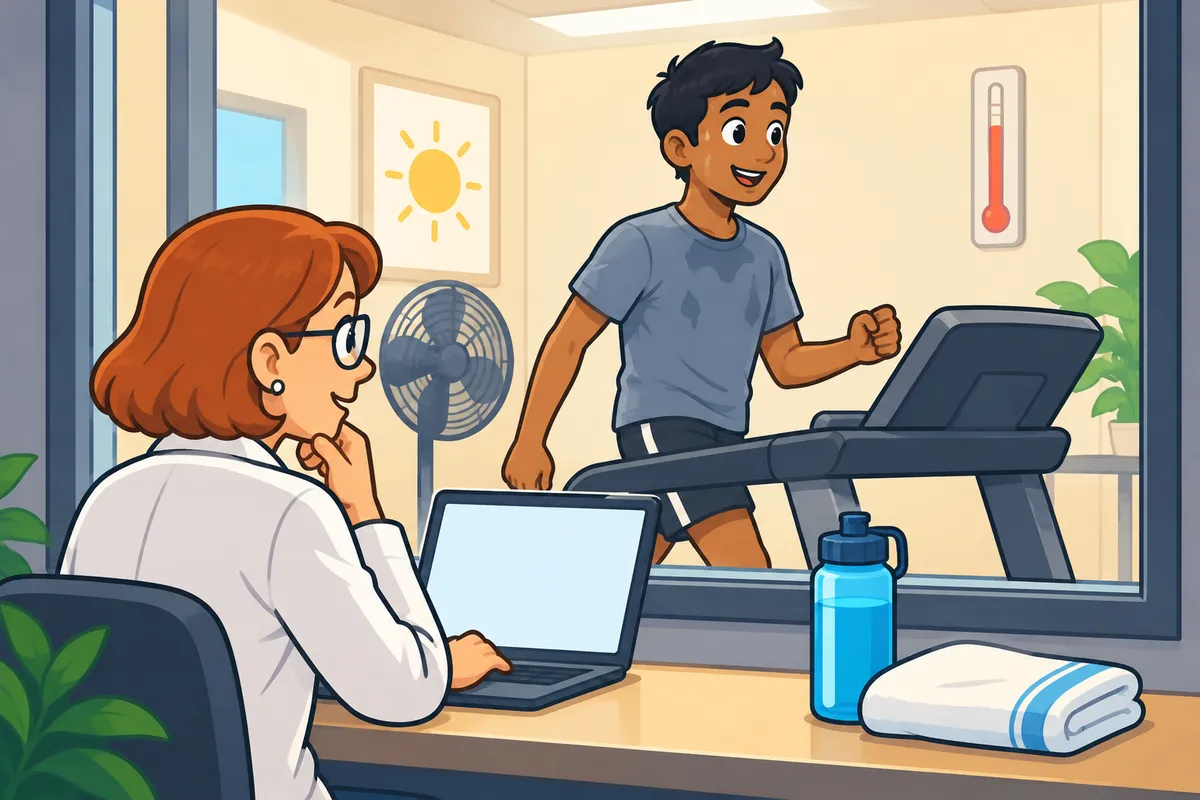
Ganio and colleagues tested 26 men aged about 20. In a 27.7 °C (82 °F) room they walked on a treadmill, three 40-minute walks, until they had lost an average of 1.59 % of their body weight, and on another day stayed fully hydrated.
Dehydrated, the men made more errors on a visual vigilance task, and their working memory responded more slowly. They also reported more fatigue and more tension or anxiety at rest, and more fatigue during exercise.
The Women's Study (2012)
Armstrong and colleagues ran the same design with 25 women aged about 23, over 8-hour trials. Their average loss was 1.36 % of body weight. The women reported:
- lower vigor and more fatigue;
- harder tasks and lower concentration;
- more headaches.
Most of their test scores did not change: "most aspects of cognitive performance were not affected by dehydration." The women felt worse well before they performed worse. The University of Connecticut summary adds that mood changes and symptoms were substantially greater in the women than in the men, though the two small studies are not a head-to-head comparison.
The Meta-Analysis (2018)
Wittbrodt and Millard-Stafford pooled 33 studies with 413 people, at water losses from 1 to 6 % of body weight. Dehydration lowered performance by a small amount overall. In order of effect:
- Attention took the biggest hit.
- Motor coordination and executive function followed.
- Reaction time did not change clearly.
The effect was about twice as large above a 2 % loss as at or below it. The studies used different tests and methods, and none of them followed people through ordinary days at a desk. The two lab studies above were supported by Danone Research of France, according to the University of Connecticut, whose lab led the women's study.
How Much Water Loss Affects Your Focus?
The studies point to about 1.5 % of your body weight for mood and fatigue, and 2 % for clearer drops in attention. The National Athletic Trainers' Association counts body weight lost during exercise as water, kilogram for liter, so 2 % of a 70 kg (154 lb) adult is 1.4 kg, about 1.4 liters (47 oz) of water.
The losses in these studies came from exercise in a warm room, not from a quiet morning of emails. They fit a hot commute, a sweaty workout or a stomach bug better than a normal desk day.
Does Dehydration Cause Brain Fog or a Bad Mood?
It can cloud both, in the lab at least. "Brain fog" is not a measured term, so the studies test its pieces:
- in the men, vigilance and working memory slipped
- in the women, concentration dropped and tasks felt harder
- in both, mood scores got worse, with more fatigue and tension in the men and lower vigor in the women
The mood effect showed up before the thinking effect. If you feel flat, irritable and unfocused on a hot or busy day, a glass of water is a cheap first test, and plain water often eases a dehydration headache too.
Can Drinking More Water Give You More Energy?
It may, if you usually drink little. In a 2014 study, 30 adults who drank under 1.2 liters (41 oz) a day raised their water to 2.5 liters (85 oz) for three days and reported less fatigue and confusion. The study did not test whether people who already drink plenty gain anything from more.
The same study ran the other way too. Twenty-two heavy drinkers, who usually had 2 liters or more a day, were cut to 1 liter for three days.
Low Drinkers Raised to 2.5 L
- Less fatigue
- Less confusion
- Less thirst
- Sleepiness down slightly (a trend only)
High Drinkers Cut to 1 L
- Vigor dropped
- More thirst
- Fatigue also fell, which the authors put down to the clinic routine
Read it with care. The 52 people (41 of them women) stayed in a clinic in France for six days. The study was not randomized or blinded, so everyone knew their own water amount, and Danone Research funded it.
Is My Tiredness From Dehydration or Something Else?
Check your pee and your thirst first. If both look normal, water is probably not the main cause. The NHS page on tiredness lists poor sleep, an unhealthy diet and too little exercise, stress, depression, hormonal changes, illnesses and some medicines as common causes, and drinking more will not fix those.
Dark yellow pee is a dehydration sign, and the NHS says to drink enough during the day that your pee is a pale color. Medicines can cause fatigue too. It is a listed side effect of semaglutide, for example.
How to Keep Your Energy Up With Water
Spread your drinks through the day, since the NHS asks you to drink enough that your pee stays a pale color. A glass that sits where you can see it needs no willpower.

Say you aim for 2,500 ml (84 oz) between 7 am and 10 pm. Ten glasses of 250 ml (8.5 oz) at an even spacing comes to one glass about every 90 minutes:
A 2,500 ml day in ten 250 ml glasses
- 7 AM
- 8:30 AM
- 10 AM
- 11:30 AM
- 1 PM
- 2:30 PM
- 4 PM
- 5:30 PM
- 7 PM
- 8:30 PM
To spread your own total across your waking hours, the drinking schedule does the arithmetic for you.
Test It on Yourself in Two Days
- Day one: drink as you usually do. At 10 am and 3 pm, note the color of your pee and rate your energy from 1 to 5.
- Day two: drink a full glass with breakfast and then steadily through the day, and take the same two notes.
- Compare: if your energy rating and pee color match day one, water was not what held you back, so look at sleep, stress, food and movement next.
General information for healthy adults, not medical advice. If a doctor has set your fluid amount, follow that.

More in Water and Health



Sources
- NHS. Dehydration, 2026.
- NHS. Tiredness and fatigue, 2023.
- British Journal of Nutrition (Ganio MS et al.). Mild dehydration impairs cognitive performance and mood of men, 2011.
- Journal of Nutrition (Armstrong LE et al.). Mild dehydration affects mood in healthy young women, 2012.
- University of Connecticut, UConn Today. Even Mild Dehydration Can Alter Mood, 2012.
- Medicine and Science in Sports and Exercise (Wittbrodt MT, Millard-Stafford M). Dehydration Impairs Cognitive Performance: A Meta-analysis, 2018.
- PLOS ONE (Pross N et al.). Effects of changes in water intake on mood of high and low drinkers, 2014.
- Journal of Athletic Training (National Athletic Trainers' Association). National Athletic Trainers' Association Position Statement: Fluid Replacement for the Physically Active, 2017.
Sources checked by the Glubbo Editorial Team on Oct 19, 2026. General information, not medical advice. How we write and check our guides.

